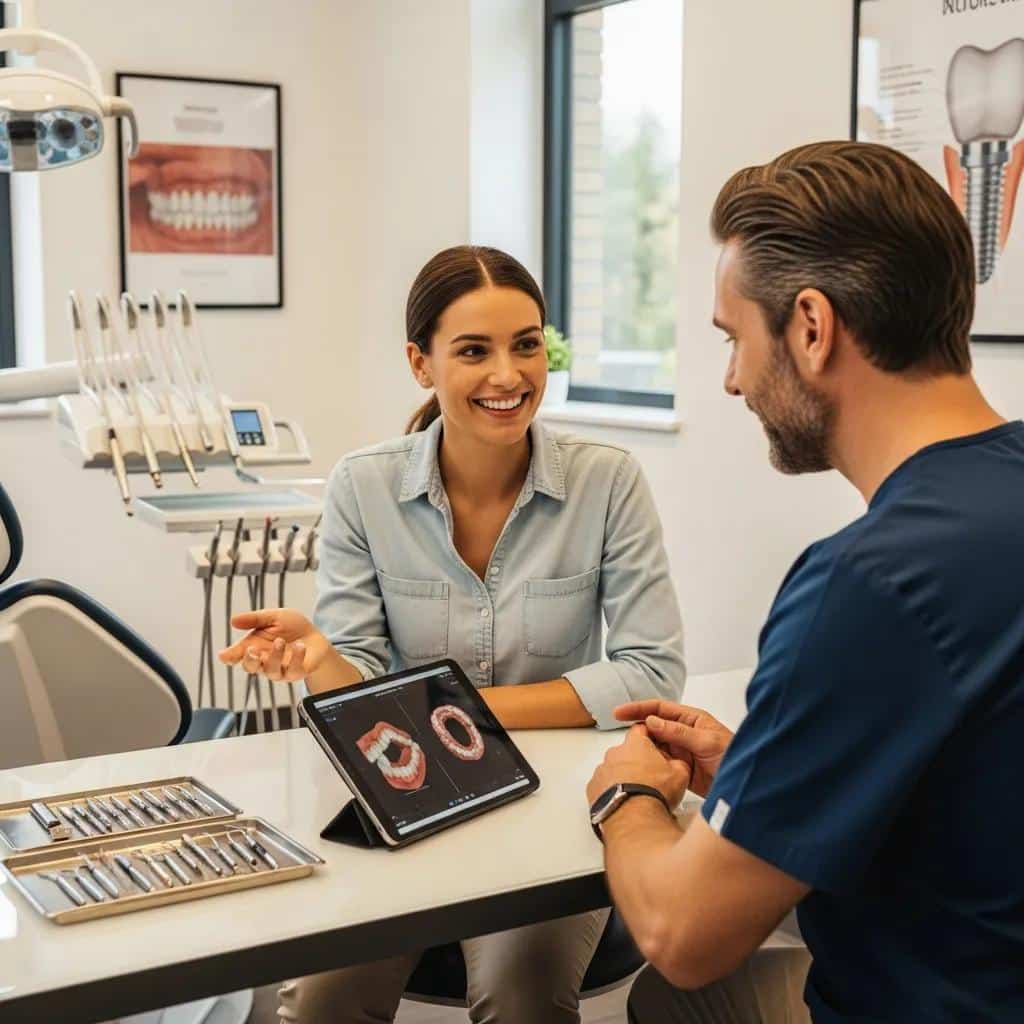
How Much Do Dental Implants Cost Per Tooth? Clear Pricing, What to Expect, and Consultation Tips
Dental implants are a durable, natural-looking way to replace missing teeth — and understanding the cost ahead of time helps you plan. This guide explains typical per-tooth prices, the factors that change those numbers, and practical financing options. You’ll also get a clear sense of what happens during consultations and treatment, so you can walk into an appointment feeling informed and confident.
Average Price for a Single-Tooth Dental Implant
A single-tooth implant usually costs between $3,000 and $6,000. That figure generally covers the implant post, the abutment, and the final crown. The final price depends on the implant system, crown materials, and the clinic’s fees — knowing these variables helps you compare estimates more effectively.
Related studies break down the individual cost components and compare implants with alternative treatments, offering useful perspective for both patients and decision-makers.
Cost Comparison and Component Breakdown for Dental Implants
This research examines clinical outcomes alongside costs, comparing strategies for patients with resorbed mandibles and chronic problems with conventional dentures. It contrasts options such as mandibular overdentures on permucosal implants, overdentures on transmandibular implants, new dentures after preprosthetic surgery, and new dentures alone. Costs were tracked per patient and itemized into labor, materials, technique, and overhead during the first year of treatment.
The cost of dental implants as compared to that of conventional strategies, 1998
The headline figure for a single tooth is helpful for a first estimate, but it does not always reflect the full patient experience. For example, the quoted range often assumes healthy bone and a straightforward surgical approach; if additional imaging, sedation, laboratory work, or temporary restorations are required, those items may appear as separate line items on an estimate. Clinics may also charge for follow-up visits, adjustments to the crown, or extended warranties, so ask for an itemized estimate and compare the same services across providers.
When you receive an estimate, clarify whether the laboratory fee for the crown, any necessary digital planning or guided surgery components, and follow-up care are included. Understanding what is bundled helps you compare total cost rather than just a low initial price that later grows with add-ons.
Typical Cost Ranges for Different Implant Treatments
Implant prices vary widely depending on the scope of treatment. The table below summarizes common options and their typical price ranges.
Implant Type
Average Cost Range
Description
Single Tooth Implant
$3,000 – $6,000
Standard implant for replacing one missing tooth.
Full Mouth Implant
$24,000 – $100,000
Comprehensive solution for replacing an entire arch or both arches.
Implant Supported Dentures
$5,000 – $30,000
Dentures anchored to implants for improved fit and function.
These ranges show how treatment type and scale drive cost. A full arch plan can be more economical per tooth than multiple single implants, but individual needs vary — discuss options with your provider to find the best fit.
When comparing per-tooth and full-arch pricing, remember that economies of scale and surgical efficiency can reduce the per-unit cost for larger plans. Conversely, single-tooth replacements often carry higher per-tooth lab and prosthetic costs because each crown is custom-made and handled separately. If budget is a concern, ask your clinician for a side-by-side estimate showing both single-tooth and arch-based approaches so you can compare total cost, timeline, and functional outcomes.
How Material and Implant Design Affect Price
Implant material and design influence both cost and appearance. Titanium is the standard due to its strength and tissue compatibility. Zirconia implants are a higher-cost, tooth-colored alternative that some patients prefer for esthetics. Material choice can affect longevity, look, and price, so weigh those trade-offs when comparing estimates.
Beyond implant body materials, prosthetic choices influence cost as well. Crowns can be made from layered porcelain, monolithic zirconia, or hybrid materials, and each option carries different lab costs and aesthetic properties. Some clinicians include a standard acrylic or temporary crown in the initial price and charge extra for higher-end ceramics; ask what material and lab standard are quoted so you can compare like with like.
Implant system and connection design also matter. Certain systems are positioned as premium because of proprietary components, specific surgical kits, or long-term warranty programs; these can increase the upfront fee but may simplify future maintenance or replacement. Discuss brand and component options with your provider if brand-specific guarantees or part availability are important to you.
Which Factors Most Influence Implant Pricing?
Several key factors change the total cost of an implant procedure. The most common include:
Oral health and bone quality : If your jawbone or gums need preparation — for example, bone grafting — costs will increase.
Procedure complexity : More complex cases or advanced surgical techniques require more time and expertise, which raises fees.
Location and local market : Prices generally reflect local overhead and demand; urban clinics often charge more than rural practices.
Understanding these drivers helps you interpret estimates and identify where costs might change.
Choosing a single-tooth implant involves balancing clinical needs, long-term outcomes, and patient preferences — not just cost.
Factors That Guide Single-Tooth Implant Decisions
Dentists often weigh whether to extract and place an implant or to preserve the natural tooth with nonsurgical endodontic therapy. Important considerations include whether the tooth is restorable, bone quality, esthetic expectations, cost-benefit trade-offs, and the patient’s preferences.
A review of factors influencing treatment planning decisions of single-tooth implants versus preserving natural teeth with nonsurgical endodontic therapy, 2008
Several patient-specific items can significantly change cost: systemic health conditions that affect healing, tobacco use, prior infection at the site, and the need for specialized imaging or surgical guides. Clinicians may recommend staged treatment—such as extraction followed by a healing period before implant placement—to improve predictability, but staging can also increase the number of visits and separate charges. When reviewing a quote, ask your clinician to explain which clinical decisions could change the estimate and how those contingencies would be billed.
How Location and Provider Experience Affect Price
The practice’s location and the clinician’s experience both affect price. Clinics in high-cost areas typically charge more. Likewise, specialists or surgeons with advanced training may have higher fees that reflect their expertise. When comparing providers, consider qualifications, reviews, and outcomes alongside cost.
Experience can reduce risk and the likelihood of complications, which may save money over time even if initial fees are higher. Ask about the clinician’s implant case volume, recent training, and whether they work with an in-house dental lab or an external ceramist. Also request to see before-and-after photos or patient testimonials for similar cases so you can judge both aesthetic skill and functional outcomes.
How Additional Procedures Influence Total Cost
Some patients require extra procedures before or during implant treatment. Common add-ons include:
Bone grafting : Needed when the jawbone lacks sufficient volume; adds about $300 to $3,000.
Sinus lift : Often required for upper-jaw implants; can add $1,500 to $2,500.
Tooth extractions : Removing remaining teeth before implant placement can add roughly $200 to $500 per tooth.
Factor these potential costs into your overall budget and treatment timeline.
Beyond the procedures listed, sedation, advanced imaging such as cone-beam CT scans, and the use of surgical guides or custom abutments can add to the invoice. Some patients elect to phase treatment for financial reasons—placing implants and adding crowns later—which can spread cost but may extend the overall timeline. Ask your provider which items are optional, which are recommended for predictable outcomes, and whether phasing is clinically acceptable for your situation.
Financing Options for Dental Implants
Many practices provide financing to make implants more affordable. Typical options include:
In-house payment plans : Clinics may let you spread the cost over several months with manageable installments.
Third-party dental financing : Specialty lenders offer loans for dental work, sometimes with promotional low- or no-interest periods.
Health Savings Accounts (HSAs) and Flexible Spending Accounts (FSAs) : These tax-advantaged accounts can be used to pay for implant care.
Reviewing these choices with your provider can help you pick the most affordable approach.
When evaluating financing, compare total interest cost, any origination or administrative fees, and the monthly payment you can comfortably manage. Some third-party plans require a credit check and offer promotional 0% interest for a short term; others spread payments over longer periods with interest. Ask for example payment schedules based on your quoted treatment so you can compare monthly cost across options rather than only the headline price.
Ways to Find More Affordable Implant Financing
If cost is a concern, try these practical strategies:
Compare local providers : Get multiple estimates and compare services, warranties, and financing terms.
Ask about discounts : Some offices offer reduced rates for upfront payment or seasonal promotions.
Review your insurance and benefits : Certain plans or employer benefits may offset part of the cost.
Taking a few proactive steps can make implants more affordable without sacrificing quality.
Additional strategies can include asking the practice about a phased treatment plan, checking whether a dental school offers supervised treatment at reduced cost, or inquiring whether the practice offers bundled pricing for multiple implants. If you have flexibility with timing, discuss seasonal promotions or financing specials that may reduce interest or provide temporary savings.
Does Insurance Cover Dental Implants?
Coverage varies by plan. Some dental or medical policies cover part of the implant cost if the procedure is medically necessary; others exclude implants entirely. Review your policy details and speak with your insurer and dentist to understand potential out-of-pocket expenses.
To maximize potential coverage, request a predetermination from your insurer before treatment. Predetermination gives a written estimate of what the insurer will pay and what you will owe. Also check whether certain pre-authorization codes are needed, and if medical necessity documentation will improve coverage for portions of the treatment, such as bone grafting or surgical hospitalization.
How Each Stage of the Implant Process Adds to Cost
The implant journey consists of discrete stages, each with its own fee. Typical cost components include:
Initial consultation and planning : Evaluation and imaging, often $100 to $300.
Implant placement surgery : The surgical insertion of the implant, usually $1,500 to $3,000.
Abutment and crown placement : Attaching the abutment and final crown, commonly $1,000 to $2,500.
Knowing these stages helps you compare estimates and plan for payments across the full treatment timeline.
Some clinics use advanced digital workflows—3D planning, guided surgical stents, and digital impressions—which can increase precision but also raise the upfront fee. These technologies may reduce chair time or complication risk for complex cases, which can be cost-effective in the long run. Ask whether the quoted price includes digital scans, laboratory fees, and any temporary prosthesis you will need during healing.
Step-by-Step: What to Expect for a Single-Tooth Implant
A typical single-tooth implant follows these steps:
Consultation and treatment planning : Your dentist evaluates oral health and maps out the plan.
Implant placement : The implant post is surgically inserted into the jaw.
Healing and osseointegration : The implant integrates with bone over about 3–6 months.
Abutment placement : The connector is attached to the healed implant to support the crown.
Crown placement : The final crown is fitted, restoring function and appearance.
Times and exact steps can vary by case; your dentist will outline a personalized timeline.
In some situations, clinicians can place a temporary crown at the time of surgery or shortly thereafter to preserve esthetics while the bone heals. Immediate provisionalization may be appropriate for front teeth in select cases, but it requires careful planning and a stable initial implant connection. Your clinician will weigh risks and benefits of immediate versus delayed restoration and explain how each option affects cost and recovery.
How Recovery and Aftercare Affect Cost
Recovery and follow-up care are part of the overall expense. Common post-treatment costs include:
Follow-up visits : Routine checks to monitor healing, typically $50 to $150 per visit.
Medications : Pain relievers or antibiotics, usually $10 to $100.
Aftercare supplies : Recommended oral hygiene products to support proper healing.
Accounting for these items upfront gives a clearer picture of total cost.
Aftercare also includes long-term maintenance. Regular professional cleanings and periodic radiographs to check bone levels are recommended, and treating gum inflammation early can prevent more expensive interventions later. If complications such as peri-implantitis occur, additional therapy or revision surgery may be required, so good daily care and prompt attention to symptoms are important both for health and for avoiding unplanned costs.
Where to Schedule a Free Dental Implant Consultation in Denton, TX
Several Denton-area dental practices offer free consultations to review implant options and costs. A consultation is a low-pressure way to learn about treatment plans, timelines, and financing.
Free consultations are useful for gathering comparative estimates and seeing how different offices present treatment options. Bring any recent X-rays or a list of prior treatments to speed up the consultation, and ask each practice for a written estimate you can compare side-by-side.
What Happens During a Free Dental Implant Consultation
At a free consultation you can expect to:
Review your dental history : The dentist will assess your oral health and any medical considerations.
Get a personalized treatment plan : The office will outline recommended steps, estimated costs, and timelines.
Ask questions : Bring a list of concerns about procedure, recovery, and payment options.
Use the consultation to compare recommendations and make an informed choice.
In addition to clinical questions, ask about scheduling flexibility, the expected number of appointments, and whether the practice coordinates with specialists (for example, an oral surgeon and a restorative dentist). Clear communication about roles and responsibilities avoids surprise charges when multiple clinicians are involved.
How to Prepare for Your Implant Appointment
A few simple preparations make the appointment more productive:
Bring your medical history : List medications and any medical conditions.
Prepare questions : Note concerns about cost, recovery, and alternatives.
Arrange recovery plans : Organize transportation and time off if needed after surgery.
Being prepared helps you get a clear plan and realistic expectations.
Also bring any available insurance information, prior radiographs, or notes about past dental work. If you have a preferred timeline—such as needing to complete treatment before an upcoming event—mention it so the team can review whether accelerated options are clinically safe and feasible.
Common Patient Questions About Implant Costs
Prospective patients frequently ask:
Are dental implants worth the investment? : Many patients find the long-term durability, improved function, and bone-preserving benefits make implants a worthwhile investment.
How can I reduce the cost? : Comparing providers, exploring financing, and discussing phased treatment can lower upfront expenses.
What if I can’t afford implants? : Your dentist can review alternative treatments and financing options to find a workable plan.
Honest conversations about goals and budget help you choose the best path forward.
Decisions about implants reflect clinical needs, patient priorities, and financial realities — understanding all three leads to better outcomes.
How Patients and Clinicians Negotiate Implant Decisions
This study looks at how clinicians and patients balance clinical need and finite resources when deciding on implant treatment. Because implant therapy is often private and costly, clinicians and patients face trade-offs compared with less expensive alternatives like removable dentures. The research explores how treatment options are offered and how patients weigh costs when making decisions.
Paying for treatments?
Influences on negotiating clinical need and decision-making for dental implant treatment, CE Exley, 2009
Is Implant Cost Quoted Per Tooth or for the Full Mouth?
Implant pricing can be presented either per tooth or as a full-mouth package. Single-tooth cases are usually priced individually, while full-arch treatments often come as a bundled plan that can lower the per-tooth cost. Discuss both approaches with your clinician to see which offers the best value for your situation.
When seeking estimates, ask whether the per-tooth price reflects a complete restorative solution (including crown and any temporary prosthesis) or only the surgical component. Bundled full-mouth plans can simplify billing and reduce surprises, but ensure the package includes the prosthetic quality you want rather than a basic temporary solution.
How Insurance Coverage Changes Out-of-Pocket Costs
Insurance coverage varies. Some plans cover part of the work if it’s medically necessary; others exclude implants. Check policy details and coordinate with your provider and insurance company to estimate your out-of-pocket responsibility.
Many patients find implants a lasting solution. To explore local availability, consider booking an appointment with a nearby dentist.
Frequently Asked Questions
What long-term benefits do implants offer over dentures or bridges?
Implants fuse with the jawbone to help prevent bone loss and preserve facial structure. They restore chewing function and speech more naturally than many removable options, and they don’t require altering adjacent teeth the way some bridges do. For many people, these advantages explain the higher upfront cost.
How do I find a qualified implant dentist?
Look for clinicians who list implant experience, check credentials and patient reviews, and ask about case volume and outcomes. Scheduling consultations with a few providers will give you a sense of comfort, expertise, and treatment approach before you decide.
What should I expect during recovery after implant surgery?
Recovery typically involves a few days of soreness and several weeks to months of healing while the implant bonds with bone. Swelling and mild discomfort are common and usually controlled with medications and proper care. Follow your dentist’s instructions and attend follow-up visits to ensure smooth healing.
What risks or complications can occur with implants?
While implants have a strong success record, possible issues include infection, nerve irritation, sinus complications for upper implants, or implant failure if bone support is insufficient. Careful planning and good surgical technique reduce these risks.
How should I care for implants to help them last?
Care mirrors routine dental hygiene: brush twice daily, floss, and keep regular dental checkups. Avoiding tobacco and maintaining a healthy diet also support implant health. Report any pain or changes to your dentist promptly.
What financing options exist if I can’t pay upfront?
Options include in-house payment plans, third-party dental loans (sometimes with promotional rates), and tax-advantaged accounts like HSAs or FSAs. Discuss available plans with your dental office to find the best fit for your budget.
Conclusion
Knowing what drives implant costs — materials, additional procedures, provider expertise, and financing — helps you make practical, informed choices. Start with a consultation to get a personalized plan and clear estimates. Taking that step will clarify costs and set you on the path to a healthy, confident smile.
Preparing questions in advance, requesting itemized estimates, and comparing both clinical outcomes and long-term maintenance requirements will help you choose the right plan for your needs. When cost is a concern, combine financing options with careful provider selection to achieve a predictable result without unwanted surprises.