Dental Implants Healing Explained: How It Compares With Partial and Full Dentures for Effective Tooth Replacement
Dental implants and removable dentures are both established tooth replacement options, but they produce very different healing journeys and day-to-day experiences for patients. This article explains the implant healing process—centered on osseointegration—alongside the adaptation timelines for partial and full dentures, so readers can weigh healing time, comfort, bone preservation, and long-term value. Many patients ask how long implant recovery takes, what sensations are normal, and when function returns; this guide answers those questions and maps practical care steps for each option. We will cover the stages of implant healing and a clear timeline, compare denture adjustment versus implant osseointegration, review common complications and comfort differences, outline long-term functional and bone-health benefits, present transparent cost ranges, and provide practical post-op and denture-care instructions. Along the way, you’ll find comparison tables, actionable lists for self-care, and specific local options to get a free implant consultation with Affordable Dentist Near Me – Crowley if you want a personalized treatment plan.
What Is the Dental Implant Healing Process and How Long Does It Take?
Dental implant healing is the biological process by which a titanium or biocompatible implant becomes integrated with the jawbone—a process called osseointegration that transforms a surgically placed fixture into a stable foundation for a prosthetic tooth. Osseointegration works because bone cells respond to the implant surface, gradually growing onto and around the fixture to create mechanical and biological stability; the result is restored force transmission and long-term anchorage for a crown or overdenture. The primary clinical benefit of this mechanism is predictable long-term function and prevention of the bone loss that typically follows tooth loss, which makes understanding the timeline important for patient expectations. Factors such as the implant site (upper vs lower jaw), bone density, whether bone grafting was performed, smoking status, and systemic health conditions influence the speed and predictability of integration. Below we outline stages, typical durations (commonly in the 3–9 month range for full restoration), and signs of normal versus concerning recovery, and then explain how you can get a free implants consultation locally to review your specific timeline.
For patients ready to discuss implants in Crowley, Affordable Dentist Near Me – Crowley offers implant treatment planning and a free implants consultation to assess bone needs, grafting likelihood, and expected timelines; the consult is an opportunity to align clinical staging with lifestyle goals and to discuss sedation options for comfort. This local consult helps translate general timelines into a personalized plan based on diagnostic imaging and clinical findings, and it is often the next step patients take once they understand osseointegration basics and typical healing intervals.
What Are the Stages of Osseointegration in Dental Implant Healing?
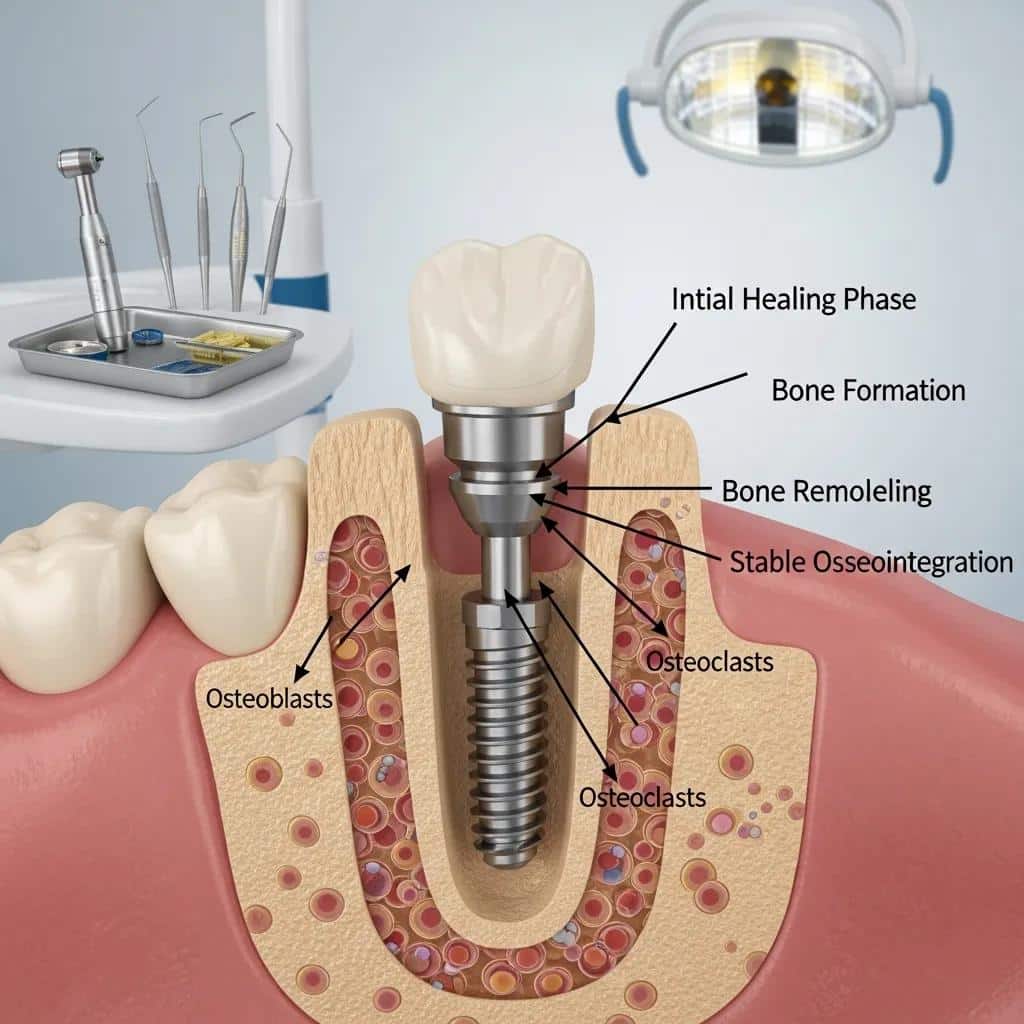
Osseointegration unfolds through a sequence of biological stages: an initial inflammatory response, followed by cell proliferation and new bone formation, then remodeling that strengthens the bone–implant interface. In the inflammatory phase, clot formation and soft-tissue closure protect the surgical site while immune cells clear debris; patients typically experience swelling and mild discomfort that peaks in the first 48–72 hours. The proliferative phase brings osteoblast recruitment and early woven bone deposition on the implant surface; clinically this corresponds to reduced pain and progressive stabilization over weeks. Remodeling converts woven bone to lamellar bone and increases mineral density around the implant, a process that continues over months and is essential before final prosthetic loading in many protocols. Understanding these stages helps patients recognize normal healing signs and the rationale behind staging prosthetic steps, which leads into expected timeframes for recovery and function.
Introductory table: osseointegration stages and typical clinical signals.
Osseointegration Stage
Biological Process
Clinical Sign / Typical Duration
Inflammatory (Immediate)
Hemostasis, clot, immune response
Swelling, tenderness; 0–2 weeks
Proliferative (Early Bone)
Osteoblast migration, woven bone deposition
Less pain; initial stability increases; 2–12 weeks
Remodeling (Maturation)
Lamellar bone formation, mineralization
Progressive firmness around implant; 3–9+ months
This stage map clarifies why many implants require months before final crowns are placed and explains the clinical checks used to confirm integration.
The initial stage of osseointegration commences with drilling the implant socket within the bone, involving the recruitment of mesenchymal stem cells that differentiate into osteoblasts and lay down new bone matrix.
Osseointegration: Visualizing Cellular Events in Dental Implant Healing
The goal is to visualize the molecular and cellular events during the healing of an osseous wound after installation of a dental implant with special emphasis on the process of osseointegration.
Osseointegration–communication of cells, 2012
The initial stage of osseointegration commences with drilling the implant socket within the bone, involving the recruitment of mesenchymal stem cells that differentiate into osteoblasts and lay down new bone matrix.
Physiology of Osseointegration: The Initial Bone Healing Stage
The initial stage of osseointegration commences with drilling the implant socket within the bone. This process involves the recruitment of mesenchymal stem cells, which differentiate into osteoblasts and lay down new bone matrix.
Physiology of osseointegration, ML Bance, 2019
How Long Is the Typical Dental Implant Recovery Timeline?
A practical recovery timeline divides healing into immediate post-op (0–2 weeks), early integration (2–12 weeks), and maturation/restoration (3–9+ months), with variability driven by grafting and patient health. In the first 48–72 hours patients should expect localized swelling, mild-to-moderate discomfort managed with prescribed analgesics and ice, and instructions to avoid vigorous rinsing or smoking; soft diet and oral hygiene adjustments protect the surgical site. Between two and twelve weeks clinicians monitor for increasing implant stability and diminishing soft-tissue symptoms; radiographic evaluations and clinical mobility checks help determine readiness for loading. Final restoration—placement of an abutment and crown or fabrication of an overdenture—is typically scheduled after sufficient remodeling, often between three and nine months; immediate-load protocols can shorten this for suitable cases, but they require careful case selection. Key factors that can extend the timeline include bone grafting, sinus lifts, systemic disease, and tobacco use; recognizing these variables early guides realistic expectations and patient planning for work and lifestyle.
How Does Healing and Adjustment Differ Between Partial and Full Dentures?
Partial and full dentures both rely on soft-tissue support and mechanical retention rather than osseointegration, so their healing and adjustment focus on soft-tissue adaptation, pressure distribution, and periodic professional relines as tissues change. When a removable partial denture uses clasps on remaining teeth, patients must adapt to new proprioceptive feedback and altered occlusion, and sore spots often occur where acrylic bases or clasps contact mucosa; these are usually resolved with office adjustments. Full dentures, particularly immediate dentures placed at the time of extraction, interact directly with healing extraction sockets and the mucosal remodeling process, which means that as the underlying tissues shrink and reshape over weeks to months, denture fit will loosen and relines are commonly required. The core difference is biological: dentures require the oral mucosa and residual ridge to adapt around an appliance, while implants cause the bone to grow into the implant—this leads to different timelines and different types of clinical follow-up needs.
To help patients understand practical expectations, the next sections detail initial adjustment for partial dentures and how full dentures interact with post-extraction healing so readers can anticipate common symptoms and the schedule of office visits needed for relines and adjustments.
What Is the Initial Adjustment Period for Partial Dentures?
The initial adjustment period for partial dentures typically lasts days to a few weeks as patients adapt to new bulk, clasps, and altered chewing dynamics; early issues include clasp irritation, increased salivation, speech changes, and localized soreness. During the first week, wearing the appliance as instructed helps tissues adapt, but short pain episodes or pressure areas should prompt a return visit for selective trimming or clasp modification. Practical at-home measures include eating soft, cut foods, practicing speaking aloud to regain speech patterns, and maintaining meticulous hygiene of both the prosthesis and remaining teeth to prevent decay around abutment teeth. Professional adjustments usually resolve most early problems within two to four visits, and once the patient’s muscle memory adapts and sore spots are smoothed, function and comfort improve steadily. Understanding these patterns prepares patients to follow up promptly and prevents escalation of mucosal irritation into ulceration.
How Do Full Dentures Affect Post-Extraction Healing and Adaptation?
Full dentures alter post-extraction healing because immediate dentures cover fresh sockets and apply pressure that can both protect clot formation and mask tissue changes that later require relining; soft-tissue shrinkage is most pronounced in the first 6–12 weeks after extractions. Immediate dentures provide the psychosocial benefit of never being without teeth, but they commonly need a sequence of relines as edema resolves and the ridge remodels—patients should expect at least one reline in the early months and periodic adjustments thereafter. A delayed or conventional denture made after the ridge has healed may fit more predictably at delivery, but it still requires an adaptation period for speech and mastication as patients learn to control the prosthesis with tongue and perioral muscles. Clinicians advise staged follow-up visits: initial adjustment in the first week, re-evaluation at 2–6 weeks, and relining as needed at 2–6 months, with the goal of restoring comfortable occlusion and minimizing sore spots as tissues stabilize.
What Are the Key Differences in Healing Time and Comfort Between Dental Implants and Dentures?
Implants and dentures diverge along several clinical axes: healing time (implants require months for osseointegration while dentures require weeks to months for mucosal adaptation), comfort and stability (implants provide fixed or implant-retained stability versus the movement of removable prostheses), and tissue effects (implants help preserve jawbone while dentures may accelerate resorption). The main advantage of implants is mechanical integration with bone, which translates to predictable bite force restoration and a lower likelihood of instability or slipping; dentures, while often faster to deliver initially, rely on suction, adhesives, and muscular control, which can leave patients managing slippage and recurrent sore spots. From a comfort viewpoint, implant-supported crowns or overdentures typically cause less long-term mucosal irritation and enable a broader diet, whereas removable dentures frequently require relines and adhesive use to maintain acceptable comfort. With these differences in mind, the table below summarizes healing time, comfort level, bone effect, and maintenance for each option to clarify trade-offs for patients considering available treatments.
Option
Healing Time
Comfort & Stability
Bone Effect
Single-tooth Dental Implant
3–9 months (full restoration)
High stability; minimal long-term mucosal irritation
Preserves bone via load transfer
Removable Partial Denture
Days–weeks adaptation; ongoing adjustments
Moderate stability; clasp-related sensitivity possible
Neutral to modest bone effect (depends on remaining teeth)
Full Denture (Immediate/Delayed)
Weeks–months adaptation; relines often needed
Variable stability; risk of slipping and sore spots
No direct bone preservation; resorption likely over years
This comparison shows why implants are often recommended when long-term function and bone preservation are priorities, while dentures remain viable short-term or cost-sensitive solutions.
How Does Dental Implant Healing Compare to Denture Adjustment Periods?
Dental implant healing is a biologically-driven, inward process of bone formation that typically requires staged clinical checks and radiographic monitoring, whereas denture adjustment is an externally focused process of reshaping and refining the prosthesis to fit changing soft tissues and patient behavior. For implants, clinicians assess osseointegration through clinical stability tests and imaging; success depends on bone remodeling and absence of infection, and restoration timing prioritizes biological maturity. For dentures, clinicians focus on identifying pressure points, improving occlusion, and scheduling relines as the ridge remolds; outcomes depend heavily on appliance design, patient adherence to care guidance, and repeated adjustments. Practically, implants often mean a longer wait before final teeth are in place but offer more permanent comfort, while dentures provide quicker initial restoration but require frequent follow-up for fit and comfort refinement.
What Are the Common Discomforts and Complications During Healing for Each Option?
Each option carries characteristic short-term symptoms and distinct complication profiles: implants commonly present temporary swelling, bruising, and soreness after surgery, with rare complications such as infection, peri-implantitis, or failure if osseointegration does not occur. Dentures frequently cause mucosal soreness, ulceration from pressure points, and instability that can impair speech and eating; long-term denture wear is associated with progressive ridge resorption and the need for relines and replacements. Red-flag symptoms for implants include persistent severe pain, uncontrolled bleeding, fever, or mobility of the implant; for dentures, persistent ulceration, ongoing inability to wear the prosthesis, or rapid tissue changes should prompt prompt evaluation. Preventative measures—antibiotic stewardship when indicated, strict oral hygiene, avoiding tobacco, and timely visits for adjustments—reduce complication risk and support smoother healing for both pathways.
What Are the Long-Term Benefits of Dental Implants Over Partial and Full Dentures?
Over the long term, dental implants deliver superior functional outcomes, better preservation of jawbone, and greater patient satisfaction with eating and speaking compared to removable dentures. Implants act as artificial tooth roots, transmitting occlusal forces to bone in a manner that maintains alveolar volume and prevents the accelerated resorption commonly seen after tooth loss and with prolonged denture wear. Functionally, implant-supported teeth restore more natural chewing efficiency, enabling patients to eat a wider range of textures without the instability or adhesive dependence associated with removable prostheses. Because implants are fixed or implant-retained, they also reduce the anxiety and social inconvenience of slippage, which contributes significantly to improved confidence and quality of life. These long-term advantages must be balanced with upfront cost and surgical considerations, but for many patients the durability and reduced maintenance of implants make them a compelling long-term investment in oral function and facial structure.
The next subsections explain the bone-preserving mechanism of implants and the specific functional gains patients typically report, grounding benefits in clinical mechanisms and everyday outcomes.
How Do Dental Implants Support Jawbone Health Compared to Dentures?
Dental implants support jawbone health by providing direct mechanical stimulation to the alveolar bone, which preserves bone density through functional loading; this contrasts with dentures, which rest on mucosa and do not provide the same osteogenic stimulus. When a tooth is lost, the lack of load leads to predictable resorption; an implant restores loading patterns, promoting bone maintenance and reducing the need for future grafting or prosthetic compromises. In cases where bone volume is already reduced, bone grafting or socket preservation can create a suitable foundation for implants, and once integrated, implants help preserve the augmented volume. Clinically, this difference explains why implant planning often includes assessment of long-term bone health, since implants not only replace teeth but also mitigate progressive anatomical collapse that complicates future prosthetic options.
Research has explored how different implant surface properties can influence the osseointegration process and healing outcomes.
Osseointegration: Comparing Implant Surface Properties for Healing
Subsequently, the animal model described above 5 was used to evaluate and compare the process of osseointegration at polished (Average roughness over a surface = 0.35 μm) and roughened implant surfaces.
Temporal sequence of hard and soft tissue healing around titanium dental implants, 2015
How Do Implants Improve Eating, Speaking, and Overall Comfort?
Implants restore occlusal stability and proprioception more effectively than removable prostheses, which translates to measurable improvements in chewing efficiency, speech clarity, and everyday comfort. Fixed crowns or implant-retained overdentures distribute bite forces in a way that reduces mucosal loading and allows patients to bite into firmer foods without dislodgement; this expands dietary options and enhances nutritional variety. Speech benefits come from eliminating large palatal coverage or unstable lower dentures that interfere with tongue placement; stable implant solutions allow more natural articulation. Overall comfort improves because implants reduce chronic mucosal trauma and the need for adhesives; these functional and psychosocial gains explain why many patients report higher satisfaction after transitioning from dentures to implant-supported restorations.
How Do the Costs of Dental Implants Compare to Partial and Full Dentures?
Cost considerations are a common decision point: implants have higher upfront costs but often lower lifetime maintenance compared with removable dentures that require relines, repairs, and periodic replacement. Typical price components for implants include the implant fixture, abutment, prosthetic crown or overdenture, imaging, and any grafting or guided-surgery fees; these components drive variability in single-to-full-arch estimates. Dentures present lower initial investment—especially conventional full or partial prostheses—but ongoing costs for relines, adhesive products, and replacement over the years can offset some initial savings. To help patients evaluate value, the table below outlines common procedure types, typical upfront ranges, expected maintenance, and lifespan considerations so readers can interpret cost in the context of long-term function.
Procedure
Typical Upfront Cost Range
Typical Maintenance Cost
Typical Lifespan
Single implant (fixture + abutment + crown)
Varies by clinical complexity; range typically higher than denture tooth replacement
Occasional hygiene visits; rare crown replacement over years
10–25+ years with good care
Implant-supported full-arch (fixed or overdenture)
Higher upfront due to multiple fixtures and prosthetic complexity
Periodic maintenance (screw/tissue maintenance)
Many years; prosthesis refresh possible
Removable partial denture
Lower upfront cost than implants
Relines/repairs every few years; clasp maintenance
5–10 years typical
Full denture (conventional or immediate)
Lowest upfront cost among options
Relines, rebases, adhesives; replacements over years
5–8 years typical
After reviewing costs like these, patients seeking affordable care should consider scheduling a free consult to obtain a personalized estimate and discuss financing options.
For patients in Crowley who want a tailored cost estimate, Affordable Dentist Near Me – Crowley emphasizes everyday low fees, transparent pricing discussions, and a free dental or implant consultation to review individualized options and financing possibilities; discussing bone graft needs and arch complexity at the consult clarifies whether single implants, implant-supported arches, or denture solutions best match budget and clinical needs. A free consult helps place the cost ranges above into personal context and supports decision-making about long-term value versus short-term savings.
What Is the Breakdown of Dental Implant Costs for Single and Full-Arch Replacements?
Implant cost breakdown typically includes distinct billable elements: diagnostic imaging (including 3D scans if needed), the implant fixture, the abutment, the prosthetic crown or overdenture, any bone grafting/sinus lift procedures, and surgical/lab fees—each contributes to final pricing. For single implants, the fixture plus crown is the central cost; for full-arch solutions, the number of fixtures, whether a fixed bridge or removable overdenture is planned, and use of guided surgery or CAD/CAM prosthetics influence the range. Bone grafting can add significant cost and extend timeline; conversely, when extraction sockets are favorable and immediate protocols are feasible, some costs and visits may be reduced. The free implant consultation provided by Affordable Dentist Near Me – Crowley can identify which components are necessary and create a transparent estimate tailored to the patient’s anatomy and goals.
Introductory cost-list and summary:
Diagnostic and planning: Imaging and surgical planning fees help determine feasibility.
Surgical components: Implant fixtures and any grafting/sinus augmentation.
Restorative components: Abutment, custom crown, bar, or overdenture framework.
Laboratory and follow-up: Lab fabrication and maintenance visits.
This breakdown shows why implant pricing varies and why a consult is the best way to get an accurate personalized range.
How Do Partial and Full Denture Costs and Maintenance Compare?
Partial and full dentures generally require lower initial investment than implants, but they often incur recurring costs that include relines, occasional repairs, adhesive purchases, and eventual replacement when esthetics or fit degrade. Typical maintenance schedule for dentures includes immediate follow-up adjustments after delivery, a re-evaluation within the first month, relines as tissues change (commonly every 2–5 years), and potential rebasing or replacement when occlusion or esthetics no longer meet function. Hidden costs—adhesives, overnight soaking solutions, and unscheduled repairs—should be included in lifetime cost calculations. Patients weighing options should consider not only the upfront price but expected maintenance commitments and how those align with lifestyle and long-term oral health goals.
This cost comparison highlights the trade-off between lower initial cost and potential higher lifetime maintenance, a calculation best finalized during a free consult where clinical specifics guide the financial decision.
How Can Patients Care for Their Mouth During and After Dental Implant or Denture Healing?
Effective care during healing directly affects outcomes for both implants and dentures; following clear post-op protocols reduces complications and accelerates comfortable function. For implants, immediate post-op care focuses on wound protection, pain and swelling control, a soft diet, and gentle hygiene measures that protect the clot while preventing infection. For dentures, daily cleaning, careful wear schedules, and prompt professional adjustment of sore spots maintain tissue health while the oral mucosa adapts. Both pathways benefit from scheduled follow-up visits to monitor healing and to intervene early for relines, adjustments, or management of red-flag symptoms; these visits form the backbone of a successful recovery plan and lead naturally into the specific best-practice steps outlined below.
What Are the Best Practices for Post-Surgery Care After Dental Implant Placement?
After implant surgery, immediate care priorities are controlling bleeding, minimizing swelling, managing pain, and protecting the surgical site to support osseointegration and prevent infection. Patients should follow instructions that commonly include soft cold compresses for the first 24–48 hours, a soft-to-liquid diet for the initial days, and avoiding straws or forceful rinsing that could dislodge clots; gentle saline rinses typically begin 24 hours after surgery as directed by the clinician. Oral hygiene should be maintained while avoiding direct trauma to the surgical site—this may mean modified brushing techniques and use of antiseptic rinses. Important red flags include fever, uncontrolled bleeding, severe increasing pain, or implant mobility; these symptoms require prompt clinical contact. Proper adherence to these steps supports predictable osseointegration and reduces the need for additional interventions.
Key immediate steps after implant placement:
Control swelling: Ice for 10–20 minutes cycles in first 48 hours.
Diet modifications: Soft foods, avoid hot liquids and crunchy items.
Hygiene updates: Gentle brushing, antiseptic rinses as directed.
Follow-up schedule: Post-op check within 1–2 weeks and integration reviews.
These practices protect early healing and set the stage for later restorative steps.
Affordable Dentist Near Me – Crowley offers sedation dentistry to support comfort during surgical visits and schedules follow-up appointments for post-op checks and hygiene care, ensuring patients have access to both clinical monitoring and support resources during healing. Patients interested in a surgical plan and postoperative schedule can request a free implants consultation to review sedation options and follow-up care logistics at the Crowley location.
How Should Patients Clean and Maintain Partial and Full Dentures During Healing?
Denture hygiene and careful wear patterns are essential during the adjustment period to prevent mucosal irritation and to maintain oral health beneath the prosthesis. Daily cleaning routines should include mechanical cleaning of the denture with a soft brush and nonabrasive cleanser, nightly soaking in an appropriate solution if recommended, and cleaning of the oral tissues with a soft brush or damp cloth to remove biofilm. When new sore spots develop, patients should remove the denture for short periods to relieve pressure and contact the dental office for selective adjustment; persistent sores require professional trimming and cannot be managed indefinitely at home. Adhesives can provide temporary retention but should not be used to mask major fit problems; regular follow-up ensures relines or rebases are performed as tissues remodel.
Daily denture-care checklist:
Rinse after meals and brush the denture daily.
Soak overnight when not in use, unless advised otherwise.
Inspect tissues daily for redness or ulceration.
Return for adjustments if discomfort persists beyond a few days.
These cleaning and maintenance actions reduce infection risk and expedite comfortable adaptation to the prosthesis.
What Do Real Patients Say About Their Healing Experiences With Implants and Dentures?
Patient-centered outcomes highlight that while individual experiences vary, many who receive implants report durable comfort and restored function over the long term, whereas denture patients often describe a learning curve with periodic adjustments and maintenance needs. Common themes in patient reports include relief at regaining the ability to eat favored foods after implant restoration and frustration among some denture wearers about adhesives or slipping in social situations. Hearing how practical problems were resolved—through relines, adjustments, or transitioning to implant-retained solutions—helps prospective patients set realistic expectations and recognize the support pathways available from dental teams. Below we summarize representative patient experience patterns and typical resolutions that clinicians use to improve adaptation and comfort.
How Have Dental Implants Improved Patient Comfort and Confidence?
Many implant patients describe a marked improvement in comfort, confidence, and daily function: stable crowns and implant-retained prostheses eliminate slippage, enable broader food choices, and reduce mucosal irritation, which together promote better nutrition and social ease. These outcomes arise because implants re-establish a stable foundation for prosthetic teeth, restoring predictable chewing efficiency and speech articulation without the need for adhesives. Clinicians often report that patients who transition from unstable dentures to implant-supported restorations experience notable psychosocial benefits, including greater willingness to eat in public and improved self-image. For patients weighing options, these real-world gains complement the clinical rationale for implants and inform cost–benefit discussions during a free consult.
What Challenges Do Patients Face During Denture Adjustment and How Are They Resolved?
Denture adjustment challenges commonly include persistent sore spots, instability during eating or speaking, and difficulty achieving an ideal occlusal scheme; clinicians address these problems through a sequence of office-based interventions. Typical solutions include selective trimming of pressure areas, chairside relines to improve immediate fit, laboratory rebasing for medium-term changes, and education in dietary modifications and prosthesis control to expedite adaptation. When problems persist, transitioning to implant-retained overdentures or fixed solutions can resolve chronic instability, but this requires an evaluation of bone availability and treatment planning. Regular follow-up and prompt response to sore spots dramatically reduce the likelihood of prolonged discomfort and improve long-term adaptation outcomes.
Why Choose Affordable Dentist Near Me – Crowley for Dental Implants and Dentures?
Affordable Dentist Near Me – Crowley provides comprehensive restorative dentistry services, including dental implants and removable prostheses, with a patient-centered approach that emphasizes affordable pricing, sedation options for comfort, and free consultation offerings to help patients plan the best course for their needs. The practice highlights everyday low fees and a free dental consultation as part of its value proposition, allowing patients to receive an initial clinical assessment, discuss potential implant timelines and grafting needs, and explore financing or phased treatment strategies without upfront commitment. Comfort measures such as sedation dentistry are available for surgical visits to enhance patient experience, and the office organizes follow-up care—post-op checks, hygiene appointments, and denture adjustments—to support the healing process from placement through restoration.
What Affordable Pricing and Free Consultation Options Are Available?
Affordable Dentist Near Me – Crowley makes scheduling a free dental or implants consultation straightforward: the free consult covers implant candidacy assessment, discussion of treatment phases, and a transparent review of affordability options and everyday low fees so that patients can compare implant and denture pathways side by side. The free consult is intended to provide a clear clinical estimate that reflects diagnostic findings—such as whether bone grafting is needed—and to explain financing possibilities and phased treatment plans that align with patient budgets. Patients can use that consult to obtain a personalized cost breakdown and to decide whether immediate dentures, conventional dentures, single implants, or implant-supported arches best meet their clinical and financial goals; these consultations form a low-risk first step toward definitive treatment.
How Does Our Practice Ensure Patient Comfort During Healing?
To ensure patient comfort during healing, Affordable Dentist Near Me – Crowley offers sedation dentistry for surgical procedures and maintains a warm, clean clinical environment with scheduled follow-up visits for monitoring and adjustments. Postoperative protocols include clear instructions for wound care, pain management, and sequential follow-up to detect and manage complications early; the practice’s emphasis on comprehensive services—general, cosmetic, emergency, pediatric, and restorative dentistry—allows care continuity from surgical placement through long-term maintenance. Patients are encouraged to attend scheduled hygiene and adjustment visits, and the practice coordinates care to reduce uncertainty during healing, which supports better outcomes and greater patient confidence as they transition from surgery to final restorations.
Free dental and implant consultation to clarify options.
Everyday low fees and transparent cost discussions.
Sedation dentistry for patient comfort during procedures.
Comprehensive follow-up and restorative services to support healing.
This integrated approach helps patients choose and complete the pathway—implant or denture—that best balances clinical needs, comfort, and cost.