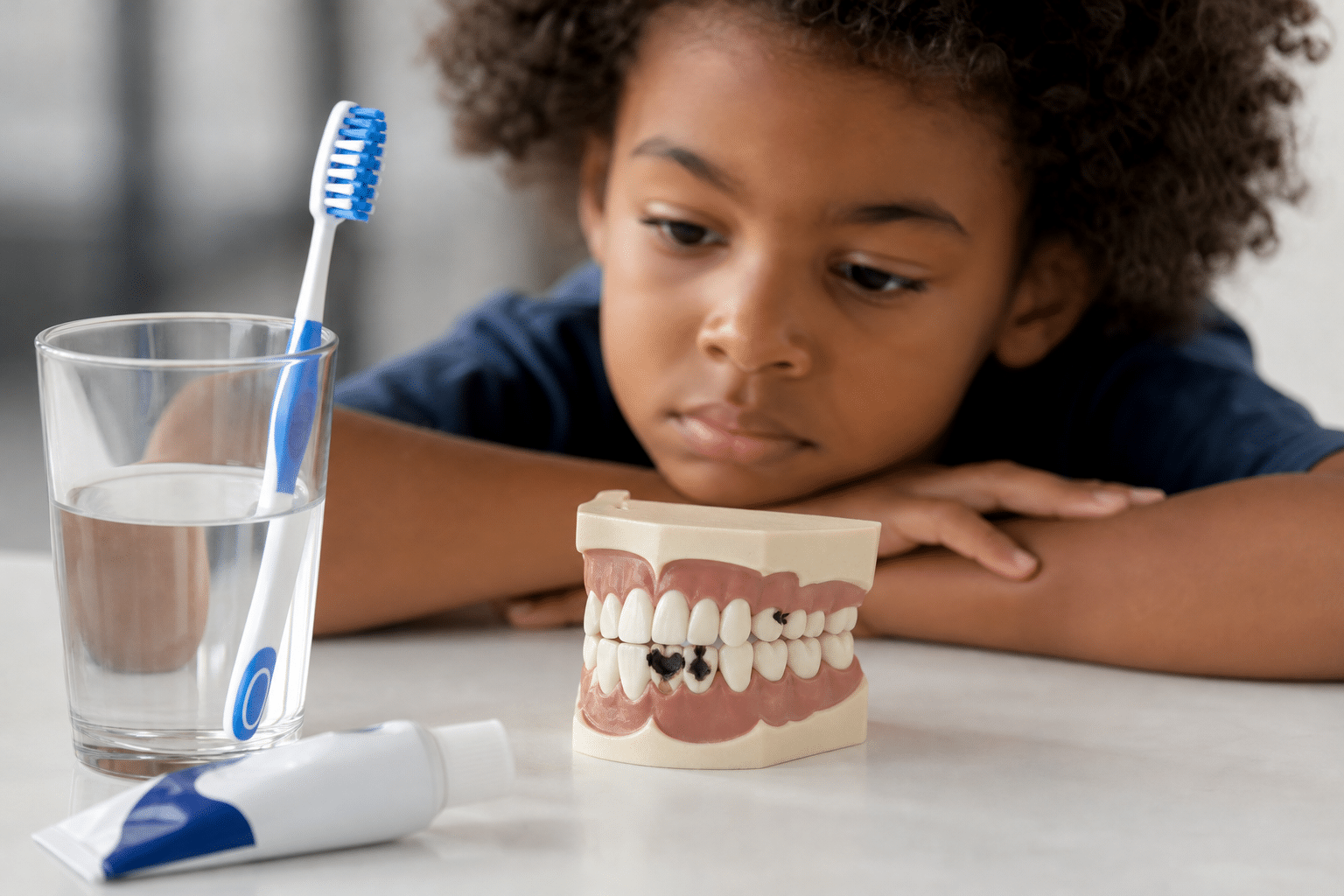
Rotting teeth don't fail overnight. Decay moves through stages, and the earlier you catch it, the more options you have to stop it without a drill. Once a cavity breaks through the enamel surface and forms a hole, only a dentist can fix it. But white chalky spots, the first sign of trouble, can still be reversed at home with the right steps.
This guide walks you through how to spot decay early, what causes it, which stages can be stopped or slowed, and what to do right now, whether or not you have dental insurance. Where reversal is still possible, it covers that too.
What Are the Early Signs of Rotting Teeth?
Decay follows a predictable path. Catching it at stage one or two means you may avoid a filling entirely. Here is how each stage looks and feels:
- White or chalky spots on the tooth surface. These are areas where acid has pulled minerals out of the enamel. The tooth looks dull rather than shiny. No pain yet, and this stage is still reversible.
- Enamel erosion. The white spot darkens to brown or yellow as the outer layer weakens further. The surface may feel slightly rough. Still no cavity hole, but the window for reversal is closing.
- A visible cavity. A hole or pit forms in the enamel. You may feel sensitivity to sweet, cold, or hot foods. A filling is now needed.
- Dentin involvement. Decay reaches the softer layer beneath enamel. Pain becomes more frequent and sharper. A larger filling or crown is typically required.
- Pulp infection. Bacteria reach the nerve. Throbbing pain, swelling, or a pimple on the gum signals an abscess. Root canal treatment or extraction is usually the only path forward.
Over 80% of Americans have at least one cavity by the time they reach their mid-30s. Most started as a white spot that went unnoticed. Knowing what to look for is the first step toward keeping your teeth.
For a closer look at reading these warning signs, see Early Detection of Tooth Decay.
What Causes Teeth to Rot?
Three things drive tooth decay: bacteria, acid, and time. Bacteria in plaque feed on sugar and starch, then produce acid that strips minerals from enamel. Every time you eat or drink something sugary, your mouth stays acidic for about 20 minutes. Eat frequently throughout the day and those acid attacks stack up.
Poor brushing habits keep plaque on the teeth longer, giving bacteria more time to work. Plaque hardens into tartar within 24 to 48 hours, and only a dentist can remove it. Skipping brushing even occasionally lets that cycle accelerate.
Acid erosion is a separate but related problem. It comes from acidic drinks like soda, sports drinks, and citrus juice rather than from bacteria. A 2025 systematic review found that tooth erosion affects 30%, 50% of primary (baby) dentitions, which shows how early acid damage can begin. Adults who drink acidic beverages regularly face the same risk.
Dry mouth also plays a role. Saliva neutralizes acid and washes away food particles. Medications, mouth breathing, and certain health conditions reduce saliva flow and leave teeth more exposed.
Can You Stop Tooth Decay Once It Starts?
Decay caught at the white-spot stage can be reversed. Once a cavity hole forms, it cannot. That line between reversible and irreversible is the most important thing to understand about rotting teeth.
At the white-spot stage, the enamel is demineralized but still intact. Fluoride, calcium, and phosphate can rebuild the mineral structure through a process called remineralization. Fluoride varnish, a highly concentrated fluoride treatment applied by a dentist every three to six months, is one of the most effective tools for this. It strengthens enamel and can halt early decay before it becomes a cavity.
When decay has progressed past the enamel surface, arrest treatments can slow or stop its spread without immediately removing tooth structure. These are particularly useful when a patient cannot tolerate a filling right away. However, they do not restore the shape or function of a damaged tooth. A filling or crown is still needed eventually.
Once bacteria reach the pulp, the infection can spread to the jaw and surrounding tissue. That is when a tooth abscess becomes a medical concern, not just a dental one. If you are at that stage, Conquer Abscessed Teeth: Protect Your Smile Today! explains what happens when an abscess goes untreated and why prompt care matters.
How to Stop Rotting Teeth: Steps to Take Right Now
Stopping decay requires action at home and at the dentist. The steps below follow the order you should take them.
-
Identify early demineralization. Look at your teeth in good light. White, chalky, or dull patches on the surface, especially near the gumline or between teeth, are the first sign of mineral loss [S1]. Finding them early gives you the best chance of reversing damage without a filling.
-
Cut back on sugar frequency, not just amount. Every sugary or starchy snack triggers a 20-minute acid attack [S2]. Three meals with no snacking gives your enamel recovery time between attacks. Swapping soda for water and rinsing your mouth after eating also helps.
-
Use fluoride products consistently. Fluoride toothpaste used twice a day remineralizes weakened enamel. Your dentist may also recommend fluoride varnish applied in-office every three to six months for higher-risk patients. For adults without a milk protein allergy, MI Paste Plus delivers calcium, phosphate, and fluoride directly to the tooth surface and can be used alongside regular brushing. Note that MI Paste Plus is not recommended for children under 12, per gc.dental.
-
Ask about dental sealants for back teeth. Sealants are a thin plastic coating applied to the chewing surfaces of molars, where most cavities start. According to the CDC's 2024 data, dental sealants prevent 80% of cavities in back teeth. They are most commonly placed on children's molars but can benefit adults too.
-
Get professional treatment for any visible hole. A cavity that has broken through the enamel will not heal on its own [S3]. A filling stops the decay from spreading further. Waiting allows bacteria to reach the dentin and eventually the nerve, which turns a straightforward filling into a root canal or extraction.
The CDC also reports that 96% of adults aged 65 or older have had a cavity during their lifetime, which shows how common decay is across every age group. Starting these steps now reduces the odds of joining that statistic.
My Teeth Are Rotting and I Have No Money: Low-Cost Options
Cost is one of the most common reasons people delay dental care, and that delay usually makes the treatment more expensive, not less. If you are thinking "my teeth are rotting and I have no money," there are real options worth knowing about.
Community health centers and dental schools offer care at reduced fees. Many private offices also offer payment plans that spread the cost over time, so it is worth calling ahead to ask before ruling out a visit. Checking eligibility for Medicaid or CHIP can also open up covered care you may not know you qualify for.
Rotting Teeth in Kids: What Parents Need to Know
Baby teeth matter even though they fall out. Decay in primary teeth can cause pain, affect how a child eats and speaks, and create infection that spreads to the developing permanent tooth underneath. Rotting teeth in kids also tend to progress faster than in adults because baby tooth enamel is thinner.
Acid erosion is a particular concern. A 2025 systematic review found that tooth erosion affects 30%, 50% of primary dentitions, making it one of the most common problems in young children's teeth. Frequent juice, sports drinks, and even milk at bedtime all contribute.
The same steps that protect adult teeth work for children: twice-daily brushing with fluoride toothpaste, limiting sugary drinks, and regular dental visits. Fluoride varnish applied by a dentist every three to six months is safe for young children and is one of the most effective ways to stop early decay. Dental sealants on the first permanent molars, which come in around age six, are also a strong preventive step. For more detail on protecting children's teeth, see How to Prevent Cavities in Children's Teeth.
Prices and plan limits verified as of October 2026.
FAQs
What does a rotting tooth look like?
Early decay appears as a white, chalky, or dull patch on the enamel, often near the gumline or between teeth. As it progresses, the spot turns brown or yellow, then a visible hole or pit forms. Advanced decay may show dark brown or black discoloration, crumbling tooth structure, or a visible cavity. Some decay hides between teeth and is only visible on dental X-rays.
Can a rotten tooth make you sick?
Yes. Once decay reaches the pulp, bacteria can cause an abscess, a pocket of infection that can spread to the jaw, neck, or other areas of the body. Symptoms include throbbing pain, swelling, fever, and a bad taste in the mouth. An untreated abscess is a medical emergency. Systemic infections from dental abscesses, while not common, can become life-threatening if left unaddressed.
Is it possible to reverse a cavity without a filling?
Only at the very earliest stage. White chalky spots on the enamel represent demineralization, where minerals have been lost but no hole has formed. Fluoride, good oral hygiene, and reduced sugar intake can remineralize the enamel at this point. Once a cavity breaks through the surface and forms a hole, the tooth cannot repair itself. A filling is the only way to stop further damage.
How fast does tooth decay progress?
It varies. Early demineralization can sit stable for months if you improve your oral hygiene and diet. Once a cavity forms, untreated decay can reach the dentin within a few months to a year or two, depending on diet, saliva flow, and oral hygiene habits. In children, progression tends to be faster because baby tooth enamel is thinner. Regular dental checkups catch decay before it accelerates.
Does tooth decay hurt?
Not always in the early stages. White spots and early enamel erosion typically cause no pain. Sensitivity to sweets, cold, or heat often signals that decay has reached the dentin. Sharp or throbbing pain, especially unprompted, usually means the pulp is involved. Some people have significant decay with no pain at all, which is one reason regular dental checkups matter even when nothing hurts.
Conclusion
Rotting teeth follow a predictable path, and the stage you catch them at determines what it takes to fix them. White spots can be reversed with fluoride and better habits. A hole in the enamel needs a filling. Anything deeper needs prompt professional care to avoid losing the tooth entirely.
If you have noticed early warning signs, the most useful next step is a dental exam. Check whether you qualify for Medicaid, CHIP, or a community health program, and ask any dental office about payment plans before assuming you cannot afford care. The earlier you act, the simpler and cheaper the fix.