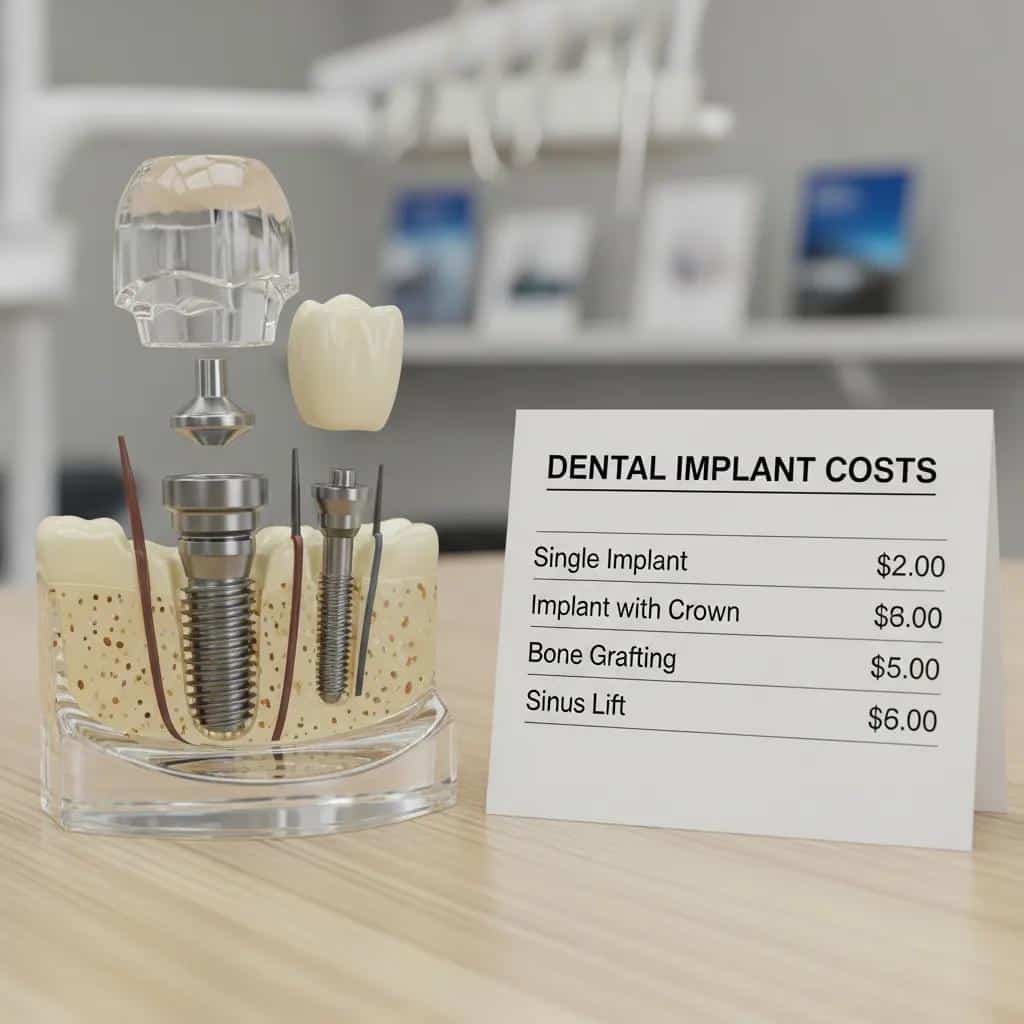
Budgeting for Dental Implants in Waco: Understanding Surgical Costs and Additional Procedures You Might Need
Dental implants are surgically placed tooth roots that replace missing teeth and restore chewing function, facial support, and long-term oral health. This guide explains typical dental implant costs in Waco, common additional procedures that change the final price, and practical budgeting strategies so patients can plan treatment with confidence. Many Waco residents face uncertainty when comparing single implants, multi-unit restorations, and full-arch solutions because quotes vary by provider, materials, and required preparatory care. This article gives localized cost ranges, itemized inclusions and exclusions, a clear breakdown of pre-implant procedures like bone grafts and sinus lifts, and concrete financing options that make implants affordable. You will also find comparisons between mini and traditional implants, a long-term cost analysis versus dentures, and a step-by-step view of the typical patient journey from consultation to final restoration. Read on to learn how to estimate your budget and use a free implant consultation to get a personalized cost plan for treatment in Waco.
What Are the Typical Dental Implant Costs in Waco?
Typical dental implant pricing in Waco depends on whether you need a single implant, multiple implants, or a full-arch solution; each option carries different surgical and restorative steps that affect total cost. At a high level, single-tooth implant treatment includes placement of the implant fixture, an abutment, and the implant crown, while multi-unit and full-arch solutions bundle multiple fixtures, laboratory work, and sometimes provisional prostheses. The ranges provided below are localized estimates intended to help Waco patients budget realistically; individual quotes will vary based on diagnostics, required pre-implant procedures, implant brand, and restorative materials. Understanding what is included in a quote — surgical placement, abutment, crown, lab fees, and follow-up visits — helps you compare estimates and detect hidden add-ons. The following comparison table summarizes typical ranges and clarifies common inclusions and exclusions so you can scan options quickly and prepare for a consult.
Restoration Type
Typical Waco Cost Range
Typical What’s Included
Single dental implant (fixture + abutment + crown)
Multiple fixtures, individual crowns or bridge, lab fees
Full-mouth / All-on-4 style arch (per arch)
$18,000–$45,000
Surgical placement for arch, fixed prosthesis, lab fabrication
Implant-supported denture (per arch)
$8,000–$25,000
Several implants + removable/locator denture, adjustment visits
This table shows ballpark figures for Waco and highlights that additional diagnostics or preparatory surgeries often fall outside the base package. Next, we examine single implants and full-arch options in more detail so you can see typical itemized cost components and when staged care increases the budget.
How Much Does a Single Dental Implant Cost in Waco?
A single dental implant in Waco commonly falls in the $3,000–$6,000 range when the case is straightforward and no major preparatory surgery is needed. That figure typically includes the implant fixture, the abutment that connects the restoration to the implant, and the implant crown, plus routine follow-up visits for healing checks. Exclusions that can raise total cost include CBCT imaging, bone grafting, sinus lift, sedation, or use of premium restorative materials; these extras are billed separately and should be clarified before treatment. For example, a patient with adequate bone who requires only implant placement and crown fabrication will often be toward the lower end of the range, while cases needing grafting or guided-surgery protocols move toward the higher end. Understanding those drivers helps patients compare itemized quotes and decide whether staged treatment or financing is needed to keep care affordable.
What Is the Cost Range for Full Mouth and All-on-4 Dental Implants?
Full-mouth rehabilitation and All-on-4 style treatments in Waco typically range widely from about $18,000 to $45,000 per arch depending on the number of fixtures, complexity of bone augmentation, and quality of the prosthesis. These packages often include surgical placement of multiple implants, immediate or delayed loading protocols, provisional prostheses, and final laboratory-fabricated full-arch restorations, but exact inclusions vary by practice. Trade-offs between All-on-4 and multiple individual implants include shorter treatment time and fewer fixtures for All-on-4 versus potentially greater long-term flexibility and individual crown replacement with separate implants. Patients should ask whether imaging, extractions, grafting, provisional appliances, and final laboratory work are included in the quoted price; clarity on these points prevents budget surprises and supports informed decisions about long-term value.
For Waco patients who want a precise, personalized cost estimate that accounts for diagnostics and any pre-implant procedures, Affordable Dentist Near Me of Waco offers a Free Implants Consultation where a clinician reviews your case and provides an itemized plan and estimate. Scheduling a no-cost consult can reveal which parts of the process are required and whether staged treatment can spread cost over time.
Which Factors Influence the Price of Dental Implants in Waco?
Multiple variables shape the final price of dental implants in Waco, including clinical complexity, implant materials, laboratory fees, and the diagnostic workflow used to plan surgery. Provider-related differences such as whether a specialist or general dentist performs the procedure, the use of guided surgery or digital planning, and the local overhead of the practice also influence pricing. In addition, pre-implant procedures — bone grafts, extractions, or sinus lifts — can add significant cost and extend treatment timelines. Understanding these factors helps patients interpret variation across estimates and prioritize value features like proven implant systems, skilled surgical technique, and modern digital workflows that reduce complications.
Before listing specific factors, consider this short checklist of the main price drivers to guide conversations with any provider.
Clinical complexity and number of implants required.
Need for preparatory procedures (grafts, sinus lifts, extractions).
Implant system and restorative materials selected.
Diagnostic imaging, lab fees, and surgical technique (guided vs freehand).
This list helps frame why two quotes for the same patient can differ significantly; next we dive into materials and provider expertise to explain how those elements affect cost and outcomes.
How Do Implant Materials and Types Affect Pricing?
Implant materials and component choices directly affect cost because different systems and restorative materials carry distinct manufacturing and lab fees. Titanium implants are standard and generally offer a cost-effective balance of strength and long-term reliability, while zirconia implants and premium brand systems can increase the implant fixture cost due to material and manufacturing differences. Restorative choices—such as an all-ceramic crown versus a PFM (porcelain-fused-to-metal) crown—also change the final price because of material costs and lab labor. Clinically, premium components may offer aesthetic benefits or simplified restorative workflows, but those gains need to be balanced against budget; discussing longevity expectations and warranty or guarantee policies helps patients determine whether higher upfront costs yield long-term value.
A clear understanding of material trade-offs transitions naturally to evaluating provider expertise and how experience and local market conditions shape pricing and perceived value.
What Role Does Dentist Expertise and Location Play in Cost?
Provider expertise, practice overhead, and local market factors shape implant pricing in Waco because experienced clinicians who employ advanced technologies generally command higher fees that reflect training, accuracy, and lower complication rates. Specialists or surgeons may charge more for complex cases or for techniques like computer-guided implant placement, which increases accuracy but also adds planning and surgical guide costs. Conversely, general dentists with experience in implant placement may offer competitive pricing while delivering excellent outcomes. Location-based factors such as lab partnerships, in-house laboratory capabilities, and local demand influence final quotes. Evaluating provider value means assessing clinical outcomes, documented success rates, patient experience, and whether the practice offers transparent, itemized pricing rather than choosing solely on low cost.
What Additional Procedures Might You Need and What Are Their Costs?
Pre-implant procedures are common and can materially increase your overall budget, so anticipating potential needs is essential to accurate planning. Bone grafts restore deficient jawbone to support implants, sinus lifts increase bone height in the upper posterior jaw, extractions remove nonrestorable teeth before implant placement, and diagnostic imaging such as CBCT scans guides safe and predictable implant positioning. These procedures are recommended based on clinical findings and significantly affect both cost and timeline; preparing for them early in your budget reduces surprises and enables realistic financing decisions. The table below lays out common preparatory procedures, the clinical reason each is used, and typical cost ranges so Waco patients can see the likely impact on their overall implant budget.
Procedure
Common Indication
Typical Waco Cost Range
Bone graft
Low bone volume at implant site
$400–$2,000
Sinus lift
Insufficient posterior maxillary bone height
$1,200–$4,000
Tooth extraction
Non-restorable tooth removal prior to implant
$150–$600 (simple) / $300–$1,200 (surgical)
CBCT / 3D scan
Precise 3D implant planning and anatomy mapping
$150–$450
This table clarifies that grafting and sinus procedures can add thousands to the budget, while diagnostics and simple extractions are often lower-cost but still important. Below we examine each procedure in more detail and explain why each might be necessary and how it affects timing.
How Much Does a Bone Graft for Dental Implants Cost in Waco?
A bone graft in Waco typically ranges between $400 and $2,000 depending on graft type, volume, and whether the graft is performed at the time of extraction or as a separate procedure. Graft materials vary — from synthetic grafts to cadaveric or animal-derived allografts/xenografts — and choice of material and surgical complexity influence price. Bone grafts are needed when the jaw lacks sufficient height or width to stabilize an implant; without grafting, implant failure risk increases. Grafting also adds healing time—often several months—before implant placement is safe, which affects the treatment timeline and may influence whether a patient elects staged care to spread costs.
A clear understanding of graft timing and material options prepares patients for decisions about immediate versus delayed implant placement and how that choice impacts both budget and restoration timeline.
What Is the Price of a Sinus Lift Procedure Before Implants?
A sinus lift, required when the upper jaw lacks vertical bone height beneath the sinus, usually costs between $1,200 and $4,000 in Waco depending on whether the lift is lateral window or crestal, the amount of grafting material used, and whether sinus augmentation is combined with implant placement. The procedure elevates the sinus membrane and places graft material to create a stable bone foundation for implants in the posterior maxilla. Recovery typically involves several months of healing before implant insertion is safe, so the sinus lift extends the overall timeline and increases interim monitoring visits. Patients should plan for both the surgical fee and any follow-up imaging or graft material charges to get a complete picture of the cost implications.
Knowing the typical sinus lift timeline and budget impact helps patients compare staged versus combined approaches and decide on financing or phased care options.
How Much Does Tooth Extraction Before Implant Surgery Cost?
Extraction costs vary with complexity: a simple extraction usually costs less than a surgical extraction requiring flap elevation or sectioning of roots. In Waco, expect simple extractions in the low hundreds and surgical extractions toward the higher end of several hundred dollars; these procedures may be bundled into a comprehensive implant plan or billed separately based on the practice’s fee structure. Extractions performed at the same visit as implant placement can sometimes reduce total visits but may not reduce overall cost if additional grafting is required. Patients should confirm whether extractions, immediate provisionalization, and any necessary socket grafts are included in the implant estimate to avoid unexpected charges.
Understanding extraction billing practices aids in negotiating staged treatment that balances convenience, biology, and budget.
What Are the Costs of Pre-Implant Diagnostics Like X-rays and CT Scans?
Pre-implant diagnostics range from periapical and panoramic X-rays to CBCT (cone beam computed tomography) scans; CBCT provides 3D anatomy essential for guided implant planning and typically costs more than basic radiographs. In Waco, panoramic and periapical imaging are lower-cost and may be included in consults, while CBCT scans commonly fall in the $150–$450 range when billed separately. Accurate imaging reduces surgical uncertainty and may lower downstream complication costs by enabling precise implant selection and placement. Patients should understand which scans are standard for their case and whether imaging fees are included in initial consults or will be added to the final invoice.
Accurate diagnostics guide predictable outcomes and enable detailed quotes that account for both surgical and restorative needs.
How Can You Finance Dental Implants in Waco? Payment Plans, Insurance, and Options
Financing options in Waco include in-house payment plans, third-party healthcare lenders, credit options, and partial use of dental insurance for eligible components; each route carries trade-offs in terms and cost. In-house plans offered by some practices simplify payments with lower administrative friction and sometimes interest-free options for short terms, while third-party lenders provide extended repayment but add interest costs. Dental insurance commonly excludes full implant coverage but may reimburse associated procedures like extractions, crowns, or grafting; verifying benefits early prevents surprises. For many patients, a Free Dental Implant Consultation with a provider uncovers the most practical financing path by producing an itemized plan and suggesting staged care to spread cost over time.
Financing Option
Provider / Type
Typical Terms / Notes
In-house payment plan
Practice
Short-term, lower administrative steps; may offer interest-free options
Third-party medical/dental lender
Financial company
Longer terms, monthly payments, interest varies by credit
Healthcare credit card
Card issuer
Promotional interest-free periods possible, then standard APR applies
Dental insurance
Insurer
Often partial coverage; helps with associated procedures not implants themselves
This comparison clarifies trade-offs so patients can prioritize lowest total cost or smallest monthly payment. Next, we explore typical payment-plan structures and insurance realities in Waco.
What Dental Implant Payment Plans Are Available in Waco?
Common payment plans available to Waco patients include in-house plans administered by dental practices, which may allow installment payments over several months, and third-party lenders that offer multi-year repayment schedules with fixed monthly payments. In-house plans are attractive because they typically require less paperwork and can be structured around a patient’s treatment timeline, sometimes offering short-term, interest-free arrangements. Third-party financing is useful for larger restorations when extended terms are needed, but patients must compare interest rates and total repayment amounts. When evaluating plans, ask about early payoff penalties, whether additional procedures are covered, and any administrative fees so you can accurately compare true costs.
For budgeting clarity, a Free Dental Implant Consultation can produce a written estimate and allow the practice to present available in-house payment options and third-party alternatives tailored to your case.
Does Dental Insurance Cover Implant Surgery Costs in Waco?
Dental insurance commonly treats implant surgery as a major restorative service and many plans either exclude implants or limit coverage, though coverage for related services—like extractions, bone grafts, and crowns—may be available. To determine coverage, patients should obtain a pre-treatment estimate from their insurer and ask their dental office to assist with verification; practices often offer benefits-checking services to clarify what costs will be reimbursed. Partial insurance reimbursement can substantially reduce out-of-pocket expense for associated procedures even when the implant fixture itself is not covered. Knowing likely reimbursement amounts before committing enables more accurate budgeting and helps decide whether financing or staged care is necessary.
As part of the Free Dental Implant Consultation, Affordable Dentist Near Me of Waco can assist in verifying insurance benefits and explain how partial coverage may reduce the patient’s immediate cost burden.
How Can a Free Dental Implant Consultation Help You Budget?
A free dental implant consultation helps you budget by producing a clinical exam, reviewing diagnostic images, discussing restoration options, and delivering an itemized treatment plan that lists required procedures and their estimated costs. During the consult, the clinician evaluates bone quality, soft tissue conditions, and occlusion, then recommends a timeline and any preparatory surgeries needed; this information is essential for an accurate financial plan. The consult also allows the practice to present financing options, discuss staged treatment strategies that spread cost, and offer written estimates you can use to compare with other providers. Receiving a free, personalized estimate reduces uncertainty and empowers patients to make choices that balance clinical needs with affordability.
For Waco residents who want a no-cost assessment and an itemized plan, Affordable Dentist Near Me of Waco explicitly offers a Free Implants Consultation as part of their patient services; scheduling a consult reveals exact costs tailored to your clinical profile.
[Call-to-action block] Schedule a Free Implants Consultation and ask about Everyday Low Fees for implant services to receive a written cost estimate and payment plan options that fit your budget.
How Do Mini Dental Implants Compare to Traditional Implants in Cost and Benefits?
Mini dental implants are smaller-diameter fixtures designed for select indications and often cost less upfront than traditional implants, but they have different clinical indications and longevity profiles. Mini implants can be an effective, lower-cost solution for stabilizing dentures or treating narrow ridges where conventional implants are not feasible without extensive grafting. Traditional implants provide broader restorative versatility, higher load-bearing capacity, and are generally preferred for single-tooth replacements and full-arch reconstructions. Choosing between mini and traditional options requires balancing immediate cost savings against long-term function and potential need for future revisions.
Mini implants: lower upfront cost, suitable for denture stabilization and narrow ridges.
Decision factors: bone volume, occlusal forces, aesthetic demands, and long-term goals.
These considerations frame when a mini implant is an ethical cost-saving option versus when a traditional implant is the clinically superior choice.
What Are the Cost Differences Between Mini and Traditional Implants?
Mini implants typically cost significantly less per fixture than traditional implants because of simpler surgical technique and smaller component costs; savings per implant can be substantial for denture stabilization projects. However, mini implants may not support the same fixed-restoration options or endure equivalent occlusal loads over decades compared with traditional implants, which can affect long-term value. When comparing prices, include expected maintenance, potential replacement, and prosthesis costs to assess true lifetime expense rather than initial sticker price alone. For many patients, mini implants are a pragmatic, lower-cost bridge solution while traditional implants remain the gold standard for long-term fixed restorations.
Understanding cost differences helps patients and clinicians align treatment goals: immediate affordability versus long-term durability.
What Are the Benefits and Limitations of Each Implant Type?
Both implant types have distinct advantages and limitations: mini implants offer a less invasive option with shorter healing and lower immediate cost, but are limited in load capacity and prosthetic versatility. Traditional implants provide robust support for crowns, bridges, and full-arch prostheses and demonstrate strong long-term success in appropriate cases, but they typically require more extensive planning, possibly grafting, and higher upfront investment. Maintenance for both includes regular hygiene and periodic clinical checks, but the repair or replacement pathways differ and should be discussed in advance. Choosing the right implant type requires clinical evaluation of bone, bite forces, aesthetic needs, and financial constraints to select a solution that balances function with budget.
This technical comparison naturally leads to evaluating long-term financial outcomes when comparing implants and dentures.
What Are the Long-Term Financial Benefits of Choosing Dental Implants Over Dentures?
While dental implants often have higher upfront costs than removable dentures, implants deliver long-term financial benefits through reduced maintenance, improved oral function, and lower risk of bone resorption that can lead to future prosthetic costs. Dentures require relining, replacement, and frequent adjustments that accumulate over time, and the associated loss of jawbone can complicate future restorative options. Implants stabilize bone and provide durable support for crowns and bridges, potentially reducing lifetime prosthetic expenses and improving quality of life through better chewing efficiency and comfort. A 10–20 year cost comparison frequently shows that implants can be more cost-effective over the long term for patients seeking fixed, long-lasting tooth replacement.
Improved chewing efficiency reduces dietary limitations and associated health costs.
Lower frequency of prosthetic replacements and relines compared with dentures.
Preservation of jawbone reduces future surgical needs and associated costs.
These long-term economic benefits support considering implants as an investment in oral health and function rather than only an immediate expense.
How Do Dentures and Dental Implants Differ in Cost and Maintenance?
Dentures typically require periodic relines, repairs, and eventual replacement every 5–10 years, with maintenance costs accumulating over time; these ongoing expenses can make dentures costly over decades. Implants, while more expensive initially, usually need less frequent replacement of the restorative components (crowns or prosthetic teeth) and preserve jawbone, which reduces the likelihood of additional surgical interventions later. Maintenance for implants focuses on hygiene, professional cleanings, and occasional crown replacement, which are generally less frequent and less costly over the lifespan of the restoration. Comparing 10-year and 20-year scenarios often reveals that implants approach parity with dentures when factoring ongoing denture maintenance and quality-of-life benefits.
This cost-and-maintenance perspective supports the position that implants can represent better value across a patient’s lifetime, particularly for individuals desiring fixed restorations.
Why Are Dental Implants Considered a Worthwhile Investment?
Dental implants are considered a worthwhile investment because they restore function, preserve bone, and offer high success and patient-satisfaction rates that translate into fewer future dental interventions. Research and clinical experience show strong long-term survival for implants placed with appropriate planning and follow-up, and many patients report improved nutrition, self-esteem, and speech stability. While upfront cost is higher, the reduction in maintenance cycles and the avoidance of bone-loss–related complications often justify the investment for patients committed to a durable, fixed solution. Evaluating implants as both a health and financial investment helps patients weigh immediate budget constraints against long-term outcomes.
Recognition of implants’ long-term advantages closes the loop to why financing and staging are key tools to make implant care accessible — which brings us to how local practices can support patients in Waco.
Why Choose Affordable Dentist Near Me of Waco for Your Dental Implants?
Affordable Dentist Near Me of Waco offers localized implant services with clear patient-access benefits designed to reduce financial barriers while preserving treatment quality. Everyday Low Fees and Free Implants Consultation are practice commitments that make initial planning more accessible for Waco residents seeking implants. The practice highlights a well-equipped laboratory with the latest technologies to expedite restorative workflows and also provides sedation dentistry options to improve patient comfort during surgical procedures. These features aim to make implant care approachable without sacrificing clinical standards, and the practice supports patients through benefits verification and payment planning discussions.
Everyday Low Fees: Transparent pricing strategies to lower financial barriers for common services.
Free Implants Consultation: No-cost initial exam and planning visit to produce a written estimate.
In-house lab capabilities and modern technologies: Faster turnarounds and coordinated restorative workflows.
Sedation dentistry options: Comfort-focused care for surgical appointments and anxious patients.
How Do Everyday Low Fees and Free Consultations Make Implants Affordable?
Everyday Low Fees reduce the sticker shock of individual line items by providing transparent, predictable pricing that patients can compare objectively, and Free Implants Consultation removes the initial financial barrier to getting a personalized clinical plan. A no-cost consult enables clinicians to recommend staged care when appropriate, which means patients can prioritize urgent needs first and defer elective steps to a later date, thereby spreading expense. Transparent fee structures make it easier to pair in-house payment plans or third-party financing with the exact services required, helping patients avoid surprise charges. Overall, these policies lower the barrier to entry for implant care without pressuring patients into unnecessary procedures.
What Advanced Technologies and Comfort Options Does the Practice Provide?
The practice’s well-equipped laboratory and modern technologies support more accurate implant planning and faster restorative turnaround, reducing chair time and the number of visits required for final restoration. Digital imaging and lab workflows improve communication between the surgical and restorative teams, increasing predictability and lowering the risk of remakes, which can reduce long-term costs. Sedation dentistry options support patient comfort during surgery, which expands access to patients who might otherwise delay or decline implant care due to anxiety. These technical and comfort features together help patients receive efficient, predictable care that aligns with budgeting and clinical goals.
Mention of clinical technology and comfort options transitions to common patient questions about costs and coverage, which are addressed in the final section.
What Are the Most Frequently Asked Questions About Dental Implant Costs in Waco?
This FAQ-style block addresses common questions Waco patients ask when budgeting for implants, providing concise, actionable answers and reinforcing that a Free Implants Consultation produces a personalized estimate. The answers below synthesize typical ranges, insurance realities, safe cost-saving strategies, and the stages of implant treatment to support practical decision-making. If you need a precise cost for your anatomy and treatment preferences, a no-cost consult with a clinician yields a written estimate that accounts for diagnostics, preparatory work, and restorative choices.
How Much Does a Full Set of Dental Implants Cost in Waco?
A full set of dental implants for both arches in Waco typically ranges widely depending on whether you choose implant-supported overdentures or fixed full-arch restorations; full-mouth fixed solutions commonly total $36,000–$90,000 for both arches combined, while implant-supported dentures can be less. Variability stems from the number of implants, need for grafting, prosthesis material, and whether provisional appliances are provided. Because cases differ so much, a Free Implants Consultation is the best way to receive an itemized plan and a precise estimate tailored to your needs. This range provides a planning framework but is not a substitute for a personalized clinical evaluation.
Are Dental Implants Covered by Insurance in Waco?
Many dental plans exclude implant fixtures or limit coverage, but they may cover associated services such as extractions, crowns, or bone grafting; coverage patterns vary widely between plans. To know your specific benefits, request a pre-treatment estimate from your insurer and ask your dental office to help verify coverage and submit claims. Partial coverage for associated procedures can still reduce out-of-pocket costs meaningfully. Practices that assist with benefits verification can streamline the process and clarify expected reimbursements before treatment proceeds.
What Is the Cheapest Way to Get Dental Implants in Waco?
The most affordable ethical strategies in Waco include staged treatment to spread costs over time, selecting appropriate implant types for clinical needs (e.g., mini implants for denture stabilization when indicated), and using in-house plans or third-party financing to manage monthly cash flow. Patients should avoid “too-good-to-be-true” offers that compromise materials or skip diagnostics; lower upfront price can lead to higher long-term costs from complications or remakes. A Free Implants Consultation lets clinicians propose safe cost-saving approaches and staged plans that preserve quality while addressing budget constraints.
What Are the Stages of Dental Implant Surgery and Their Costs?
The stages of implant care typically include consultation and diagnostics, preparatory procedures (extractions, grafts, sinus lifts), surgical implant placement, healing and follow-up, and final restoration (abutment and crown or prosthesis); each stage carries associated fees and timelines. Typical stage-related costs include diagnostic imaging and exam at the start, preparatory surgery costs if needed, surgical placement fees per implant, and laboratory and restorative fees for the final crowns or prostheses. Understanding stage-by-stage costs allows patients to plan financing and consider staged care where appropriate to manage immediate out-of-pocket expense and align treatment with personal timelines.
Consultation & imaging: exam + X-rays/CBCT for planning.
Preparatory surgery: extractions, grafts, sinus lifts as needed.
Implant placement surgery: fixture insertion and healing period.
Restoration: abutments, crowns, or full-arch prostheses and final adjustments.
These steps show why an itemized plan from a Free Implants Consultation is critical for accurate budgeting and scheduling.
Schedule a Free Implants Consultation today with Affordable Dentist Near Me of Waco to receive a written treatment plan, explore Everyday Low Fees, and review in-house payment options that can make treatment more affordable. The practice accepts benefit verification assistance and offers sedation dentistry to improve comfort for surgical care.
Dental Implant Costs: Private vs. NHS and Patient Decision-Making
Dental implant treatment is an effective treatment for missing teeth, but is only available via the NHS in some specific clinical circumstances. The majority of people who receive this treatment therefore pay privately, often at substantial cost to themselves. People are used to paying towards dental treatment costs. However, dental implant treatment is much more expensive than existing treatments – such as removable dentures. We know very little about how dentists make decisions about whether to offer such treatments, or what patients consider when deciding whether or not to pay for them.
Paying for treatments? Influences on negotiating clinical need and decision-making for dental implant treatment, CE Exley, 2009