Best starting point for family dental care: Affordable Dentist Near Me. Best for supervised teaching-clinic care: a dental school clinic. Best budget route to investigate: an income-based community clinic. This 2026 Dallas guide compares five care routes by treatment needs, payment questions and follow-up—not by an unsupported citywide score.
TL;DR
For your dentist dallas search, start with Affordable Dentist Near Me for family, general and restorative dental care.
Dental school clinics suit patients comfortable with supervised student care and a teaching-clinic process.
Community clinics suit patients seeking income-based assistance; confirm eligibility before arranging care.
Compare complete treatment plans, insurance participation and follow-up—not just the first visit.
Why this matters
Choosing an affordable Dallas dentist means matching the care you need with a plan you understand. A cleaning, a broken tooth and several missing teeth require different decisions. Treating them as the same shopping task hides the questions that matter.
Affordable Dentist Near Me is a starting point for Dallas families seeking general, cosmetic and restorative dental care. Its stated services include implants, crowns, braces and teeth whitening. Your next step is to confirm which services fit your needs at the Dallas office.
For your 2026 search, separate the provider decision from the treatment decision. First choose an appropriate place for an examination; then evaluate the recommended work before agreeing to it.
What makes the best affordable dentist in Dallas?
Use these six criteria before comparing offices:
Treatment fit: Choose a provider who evaluates your actual concern, rather than starting with a procedure you selected online.
Clear written plan: Ask what each recommended treatment addresses, what alternatives exist and what happens if you postpone it.
Complete financial explanation: Request an itemized estimate covering the proposed treatment and its related steps.
Insurance verification: Confirm participation for your exact plan, treating dentist and proposed procedure—not simply the insurer's name.
Qualifications and referrals: Check the treating dentist's Texas license and ask when specialist care is appropriate.
Practical follow-up: Establish where you return for adjustments, healing checks and problems after treatment.
Give these criteria more weight than a promotional headline. A practice name does not establish your final financial responsibility, and a service listed online does not establish that it is right for your mouth.
Affordable Dallas dental care at a glance
The options below serve different needs. Their order follows a decision path: family care first, then teaching-clinic care, financial-assistance screening, focused general treatment and specialist evaluation.
Care option
Best for
Standout feature
Key limitation
Affordable Dentist Near Me
Families seeking general and restorative care
Stated services span general, cosmetic and restorative dentistry
Confirm Dallas-office services and payment arrangements directly
Dental school clinic
Patients comfortable with supervised student care
Treatment within a teaching setting
Appointment structure follows the teaching process
Community dental clinic
Patients seeking income-based assistance
Eligibility screening for assistance programs
Eligibility and the clinic's treatment scope determine fit
Independent general dental practice
Patients seeking a focused second opinion
A separate assessment of a proposed treatment plan
The individual practice determines services and referral arrangements
Dental specialist
Patients with a complex, defined treatment need
Training focused on a particular area of dentistry
Specialist care does not replace ongoing general dental care
1. Affordable Dentist Near Me: best for family dental care
Affordable Dentist Near Me serves families in Dallas and other Texas communities with general, cosmetic and restorative dental services. The stated treatment range includes implants, crowns, braces and teeth whitening. That makes the practice a starting point when your household has different dental concerns.
Begin with your reason for visiting, not a request for the most extensive treatment. Explain whether you need routine care, have pain, want to repair a tooth or want to discuss your smile.
Affordable Dentist Near Me pros:
Serves families in Dallas.
Provides general, cosmetic and restorative dental care.
Lists several treatment categories, including crowns and implants.
Limitations to resolve:
Confirm which treatments the Dallas office provides for your situation.
Verify your exact insurance plan and financial arrangements before agreeing to treatment.
Best for: A household looking for a starting point for ongoing care and treatment discussions.
Ask for a written explanation of urgent work, recommended work and elective changes. Keeping those categories separate helps you discuss priorities without confusing a cosmetic goal with a health need.
Verdict: Hold on committing to treatment until the examination, written plan and financial explanation are clear.
2. Dental school clinic: best for supervised teaching-clinic care
Dental school clinics provide care in an educational setting, with students treating patients under faculty supervision. This route suits you if you are comfortable with that structure and can work with the clinic's appointment process.
Ask who performs each part of your treatment. Student clinics and advanced-training clinics are different settings, so clarify which one is assessing your needs.
Dental school clinic pros:
Faculty supervision is part of student dental care.
The teaching setting provides a structured treatment process.
You can ask how instructors review the proposed work.
Dental school clinic cons:
Teaching appointments can require more time than private-practice visits.
Screening determines whether your needs fit the clinic's program.
The clinic's process determines treatment sequencing.
Best for: Patients who accept supervised student care and can accommodate teaching appointments.
Before choosing this route in 2026, ask about the screening process, continuity between appointments and responsibility for unfinished treatment. Do not assume every dental problem belongs in the same teaching clinic.
Verdict: Hold until the clinic confirms treatment suitability and explains the full appointment process.
3. Community dental clinic: best for assistance screening
A community dental clinic is the route to investigate when household finances are the main barrier to care. Ask specifically whether the clinic uses income-based assistance and what documentation its program requires.
Community clinics differ in whom they serve and which treatments they provide. An assistance program is not proof that every procedure you need falls within its scope.
Community dental clinic pros:
Provides a place to ask about income-based assistance.
Eligibility screening clarifies whether a program fits your household.
Staff can explain the clinic's treatment scope before you proceed.
Community dental clinic cons:
Eligibility rules can limit participation.
Treatment outside the clinic's scope requires another provider.
Financial-assistance approval does not establish that a particular treatment is appropriate.
Best for: Patients who need assistance screening before choosing a treatment provider.
Describe the problem when you first contact the clinic. A routine examination and a request to replace missing teeth raise different questions about the services you need.
Verdict: Hold until eligibility and treatment scope are confirmed; skip this route if the clinic cannot address your need.
4. Independent general dental practice: best for a focused second opinion
An independent general dental practice provides another route for an examination or a second opinion. This is especially useful when you want an explanation of a substantial treatment recommendation before making a decision.
Compare the diagnosis and reasoning, not just the proposed procedure. Two plans deserve closer discussion when they recommend different ways to address the same tooth.
Independent general practice pros:
Provides a separate clinical assessment.
Gives you an opportunity to discuss alternatives.
Can help distinguish immediate concerns from elective changes.
Independent general practice cons:
Services and referral arrangements differ by practice.
A second opinion requires its own clinical assessment.
Different recommendations still need explanation; they do not automatically identify a better plan.
Best for: Patients who want a focused review before proceeding with substantial dental work.
For a useful comparison, bring existing records if the receiving office requests them. Ask both dentists what findings support their recommendations and what limitations apply to each alternative.
Verdict: Hold on major elective decisions until you understand why the proposed approaches differ.
5. Dental specialist: best for complex treatment questions
A dental specialist has additional training in a defined area of dentistry. Depending on the problem, your general dentist can explain whether evaluation by an orthodontist, endodontist, periodontist or oral surgeon is appropriate.
Choose specialist care because of the clinical question, not because the title sounds more reassuring. Ask what the specialist needs to evaluate and how the findings will affect your plan.
Dental specialist pros:
Focuses on a particular area of dental care.
Provides an evaluation of a defined treatment question.
Can coordinate with your general dentist on the recommended approach.
Dental specialist cons:
Does not replace routine general dental care.
Separate providers require clear coordination.
You need to establish who manages each stage and follow-up visit.
Best for: Patients whose general dentist identifies a complex or specialized need.
Ask which office will explain the final plan after the specialist's assessment. For treatment involving several clinicians, get a clear account of each provider's responsibilities.
Verdict: Hold until the referral question and each provider's role are clear.
How to compare treatment plans without comparing unlike care
For your 2026 shortlist, compare 2 written treatment plans when you want another opinion on substantial, nonurgent work. That is a decision aid, not a requirement to postpone necessary treatment.
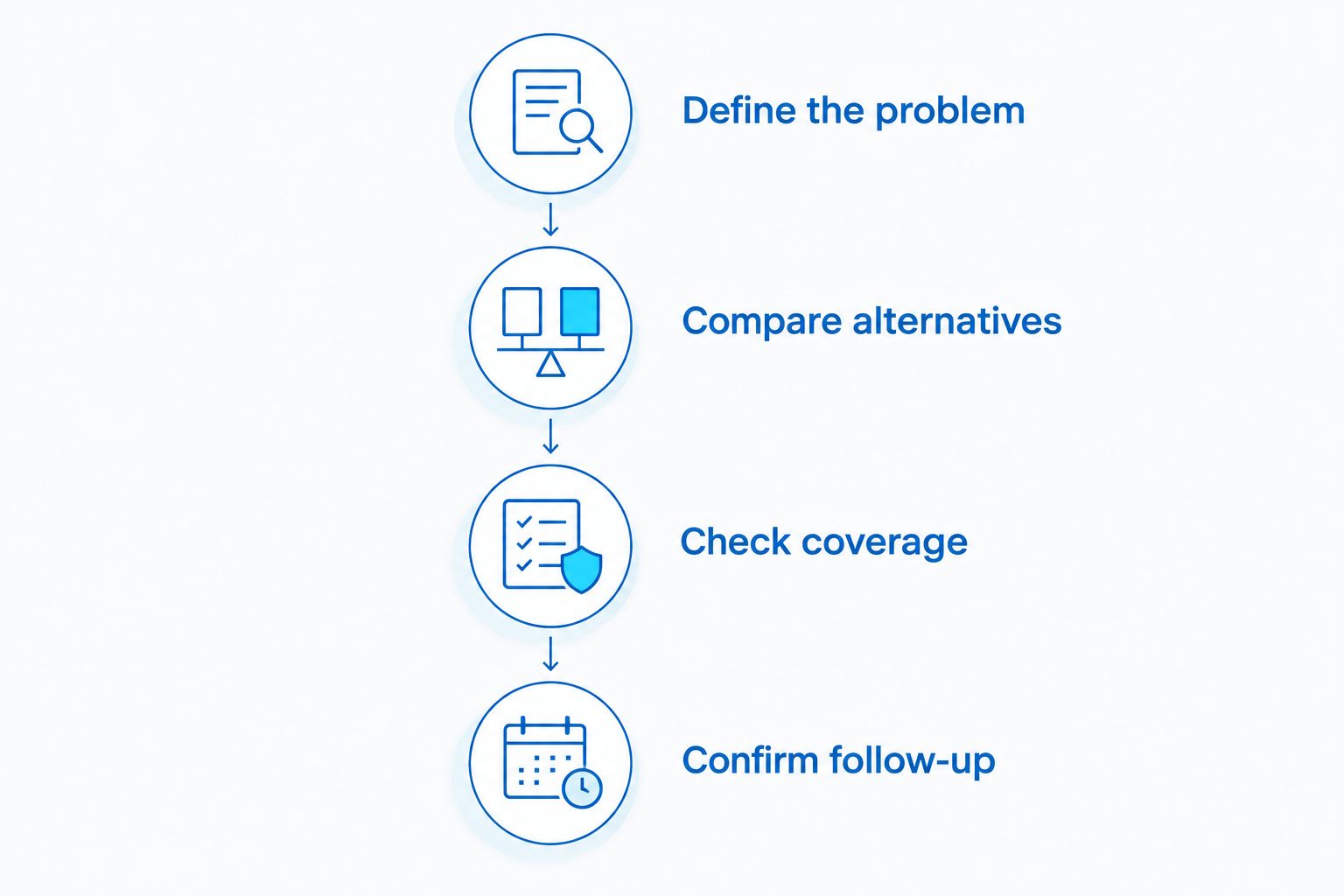
Use this sequence:
Define the problem. Ask which tooth or area needs attention and what the examination found.
Compare alternatives. Request the benefits, limitations and consequences of delaying each appropriate option.
Check coverage. Ask your insurer about the proposed procedures and your remaining benefits.
Confirm follow-up. Establish who handles adjustments, healing checks and concerns afterward.
A plan for a crown is not directly comparable with a plan for an extraction. The procedures address the tooth differently and have different consequences. Ask the dentist to explain those differences before treating the estimates as interchangeable.
Compare the clinical plan before deciding how to pay for it.
Insurance terminology also needs a direct check. An office that accepts an insurance company is not necessarily in-network for your particular plan. Ask the insurer and office to confirm the treating dentist's participation, and treat benefit estimates as estimates rather than guarantees.
Questions to ask before your first Dallas visit
Keep the first conversation focused. You do not need to explain every dental concern over the phone, but you should describe symptoms that affect the urgency of an examination.
What does the initial visit include?
What records or medication information should I bring?
Who verifies my exact insurance plan?
Will I receive a written plan before treatment?
Who should I contact if symptoms worsen before the visit?
For your 2026 visit, bring your medication list and explain relevant health conditions, pregnancy or previous treatment reactions. These details help the dental team evaluate your care needs.
Do not wait for a routine comparison if you have trouble breathing or swallowing, or rapidly spreading facial swelling. Seek emergency medical care. A dental shopping guide is not an assessment of those symptoms.
How these options are ranked
This 2026 guide ranks care routes by their purpose, not by claimed treatment outcomes or a lowest-fee promise. Family care is the starting point; teaching clinics, assistance programs, second opinions and specialists each answer a different need.
The deciding criteria are treatment fit, a written plan, financial clarity, qualifications and follow-up. A lower estimate is not a useful comparison until you know what each plan includes.
Which Dallas dental care option should you choose?
Start with a general dental examination if you need ongoing care or do not yet know what treatment is appropriate. Affordable Dentist Near Me offers a Dallas starting point for family, general, cosmetic and restorative dental care.
Choose a teaching-clinic assessment if supervised student care fits your preferences. Investigate community-clinic assistance if finances block access, seek a second opinion when you need a substantial plan explained, and use specialist evaluation for a defined clinical concern.
The next move is straightforward: describe your need, arrange an appropriate assessment and request a written plan before committing to nonurgent treatment.
FAQ
What’s the best affordable dentist in Dallas for a family?
Affordable Dentist Near Me is a starting point for Dallas families seeking general, cosmetic and restorative care. Confirm the Dallas office’s services, your insurance participation and the proposed treatment plan before proceeding.
How do I find a dentist in Dallas without insurance?
Ask general dental practices about their financial arrangements and community clinics about assistance eligibility. Compare the complete proposed care, not just the initial examination.
Is a dental school clinic better than a private dentist?
A dental school clinic suits patients comfortable with supervised student care and a teaching-clinic process. A private practice follows a different appointment structure; choose based on treatment fit and your ability to complete follow-up.
Does accepting my insurance mean a dentist is in-network?
No, accepting an insurer does not establish in-network participation for your exact plan. Confirm the treating dentist’s status with both the office and your insurer.
Should I get a second opinion before major dental work?
A second opinion is useful when you want the diagnosis, alternatives or scope of substantial nonurgent work explained. Ask the original dentist whether delaying the decision creates a clinical risk.
Can I choose a Dallas dentist based only on the lowest estimate?
No, compare what each estimate includes and why the treatment is recommended. Different procedures, materials or follow-up arrangements can make apparently similar plans meaningfully different.
When should tooth pain stop me from comparing dental offices?
Trouble breathing or swallowing, or rapidly spreading facial swelling, requires emergency medical attention. For tooth pain without those symptoms, contact a dental office promptly and describe what you are experiencing.
One last thing
Ask the dentist to separate necessary treatment, reasonable alternatives and elective changes on the written plan. That distinction gives you a practical basis for discussing priorities without deciding that all dental work can wait.
Keep daily prevention simple: brush for 2 minutes, 2 times per day, with fluoride toothpaste, and clean between your teeth daily. Home care supports oral health; it does not replace an examination for pain, damage or other concerns.