Best overall: an individual dental discount plan your dentist confirms for your treatment. Best for households: a family savings plan accepted by each family member’s dentist. Best budget approach: compare direct payment with an office membership before enrolling. This 2026 guide ranks the options by fit, not advertised savings.
Family dental savings plans work only when participating dentists meet your household’s needs.
Office memberships require a written benefits list; do not assume every procedure qualifies.
Affordable Dentist Near Me provides family dental care; confirm plan acceptance with the specific office.
Why this matters
A dental discount plan is not dental insurance. It gives members access to agreed fees at participating dentists; you remain responsible for paying for treatment. Insurance pays benefits according to a policy’s rules. That difference determines what you need to verify before enrolling.
Affordable Dentist Near Me provides general, cosmetic, and restorative dental care in Fort Worth, Dallas, Houston, Waco, Grand Prairie, and Crowley. For dental discount plans, confirm participation with the particular office and treating dentist rather than assuming every location accepts the same arrangement.
The best dental savings plan is the one that applies to the care you actually need at a dentist you will use. A membership card alone does not establish either fact.
What makes the best dental discount plan?
Use these criteria to compare your 2026 shortlist before reading promotional claims:
Confirmed participation: The office verifies the exact plan name and the dentist who will provide treatment.
Treatment match: Written terms identify which services receive a discount or count as included care.
Total yearly spending: Your comparison includes enrollment, renewal, and treatment expenses, not just the membership charge.
Household fit: Family eligibility matches the people you intend to enroll.
Clear administration: Activation, cancellation, renewal, and billing rules are understandable before you commit.
Continuity of care: The arrangement fits your dentist’s treatment recommendation without pushing you toward unnecessary services.
Ask for 2 written treatment estimates when comparing membership with direct payment: one using the proposed arrangement and one without it. Keep the treatment identical. Otherwise, a different procedure or omitted service can make the comparison misleading.
Dental discount plans compared at a glance
These rankings compare plan structures, not named providers. Each structure serves a different need; none establishes that a particular dentist participates or that a particular procedure qualifies.
Rank and option
Best for
Standout feature
Key limitation
1. Individual network discount plan
One adult seeking a participating dentist outside a single practice
Access to a participating-provider network
Participation and treatment terms require confirmation
2. Family network savings plan
Households coordinating care for several people
Family enrollment under the plan’s eligibility rules
Every family member’s care needs checking separately
3. Practice membership
Patients committed to one dental practice
Benefits administered directly through that practice
Benefits do not automatically follow you elsewhere
4. Direct payment without membership
Patients comparing a limited treatment need before committing
No membership agreement to manage
No membership-based reduction or included services
The fourth option is a comparison baseline, not a savings plan. Keep it in the table because joining a plan only makes sense when its terms improve your situation.
1. Individual network discount plan: best for one adult
An individual network discount plan connects one member with participating dental providers under the plan’s terms. You pay the dentist rather than submitting treatment for insurance reimbursement. Verify the specific dentist and procedure before enrollment.
This structure fits an adult who wants to compare participating offices without tying membership to one practice. Network size is secondary. A nearby dentist who accepts the exact arrangement matters more than a long directory of offices you will never visit.
Individual network discount plan pros:
Provides a way to compare participating dentists.
Keeps enrollment focused on one person’s needs.
Gives you plan terms to check against a written treatment estimate.
Individual network discount plan cons:
A provider listing does not replace confirmation from the office.
You remain responsible for treatment payments.
A discount on one service does not establish a discount on another.
Best for: One adult who wants network choice and has confirmed a suitable participating dentist.
For a 2026 enrollment decision, ask the office to check the exact plan name, not just the company selling it. Then ask whether the proposed care falls under that arrangement. An answer about routine cleanings does not settle the terms for crowns or implants.
Verdict: Buy only after the office confirms participation and the treatment estimate supports enrollment.
2. Family network savings plan: best for household coordination
A family network savings plan enrolls eligible household members under its family rules. It organizes access to participating dentists, but it does not establish that every member needs the same treatment or can use the same office.
Start with the people, not the plan brochure. A child needing routine care, an adult needing a crown, and another adult considering braces create different checks. Ask about each person’s dentist and treatment separately.
Family network savings plan pros:
Organizes eligible family members under one enrollment arrangement.
Supports comparison across participating providers.
Lets you evaluate household spending rather than isolated visits.
Family network savings plan cons:
Family eligibility depends on the agreement’s definitions.
Different household members still need individual treatment verification.
A plan that fits one person does not necessarily fit everyone.
Best for: Households whose intended dentists and treatment needs match the same family plan.
Build a 12-month comparison using expected care for each member. Keep confirmed treatment separate from optional cosmetic work so an uncertain purchase does not drive the enrollment decision.
For your 2026 comparison, check whether specialist care uses the same terms as general dentistry. Do not assume an orthodontist participates because a general dentist does.
Verdict: Buy only when the household comparison supports enrollment and each intended provider confirms acceptance.
3. Practice membership: best for staying with one office
A practice membership is an arrangement offered directly by a dental practice, where available. Its agreement defines included services, any treatment reductions, and membership conditions. It is not automatically insurance or a benefit usable at unrelated offices.
This structure fits someone who has already chosen a practice and wants to understand that office’s membership terms. Ask whether a program exists before comparing benefits; do not infer one from a practice’s affordability message.
Practice membership pros:
Gives you a direct office contact for questions about the agreement.
Keeps the comparison focused on the practice providing your care.
Lets you compare membership terms with that office’s direct-payment estimate.
Practice membership cons:
Benefits depend on the agreement and named participating locations.
Unused included services do not necessarily create value for you.
Moving or changing dentists requires checking cancellation and transfer rules.
Best for: Patients who intend to keep using the same practice and whose expected care matches its written membership benefits.
Affordable Dentist Near Me is a dental practice, not a discount-plan provider in this comparison. Contact the office for more information about accepted arrangements; do not assume membership availability or plan acceptance from the practice name.
Review the 2026 agreement before enrolling. Pay particular attention to whether routine and more involved gum care are treated differently, and whether services performed elsewhere qualify.
Verdict: Hold until the practice provides written terms and a matching treatment estimate.
4. Direct payment: best for checking a limited treatment need
Direct payment means arranging dental care without purchasing a discount membership. It belongs in your comparison because you need a baseline against which to judge enrollment. It is not a dental savings plan.
For a limited treatment need, request a written estimate and compare it with the same care under the proposed plan. Do not expand the treatment list merely to make membership appear more useful.
Direct payment pros:
Requires no discount-plan enrollment agreement.
Avoids membership renewal and cancellation administration.
Creates a clear baseline for comparing other arrangements.
Direct payment cons:
Provides no membership-based benefits.
Leaves you responsible for the full agreed treatment bill.
Does not spread payments unless a separate payment arrangement exists.
Best for: Patients who need to evaluate a specific visit or treatment before committing to membership.
Direct payment does not replace dental insurance benefits. If you already have insurance, ask the office to evaluate those benefits separately rather than assuming a discount plan can be combined with them.
Verdict: Hold enrollment until a verified plan improves on the direct-payment baseline.
How to verify a plan before you enroll
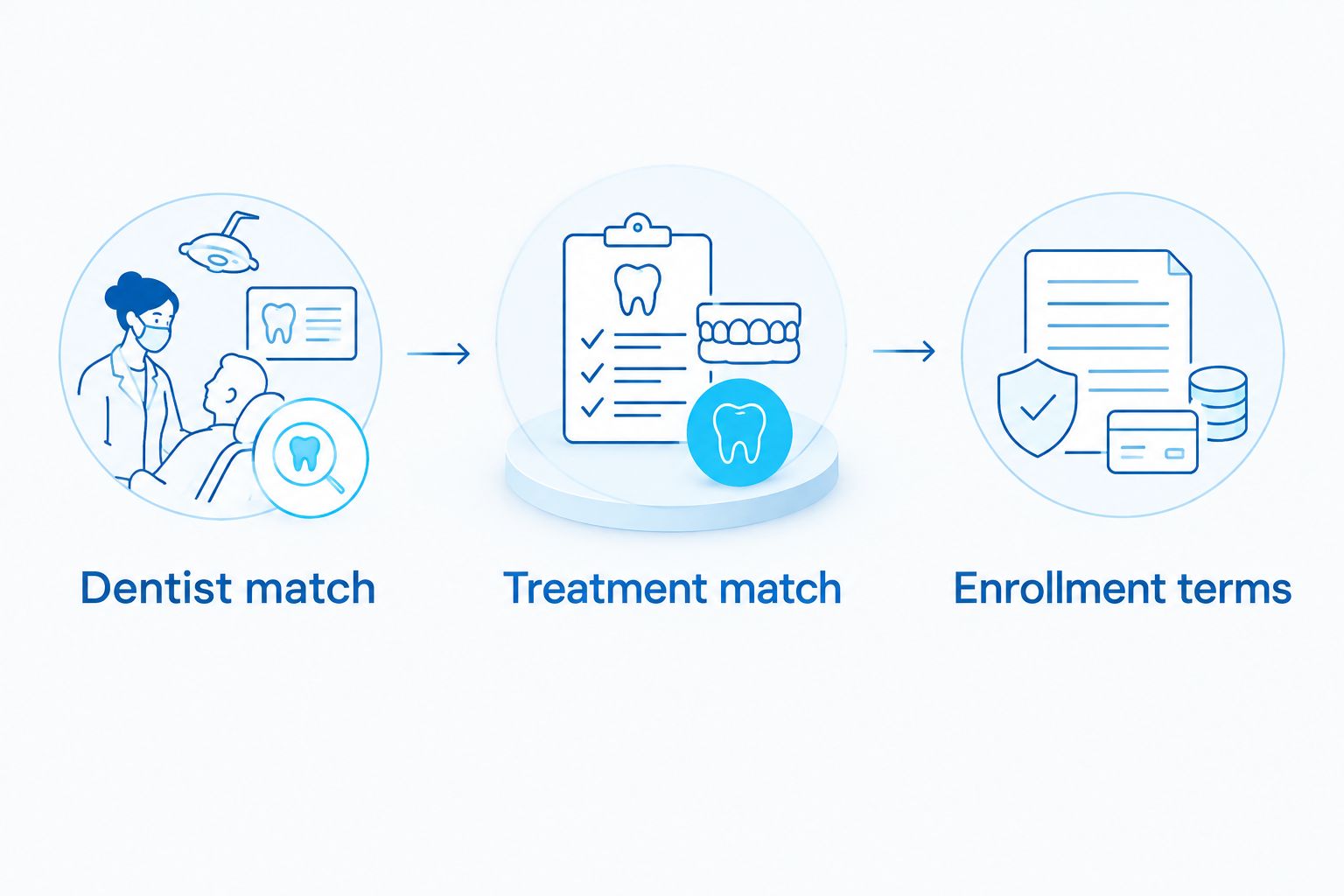
Use 3 checks in this order: dentist match, treatment match, and enrollment terms. Each check answers a different question. Passing one does not answer the others.
Dentist match
Give the office the exact plan name and ask whether the treating dentist participates. Confirm the location too. A directory entry for another office does not settle acceptance at your appointment.
Treatment match
Ask for a written estimate identifying the recommended services and how the plan applies. For complex care, clarify whether the estimate includes separate stages and services. A general statement about implant discounts is not a complete treatment estimate.
Enrollment terms
Read activation, renewal, cancellation, and household eligibility rules. Check when benefits begin and what happens if you change dentists. Save the agreement alongside the office’s estimate.
Confirm the dentist and treatment before reviewing enrollment conditions.
After those checks, use the dental discount card to a booked cleaning workflow to organize the move from a verified arrangement to an appointment. Booking follows confirmation; it does not prove the plan applies.
Ask about your dental care options
Contact the practice for more information about dental care and confirm acceptance with your chosen office.
The order follows practical fit: individual network access, household coordination, continuity with one practice, then a no-membership baseline. The criteria are confirmed participation, treatment match, yearly spending, household eligibility, clear terms, and continuity of care.
This is not a provider performance ranking. An individual plan loses its first-place position for you if your dentist does not accept it. A practice membership becomes the better fit when its documented terms match your care and you intend to stay with that office.
Which dental savings option should you choose?
Start with your dentist and treatment, then select the arrangement. If you are undecided in 2026, compare an individual network plan with direct payment first. Add a family plan when several people need enrollment, or a practice membership when you intend to stay with one office.
Affordable Dentist Near Me is a local dental-care option for families in its listed Texas service cities. For dental discount plans, its suitability depends on the chosen office confirming the exact arrangement—not on a general recommendation.
Do not postpone urgent care while shopping for savings. Trouble breathing or swallowing requires emergency medical attention; tooth pain or swelling needs prompt professional assessment.
FAQ
What’s the best dental discount plan for me in 2026?
The best dental discount plan is one your treating dentist confirms for your recommended care and whose total membership-plus-treatment spending supports enrollment. Compare written terms and equivalent treatment estimates before deciding.
Is a dental savings plan the same as dental insurance?
No, a dental savings plan is not dental insurance. A savings plan provides access to agreed fees at participating dentists, while insurance pays benefits under a policy’s rules.
Can I use a dental discount plan at any dentist?
No, dental discount plans apply through participating providers under their terms. Confirm the exact plan, treating dentist, and office location before enrollment.
Is a family dental savings plan better than an individual plan?
A family dental savings plan is the better fit only when its eligibility rules and participating dentists match your household. Check each person’s anticipated care rather than assuming one member’s benefit applies to everyone.
Do dental discount plans apply to implants and braces?
Application to implants and braces depends on the specific plan and participating provider. Ask for a written estimate identifying which treatment stages and services qualify; do not assume a general discount includes the entire treatment.
Can I combine a dental discount plan with insurance?
Do not assume you can combine a dental discount plan with insurance for the same treatment. Ask the dental office and plan administrator how the arrangements interact before enrolling.
Does Affordable Dentist Near Me accept my dental savings plan?
Confirm your exact plan with the Affordable Dentist Near Me office you intend to visit. The practice’s service locations do not establish acceptance of a particular plan or arrangement.
Should I enroll before scheduling a dental cleaning?
Confirm participation and activation requirements before enrolling for a cleaning. You can ask the office about scheduling while checking the plan, but an appointment confirmation does not establish eligibility for its benefits.
One last thing
A cleaning benefit does not tell you whether all gum treatment qualifies. Routine cleaning and treatment for gum disease are different services. Ask the dentist what you need, then check that service against the agreement; choosing a plan first does not determine the appropriate care.