Dental implants for seniors deliver stable, long-term tooth replacement, and age alone is rarely a barrier. Success rates for older adults are comparable to younger patients. What matters most is overall health, jawbone density, and gum condition. Implant-supported dentures offer a more secure alternative to traditional removable dentures.
Key Takeaways
Age alone is rarely a barrier; success rates for older adults are comparable to younger patients.
Overall health, jawbone density, and gum condition matter far more than chronological age.
Mini dental implants require less bone density and serve as the lowest-cost entry point.
All-on-4 implant dentures use four strategically placed implants to hold a complete arch.
What Are Dental Implants for Seniors?
Dental implants are small titanium posts inserted into the jawbone. These posts act as anchor points for prosthetic teeth. The Best Dental Implants for Seniors function identically to those placed in younger patients, with success rates that remain high regardless of age. Age alone is not a limiting factor for tooth replacement in older patients. Many people in their 70s, 80s, and beyond are ideal candidates for the procedure.
The implant process relies on a biological mechanism called osseointegration. Over time, the titanium post integrates directly with the jawbone. This fusion strengthens the bone itself and creates a firm foundation for new teeth. Without this integration, the implant lacks the stability needed for daily chewing and speaking.
How does the final restoration attach to the implant?
The prosthesis connected to the implant varies by patient need. A single missing tooth typically receives a custom crown. Multiple missing teeth in a row may require an implant-supported bridge. For patients missing most or all teeth, implant-supported dentures provide a secure alternative to removable appliances. The specific recommendation depends on the doctor’s assessment of bone density and oral health.
What makes someone a candidate for implants later in life?
Overall health and jawbone condition matter far more than chronological age. A patient in their 80s with adequate bone volume often qualifies more readily than a younger person with significant bone loss. The titanium post requires sufficient jawbone for initial stability. Patients without enough bone may still qualify after preparatory grafting procedures. Affordable Dentist Near Me in Fort Worth, TX evaluates these factors through diagnostic imaging before recommending treatment.
Which Implant Type Fits Each Senior?
Matching the right implant to a senior’s specific tooth loss pattern determines long-term success and cost efficiency. The best dental implants for seniors vary by how many teeth are missing and the condition of the jawbone.
What is the most affordable implant for a single missing tooth?
Mini dental implants serve as the lowest-cost entry point for replacing one tooth or stabilizing a loose denture. These narrower posts require less bone density, which makes them practical for seniors who have experienced some jawbone resorption over time.
Which option works best when several adjacent teeth are gone?
An implant-supported bridge reduces the cost per tooth when three or more teeth in a row are missing. Instead of placing an implant for every gap, the bridge anchors to two or more implants and spans the empty space. This approach preserves healthy neighboring teeth while restoring chewing function across a wider section of the mouth.
What delivers the lowest cost for a full arch of missing teeth?
Implant-supported dentures using the All-on-4 style provide the lowest cost per replaced tooth for a full arch. Four strategically placed implants hold a complete set of prosthetic teeth. For seniors missing multiple teeth, implant-supported dentures offer a far more stable and comfortable alternative to traditional removable dentures. The fixed prosthesis eliminates slipping and reduces gum irritation that often accompanies conventional dentures.
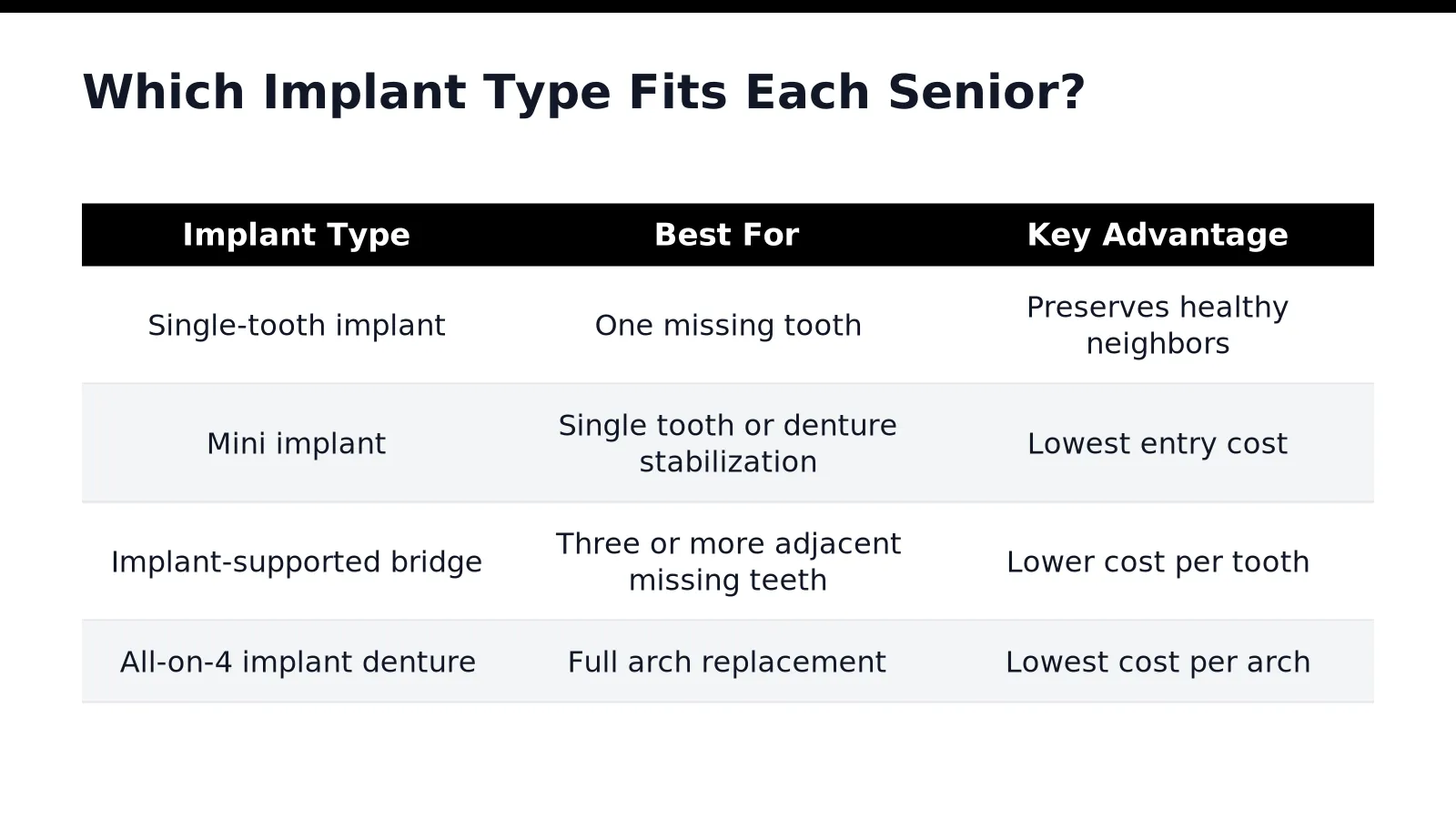
Implant Type
Best For
Key Advantage
Single-tooth implant
One missing tooth
Preserves healthy neighbors
Mini implant
Single tooth or denture stabilization
Lowest entry cost
Implant-supported bridge
Three or more adjacent missing teeth
Lower cost per tooth
All-on-4 implant denture
Full arch replacement
Lowest cost per arch
A single-tooth dental implant wins for replacing one missing tooth long-term without touching healthy neighbors. The titanium post fuses with the jawbone and supports a custom crown that functions like a natural tooth.
Why Does Bone Density Matter After 65?
Jawbone density and gum condition determine implant candidacy far more than chronological age does. Overall health, jawbone density, and gum condition carry the most weight in a clinical evaluation, and age alone is rarely a barrier to treatment.
Bone loss changes the calculus. When a tooth is missing, the jawbone no longer receives the mechanical stimulation that keeps it dense, and the ridge gradually shrinks. A thinner ridge offers less material for a titanium post to grip. That is why a dentist assesses bone volume before recommending a treatment path, and why the Best Dental Implants for Seniors are matched to the individual jaw rather than chosen from a single default option.
How Does Osseointegration Strengthen the Jaw?
Osseointegration is the process by which the implant fuses with living bone over time. This fusion strengthens the bone itself and creates a firm foundation for the new teeth. The result is a stable anchor that supports a crown, a bridge, or an implant-supported denture.
Are Implants Safe for Older Adults?
Modern techniques make implants a safe option for healthy seniors. Success rates for older patients are comparable to those of younger patients, and the treatment ranks as safe, effective, and long-lasting. A single team can handle a case from one missing tooth to a full-arch fixed implant bridge, with the price confirmed in writing before treatment starts.
What Should Seniors Expect During Treatment?
The treatment journey for best dental implants for seniors follows a doctor-directed plan tailored to each patient’s oral health. Specific treatment depends on the doctor’s recommendation, which determines whether the final restoration is a crown, bridge, or implant denture.
How long does the implant process take for older adults?
The timeline varies by case complexity and healing speed. Dental implants are small titanium posts inserted into the jawbone that integrate with the bone over time through a process called osseointegration. This biological fusion creates a firm foundation for the replacement teeth. Healing typically spans several months before the final restoration attaches.
What results can seniors realistically expect?
Dental implants are designed to look natural, feel stable, and function like real teeth. For individuals already wearing dentures or those replacing a few missing teeth, implants revive the smile and improve comfort, confidence, and quality of life. The outcome restores both appearance and practical chewing ability.
The process involves several coordinated steps:
Initial evaluation: A comprehensive exam and imaging assess jawbone density and gum health
Surgical placement: The titanium post is anchored into the jawbone
Healing period: Osseointegration occurs as the bone fuses to the implant surface
Restoration: A custom crown, bridge, or implant denture attaches to the healed post
Each phase moves at the pace the patient’s body requires. The doctor monitors progress throughout and adjusts the timeline when healing demands it.
How Can Caregivers Make Implants Affordable?
Caregivers make dental implants affordable by matching the right implant type to the senior’s specific tooth-loss situation. Dental implants cost less when the implant type fits the clinical need instead of assuming one option works for every mouth. Without this matching step, families overpay for unnecessary complexity or choose a solution that fails early and requires costly revision.
What Implant Type Offers the Lowest Entry Cost?
Mini dental implants provide the lowest-cost entry point for a single tooth or denture stabilization in 2026. For a senior needing only to lock a loose lower denture in place, mini implants avoid the surgical cost and healing time of full-diameter posts. The savings come from shorter appointments and fewer components.
How Does Cost Per Replaced Tooth Change the Decision?
Ranking options by cost efficiency, not just sticker price, reveals which choice actually saves money over time. A single-tooth implant preserves neighboring healthy teeth, eliminating the future expense of bridge repairs. For three or more missing teeth in a row, an implant-supported bridge cuts the cost per tooth compared to placing individual implants. Full-arch solutions like implant-supported dentures deliver the lowest cost per replaced tooth when a senior has lost all teeth in one arch.
Affordable dental implants remain a searched topic nationally, with roughly 6,600 monthly searches for the term. Most of those searches come from people who assume implants are automatically expensive. Comparing options by cost per replaced tooth shifts the conversation from upfront price to long-term value. The Fort Worth office offers full and partial dentures alongside dental implants, so caregivers can compare replacement paths with one team and receive pricing in writing before treatment starts.
FAQ
Which implant type is most affordable for a senior with a single missing tooth?
Mini dental implants serve as the lowest-cost entry point for replacing one tooth. These narrower posts require less bone density, making them practical for seniors with some jawbone resorption.
How do implant-supported dentures differ from traditional removable dentures?
Implant-supported dentures provide a secure alternative to removable appliances. They use strategically placed implants to hold a complete arch, offering more stability than traditional dentures.
Conclusion
The best dental implants for seniors come down to matching the implant type to the individual jaw, not to age. Bone density, gum condition, and overall health drive candidacy, and comparing options by cost per replaced tooth reveals which path delivers lasting value. Caregivers who start with a comprehensive evaluation and written pricing make a confident, informed decision for the senior in their care.