A dental discount plan is cheaper than insurance for cleanings only when its membership fee plus discounted dental bills is lower than your insurance premiums plus out-of-pocket dental bills. Include exams, X-rays, and any gum treatment in that comparison, not just the cleaning. For 2026, compare the same care over the same period before choosing either option.
TL;DR
Dental discount plan vs insurance for cleanings: compare total yearly spending, not the advertised cleaning benefit.
Dental discount plans reduce participating dentists’ fees; they do not pay insurance benefits.
Affordable Dentist Near Me serves families seeking general dental care across its Texas locations.
Is a dental discount plan cheaper than insurance for cleanings?
Neither option is automatically cheaper. A discount plan wins only when its total membership and treatment expenses beat the insurance alternative for the care you need. Start with the services in your appointment; the guide to dental cleaning costs without insurance explains the self-pay side of that comparison.
You still pay the dentist; membership does not provide insurance benefits
Exact office participation, covered services, and the current fee schedule
Dental insurance
Patients whose preventive benefits and broader coverage justify their premiums
The insurer pays benefits for eligible covered care
Premiums, exclusions, and benefit rules affect your actual savings
Network status, cleaning coverage, frequency limits, and patient responsibility
Direct self-pay
Patients whose quoted care costs less than joining or maintaining a plan
No separate plan enrollment needed for the comparison
You pay the agreed dental bill without insurance benefits
A written estimate including associated services
For a fair 2026 comparison, use a 12-month period and the same proposed services for each option. If you already have insurance, separate the question of using existing benefits from the question of buying a new policy. They are different financial decisions.
Why this matters
A reduced cleaning fee does not tell you whether a plan saves money. The membership expense can outweigh the reduction, while insurance premiums can outweigh preventive benefits if you are buying coverage solely for those visits. Count both the plan expense and the dental bill.
The clinical side matters just as much. A routine cleaning and treatment for gum disease are different services, and a benefit description for one does not establish coverage for the other. Ask your dentist what care is appropriate before comparing payment arrangements.
Your goal is not to find the most attractive benefit description. It is to identify the lowest total expense for appropriate care at an office you can actually use.
Dental discount plans: compare membership plus dental bills
A dental discount plan gives members access to negotiated or discounted fees from participating providers. It is not dental insurance. You pay the membership expense and remain responsible for the dentist’s applicable charges.
Best for: You have confirmed that your chosen office participates, obtained its applicable fees, and calculated savings that exceed the membership expense. The strongest reason to choose a discount plan is a verified total, not a discount percentage on an advertisement.
The advantage is that you can compare a participating dentist’s fee schedule with a direct self-pay estimate. The drawback is that the plan does not transfer your treatment bill to an insurer. A lower fee still leaves a bill to pay.
Before enrolling in 2026, ask whether the quoted membership applies to you alone or includes the family members who need care. Check the effective date, renewal terms, and cancellation conditions. Do not assume that every service or every office associated with a practice participates.
Also distinguish a discount plan from an office membership arrangement. Both can involve enrollment expenses, but their terms are not interchangeable. Read the actual agreement rather than applying another plan’s rules to it.
Dental insurance: compare premiums plus patient responsibility
Dental insurance pays benefits according to the policy’s terms. Your total spending includes the premiums you pay and your responsibility for dental services after those terms are applied. A covered cleaning is not necessarily the same as an appointment with no patient bill.
Best for: Your verified preventive benefits and other expected covered care justify the premiums you personally pay. Employer contributions matter because the employee’s expense can differ from the policy’s full premium.
The advantage is insurance benefits for eligible care, potentially beyond cleanings. The drawback is that network rules, exclusions, frequency limits, deductibles, and other policy provisions affect what the insurer pays. Check which provisions apply specifically to preventive care rather than assuming all services follow the same rules.
If you already have coverage in 2026, ask the office to verify your remaining cleaning benefits before you buy a discount membership. An unused covered benefit changes the comparison. It does not prove that another plan is unnecessary for every situation, but it belongs in your calculation.
An estimate of benefits is not a promise that every charge will be paid. Confirm the proposed services, the provider’s network status, and your expected responsibility with both the office and the insurer.
Direct self-pay: establish the baseline
A direct self-pay estimate gives you a baseline against which to judge both plans. Ask for the full proposed appointment, not an isolated cleaning line. Otherwise, you risk comparing one option’s complete visit with another option’s incomplete quote.
Best for: Your written self-pay total is lower than the membership or premium expense plus the remaining dental bills. This is a calculation, not a general recommendation to go without insurance.
The advantage is avoiding a separate plan expense for that comparison. The drawback is paying the agreed bill without insurance benefits and without establishing coverage for future treatment. A favorable cleaning estimate does not answer what you would spend if your care needs change.
Keep direct self-pay in the comparison even when you expect to choose a plan. It shows whether enrollment creates a real saving for the services under discussion.
Why the cheaper option varies
These factors change the result of a dental discount plan versus insurance comparison:
Enrollment expense: Include the membership fee or the premiums you personally pay over the full comparison period.
Dentist participation: A discount schedule is useful only at a participating office; insurance network status affects applicable benefits and charges.
Cleaning type: Compare the actual recommended procedure, not a routine cleaning benefit if you need gum treatment.
Associated services: Exams and X-rays can have separate charges and separate benefit rules.
Benefit limits: Check covered cleaning frequency, eligibility dates, and any relevant policy restrictions.
Household needs: Include the people enrolled and their expected care rather than judging a family arrangement by one person’s cleaning.
These are reasons to request written information, not reasons to postpone care. If your gums bleed, your teeth hurt, or you have other symptoms, arrange an evaluation while you clarify the payment details.
How do you compare the plans before enrolling?
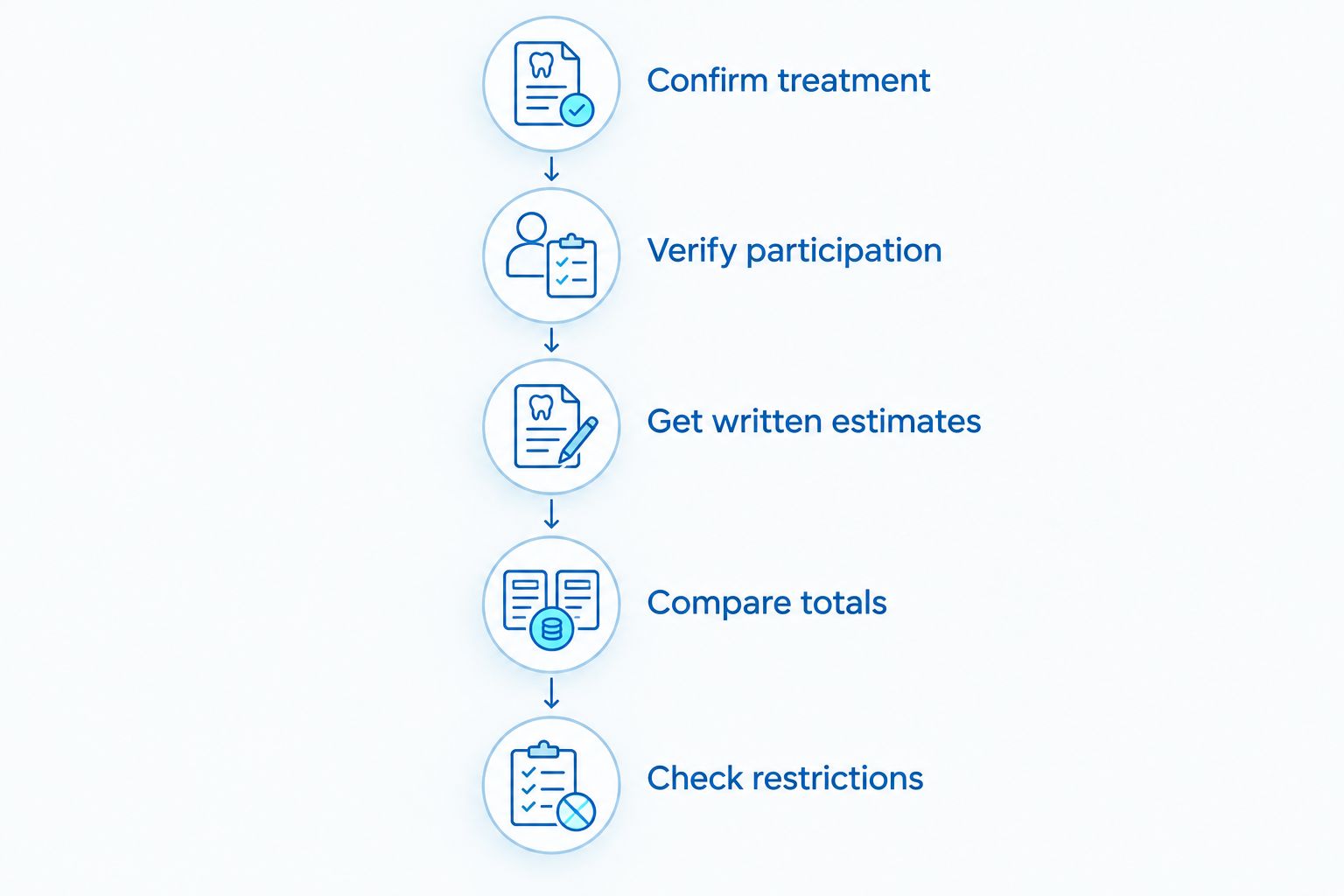
Use this sequence to turn benefit descriptions into a decision. Request 2 plan-specific quotes—one using the discount arrangement and one using insurance—for the same proposed care. Keep a direct self-pay estimate as the baseline.
Confirm treatment. Ask whether the dentist recommends a routine cleaning, gum treatment, or a different service. Obtain 1 written treatment plan identifying the proposed care.
Verify participation. Confirm the exact office and treating provider with the discount plan or insurer. A provider listing alone is not enough to resolve conflicting information.
Get written estimates. Ask the office to include the cleaning, exam, X-rays if recommended, and other planned services. Request the expected patient responsibility under each arrangement.
Compare totals. Add enrollment expenses to the dental bills you expect to pay during the same period. Keep unrelated services out of a cleaning-only comparison.
Check restrictions. Read effective dates, renewal terms, cleaning limits, and cancellation rules before enrolling or changing coverage.
The most useful estimate names the services and explains what is included. A verbal assurance that a plan offers savings is not enough to compare it with insurance.
Confirm the treatment before comparing how each arrangement pays for it.
Keep the estimates together with the plan documents. If the service changes after your examination, ask for an updated comparison rather than relying on the original routine-cleaning quote.
What should you ask the dental office?
Ask direct questions that produce usable answers. Begin with the appointment itself, then move to plan participation and payment responsibility.
Is the estimate for a routine cleaning or treatment for gum disease?
Does it include the examination and any recommended X-rays?
Does this exact office participate in the discount plan or insurance network?
What is my expected responsibility for each proposed service?
Which benefits have already been used during the applicable benefit period?
What changes if the dentist recommends different care after the examination?
Affordable Dentist Near Me is a dental-care option for families in Fort Worth, Dallas, Houston, Waco, Grand Prairie, and Crowley seeking general, cosmetic, or restorative services. Confirm payment arrangements with the specific office; the practice’s service range does not establish participation in a particular plan.
You can start with Affordable Dentist Near Me to discuss your general dental-care needs. Ask for an appointment estimate and plan verification rather than assuming the office accepts a membership card or insurance policy.
Ask about your cleaning appointment
Discuss the proposed services and confirm payment arrangements with the office.
Existing insurance deserves the first check because buying another arrangement adds an enrollment expense. Ask what your current policy pays for the proposed cleaning and whether benefits remain available. Then compare that responsibility with the discount plan’s full expense.
Do not cancel coverage solely because another arrangement offers a lower cleaning fee. Insurance can address other covered services, while a discount plan reduces participating providers’ charges without paying insurance benefits. Compare those roles before making a broader coverage decision.
Is a discount plan better if you only need cleanings?
A discount plan is better for cleanings only when verified savings exceed its enrollment expense and beat the available alternatives. A preventive-only comparison should include the recommended appointments and related services, not treatment you do not currently need.
Recheck the calculation when your care changes. If an examination identifies gum disease or another problem, your original cleaning-only comparison no longer describes the proposed treatment.
Does deep cleaning count as a regular cleaning?
Treatment for gum disease is not interchangeable with a routine preventive cleaning. Ask the dentist to name the recommended service and explain why it is needed in plain language. Then check that specific service against the policy or discount schedule.
For your 2026 decision, keep separate estimates for routine preventive care and gum treatment. Do not select a plan based on a routine-cleaning benefit and assume it answers the cost of treating gum disease.
FAQ
Is a dental discount plan always cheaper than insurance for cleanings?
No. A dental discount plan is cheaper only when membership expenses plus discounted dental bills are lower than insurance premiums plus your remaining dental bills for the same care.
Do dental discount plans pay for my cleaning?
Dental discount plans do not pay insurance benefits for your cleaning. You pay the participating dentist’s applicable fee, along with the plan’s membership expense.
Does dental insurance cover the whole cleaning appointment?
Coverage for the whole appointment depends on your policy and the services performed. Verify the cleaning, examination, and any recommended X-rays separately, including network status and benefit limits.
Can I use dental insurance and a discount plan together?
Do not assume that insurance and a discount plan can be combined on the same service. Ask the office and both plan administrators which arrangement applies and whether combining them is permitted.
Should I buy a discount plan if I already have dental insurance?
Check your existing insurance benefits before buying a discount plan. Compare the additional membership expense with the savings available for care your current policy does not fully address.
What if my dentist recommends a deep cleaning?
Compare coverage and fees for the specific gum treatment recommended, not for a routine cleaning. Ask for an updated written estimate that identifies the services and your expected responsibility.
Can Affordable Dentist Near Me help me compare payment arrangements?
Contact the specific Affordable Dentist Near Me office to ask about your proposed care and payment arrangements. Confirm plan participation and request an estimate rather than assuming a particular policy or discount membership applies.
One last thing
Compare the bill for the appointment, not the benefit for the cleaning. A cleaning benefit can look favorable while the examination, X-rays, or different recommended treatment change the total you owe.
Before enrolling for 2026, get the services and payment assumptions in writing. That document is more useful than a headline discount because it connects your actual dental needs to the arrangement you are choosing.