Your toothache needs urgent dental care if it is severe, keeps you from sleeping, follows an injury, or comes with swelling, fever, or a bad taste from drainage. Trouble breathing or swallowing, rapidly spreading face or neck swelling, or bleeding that will not stop requires emergency medical care—not a wait for a dental appointment.
TL;DR
Is my toothache a dental emergency? Severe pain, swelling, fever, or injury calls for urgent dental assessment.
Trouble breathing or swallowing with dental swelling requires emergency medical care now.
Affordable Dentist Near Me serves Texas families seeking general and restorative dental care; emergency arrangements require confirmation.
Pain relief does not repair a damaged tooth or remove the source of a dental infection.
Why this matters
A toothache's urgency depends on the symptoms around it, not just how much it hurts. A mild ache with spreading swelling deserves more immediate attention than brief cold sensitivity without swelling.
For your 2026 care decisions, separate two questions: do you need a hospital now, and how quickly do you need a dentist? If you need help arranging dental care, read about same-day assessment for a toothache, then confirm arrangements directly with the office.
How do you know if a toothache is a dental emergency?
Check breathing, swallowing, swelling, bleeding, injury, and your ability to function before judging the pain alone. You cannot reliably identify the cause by looking at the tooth yourself. A dental examination, sometimes with X-rays, determines whether the problem involves decay, a crack, the gums, or an infection.
Use this 2026 symptom guide to choose your next step. It supports triage, not a diagnosis.
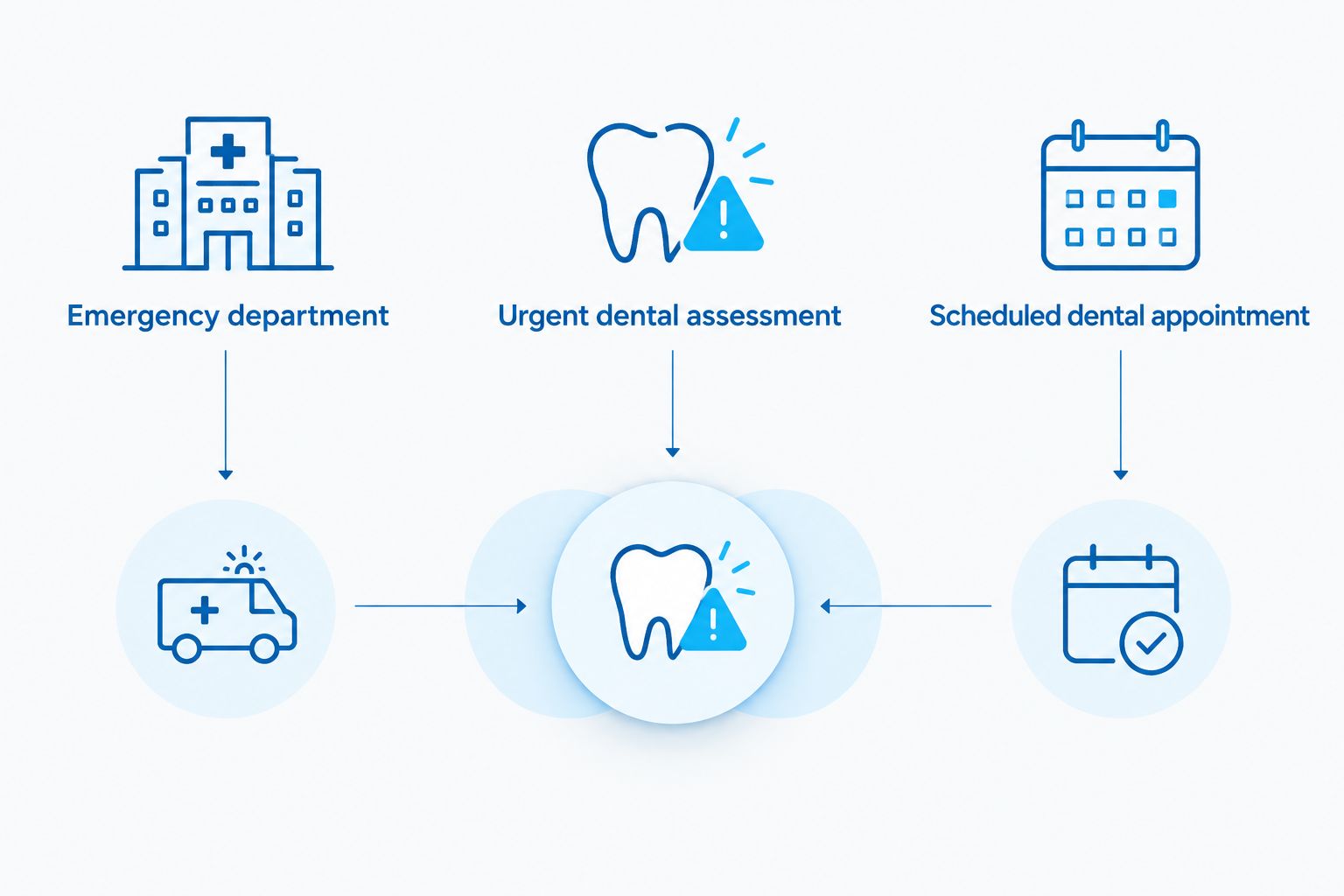
Care route
Best for
What it provides
Important limitation
Emergency department
Breathing or swallowing trouble, spreading neck swelling, serious facial injury, or uncontrolled bleeding
Assessment and treatment of dangerous medical complications
Follow-up dental treatment is often still necessary
Urgent dental assessment
Severe or worsening tooth pain, localized swelling, suspected infection, or a damaged tooth
Examination and treatment planning for the dental cause
Call ahead; an urgent request does not establish an appointment
Scheduled dental appointment
Brief sensitivity or mild discomfort without warning signs
Assessment before a smaller problem progresses
New swelling, fever, or worsening pain changes the urgency
Tell the person answering the phone about warning signs before discussing scheduling or payment. Say whether you can swallow normally, whether your face is swelling, and whether the pain started after an injury.
Choose the care setting from your symptoms, not from pain intensity alone.
When should you go to the emergency department?
Seek emergency medical care now if dental symptoms interfere with breathing or swallowing. Do not wait for a dental office to return your message. Call 911 if you are struggling to breathe or cannot travel safely.
Other warning signs include:
Swelling that spreads into the neck or the area around an eye.
Rapidly increasing facial swelling, especially with fever or feeling very ill.
Difficulty opening your mouth together with significant swelling or trouble swallowing.
Heavy bleeding that continues despite firm pressure with clean gauze.
A major facial injury, suspected broken jaw, or head-injury symptoms.
An emergency department addresses threats to your airway, serious infection, bleeding, and trauma. It is not a substitute for repairing the tooth afterward. Once the immediate danger is treated, follow the discharge instructions and arrange the recommended dental follow-up.
When should you call a dentist urgently?
Call a dentist promptly for pain that disrupts sleep, prevents normal eating, keeps returning, or does not settle with appropriate nonprescription pain relief. Localized gum or facial swelling, pus, a bad taste, or fever also needs urgent assessment.
A fever of 100.4°F or higher is a useful detail to report, but it is not a requirement for a serious dental infection. Do not wait for a temperature reading if swelling is spreading or you have trouble swallowing.
Urgent dental problems also include a broken tooth with pain, a loose adult tooth after trauma, or a lost filling or crown that leaves substantial pain or a sharp edge. A knocked-out adult tooth needs immediate dental attention even if the pain is limited.
Describe what you can no longer do: sleep, chew, open your mouth, or drink comfortably. Those details help the dental team judge urgency more clearly than calling the pain simply unbearable.
Can a mild toothache wait for an appointment?
Brief sensitivity that stops when the trigger is removed is generally less urgent than spontaneous, lingering, or worsening pain. You still need a dental assessment if it keeps happening. Sensitivity alone does not reveal whether the cause is exposed root surface, decay, a crack, or another problem.
The NHS toothache guidance advises seeing a dentist for pain lasting more than 2 days, or sooner when other warning signs occur. That is not permission to wait through swelling, fever, injury, or severe pain.
While arranging care, avoid the food or drink that triggers discomfort and keep the area clean. If your symptoms change, call again and describe the change rather than keeping the original appointment without an update.
Why toothache urgency varies
These factors explain why two people with similar pain need different next steps:
Spread of swelling: Swelling confined to the gum differs from swelling extending toward the eye, neck, or airway.
Whole-body symptoms: Fever, marked weakness, or feeling seriously unwell adds concern about infection beyond the tooth.
Loss of function: Trouble swallowing, breathing, opening your mouth, or eating changes the urgency.
Recent injury: Trauma can damage a tooth or its supporting structures even when little damage is visible.
Symptom pattern: Pain that lingers, wakes you, or worsens needs a different assessment from a brief response to cold.
Medical history: A weakened immune system or poorly controlled diabetes warrants particular attention when infection is suspected.
Tell the dental team about pregnancy, medical conditions, allergies, and medicines. Do not stop prescribed medicines on your own, including blood thinners, before getting professional advice.
What should you do while waiting for dental care?
Temporary care can make you more comfortable, but home care does not repair a tooth or cure an abscess. Use these steps while arranging the appropriate appointment, not instead of arranging it.
Check warning signs. Reassess breathing, swallowing, swelling, fever, and bleeding. Escalate to emergency medical care when dangerous symptoms appear.
Clean gently. Brush carefully and gently floss if food appears trapped between teeth. Do not dig into the gum with a sharp object.
Reduce irritation. Choose soft foods, chew away from the painful area, and avoid very hot, cold, or sugary foods if they trigger pain.
Use medicines safely. Follow the package directions for any nonprescription pain reliever. Ask a pharmacist if you have medical conditions, are pregnant, or take other medicines.
Prepare your history. Write down when symptoms started, what makes them worse, and which medicines you have taken.
Never place aspirin directly against a tooth or gum; it can burn the tissue. Do not puncture a swelling, use household glue on a tooth, or take leftover antibiotics.
For medication questions in 2026, use the current package label and advice from a pharmacist or clinician. Do not combine products without checking their active ingredients, because different products can contain the same medicine.
Will antibiotics fix a tooth infection?
Antibiotics alone do not remove the source of most tooth-related infections. Depending on the examination, treatment can involve drainage, root canal treatment, or removal of a tooth that cannot be saved.
American Dental Association guidance prioritizes dental treatment rather than antibiotics for most localized tooth pain and swelling in adults with a normal immune system. A clinician decides whether antibiotics are needed when infection spreads, causes whole-body symptoms, or involves other clinical concerns.
For your 2026 appointment, report any antibiotic you have already taken and whether symptoms improved or worsened. Never use someone else's prescription. Temporary improvement does not confirm that the underlying dental problem is resolved.
Does severe tooth pain mean you need an extraction?
Severe tooth pain does not automatically mean the tooth must be removed. The dentist assesses how much tooth remains, whether there is a crack, the condition of the supporting bone and gums, and whether treatment can predictably preserve it.
Ask the dentist to explain the diagnosis, the tooth-saving option if one exists, and the consequences of delaying treatment. Extraction removes a tooth, while root canal treatment aims to retain it; each has different treatment and follow-up needs.
Do not select a procedure from symptoms alone. Pain intensity cannot tell you whether a filling, root canal, gum treatment, or extraction is appropriate.
How do you arrange care without losing time?
Start the call with your symptoms, not a request for a specific procedure. Explain when the pain began, whether swelling is spreading, and whether you can breathe, swallow, and eat normally. Ask where to go if the office cannot assess you promptly.
Affordable Dentist Near Me is a general and restorative dental care option for families in Fort Worth, Dallas, Houston, Waco, Grand Prairie, and Crowley. The practice provides dental services, but that does not establish an emergency appointment or replace hospital care for dangerous symptoms.
Contact Affordable Dentist Near Me to ask about assessment arrangements. Confirm the location, appointment details, and what the initial examination includes before traveling.
If you are worried about payment, ask for a written treatment plan and an explanation of what needs immediate attention versus later care. Do not postpone emergency medical care for breathing trouble or spreading swelling while comparing dental payment arrangements.
FAQ
Is my toothache a dental emergency if there is no swelling?
A toothache can need urgent dental assessment without swelling, especially if severe pain prevents sleep or eating, follows an injury, or keeps worsening. Lack of visible swelling does not rule out a significant dental problem.
Can I wait until morning with a toothache?
Do not wait until morning if you have trouble breathing or swallowing, spreading face or neck swelling, uncontrolled bleeding, or a serious injury. For tooth pain without those warning signs, contact the dental office’s after-hours service for instructions.
Should I go to the emergency room or an emergency dentist?
Go to the emergency room for breathing or swallowing trouble, dangerous swelling, serious trauma, or uncontrolled bleeding. An urgent dental assessment addresses severe tooth pain and the underlying tooth problem when those medical warning signs are absent.
Is a toothache with a fever an emergency?
A toothache with fever needs urgent assessment, particularly when swelling or feeling seriously unwell is present. A temperature of 100.4°F or higher is useful to report, but a lower temperature does not rule out a serious infection.
Can a tooth infection go away on its own?
A dental abscess needs professional treatment and should not be left to resolve on its own. Drainage or reduced pain does not prove the infection’s source has been removed.
What if my toothache suddenly stops hurting?
A toothache that suddenly stops still needs assessment if it was severe, persistent, or accompanied by swelling. Pain can decrease after drainage or damage to the nerve inside the tooth without the underlying problem being fixed.
Can Affordable Dentist Near Me help with a painful tooth?
Affordable Dentist Near Me provides general and restorative dental care for families in its listed Texas communities. Contact the office to confirm assessment arrangements; seek emergency medical care instead for breathing trouble or other dangerous warning signs.
One last thing
Less pain does not always mean a healthier tooth. If severe pain suddenly disappears but swelling, drainage, or a bad taste remains, keep seeking care rather than canceling the appointment.
Save a short symptom history on your phone for your 2026 dental visit. The most useful details are when the pain started, whether it wakes you, what triggers it, and whether swelling has changed.