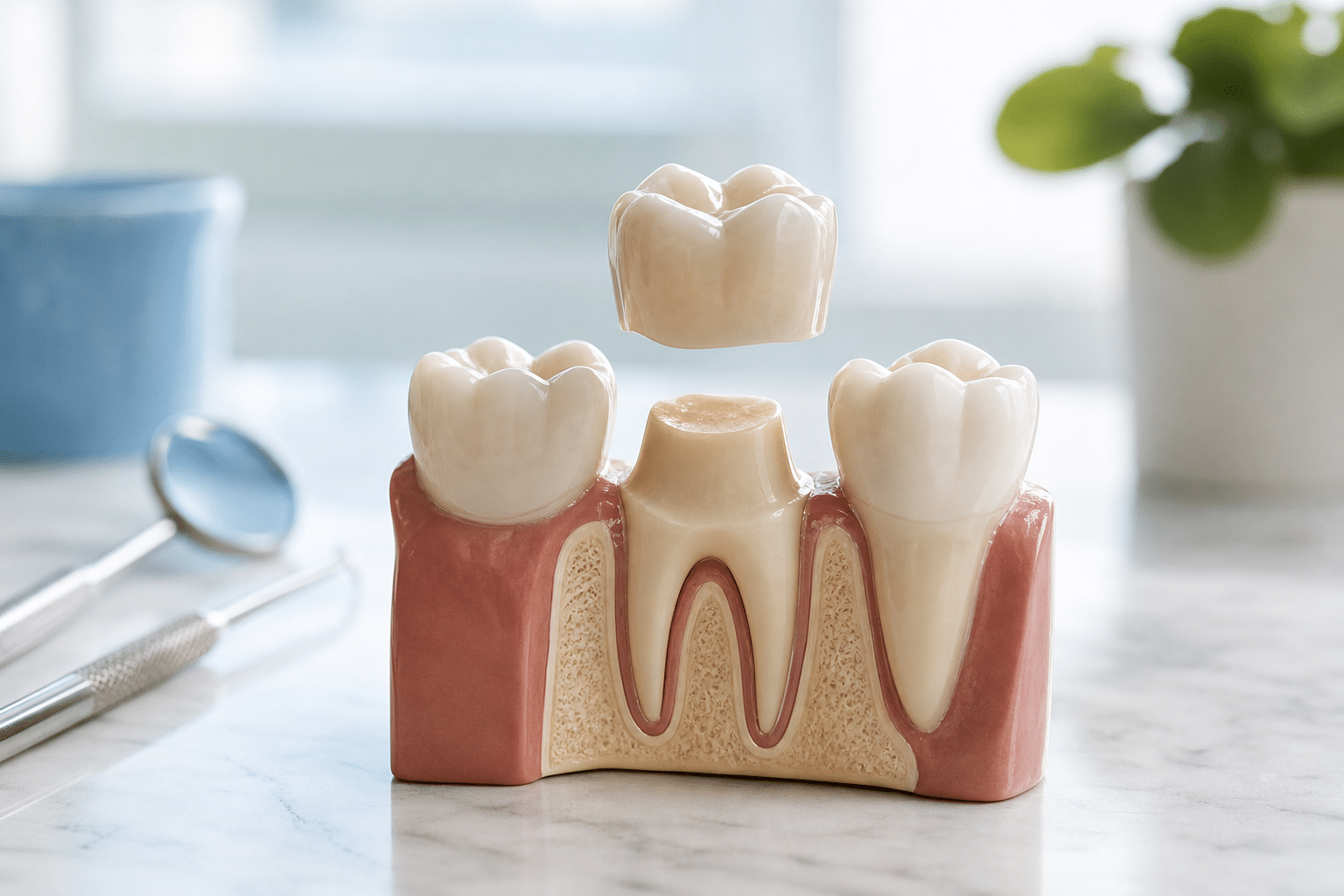
A crown in dentistry is a tooth-shaped cap cemented over a damaged or weakened tooth to restore its shape, strength, and function. Crowns are used after root canals, for cracked or heavily decayed teeth, and to anchor bridges. Made from metal, porcelain, zirconia, or resin, a crown typically lasts 10 to 20 years with proper care. If you are facing a crown recommendation, this guide walks through what type of crown fits your tooth, what the procedure involves, how long a crown lasts, and whether a crown is the right choice for your situation.
What Is a Crown in Dentistry?
A dental crown is a cap that fits over the entire visible portion of a tooth, from the gumline up. It replaces the outer surface completely. That is what sets it apart from a filling, which repairs only a section of a tooth.
If you want to see how crowns compare to other restorations side by side, the guide to tooth replacement options compared covers the full picture.
Once cemented in place, you chew on it, brush it, and floss around it the same way you would any other tooth.
When Do You Need a Dental Crown?
A crown becomes necessary when a tooth is too damaged for a filling to hold. Fillings work well for small to moderate decay, but once a tooth loses enough structure, a filling cannot support the load of chewing. A crown wraps around what remains and holds it together.
Your dentist may recommend a crown in any of these situations:
- Severe decay. When a cavity has destroyed too much of the tooth for a filling to restore it reliably, a crown covers and protects what is left.
- A cracked or fractured tooth. A crack that runs deep into the tooth can spread with every bite. A crown holds the pieces together and stops the crack from worsening.
- A broken cusp. If a large chunk of the tooth has broken off, a crown rebuilds the missing structure and restores the bite.
- After a root canal. A root canal removes the pulp from inside the tooth, which leaves the remaining structure brittle. A crown placed over the treated tooth protects it from cracking under normal chewing forces. This is why a crown and a root canal are not competing options: the root canal treats the infection inside the tooth, and the crown protects the outside afterward.
- A dental implant restoration. When a tooth is replaced with a dental implant, the implant post sits in the jawbone and an implant crown is attached on top. The crown is the visible, functional part of the restoration.
- An existing large filling that is failing. Old fillings can crack or allow new decay to form around them. If the remaining tooth structure is too thin to support another filling, a crown is the more stable long-term option.
If you are noticing pain when you bite, visible cracks, or a filling that feels loose, the article on Signs That You Need A Dental Crown lists the specific warning signs worth watching for.
What Are the Different Types of Dental Crowns?
Crown material affects strength, appearance, and how much natural tooth your dentist needs to remove. The right choice depends on which tooth is being crowned, how visible it is when you smile, and how much biting force it handles daily.
| Crown Type |
Strength |
Appearance |
Best For |
| Metal (gold or base alloy) |
Highest |
Metallic, very visible |
Back molars where strength matters most |
| Porcelain-fused-to-metal (PFM) |
High |
Natural-looking with a possible dark line at the gum |
Back teeth, some front teeth |
| All-porcelain (ceramic) |
Moderate |
Most natural-looking, matches tooth color closely |
Front teeth where aesthetics are the priority |
| Zirconia |
Very high |
Natural-looking, no metal |
Front or back teeth; a strong all-around option |
| Resin (composite) |
Lower |
Tooth-colored but less durable |
Temporary crowns or lower-cost short-term solutions |
Metal crowns require the least removal of natural tooth structure and rarely chip or break. Their obvious drawback is appearance, so most patients reserve them for second molars that are rarely visible.
Porcelain-fused-to-metal crowns give you a tooth-colored surface with a metal core for strength. Over time, the gum can recede slightly and reveal a thin dark line at the base of the crown where the metal meets the porcelain.
All-porcelain crowns blend most naturally with surrounding teeth and contain no metal, which makes them a good option for patients with metal sensitivities. They can chip under heavy biting force, so placement matters.
Zirconia crowns have become a widely used option because they combine the natural look of ceramic with strength that rivals metal. A zirconia crown handles molar-level chewing forces while still looking like a natural tooth, which is why many dentists now recommend it for both front and back teeth.
Resin crowns cost less but wear down faster and are more prone to fracture. They are most often used as temporaries while a permanent crown is being made.
Your dentist can help you weigh the material trade-offs for your specific tooth and budget.
How Is a Dental Crown Procedure Done, Step by Step?
A standard crown takes two appointments, though some offices use in-office milling technology to complete the crown in a single visit. According to the University of Bristol Dental School, each appointment can run up to 3 hours, and the lab fabrication between visits typically takes 2 to 4 weeks. Knowing what happens at each stage makes the process far less intimidating.
Here is what to expect from start to finish:
-
Numb the area. Your dentist injects local anaesthetic around the tooth and the surrounding gum. You may feel pressure during the procedure, but you should not feel pain. If you do, tell your dentist immediately so they can add more anaesthetic [S1].
-
Prepare the tooth. The dentist reshapes the tooth by filing down the outer surface on all sides and the top. This creates room for the crown to sit over the tooth without making your bite feel too high. How much tooth is removed depends on the crown material: metal crowns require less removal, while porcelain and zirconia crowns need a bit more space.
-
Take an impression or digital scan. Once the tooth is shaped, your dentist captures its exact dimensions. Traditional impressions use a putty-like material; digital scans use a small wand that maps the tooth in seconds. That record goes to a dental lab, or in same-day cases, directly to an in-office milling machine [S2].
-
Place a temporary crown. A temporary crown made from resin is cemented over the prepared tooth to protect it while the permanent crown is being made. Temporary crowns are not as strong as permanent ones, so avoid chewing hard or sticky foods on that side. You can find specific guidance on keeping a crown clean and protected in the Oral Hygiene Tips for Artificial Crowns resource [S3].
-
Return for the permanent crown. At the second visit, the temporary crown comes off and your dentist checks the fit, color match, and how the crown meets the opposing teeth when you bite down [S4].
-
Cement the crown in place. Once the fit is confirmed, the dentist bonds the permanent crown using dental cement or adhesive. After it sets, the crown functions like a natural tooth [S5].
If you are curious about how long the full timeline runs from first appointment to final placement, the article on How Long Does it Take to Get a Dental Crown? breaks it down in more detail.
How Long Does a Dental Crown Last?
Most dental crowns last at least 5 years and can last 15 to 20 years with consistent care. A retrospective study found cumulative survival rates of 89.9% at 5 years and 80.9% at 10 years, according to a 2022 report in the European Journal of Oral Sciences. The Canadian Dental Association puts the benchmark at 10 years or longer when good oral hygiene is maintained.
Several factors influence where your crown falls on that range. Back molars absorb far more force than front teeth, which puts more stress on the crown over time. Whether the underlying tooth still has a living nerve and blood supply also plays a role. A crown over a root-canal-treated tooth sits on a non-vital abutment, which the same 2022 study identified as a factor that increases failure risk.
Bruxism, the habit of grinding or clenching your teeth, is one of the most common reasons crowns fail early. A custom night guard can protect the crown and extend its life significantly if you grind at night. Consistent brushing, flossing around the crown margin, and keeping up with regular checkups all contribute to a longer-lasting restoration. Tips on Do You Want Your Dental Crown to Last Longer? Follow These Tips covers those habits in practical detail.
What Are the Disadvantages of Dental Crowns?
Crowns are effective, but they come with real trade-offs worth understanding before you commit.
- Irreversible tooth reduction. Preparing a tooth for a crown means removing enamel permanently. That tooth will always need a crown or some form of coverage going forward. This is the most significant downside for otherwise healthy teeth.
- Sensitivity after placement. It is common to feel temperature sensitivity for a few weeks after a crown is placed, especially to cold. This usually fades as the tooth settles, but it can persist if the crown sits too high on the bite.
- Risk of failure over time. No crown lasts forever. The 2022 European Journal of Oral Sciences study found that survival rates drop noticeably by the 10-year mark. Anterior teeth, non-vital abutments, and bruxism all raise that risk meaningfully.
- Possible need for a root canal later. In some cases, the tooth preparation process irritates the nerve enough that a root canal becomes necessary after the crown is placed. This is not common, but it is a known possibility.
- Cost. Crowns cost more than fillings. The exact amount varies by material, location, and insurance coverage, but the investment is real. Metal and resin options tend to be less expensive; zirconia and all-porcelain crowns generally sit at the higher end.
- Fit issues or loosening. A crown can loosen if the cement breaks down over time or if the fit was not precise. A loose crown needs prompt attention to prevent decay from forming underneath it.
Weigh these trade-offs against the alternative. A tooth that needs a crown but does not get one often deteriorates further, which can lead to extraction and a more complex, more expensive replacement later.
Dental Crown vs Veneer: Which One Do You Actually Need?
Crowns and veneers both improve the look of a tooth, but they serve different purposes and involve very different amounts of tooth reduction.
A veneer is a thin shell, usually porcelain, that covers only the front surface of a tooth. It requires removing a small amount of enamel from the front face, but the back and sides stay intact. Veneers work well for cosmetic concerns: staining that does not respond to whitening, minor chips, slight gaps, or teeth that are slightly uneven in size. The tooth underneath needs to be structurally sound. If the tooth is healthy and the problem is purely cosmetic, a veneer is the less invasive option.
A crown covers the entire tooth. That level of coverage is necessary when the tooth has lost significant structure, has a deep crack, or needs protection after a root canal. Choosing a veneer for a structurally compromised tooth would leave the damaged areas exposed and unprotected.
The decision usually comes down to one question: is the tooth damaged or just discolored? If the tooth is intact and you want to change its appearance, a veneer may be appropriate. If the tooth has decay, cracks, or missing structure, a crown is the right call. For a closer look at the veneer side of that comparison, the article on What are the Pros and Cons of Dental Veneers? covers the trade-offs in detail. Your dentist can examine the tooth and tell you which option actually fits your situation.
Where Can You Get a Dental Crown in Texas?
If you are in Texas and ready to move forward, you can find a local dentist near you who can examine the tooth and give you a written treatment plan with exact fees.
FAQs
Is a dental crown the same as a cap?
Yes. "Crown" and "cap" describe the same restoration. "Cap" is older, informal language that patients and some dentists still use, while "crown" is the current clinical term. Both refer to a tooth-shaped cover cemented over the entire visible portion of a damaged tooth, from the gumline up.
Do dental crowns hurt to get?
The procedure itself should not be painful. Your dentist numbs the tooth and surrounding area with local anaesthetic before any preparation begins. You may feel pressure or vibration, but not sharp pain. Some sensitivity and mild soreness around the gum is normal for a few days after the appointment and typically fades on its own.
Can a crown be placed the same day?
Some dental offices use in-office CAD/CAM milling technology to design and fabricate a crown in a single visit, skipping the temporary crown stage entirely. Whether same-day crowns are available depends on the specific office and equipment. Ask your dentist at the consultation whether that option is offered for your tooth.
How much does a dental crown typically cost?
Crown costs vary based on material, the tooth being treated, your location, and your insurance coverage. Metal and resin crowns tend to sit at the lower end of the range, while zirconia and all-porcelain options generally cost more. Dental insurance often covers a portion of the cost when a crown is medically necessary. Ask your dentist for a written treatment plan with exact fees before any work begins so you can plan accurately.
How do I care for a dental crown after it is placed?
Brush twice a day and floss carefully around the crown margin where the crown meets the gum. Avoid chewing hard or sticky foods on a temporary crown. Once the permanent crown is in place, treat it like a natural tooth, but keep close attention on that gumline. Routine checkups let your dentist catch any loosening or wear early.
Can a crowned tooth still get a cavity?
The crown itself cannot decay, but the natural tooth structure beneath it can. Decay most often starts at the margin, the edge where the crown meets the tooth near the gumline. Consistent brushing, flossing, and regular cleanings are the best defense. If a cavity forms under a crown, the crown may need to be removed to treat it, so prevention matters.
Conclusion
A dental crown is a reliable way to save a tooth that is too damaged for a filling. It restores the tooth's shape, protects it from further breakdown, and lets you chew normally again. Most crowns last 10 to 20 years with consistent care, though placement site, tooth vitality, and habits like grinding all affect how long yours will hold up.
Before your next appointment, know which crown material fits your tooth and budget, and whether a crown is the right option compared to alternatives like a veneer. Bring those questions to your dentist, ask for a written treatment plan with exact fees, and confirm whether your insurance covers any portion of the cost. That conversation is the most useful next step you can take.