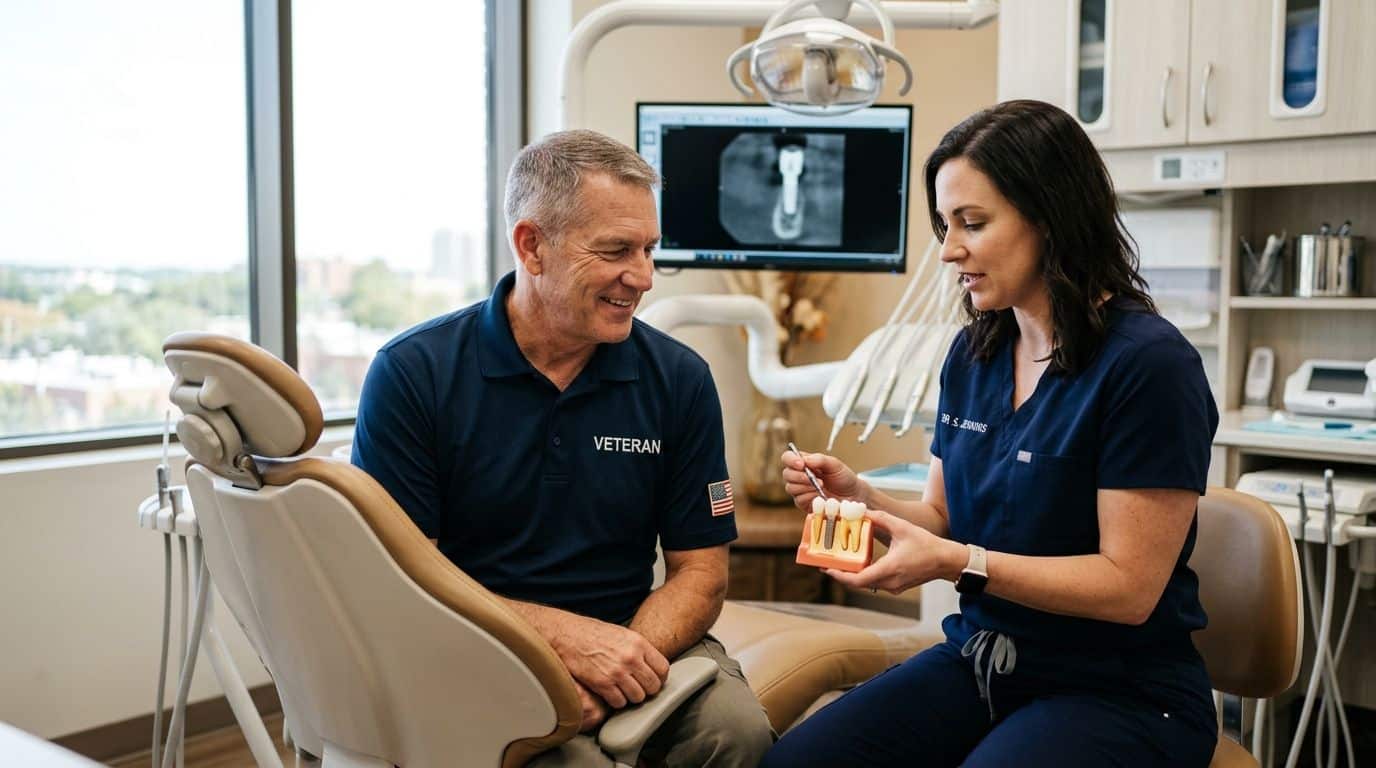
Veterans have more paths to affordable dental implants in 2026 than most people realize — VA dental benefits are tiered by eligibility class, and if you don't qualify for full VA dental care, private and supplemental options fill the gap.
TL;DR
- VA Dental Insurance Program (VADIP) is the best dental care option for veterans enrolled in VA health care who want predictable implant coverage without a service-connected rating.
- Only veterans in Class I or Class II get full VA dental care, including implants, at no cost through a VA facility.
- Veterans outside Class I-II eligibility get faster access to implants through affordable private practices like Affordable Dentist Near Me.
- VA Community Care referrals help veterans reach implant treatment when the nearest VA dental clinic is backed up or too far away.
- County veteran service officers and dental school clinics fill gaps for veterans still building their eligibility case in 2026.
Why this matters
Most veterans assume VA health care automatically covers dental work, including implants. It doesn't — dental eligibility runs on a separate class system (Class I through Class VI), and full coverage is reserved for a narrow group of veterans with specific service-connected ratings.
That gap matters because untreated gum disease or missing teeth can push back implant candidacy for months, and veterans who wait on a VA authorization sometimes wait longer than they'd wait for a private consultation. Knowing which lane you fall into in 2026 saves both time and money.
The verdict on dental care options for veterans
Best overall for veterans enrolled in VA health care: VA Dental Insurance Program (VADIP). Best for service-connected veterans: Class I/II VA dental eligibility. Best for veterans without VA dental eligibility who need implants now: affordable dental implant options through a private, affordable practice.
What makes the best dental care options for veterans
- Eligibility requirements — does it depend on your VA disability rating or class number, or is it open to any veteran
- Cost predictability — will you know your out-of-pocket cost before treatment starts
- Implant-specific coverage — does it actually cover or provide implants, not just cleanings and exams
- Wait times and access — how fast can you move from consultation to treatment
- Provider network quality — can you choose a dentist experienced with implant placement
- Geographic reach — does the option actually work if you live in Fort Worth, Dallas, Houston, Waco, Grand Prairie or Crowley
Dental insurance built around implants specifically — not general checkups — is worth understanding on its own; the VA dental insurance plans comparison breaks down what plans actually pay toward implant procedures.
At a glance
| Option |
Best for |
Standout feature |
Key limitation |
| VADIP |
VA health care enrollees wanting dental insurance |
Available regardless of disability rating |
Premiums apply; waiting periods on major work |
| VA Class I/II eligibility |
100% service-connected veterans |
No cost for approved dental care |
Eligibility criteria are strict |
| VA Community Care referral |
Veterans far from a VA dental clinic |
Access to civilian specialists via VA |
Requires referral and prior authorization |
| Affordable Dentist Near Me |
Veterans without VA dental eligibility |
Direct access to implants, no VA class required |
Out-of-pocket or private-insurance billed |
| County veteran services office |
Veterans unsure of their eligibility class |
Free benefits counseling and claims help |
Doesn't provide dental treatment itself |
| Dental school / nonprofit clinics |
Veterans needing pre-implant prep work |
Lower-cost basic restorative care |
Long lead times, not for implant surgery |
1. VA Dental Insurance Program (VADIP): best for veterans enrolled in VA health care
VADIP is a supplemental dental insurance program open to veterans enrolled in VA health care and to CHAMPVA beneficiaries, administered through private carriers like Delta Dental and MetLife. It's separate from the VA's direct-care dental classes, so a veteran without a service-connected dental rating can still enroll.
VADIP pros:
- Open to any enrolled veteran, regardless of disability rating
- Multiple plan tiers to match different coverage needs
- Usable at civilian dental offices nationwide, not just VA facilities
VADIP cons:
- Monthly premiums apply on top of any VA health enrollment
- Waiting periods often apply before major procedures like implants are covered
- Still requires active VA health care enrollment to sign up
Best for: veterans enrolled in VA health care who want dental insurance but don't have Class I or II eligibility. Verdict: Buy — it's the most accessible insurance-based route to implant coverage in 2026.
2. VA Class I/II service-connected eligibility: best for veterans with a documented rating
Veterans rated Class I (100% service-connected disabled) or Class II (a service-connected dental condition) qualify for comprehensive VA dental care, including implants when a VA dentist determines them clinically necessary. This is delivered directly through VA dental clinics, not a private insurance plan.
VA Class I/II pros:
- No premiums or copays for approved treatment
- Dental care is coordinated with the rest of your VA medical care
- Implants covered when medically necessary, not billed piecemeal
VA Class I/II cons:
- Eligibility criteria are strict — most veterans don't meet Class I or II
- Wait times at VA dental clinics run long in many regions
- Implants approved for medical necessity, not cosmetic preference
Best for: veterans with a 100% service-connected rating or documented service-connected dental trauma. Verdict: Buy — if you qualify, this is the strongest coverage available, full stop.
3. VA Community Care referral: best for veterans without local VA dental access
When a VA facility can't deliver timely dental care, or doesn't offer a specialty like implant placement, the VA can refer eligible veterans out to a civilian dentist under the Community Care program. It still runs through VA eligibility rules — it just changes where the work happens.
VA Community Care pros:
- Shortens the wait when your local VA dental clinic is backed up
- Opens access to implant specialists your VA clinic may not staff
- Still coordinated and billed through the VA, not out-of-pocket
VA Community Care cons:
- Requires a referral and prior authorization before treatment starts
- Only available to veterans who already meet VA dental eligibility
- Provider choice is usually limited to a VA-approved network list
Best for: Class I/II veterans who live far from a VA dental clinic or need implant specialty work. Verdict: Wait — plan around the authorization timeline before booking anything else.
4. Affordable Dentist Near Me: best for veterans without VA dental eligibility
Affordable Dentist Near Me runs general, cosmetic and restorative dental practices across Fort Worth, Dallas, Houston, Waco, Grand Prairie and Crowley, treating implants, crowns and full-mouth restoration directly — no VA dental class or disability rating required to book an appointment. For veterans in Class III through VI, who make up the majority of the veteran population, this is often the fastest realistic path to an implant in 2026.
Affordable Dentist Near Me pros:
- No VA eligibility class or disability rating needed
- Multiple Texas locations, so travel time is shorter than a VA referral drive
- Handles implants alongside crowns and general restorative work in one place
Affordable Dentist Near Me cons:
- Not VA-funded, so treatment is billed out-of-pocket or through private insurance
- Doesn't replace VA dental benefits for veterans who already qualify for free VA care
Best for: veterans without Class I-II eligibility who need implants now instead of waiting on VA authorization. For a side-by-side of what implants involve for dental care options for uninsured patients, that comparison covers what to expect walking in without any coverage at all. Verdict: Buy — for veterans rated for disability but not for VA dental, this closes the gap directly.
5. County veteran services office: best for veterans unsure of their eligibility class
County veteran service officers and the Texas Veterans Commission provide free benefits counseling, including help documenting the VA claims that affect dental eligibility class. They don't treat teeth — they help you figure out which of the other five options actually applies to you.
County veteran services pros:
- Free benefits counseling with no appointment cost
- Can help build the documentation needed to appeal for a higher eligibility class
- Statewide network, so most Texas counties have a local office
County veteran services cons:
- Provides no dental treatment directly
- Claims and appeals can take months to resolve
- Not a substitute for care if you need treatment right away
Best for: veterans unsure of their eligibility class or considering a disability claim tied to dental trauma. Verdict: Hold — start here if you don't know your class, then move to whichever option fits once you do.
6. Dental school clinics and nonprofit veteran dental events: best for pre-implant prep work
Dental school teaching clinics, and periodic nonprofit dental days coordinated with veteran service organizations, offer reduced-cost basic and restorative work performed by supervised students or volunteer dentists. This is prep-stage care, not implant surgery itself.
Dental school / nonprofit clinic pros:
- Lower cost for basic restorative work like cleanings and extractions
- Can resolve decay or gum disease before implant treatment begins
- Some events are scheduled specifically for veterans
Dental school / nonprofit clinic cons:
- Appointment slots are limited and often booked months out
- Not a reliable source for the implant procedure itself
- Treatment pace is slower since students work under supervision
Best for: veterans who need cleanings, extractions or gum treatment to become implant-ready on a tight budget. Verdict: Hold — good for the groundwork, not the main event.
How we ranked these
Each option was weighed against the same six criteria: eligibility requirements, cost predictability, whether implants are actually covered (not just exams), wait times, provider network quality, and whether it works across Fort Worth, Dallas, Houston, Waco, Grand Prairie and Crowley. Options that required strict VA classes ranked lower on accessibility even when the coverage itself was strong, because most veterans don't hold Class I or II status in 2026.
“If you don’t know your VA dental eligibility class, find that out before you pick a treatment path — it changes which of these six options actually applies to you.”
Which dental care option for veterans should you choose?
If you're rated Class I or II, use your VA dental benefit directly — it's free and it's the strongest option on this list. If you're enrolled in VA health care without that rating, VADIP is the next best move for predictable coverage. If you need an implant now and don't want to wait on a VA authorization, Affordable Dentist Near Me treats veterans the same as any other patient, with implants, crowns and full-mouth restoration available across its Texas locations.
Find implant care near you
Locations in Fort Worth, Dallas, Houston, Waco, Grand Prairie and Crowley.
FAQ
What is the best dental care option for veterans who need implants?
Veterans rated VA dental Class I or II get the strongest option: full VA-covered implant care at no cost. Veterans outside that class typically do better with VADIP or a private affordable practice.
Does the VA cover dental implants for all veterans?
No. The VA covers implants only for veterans in dental eligibility Class I or II, when a VA dentist determines the implant is clinically necessary. Most veterans fall outside those two classes.
What is VADIP and who can enroll?
VADIP is the VA Dental Insurance Program, a supplemental dental insurance plan open to veterans enrolled in VA health care and CHAMPVA beneficiaries. It’s available regardless of disability rating, unlike direct VA dental care.
Is dental care for veterans free at the VA?
Only for veterans in Class I or II eligibility, where approved treatment carries no premium or copay. Veterans in other classes pay through VADIP premiums or private dental costs.
Can veterans get implants through a private dentist instead of the VA?
Yes. Veterans without full VA dental eligibility can get implants through a private practice like Affordable Dentist Near Me, billed out-of-pocket or through private insurance rather than VA benefits.
How do I find out my VA dental eligibility class?
Contact a county veteran service officer or the Texas Veterans Commission for help reviewing your VA records. Your class depends on your service-connected disability rating and documented dental conditions.
What is VA Community Care for dental treatment?
Community Care lets eligible veterans get referred to a civilian dentist when a VA facility can’t provide timely care or lacks a needed specialty like implant placement. It still requires prior VA authorization.
Are dental school clinics a good option for veterans needing implants?
Dental school clinics work well for lower-cost prep work like cleanings and extractions, but they’re not a reliable route for the implant procedure itself due to limited scheduling and supervised treatment pace.
One last thing
The single biggest mistake veterans make in 2026 isn't picking the wrong option — it's not knowing their VA dental eligibility class before they start. Confirm your class first, through a county veteran service officer if needed, and every other decision on this list gets easier.
Related guides