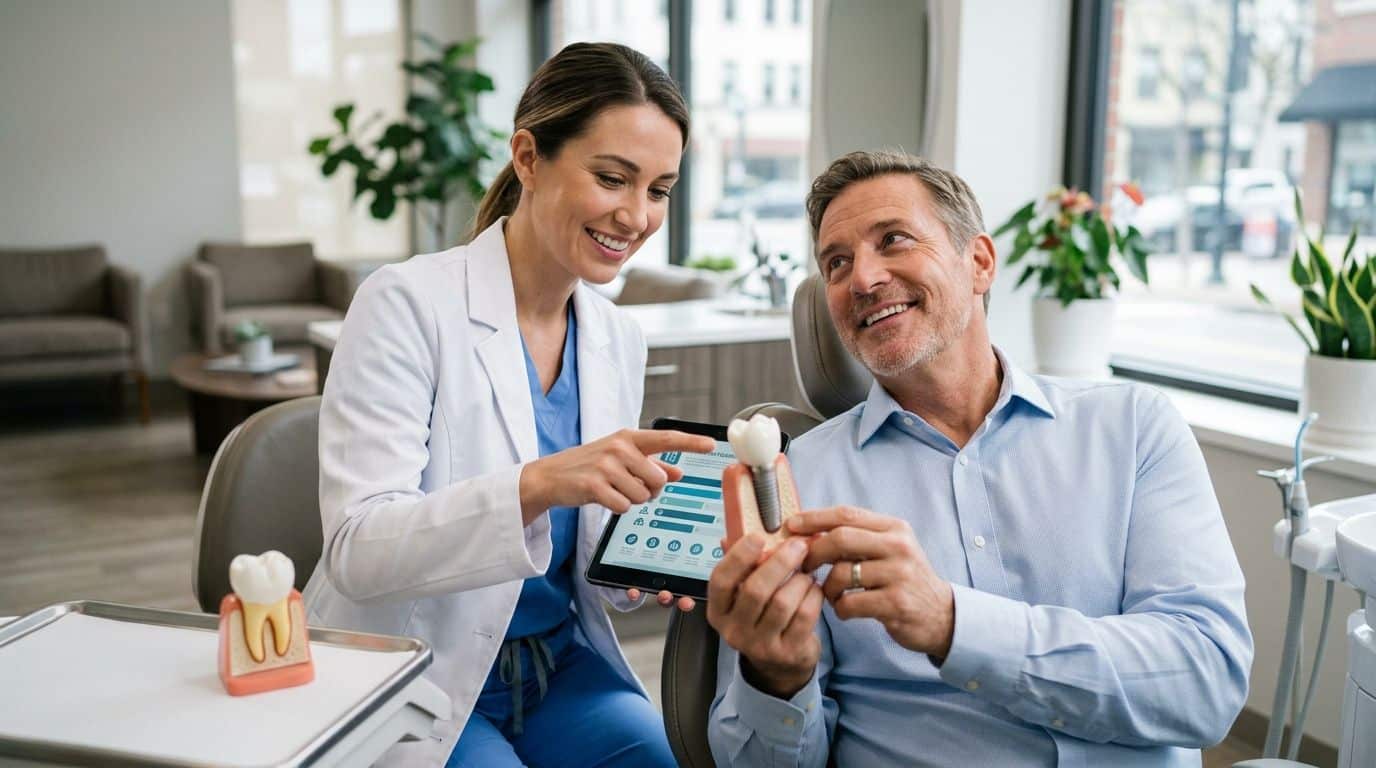
Dental implants cost less when you match the right implant type to your situation instead of assuming one option fits every mouth. This guide ranks the affordable dental implant options available in 2026 by cost efficiency, not just sticker price, so you can see which one actually saves you money over time.
TL;DR
- Single-tooth dental implants win for replacing one missing tooth long-term without touching healthy neighbors.
- Mini dental implants are the lowest-cost entry point for a single tooth or denture stabilization in 2026.
- Implant-supported bridges cut cost per tooth when three or more teeth in a row are missing.
- Implant-supported dentures (All-on-4 style) deliver the lowest cost per replaced tooth for a full arch.
- Affordable dental implants remain a searched topic nationally, with roughly 6,600 monthly searches for the term.
Why this matters
Affordable dental implants get searched about 6,600 times a month nationally, and most of those searches come from people who assume implants are automatically expensive. That's only true if you default to replacing every missing tooth with its own separate implant.
The real cost driver is how many implant posts a treatment plan actually needs. A single missing tooth, three teeth in a row, and a full arch each call for a different implant strategy, and the wrong choice inflates cost without adding function. Affordable Dentist Near Me serves families across Fort Worth, Dallas, Houston, Waco, Grand Prairie and Crowley, and the same pattern shows up across all six locations: patients overpay when they pick the option built for a different case than theirs.
What makes the best affordable dental implant option
- Number of teeth being replaced — one tooth, several in a row, or a full arch each favor a different implant type
- Jawbone density and volume — some options need a bone graft first, others don't
- Appointment count — fewer visits usually means lower total cost, not just convenience
- Long-term maintenance — implants that need less follow-up care cost less over a decade
- Candidacy restrictions — not every patient qualifies for every option at the first exam
- Per-tooth cost efficiency — the option that costs less per replaced tooth, not just less overall
Affordable dental implant options at a glance
| Option |
Best for |
Standout feature |
Key limitation |
| Single-tooth dental implant |
One missing tooth, long term |
Functions like a natural tooth root |
Needs adequate jawbone or a graft first |
| Mini dental implants |
Lowest upfront cost per tooth |
Narrower post, often single-visit placement |
Not rated for heavy molar bite force |
| Implant-supported bridge |
Three or more teeth in a row |
Two implants anchor multiple replacement teeth |
Middle teeth don't get their own root |
| Implant-supported dentures (All-on-4 style) |
Full arch replacement |
Lowest cost per tooth when a whole arch is missing |
Longest healing and treatment timeline |
| Immediate-load (same-day) implants |
Fewest total appointments |
Temporary tooth attached the same day as surgery |
Requires strong bone stability to qualify |
1. Single-tooth dental implant: best for one missing tooth
A single-tooth implant places one post into the jawbone to act as an artificial root, then attaches a crown on top once the site heals. It's the option most patients picture when they hear "dental implant," and it's still the standard when only one tooth is gone.
Single-tooth implant pros:
- Doesn't require grinding down or altering healthy neighboring teeth
- Typically the longest-lasting single-tooth replacement available in 2026
- Keeps the jawbone stimulated in that spot, slowing further bone loss
- Functions close to a natural tooth for biting and chewing
Single-tooth implant cons:
- Needs enough healthy jawbone; thin bone means a graft procedure first
- Timeline runs several months from placement to final crown
- Cost per tooth is higher than a bridge once you're replacing more than one or two
Best for: patients missing exactly one tooth with adequate bone.
Verdict: recommended as the default when only one tooth needs replacing.
2. Mini dental implants: best for the lowest upfront cost per tooth
Mini dental implants use a narrower-diameter post than standard implants, which usually means a less invasive placement procedure. They're often used to replace a small tooth or stabilize a denture.
Mini implant pros:
- Lower cost per tooth than standard-diameter implants
- Often placed in a single visit with faster healing
- Can work for patients who don't qualify for standard implants due to thinner bone
Mini implant cons:
- Not built for the same bite force as standard implants in the back molar area
- May wear faster under heavy, repeated chewing
- A dentist still has to confirm bone thickness before approving the case
Best for: front-tooth replacement or denture stabilization on a tighter budget.
Verdict: recommended for anterior teeth and dentures; skip for back-molar replacement if bite force is heavy.
3. Implant-supported bridge: best for three or more missing teeth in a row
An implant-supported bridge uses two implants as anchors to support a bridge spanning three or more replacement teeth, instead of placing an implant under every single one.
Implant bridge pros:
- Lower cost per replaced tooth than single implants once three or more teeth are missing
- Fewer surgical sites than placing an individual implant under each tooth
- Still stimulates the jawbone at the two anchor points
Implant bridge cons:
- Teeth between the two anchors don't have their own root, so bone loss can continue underneath
- If one anchor implant fails, the whole bridge is affected
- Requires two healthy implant sites, which not every patient has
Best for: three or more adjacent missing teeth where a full denture isn't needed.
Verdict: recommended when several teeth in a row are gone but the rest of the arch is healthy.
4. Implant-supported dentures (All-on-4 style): best for full-arch replacement
This approach places four to six implants per arch to anchor a full denture, replacing an entire row of teeth without an implant under each individual one. For a full arch, it's the option with the lowest cost per replaced tooth of anything on this list.
Implant-supported denture pros:
- Lowest cost per tooth when a whole arch is missing
- Denture snaps in securely, so it doesn't shift while eating or talking
- Needs far fewer implants than replacing each tooth individually
Implant-supported denture cons:
- Longest surgery and healing timeline of any option here
- Harder to reverse once treatment is underway
- Still requires periodic denture maintenance over the years
Best for: a full upper or lower arch with no remaining healthy teeth.
Verdict: recommended for full-arch cases where the alternative is replacing eight to fourteen individual teeth.
5. Immediate-load (same-day) implants: best for fewest total appointments
Instead of waiting months between implant surgery and a finished restoration, immediate-load implants attach a temporary crown or denture the same day as placement.
Same-day implant pros:
- Fewer total appointments than a staged treatment plan
- Less time without a visible tooth
- Can reduce the number of paid visits across the full timeline
Same-day implant cons:
- Requires strong initial bone stability to support a same-day load
- The temporary restoration still has to be swapped for a permanent one later
- Not every patient qualifies at the first exam
Best for: patients who want to minimize appointment count and time away from work.
Verdict: consider it if an exam confirms you qualify; skip if bone density is borderline.
How we ranked these
Each option is ranked against the six criteria above: number of teeth replaced, bone requirements, appointment count, long-term maintenance, candidacy restrictions, and cost per tooth. The ranking order in the table matches the order the options appear in this guide, from single-tooth cases through full-arch cases.
Find your affordable dental implant option
See real cost ranges by location for 2026 before you commit to a plan.
Which affordable dental implant option should you choose?
If you're missing one tooth and have healthy jawbone, the single-tooth dental implant is still the right call in 2026. If budget is the main constraint or you're replacing a front tooth, mini dental implants are the lower-cost entry point. Three or more teeth in a row point toward an implant-supported bridge, while a full arch with no remaining healthy teeth points toward implant-supported dentures. Immediate-load implants are worth asking about only after an exam confirms you're a candidate — they save appointments, not treatment steps.
FAQ
What is the most affordable dental implant option in 2026?
Mini dental implants typically have the lowest cost per tooth of any implant option in 2026, though they aren’t rated for heavy bite force in the back molar area. A dentist has to confirm bone thickness before approving the case.
Are dental implants cheaper than dentures long-term?
Implant-supported dentures often cost less per replaced tooth than a full arch of individual implants, and they typically need less ongoing adjustment than traditional dentures. Traditional dentures still have a lower upfront cost but require more frequent refitting over time.
How many implants do I need for a full arch?
Implant-supported dentures for a full arch typically use four to six implants per arch rather than one implant per missing tooth. This is why the cost per replaced tooth is lower than single-tooth implants once a whole arch is involved.
Can I get a dental implant if I have bone loss?
Bone loss doesn’t automatically disqualify you, but thin jawbone usually means a bone graft procedure before implant placement. Mini dental implants are sometimes an option for patients who don’t qualify for standard-diameter implants.
What’s the difference between a single-tooth implant and an implant bridge?
A single-tooth implant places one post under one crown, while an implant bridge uses two implants to anchor a bridge spanning three or more teeth. The bridge costs less per tooth when several adjacent teeth are missing.
Do same-day dental implants cost less than staged implants?
Same-day implants can reduce the total number of paid appointments across the treatment timeline, but the temporary restoration still needs to be replaced with a permanent one later. Candidacy depends on having strong initial bone stability.
Is a dental bridge or an implant better for missing teeth?
An implant-supported bridge preserves more of the surrounding bone at the two anchor points than a traditional tooth-supported bridge, which requires grinding down healthy neighboring teeth. It’s a better long-term option when three or more teeth in a row are missing.
One last thing
The detail most patients miss in 2026: the number of implants in a treatment plan matters more to total cost than the type of implant itself. A full arch replaced with individual single-tooth implants can require eight or more separate posts, while the same arch replaced with implant-supported dentures needs only four to six. Ask for the implant count before you compare any two treatment plans side by side.
Related guides