Yes, you can ask a private dental practice to negotiate the fee before you agree to treatment, but the practice does not have to lower it. A payment arrangement changes when you pay; it does not necessarily reduce what you owe. Start with a written, itemized treatment estimate, then ask about the fee, clinically appropriate alternatives, and payment terms without removing necessary care.
TL;DR
Can you negotiate dental prices? Yes, ask before treatment; a private practice is not required to reduce its fee.
Compare the complete treatment, not just the advertised procedure or monthly payment.
Ask separately about fee changes, payment terms, and safely staging treatment.
Affordable Dentist Near Me serves Texas families seeking general, cosmetic, and restorative dental care.
Can you negotiate the price of dental work at a private practice?
You can request a lower fee, but you cannot assume the dentist will agree. The useful conversation starts with what treatment you need and what the estimate includes—not with a demand for a discount.
If you lack coverage, review dental care options for uninsured patients before choosing how to pay. Ask the office to explain your treatment estimate in plain language and identify which decisions require the dentist's approval.
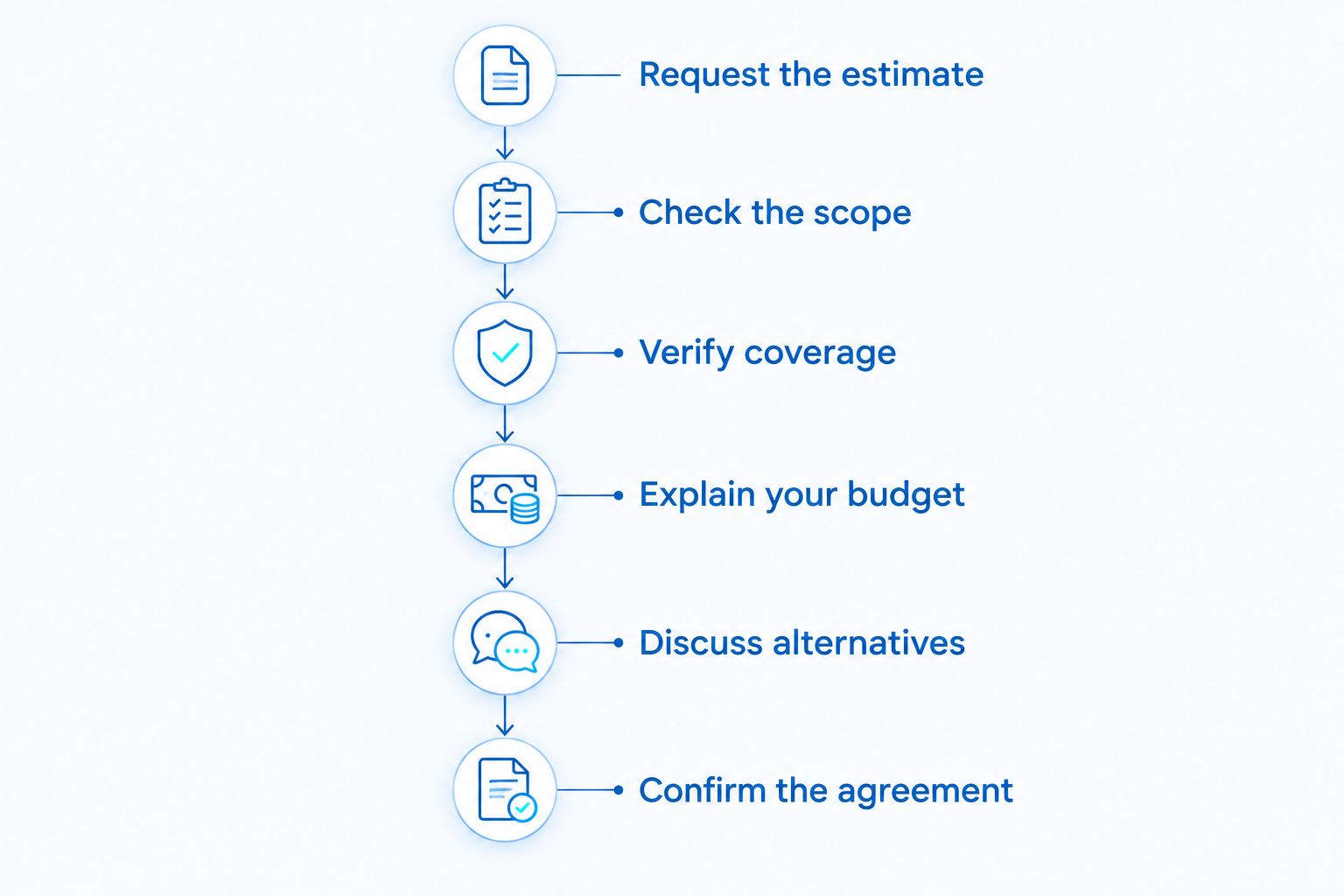
Use this sequence for a dental-fee discussion in 2026:
Request the estimate. Get the recommended treatment, individual charges, and expected patient responsibility in writing. Ask whether the estimate covers the entire course of care or only the next appointment.
Check the scope. Ask what is included and what would be billed separately. Confirm whether the plan includes any necessary imaging, temporary work, laboratory work, and follow-up care.
Verify coverage. If you have insurance, ask the office and insurer to clarify benefits and network status. Do not treat an estimated insurance contribution as a guaranteed payment.
Explain your budget. State what you can manage without offering financial details you do not want to share. Ask whether the office can adjust the fee or discuss another payment arrangement.
Discuss alternatives. Ask the dentist whether another treatment or a different sequence is clinically appropriate. The billing team can explain payments; the dentist should explain treatment trade-offs.
Confirm the agreement. Request an updated written estimate before authorizing treatment. Read separate financing paperwork before signing it.
An itemized estimate turns a vague concern about affordability into specific questions. It also helps you distinguish a genuine reduction from a smaller payment spread across a longer period.
Clarify the treatment and payment terms before you authorize care.
Why this matters
The goal is affordable, appropriate treatment—not simply a smaller bill. Removing something necessary from a treatment plan is different from negotiating the fee for the same care.
A lower initial charge also does not prove that a plan is less expensive overall. Ask what happens after the first procedure and whether the proposed treatment requires additional work to finish.
For your 2026 dental budget, separate the clinical decision from the payment decision. First understand what the dentist recommends and why; then decide how to pay for that agreed treatment.
Which approach should you ask about?
Fee negotiation, payment arrangements, treatment staging, and treatment alternatives solve different problems. Ask for the option that addresses your actual obstacle. If you cannot manage the total bill, changing the payment date alone does not solve that problem.
The approaches below are questions to raise with a practice, not promises that every office offers them.
Approach
Best for
Benefit
Limitation to check
Request a fee adjustment
Patients whose main concern is the total charge
Keeps the discussion focused on the fee for the agreed treatment
The practice can decline; confirm any change in writing
Discuss payment terms
Patients who need to spread payments over time
Addresses the timing of payments
Does not necessarily reduce the total; review financing terms
Ask about treatment staging
Patients with several treatment needs
Separates care into a dentist-approved sequence
Not every procedure can safely wait
Discuss a treatment alternative
Patients choosing between clinically suitable approaches
Lets you weigh treatment goals against practical limits
Different treatments have different maintenance needs and trade-offs
Seek a second opinion
Patients who need clarification about the diagnosis or plan
Gives another dentist an opportunity to assess the recommendation
Another examination or records review can involve separate charges
Do not ask the billing coordinator to decide whether a tooth needs treatment. Ask the dentist to explain the diagnosis, then ask the appropriate office staff about financial terms.
If an office declines a fee adjustment, use that answer to choose your next question. You can still ask about coverage, timing, or a clinically suitable alternative without pressuring the dentist to remove necessary care.
How do you ask a dentist for a lower fee?
Ask directly, respectfully, and before treatment starts. A clear request is easier to answer than a general complaint that dentistry is expensive.
Use these prompts as questions, not as statements about what the practice offers:
Is there any flexibility in the fee for this exact treatment plan?
What does this estimate include, and what would be billed separately?
Does the amount change based on how I pay?
Are there payment arrangements, and what are the written terms?
Which treatment needs attention first, and what can safely wait?
Is there a clinically appropriate alternative that meets my main goal?
You do not need to bargain over every line. Start with the largest uncertainty: the total charge, an unexplained item, insurance responsibility, or the timing of treatment.
Avoid treating another practice's estimate as proof that the first office is overcharging. Ask each dentist to explain differences in the plan; different recommendations are not automatically equivalent services.
Why dental estimates vary
Dental fees are not a standardized shopping price for an identical item. Compare what each estimate covers before comparing its total. These factors explain why two plans need closer review:
Treatment scope. A plan for one tooth differs from a plan addressing several teeth or additional gum problems. Confirm exactly what the dentist intends to treat.
Preparation and supporting care. Ask whether work needed before the main procedure is included or listed separately. Do not assume the headline procedure represents the complete plan.
Materials and laboratory work. Ask what the proposed restoration uses and why the dentist recommends it. A material change is a clinical discussion, not merely a billing edit.
Insurance terms. Network rules, covered services, deductibles, annual limits, and exclusions affect patient responsibility. Verify the rules for your own plan.
Payment arrangement. Financing terms affect what you repay and when. Review interest, fees, and any conditions separately from the dental treatment estimate.
Completion and maintenance. Ask what is needed to finish the treatment and maintain the result. An initial appointment does not necessarily represent the entire course of care.
When comparing 2026 estimates, keep your goal consistent. A plan intended to preserve a tooth and a plan intended to replace it require different explanations, even when both address the same immediate problem.
Can you negotiate dental prices if you have insurance?
Yes, you can ask, but insurance contracts and plan rules can limit how an office handles charges and patient payments. Ask about your expected responsibility rather than assuming the office can waive it.
Have the insurer explain coverage and the office explain billing. If a proposed adjustment involves your deductible or other required patient payment, ask how it complies with the applicable plan terms before relying on it.
Is a payment plan the same as a lower dental fee?
No, a payment plan changes payment timing; it does not automatically lower the treatment fee. Compare the total repayment obligation with the treatment estimate, not just the installment amount.
For a financing agreement signed in 2026, read the actual terms for interest, fees, due dates, and any promotional conditions. Ask who receives your payments and who handles questions about the account.
Can you use another dentist's estimate to negotiate?
Yes, you can show another estimate and ask the practice to explain differences. A second estimate is a comparison tool, not a guarantee of a matching fee.
Check that both dentists are addressing the same teeth, diagnosis, and treatment goal. If their recommendations differ, resolve the clinical difference before treating their totals as competing offers.
What should stay in the treatment plan?
Negotiate the bill, not the need for safe care. Ask the dentist to explain any proposed change involving examination, necessary imaging, infection treatment, or follow-up.
Do not decide on your own that a step is unnecessary because it adds to the estimate. Instead, ask what the step accomplishes, whether there is an appropriate alternative, and what happens if you decline it.
The same rule applies to delaying treatment. Ask the dentist to distinguish urgent needs from work that can safely wait and to explain warning signs that require prompt attention.
Do not postpone assessment while shopping for a better fee if you have facial swelling, fever with dental symptoms, or worsening pain. Trouble breathing or swallowing requires emergency medical attention.
How do you compare written estimates fairly?
Compare matching treatment plans, then compare your payment responsibility. Keep the documents together so that you can ask about differences without relying on memory.
Start with these checks:
Diagnosis: Are both dentists treating the same problem?
Treatment: Are the recommended procedures equivalent, or do they serve different goals?
Included care: Does each estimate cover the necessary preparation and completion steps?
Insurance: Are both estimates using verified information about your coverage?
Payment: Does either agreement add financing charges or other obligations?
Changes: What happens if the dentist finds a problem that changes the plan?
Ask each office to identify estimates that depend on findings during treatment. That is different from authorizing any additional work without an explanation.
Keep the revised estimate and any payment agreement for your 2026 records. Before signing, make sure you understand what you are authorizing and how the office will discuss a change in treatment or charges.
A local option for family dental care
Affordable Dentist Near Me is an option for Texas families seeking general, cosmetic, and restorative dental care. The practice serves Fort Worth, Dallas, Houston, Waco, Grand Prairie, and Crowley, and its stated services include implants, crowns, braces, and teeth whitening.
If those locations fit your needs, ask Affordable Dentist Near Me for information about the recommended care and current financial terms. Treat fee flexibility and payment arrangements as questions to confirm with the office, not assumed benefits.
That location fit does not replace a treatment discussion. You still need an examination, an explanation of suitable care, and clear written terms before making a decision.
Discuss your dental care needs
Ask about recommended treatment, an itemized estimate, and current payment terms.
Can you negotiate dental prices at a private dentist?
Yes, you can ask a private dentist to adjust a fee before treatment, but the practice is not required to agree. Request an itemized estimate and discuss financial terms separately from necessary care.
What’s the best way to ask a dentist for a lower bill?
The best starting point is a written estimate followed by a direct question about fee flexibility. Explain your budget and ask whether the same treatment can be offered under different financial terms.
Should I ask whether paying upfront changes the dental fee?
Yes, ask whether payment timing affects the fee, but do not assume the office offers a reduction. Confirm any agreed change in writing before paying.
Can a dentist waive my insurance deductible?
Do not assume a dentist can waive your deductible; insurance contracts and plan rules can restrict that arrangement. Ask the office and insurer how any proposed adjustment complies with your plan.
Is dental financing cheaper than negotiating the fee?
Dental financing is not automatically cheaper because it changes how you pay rather than necessarily reducing the fee. Compare the full repayment terms, including interest and fees, with the treatment estimate.
Can I delay part of my dental treatment to manage the bill?
Delay treatment only after the dentist explains what can safely wait. Ask which needs are urgent and what symptoms require prompt attention.
Does Affordable Dentist Near Me negotiate dental fees?
Ask Affordable Dentist Near Me directly about current financial terms; a fee reduction is not established here. The practice provides general, cosmetic, and restorative dental care in its stated Texas service locations.
One last thing
Ask for a revised estimate whenever the agreement changes. A verbal discussion about a lower fee, a different treatment, or a new payment schedule is not a substitute for a document showing what you will receive and what you will owe.
Before authorizing care in 2026, read the treatment estimate and financing agreement as separate documents. The treatment can remain unchanged while the payment obligation changes substantially.