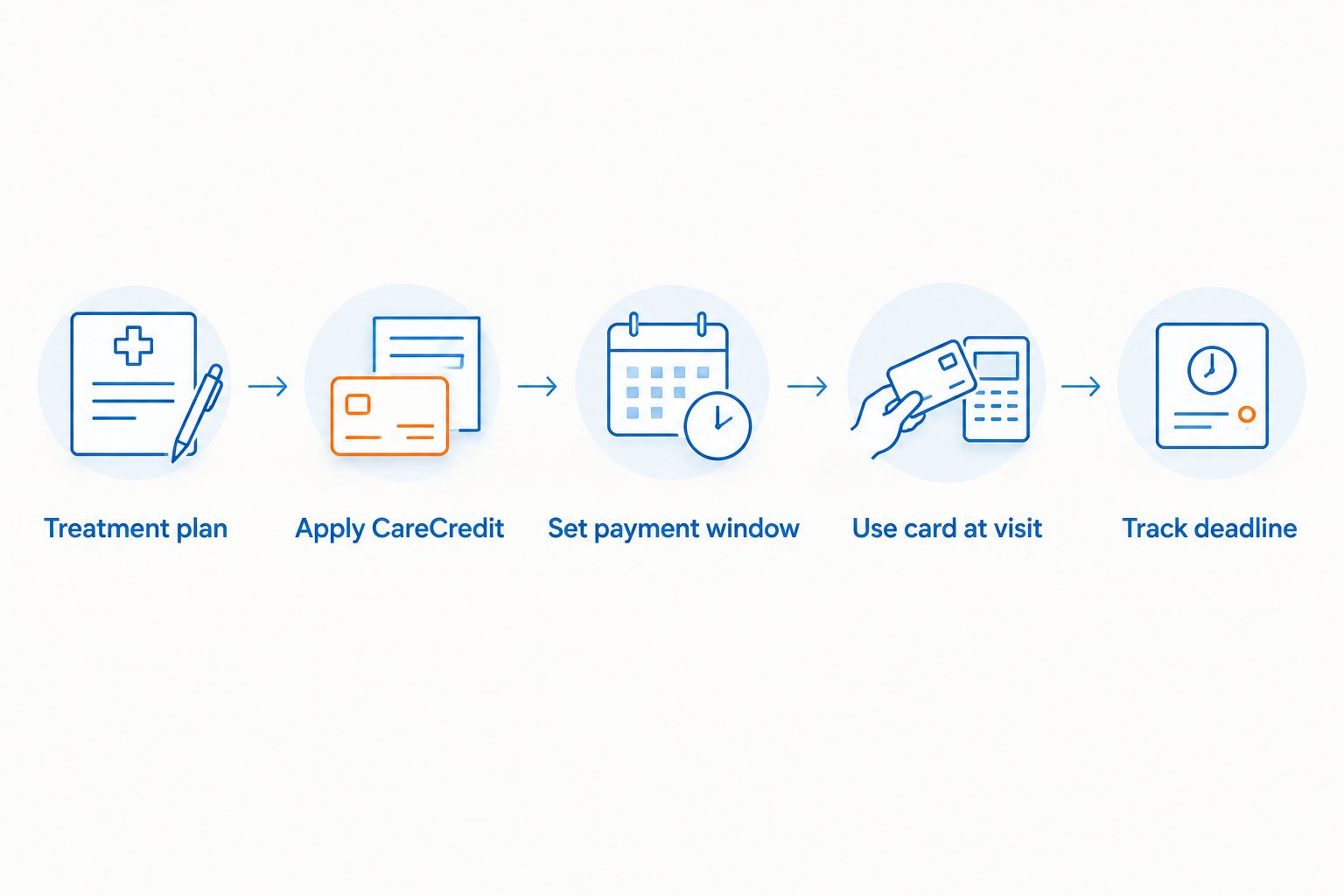
Financing braces through CareCredit follows four moves: lock in a real treatment quote, apply for the card, pick a payment window you can actually hit, then use the promotional period without tripping the deferred-interest clause. Instead of calling five offices for ballpark numbers and guessing at a monthly payment, set up this workflow once and you'll know exactly what braces near me for cheap looks like on paper before you sit in a chair.
TL;DR
CareCredit turns a braces bill most patients pay $3,000 to $7,000 for into fixed monthly payments, if you manage the promotional window correctly.
Get your treatment plan locked in before you apply — CareCredit approves a credit line, not a price.
Affordable Dentist Near Me runs in-house payment plans alongside CareCredit for patients hunting braces near me for cheap without financing risk.
Miss the promotional deadline by even one payment and interest applies retroactively to the full original balance, not just what’s left.
Why this matters
Braces are one of the few dental procedures where the total cost is known upfront and payable over 12-24 months, which is exactly the window CareCredit's deferred-interest promotions are built around. The problem isn't approval — CareCredit approves a wide range of credit profiles. The problem is patients get the card, get treatment started, then lose track of the promotional end date and get hit with retroactive interest on the entire original balance.
That single mistake is why searches for affordable braces options for adults and teens spike every January, right after December's deferred-interest bills land. The workflow below is built to prevent that, not just to get you approved.
Before you start
A signed treatment plan with a total cost, not a phone estimate — CareCredit's application asks for a specific amount, and applying before you have a number means you'll either under-borrow or over-borrow.
Your Social Security number and a recent pay stub or income figure — CareCredit runs a credit check (usually a soft pull for pre-qualification, then a hard pull if you proceed), so know your approximate credit range before you apply.
The gotcha: deferred-interest promotions are all-or-nothing. If your balance isn't paid to zero by the last day of the promotional period, the provider charges interest back to the original purchase date on the full amount — not just the remaining balance. This catches more patients than credit denial does.
Set up your CareCredit application
Go to the CareCredit site or ask the front desk for the in-office application link.
Enter the treatment total from your signed plan in the Purchase Amount field — round up slightly to cover any adjustment visits, never down.
Submit your income and SSN, then wait for the instant decision screen. Most applications resolve in under a minute.
If approved, note your credit limit and your promotional offer length (commonly 6, 12, 18 or 24 months depending on the amount financed) — both appear on the approval screen.
Expected result: you have a card number, a credit limit that covers the full treatment cost, and a specific promotional end date written down somewhere you'll actually check.
Configure your payment window
Divide the total treatment cost by the number of months in your promotional period. That's your required minimum payment to hit zero — not the minimum payment CareCredit lists on the statement, which is usually lower and will not clear the balance in time.
Set up autopay through the CareCredit account portal for that higher amount, not the statement minimum.
Mark a calendar reminder 60 days before the promotional end date to confirm your balance is on pace.
Expected result: autopay is running at the payoff rate, and you have a hard checkpoint before the deferred-interest window closes.
The deadline-tracking step is the one most patients skip, and it’s the one that costs money.
Use the card at the office
Bring the CareCredit card (physical or the account number) to your first orthodontic visit.
Ask the office to run the full treatment cost as one transaction if your plan allows a single charge, rather than charging per visit — one clean start date is easier to track than five scattered ones.
Keep the receipt or statement line showing the transaction date; that date is the anchor for your promotional deadline.
Expected result: one traceable charge, one deadline, one payoff number — not a scattered set of mini-balances with different clocks running.
The clear aligners variant
If you're comparing traditional braces against clear aligners, the CareCredit workflow above runs identically — the only thing that changes is the treatment total and, often, the timeline. Aligner cases frequently run shorter than bracket-and-wire braces, which can put you in a 12-month promotional window instead of 24. Before you apply, compare braces vs clear aligners side by side so the number you enter on the CareCredit application matches the treatment you actually choose, not the one you assumed.
Troubleshooting
Application denied. CareCredit denials are usually credit-history related, not income related. Ask the office about an in-house payment plan as a fallback before walking away from treatment altogether.
Approved credit limit is lower than the treatment cost. Split the balance: charge what fits on CareCredit and ask the office to set up a short in-house plan for the remainder, so you're not financing the gap with a higher-interest card.
Promotional period ends and you still owe a balance. Deferred interest is retroactive to the purchase date on the full original amount — call CareCredit immediately to confirm the exact payoff figure and pay it in one lump sum if at all possible, rather than letting the retroactive interest compound further.
Statement shows fees you don't recognize. Late payment fees and the loss of the promotional rate are the two most common surprises — both are avoidable by keeping autopay at the payoff rate, not the statement minimum.
Office doesn't accept CareCredit. Not every practice is enrolled in the CareCredit network. Confirm enrollment before your first visit, not at checkout.
Get a real braces quote first
See your treatment total before you apply for financing.
CareCredit isn't the only route to braces near me for cheap. If you're uninsured, in-house payment plans and sliding-scale arrangements often beat deferred-interest financing outright because there's no clock to beat. If you're on a limited income in Texas, state Medicaid dental coverage sometimes extends to orthodontic treatment for qualifying cases, which is worth checking before you finance anything at all.
The workflow above scales past braces, too — the same apply-then-track-the-deadline pattern works for crowns, implants or any procedure priced as one lump sum. The deadline discipline is the transferable part; the treatment total is the only variable.
FAQ
Is CareCredit good for braces near me for cheap?
CareCredit works well for braces when the balance is paid off inside the promotional window, since the monthly payment can be lower than a comparable personal loan. Miss the deadline and deferred interest applies retroactively to the entire original balance, which erases the savings.
Can I use CareCredit if I have bad credit?
CareCredit approves a range of credit profiles, but lower scores typically get smaller credit limits or shorter promotional periods. If denied, ask the dental office about an in-house payment plan as a fallback in 2026.
What happens if I don’t pay off CareCredit before the promotional period ends?
Interest is charged retroactively from the original purchase date on the full financed amount, not just the remaining balance. This is the single most expensive mistake patients make with deferred-interest financing.
Does Affordable Dentist Near Me accept CareCredit for braces?
Confirm CareCredit enrollment with the specific location before your first visit, since network participation can vary by office and by year.
What’s cheaper: CareCredit or a payment plan through the dentist?
An in-house payment plan avoids deferred-interest risk entirely, while CareCredit can offer more flexibility on timing. The cheaper option depends on whether you can reliably hit the promotional payoff date.
How much can I finance with CareCredit for braces?
Credit limits are set individually based on credit history and income, and most patients see limits that cover typical braces costs in the $3,000 to $7,000 range as of 2026.
Can I use CareCredit for clear aligners too?
Yes, the same application and payment-tracking workflow applies to clear aligners, and the shorter aligner timelines often fit inside a 12-month promotional window.
What if CareCredit denies my application?
Ask the office about in-house payment plans, and compare uninsured or income-based dental programs before assuming financing isn’t possible at all.
One last thing
The patients who come out ahead on CareCredit aren't the ones with the best credit scores — they're the ones who set autopay to the payoff rate on day one instead of the statement minimum. That single setting decision, made in month one, is what separates a 0% financing win from a retroactive-interest bill in month 13.