Cost Breakdown: Are Dental Implants a Better Long-Term Investment Than Bridges?
Deciding between a dental implant and a bridge often comes down to one practical question: will the higher upfront cost of an implant pay off over the years? This guide walks you through the differences in design, procedure, lifespan, maintenance, oral-health impact, aesthetics, and candidacy so you can weigh the real-world economics. You’ll find a clear explanation of implant parts and the clinical timeline, typical upfront cost ranges and what changes them, a simple lifecycle look across 10–30 years, and realistic financing and insurance options that make care manageable. If you live in Denton and want a personalized estimate, Dentist in Denton – Dentures & Dental Implants offers a Free Dental Implant Consult to give you an itemized cost plan and candidacy assessment. Below we map the decision process step by step: what implants are, initial cost comparison, long-term value, health risks and benefits, aesthetics and function, who’s a good candidate, financing and insurance, and how to book a zero-cost consultation for individualized pricing.
What Are Dental Implants and How Do They Work?
Dental implants replace a missing tooth by recreating the root and supporting a crown or denture. A titanium or zirconia post is placed in the jaw and—through a process called osseointegration—fuses with the bone to create a stable foundation. That root replacement is the main advantage of implants: it preserves alveolar bone, maintains facial support, and provides long-term stability that affects both function and lifetime cost. Understanding this basics explains why implants usually cost more up front but can deliver different value over decades, especially for patients focused on permanence and bone health. Below we break implants into their parts and outline the typical clinical timeline so you can compare process, cost, and outcomes with bridges.
What Are the Key Components of a Dental Implant?
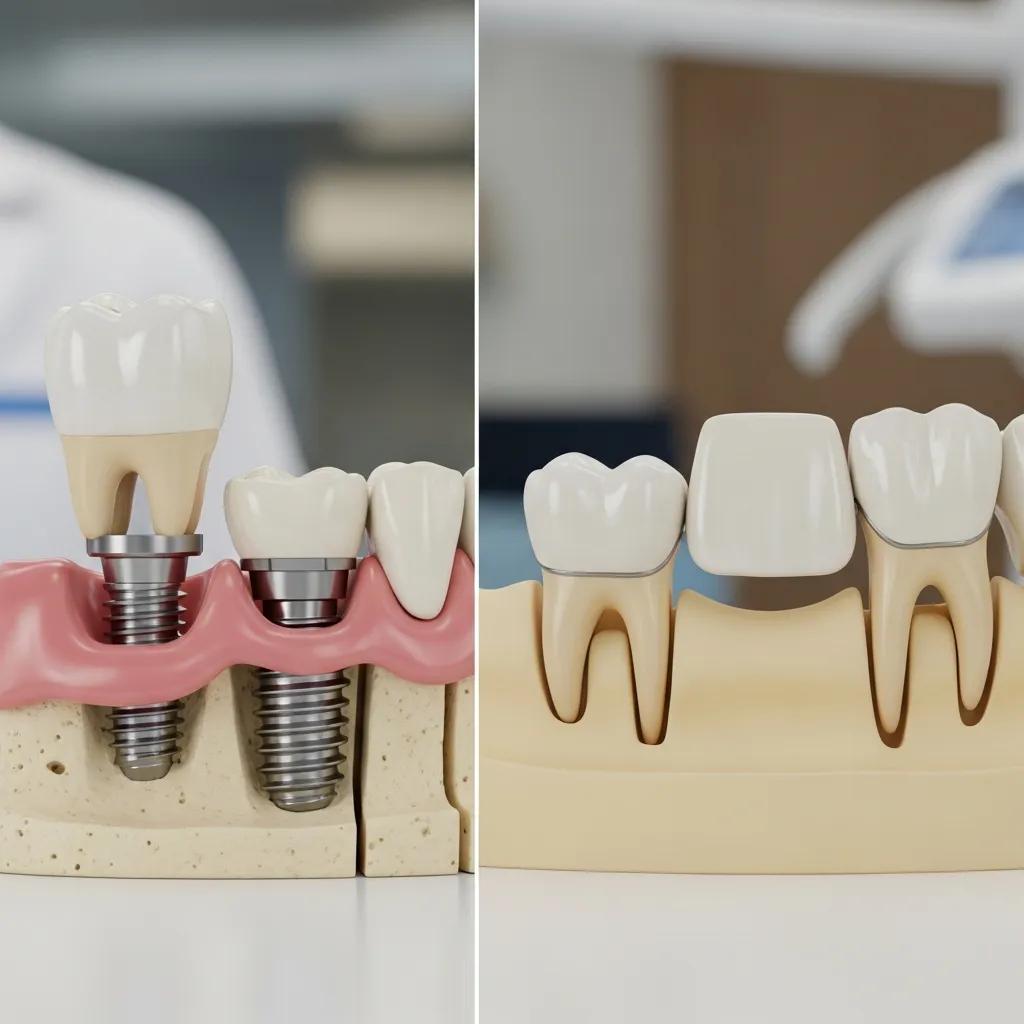
An implant restoration has three main parts: the implant post (the root substitute), the abutment (the connector), and the crown or prosthesis (the visible tooth). Posts are typically titanium, though zirconia is an option for patients seeking a metal-free solution; titanium is widely used because of its proven osseointegration and strength. Abutments can be off-the-shelf or custom—custom pieces improve the gum line and emergence profile but add lab fees. Crowns are made from porcelain, zirconia, or layered ceramics; material choice affects shade matching, durability, and cost. These components drive the material, lab, and technician charges that make up much of the initial investment and influence long-term maintenance.
The implant post provides root-level support and stability.
The abutment shapes how the crown meets the gum for a natural look.
The crown determines shade, wear resistance, and bite durability.
Knowing how these parts interact clarifies why choices in materials and customization change both upfront price and longevity—and why the clinical timeline matters for patient experience and cost.
How Is the Dental Implant Procedure Performed?
Treatment usually starts with a consultation and diagnostic imaging to check bone volume, tooth positions, and oral health. From there the process moves to surgical placement, a healing period for osseointegration, and final restoration with an abutment and crown or an implant-supported prosthesis. Advanced imaging, often including CBCT scans, helps plan exact implant placement and identifies whether bone grafts or sinus lifts are required—items you’ll see listed on estimates. Implant surgery is typically done outpatient under local anesthesia, sometimes with sedation; bone integration takes weeks to months, and a temporary restoration may be used during healing. After integration, the abutment and final crown are placed and bite is adjusted, with follow-up visits focused on hygiene and monitoring. Additional procedures such as grafting or sinus lifts increase complexity, extend treatment time, and add cost—important considerations when comparing implants and bridges.
What Is the Initial Cost of Dental Implants Compared to Bridges?
The clearest short-term difference is cost: implants generally have higher initial fees because of surgery, materials, and lab work, while bridges cost less initially since they avoid implant surgery and use fewer high-cost parts. Exact prices vary with case complexity, materials, the need for grafts, and clinician experience, so an in-person evaluation is the only way to get a precise quote. If you’d like a tailored price and to compare surgical versus non-surgical options, the Free Dental Implant Consult at Dentist in Denton – Dentures & Dental Implants is a no-cost way to get a specific estimate and candidacy review. The table below summarizes common scenarios so you can see typical ranges and what changes them.
All-on-4 and similar protocols differ by number of implants, materials, and lab complexity
Ranges overlap, and your anatomy or health can move your price up or down. For people in Denton, booking a Free Dental Implant Consult with Dentist in Denton – Dentures & Dental Implants provides an itemized evaluation so you replace generic ranges with a personalized plan and exact pricing.
Which Factors Influence the Cost of Dental Implants?
Implant pricing stems from several linked factors: post and crown materials, how many implants are needed, surgical complexity, whether grafting or sinus lifts are required, imaging and planning, lab technician fees, and the clinician’s experience and facility overhead. Material choices—titanium versus zirconia posts and different crown materials—change material and lab line items, while additional surgeries add time and cost. Reduced bone volume, proximity to nerves or sinuses, and the need for extractions raise surgical complexity and fees. Custom abutments and premium aesthetic crowns increase lab costs. Because these elements compound, a straightforward single implant with no grafting costs much less than a graft-plus-premium-crown case; the Free Dental Implant Consult can identify which factors apply to your mouth and how they affect the final quote.
Material upgrades raise implant and crown costs.
Bone grafts, sinus lifts, and staged surgeries add predictable fees.
Provider skill level and custom lab work are key cost drivers.
Bridges avoid surgical fees but introduce other costs tied to tooth preparation and future replacement—another angle to consider.
What Are the Cost Factors for Different Types of Dental Bridges?
Bridges come in several designs—traditional fixed, cantilever, and resin-bonded (Maryland)—and each has different cost drivers: number of abutment teeth, crown material, and expected lifespan. Traditional three-unit bridges require prepping and crowning adjacent teeth, increasing chair time, material, and lab fees; that prep can lead to future restorations on otherwise healthy teeth, a downstream cost not always reflected in the sticker price. Resin-bonded bridges are less invasive and cheaper up front but tend to be less durable and may need rebonding. Cantilevers are situational and depend on tooth position and bite forces, with cost varying by complexity and material. When comparing to implants, remember a bridge may be cheaper now but could cost more over time through replacements and abutment tooth treatments—topics we expand on in the lifecycle section.
Traditional bridge: moderate initial cost, requires altering adjacent teeth.
Cantilever: used in specific situations; cost depends on design needs.
These distinctions help frame the choice between a less invasive short-term bridge and a root-replacing implant that protects bone long-term.
How Do Long-Term Costs and Value Compare Between Implants and Bridges?
Long-term value looks beyond the sticker price to expected lifespan, maintenance, replacement cycles, and costs from secondary problems like bone loss or abutment tooth failure. Implants usually cost more up front but often offer better value over 10–30 years because they replace the root, preserve bone, and lower the chance of downstream restorations; bridges often need replacement every 5–15 years and can trigger additional work on neighboring teeth. The table below models typical lifespans and cumulative considerations so you can compare likely trajectories for both options.
Option
Expected Lifespan
Typical Long-Term Considerations
Dental implant (crown replaced periodically)
20+ years to lifetime (implant)
Implant post often endures for decades; crowns may need replacement every 10–15 years; preserves bone
Traditional bridge
5–15 years
Framework or pontic may fail; adjacent teeth risk decay or fracture; repeat replacements possible
Implant-supported full-arch
15–30+ years
Prosthesis requires maintenance and occasional repairs; bone preservation can lower future costs
This model shows implants concentrate cost up front with a lower chance of major structural expenses later, while bridges spread lower initial costs into repeated replacements and possible work on neighboring teeth. To make these general models specific to your situation, schedule a Free Dental Implant Consult at Dentist in Denton – Dentures & Dental Implants for itemized 10–20–30 year scenarios based on your oral health and goals.
What Is the Expected Lifespan of Dental Implants Versus Bridges?
Implants are built for long-term service: the post can last decades or a lifetime with good oral hygiene and periodic crown maintenance, though crowns and prosthetic pieces may need replacement. Implants benefit from osseointegration and don’t rely on adjacent teeth, so they’re less vulnerable to decay and mechanical failure that can affect bridge abutments. Bridges typically last 5–15 years because they depend on the health of abutment teeth, which can decay, fracture, or lose periodontal support. Patient habits, medical conditions (for example, uncontrolled diabetes), smoking, and hygiene strongly influence longevity for both options—but when bone preservation matters, implants generally deliver longer functional life and fewer cumulative replacements.
Implants: durable, root-level solution with periodic crown refreshes.
Bridges: finite lifespan tied to adjacent teeth health.
Seeing lifespans in this light helps explain why implants can be more economical over multiple decades.
How Do Maintenance and Potential Future Costs Differ?
Implant care focuses on routine hygiene, periodic crown replacement, and watching for peri-implant disease. Bridge care centers on cleaning under the pontic and monitoring abutment margins for decay—each has different long-term cost implications. Implants need professional monitoring and excellent home care to prevent peri-implantitis; while treatment for infection can be costly, such complications are relatively uncommon with proper maintenance. Bridges may require earlier replacement or additional work if abutment teeth decay or fail, which can lead to root canals, new crowns, or conversion to implants—each adding expense. Also consider that bone loss under a pontic can make future implants more complex and costly. A practical approach is to assess the likelihood and size of future costs for your oral health and weigh those against your budget and goals.
Implant maintenance: regular hygiene, crown refresh every 10–15 years, monitor for peri-implant disease.
Bridge maintenance: hygiene under the pontic, watch for abutment decay, and earlier replacement cycles.
Conversion costs: bone loss from bridges can increase future implant complexity and cost.
These contrasts help many patients choose implants for predictable long-term function and cost.
What Are the Health Benefits and Risks of Dental Implants Versus Bridges?
One clear biological advantage of implants is root replacement: implants transmit mechanical load to the jawbone, which slows alveolar bone resorption after tooth loss. Bridges restore tooth shape and chewing surface but don’t replace the root, leaving the underlying bone to remodel and shrink over time—changes that can affect facial contour and complicate future restorative options. Both options have procedure-specific risks: implants involve surgical risks and potential peri-implantitis, while bridges can damage adjacent healthy teeth and develop recurrent decay at margins. Reviewing these trade-offs with your medical history and dental anatomy is crucial, because long-term oral-health outcomes (bone preservation and adjacent-tooth integrity) affect both quality of life and cumulative costs.
How Do Dental Implants Preserve Jawbone and Adjacent Teeth?
Implants preserve jawbone by transferring chewing forces through the titanium or zirconia post into the alveolar bone, stimulating remodeling and maintaining volume through osseointegration. That preserved bone supports neighboring teeth, preserves gum contours, and simplifies future prosthetic work—reducing the need for grafting later. In short: implant → load transmission → bone preservation; preserved bone → supports → facial structure and future options. Bridges don’t replace the root, so the bone beneath the pontic receives no direct stimulation and can resorb, which may lead to ridge collapse and aesthetic or fit problems. For patients who prioritize long-term oral health and minimizing future procedures, this functional difference often favors implants.
What Are the Potential Risks and Downsides of Bridges?
Bridges require preparing adjacent teeth, which removes healthy enamel and places crowns on those teeth as abutments—an irreversible change that raises the risk of secondary decay, root canal treatment, or fracture over time. Bridges can fail when cement margins allow bacterial entry or when occlusal forces cause mechanical fatigue, leading to replacement or more invasive care. Because bridges don’t replace the root, bone loss under the pontic can change fit and appearance and sometimes force a later switch to implant-supported restorations that are more complex and costly if bone volume has decreased. Practically, a bridge can be a good short-term solution for certain clinical or financial situations, but patients should understand the likely mid-term maintenance and potential downstream costs before choosing that route.
How Do Aesthetics and Functionality Compare Between Implants and Bridges?
Aesthetics depend on crown material, lab skill, and how well the restoration recreates a natural emergence profile and gum contour. Function relates to chewing efficiency, how bite forces are distributed, and proprioception. Implant-supported crowns can better mimic natural tooth emergence and support soft tissue because they replace the root and allow the tooth to be contoured individually—often producing superior aesthetics for single-tooth cases in the visible smile zone. Bridges can offer excellent immediate aesthetics but may not maintain gum contour as well long term, and margin changes can become visible as the underlying bone remodels. Functionally, implants pass forces to bone and restore near-natural chewing stability, while bridges distribute load across abutment teeth and perform well initially but may change as abutments undergo biological or restorative changes.
Which Option Offers a More Natural Look and Feel?
Implant restorations usually deliver the most natural look and feel because crowns can be designed with individualized emergence profiles and soft-tissue support that imitate a natural tooth’s interaction with the gum. Ceramic materials like zirconia or layered porcelain can be shade-matched and contoured to reproduce translucency and light reflection similar to natural enamel. Bridges can also achieve very good aesthetics, especially with advanced ceramics, but contouring adjacent crowns to act as abutments sometimes compromises the ideal emergence profile and makes long-term gum changes more noticeable. Clinicians often prefer implants when front-tooth aesthetics are the top priority because implants recreate both the visible tooth and the supporting architecture beneath it.
How Do Implants and Bridges Affect Chewing and Speech?
Functionally, implants provide excellent chewing stability because the restoration is fixed to an osseointegrated root analogue, restoring force transmission and letting many patients return to a wider range of foods confidently. Bridges restore occlusal contact and chewing surface immediately, and many patients report good function, but bridges rely on neighboring teeth so bite forces are shared differently and can change over time as abutments are altered or affected biologically. Speech is usually minimally affected in the long term for both options once the restoration is in place and the patient adapts; short-term changes can occur during healing or adjustment but typically resolve with fitting and practice. Overall, implants tend to approximate natural proprioception and force distribution more closely, which helps with complex chewing tasks and long-term stability.
Who Is a Good Candidate for Dental Implants Versus Bridges?
Choosing between implants and bridges depends on medical status, oral anatomy, lifestyle, and budget. Implants require sufficient bone or willingness to have augmentation, reasonable systemic health for healing, and a commitment to oral hygiene; bridges may be a better option when surgery isn’t advisable or when a faster, lower-cost restoration is needed. Factors that favor implants include adequate bone (or acceptance of grafting), controlled chronic conditions, non-smoking or cessation, and a desire for a permanent root-level solution. Bridges are often chosen when adjacent teeth already need crowns, when a patient prefers to avoid surgery, or when time or budget constraints make a bridge a practical interim fix. Use the checklist below to self-assess before a clinical evaluation.
Bone Volume: Is there enough jawbone at the site, or will grafting be required?
Systemic Health: Are chronic conditions (like uncontrolled diabetes) well managed?
Smoking Status: Do you smoke, and are you willing to quit to improve implant success?
Oral Hygiene: Are you able to keep up with regular hygiene and professional visits?
This checklist points you toward likely options, but the Free Dental Implant Consult at Dentist in Denton – Dentures & Dental Implants supplies the imaging and clinician review needed to confirm candidacy and recommend the best plan.
What Health and Bone Density Factors Affect Candidacy?
Bone volume and density at the implant site are primary factors because they determine whether an implant can achieve stable osseointegration without augmentation; systemic conditions—such as diabetes control, immune status, and some medications—also affect healing and infection risk.
If bone is insufficient, grafting or sinus lift procedures can expand candidacy but increase complexity, time, and cost; these adjunctive procedures are common and usually predictable, but they require planning. Smoking raises the risk of implant failure and peri-implant disease, so cessation is strongly recommended before elective implant surgery; poorly controlled systemic disease can also impair healing and increase complications. A thorough medical and dental evaluation—available during a Free Dental Implant Consult—identifies modifiable risks and outlines whether implants, bridges, or a staged approach is best for long-term outcomes.
How Do Lifestyle and Budget Influence Treatment Choice?
Your lifestyle—how quickly you need a restoration, willingness to undergo surgery and recovery, and daily maintenance preferences—combined with budget realities will shape the right choice. Implants suit patients looking for long-term durability who accept a higher upfront investment and longer timeline; bridges fit patients who want a quicker, less invasive solution or a lower short-term cost. If you travel often or need a fast cosmetic fix, a bridge can be placed sooner, but weigh that convenience against future replacement costs and biological effects. Budget affects how many implants you choose and what materials you select; many practices, including Dentist in Denton – Dentures & Dental Implants, offer flexible financing to spread cost and make implants achievable for patients prioritizing long-term value. Weigh cost vs. longevity vs. speed to find the option that matches both your life and your finances.
What Financing and Insurance Options Are Available for Dental Implants and Bridges?
Financing and insurance shape access to implant therapy for many patients. Many PPO dental plans cover parts of restorative work, and an increasing number of offices accept most PPO plans while offering flexible financing to make implants feasible; for example, Dentist in Denton – Dentures & Dental Implants accepts most PPO dental plans and provides financing options. The Free Dental Implant Consult is the starting point for precise financing because it produces itemized quotes lenders and insurers need for pre-authorization and plan comparisons. The compact table below shows common financing scenarios so you can see how monthly payments change with term and APR—exact offers depend on credit and lender terms.
Financing Option
Typical Term / APR
Example Monthly Payment (for $6,000)
Short-term split (12 months)
0–6% APR (promotional possible)
$500 – $530 / month
Medium-term plan (24–36 months)
6–12% APR
$180 – $270 / month
Longer-term medical loan (48–60 months)
8–18% APR
$120 – $150+ / month
These examples show how financing can lower monthly burden and make implant care accessible. During a Free Dental Implant Consult, we’ll review tailored financing and assist with insurance pre-authorization so you know actual monthly costs for your individualized plan.
How Does PPO Dental Insurance Cover Implants and Bridges?
PPO plans often cover parts of the restorative components—like crowns or pontics—but coverage for the surgical implant portion varies, so pre-authorization and an itemized estimate are essential. Frequently the prosthetic crown gets coverage more readily than the surgical implant placement, though some plans offer partial implant benefits or coding that allows partial reimbursement. Practical steps: request an itemized treatment plan with diagnostic codes from your provider, submit it to insurance for predetermination, and bring your insurance details to the Free Dental Implant Consult so our team can help verify benefits. Because policies differ, working with a practice experienced in PPO pre-authorizations simplifies the insurance process.
What Flexible Financing Plans Can Help Manage Costs?
Flexible financing options include short-term interest-free promotions, medium-term installment plans, and longer-term medical loans—choose based on cash flow, credit, and how much total interest you’re willing to pay. Short-term promotions work well if you can pay within the interest-free window; medium- and long-term plans spread payments into manageable amounts but add interest. When comparing offers, check APR, term length, monthly payment, and any fees; also ask whether the practice offers in-house plans or partners with third-party lenders. At Dentist in Denton – Dentures & Dental Implants, financing options are reviewed during the Free Dental Implant Consult so you see exact monthly payments based on your treatment plan and credit profile—turning abstract ranges into real affordability scenarios.
Ask about interest-free introductory periods.
Compare APR and total interest over different terms.
Request itemized quotes to test financing calculators.
This practical overview helps reduce sticker shock and lets you pick a payment plan that fits your goals.
How Can You Schedule a Free Dental Implant Consultation in Denton?
Booking a Free Dental Implant Consult is the next step if you want personalized pricing, diagnostic imaging, and a candid candidacy review at no cost. The consult is educational and produces an itemized treatment plan and financing options tailored to your mouth. Dentist in Denton – Dentures & Dental Implants emphasizes patient-centered, education-based care in a comfortable clinic and offers 24-hour online scheduling for convenience. During the consult we review medical history, perform an oral exam and imaging as needed, and discuss realistic options and costs so you leave with a clear plan. Below we explain what to expect and how to book so you arrive prepared and leave with confidence.
What Should You Expect During a Free Dental Implant Consult?
The Free Dental Implant Consult is a focused visit: we review your medical and dental history, complete an intraoral exam, discuss your goals and concerns, and order diagnostic imaging if needed. The clinician will explain whether grafting is necessary, outline expected timelines for surgery and restoration, and go over maintenance and risks so you understand the full treatment trajectory. We’ll also cover insurance and financing options tied to your estimate so you can see monthly payment scenarios before deciding. Bring your insurance card and any recent dental records if you have them; otherwise imaging can be done during the visit to produce an accurate, itemized plan.
How to Book Your Appointment Online Anytime?
Booking the Free Dental Implant Consult is simple: our 24-hour online scheduler lets you choose a convenient time, and phone support is available if you prefer. When scheduling, indicate your primary concern (single missing tooth, multiple teeth, or full-arch restoration) and note any insurance carrier so our team can prepare predetermination materials—this makes the consult more efficient. After booking, you’ll receive confirmation and reminders and a warm intake experience at the clinic. If you have recent X-rays or treatment records, bring them; if not, we’ll take the necessary imaging during the appointment to create an itemized treatment plan and financing options.
Select “Free Dental Implant Consult” when booking and describe your concern.
Bring any dental records or insurance information to the consult.
Expect diagnostic imaging and an itemized quote tailored to your needs.
This streamlined process converts general cost comparisons into a precise plan, helping you choose with confidence which option—implant or bridge—best matches your dental health, lifestyle, and budget.
Frequently Asked Questions
What are the main differences in recovery time between dental implants and bridges?
Implant recovery is generally longer than bridge placement. After implant surgery you’ll need weeks to months for the implant to integrate with bone—this healing is essential for long-term stability. Bridges can often be completed in a single or a couple of visits with minimal surgical recovery since no implant is placed. That said, both restorations may require a short adjustment period as you get used to the feel and function.
Are there any dietary restrictions after getting dental implants or bridges?
After implant surgery we recommend a soft-food diet during the initial healing phase to protect the surgical site—foods like yogurt, mashed potatoes, and smoothies are good choices. Bridges don’t usually require strict restrictions, but avoid hard or sticky foods that could stress the restoration or damage abutment teeth. In the long term, both options let you return to a normal diet with good oral care.
How do dental implants and bridges affect oral hygiene routines?
Implants need diligent home care to prevent peri-implantitis: brush and clean around the implant as you would a natural tooth, and consider interdental brushes for hard-to-reach areas. Bridges require careful cleaning under the pontic and along margins—floss threaders or special bridge floss help. Regular dental check-ups are important for both to catch issues early and protect longevity.
What is the impact of age on candidacy for dental implants versus bridges?
Age alone is not a strict barrier to implants or bridges. What matters more is bone quality and overall health. Older adults may have bone loss or medical conditions that affect implant planning; in some cases a bridge is a more immediate option. A professional evaluation is the best way to determine the right treatment for any age.
Can dental implants fail, and what are the common reasons for failure?
Yes—implants can fail, though success rates are high when patients follow proper care. Common causes include inadequate bone density, infection at the implant site, and poor oral hygiene leading to peri-implantitis. Smoking, uncontrolled diabetes, and some medications also raise risk. Regular follow-ups and good home care lower the chance of failure and help ensure long-term success.
What are the aesthetic considerations when choosing between implants and bridges?
Aesthetics are a major factor. Implants can deliver a very natural appearance because they support the gum and recreate an emergence profile similar to a real tooth. Crowns can be custom-made to match color and translucency. Bridges can also look great, especially with modern ceramics, but because adjacent teeth are altered as abutments the final emergence profile can be less ideal over time. Discussing your cosmetic goals with the dentist will help determine the best approach for your smile.
Conclusion
Choosing implants or bridges comes down to weighing short-term cost against long-term value, health, and aesthetics. Implants require a larger upfront investment but often deliver better stability, preserve bone, and reduce future restorative needs—making them a smart choice for many patients. Bridges offer quicker, lower-cost initial results and are useful in certain situations. To see which option fits your mouth and budget, schedule your Free Dental Implant Consult today with Dentist in Denton – Dentures & Dental Implants and get a customized estimate and treatment plan. Take the first step toward a confident, long-lasting smile.