Dental Implants vs. Bridges: Which Dental Solution Fits Your Budget?
Choosing between a dental implant and a dental bridge usually comes down to three things: the up-front price, long‑term value, and what’s clinically best for your mouth. Below we explain how each option works, compare typical initial and lifetime costs, and walk through realistic scenarios for replacing one or more missing teeth. Cost is often the main concern, so we highlight key drivers—bone grafting, crown materials, replacement cycles—so you can estimate out‑of‑pocket expenses. If you live in Denton, Dentist in Denton – Dentures and Dental Implants offers a $79 FREE DENTAL CONSULTATION and dedicated Free Dental Implant Consult and Free Denture Consultation options to provide personalized pricing and financing through our scheduling portal. Keep reading for clear definitions, timelines, side‑by‑side cost comparisons, and insurance and financing guidance for Denton, TX — and to learn how to schedule a no‑pressure consult and get a written estimate.
What Are Dental Implants and How Do They Work?
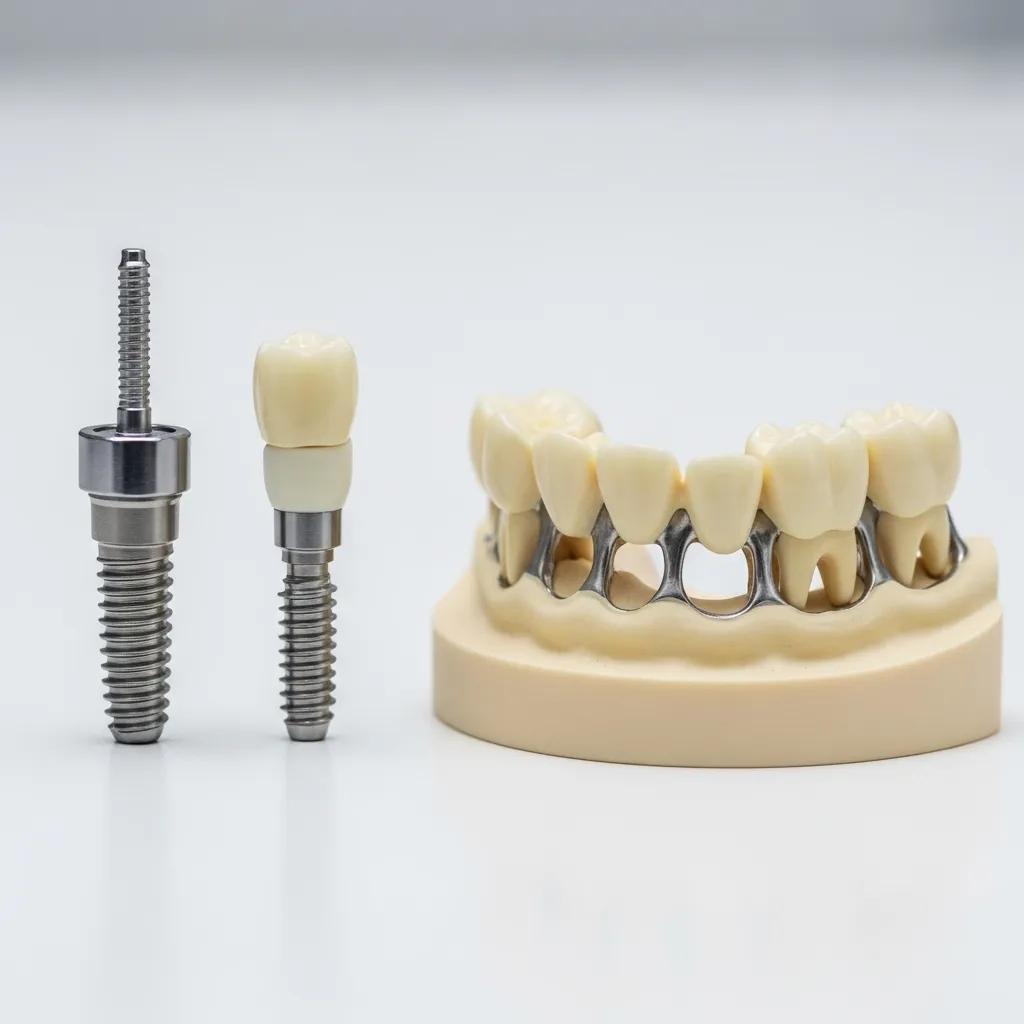
A dental implant replaces the tooth root with a biocompatible post—usually titanium or ceramic—inserted into the jawbone. That post supports an abutment and a crown so the tooth looks, feels, and functions like a natural tooth. Over several months the implant bonds with the bone (osseointegration), which stabilizes the restoration and helps prevent the bone loss that commonly follows an extraction. Because implants transfer bite forces to the jaw like a natural root, they preserve bone and often reduce the need for future work on neighboring teeth. Implant systems are modular—post, abutment, crown—so materials and components can be chosen for strength and esthetics. Up‑front costs vary by implant brand, crown material, and any adjunctive care such as grafting or sinus lifts, which helps explain why implants tend to cost more initially but can lower long‑term restorative needs.
What Is a Dental Implant?
Put simply, a dental implant is a root replacement anchored in the jaw that supports an abutment and a custom crown. The crown is matched in shape and shade to your adjacent teeth, and because the implant transfers chewing forces to bone, it helps maintain jaw volume. The modular nature of implants means individual parts can be repaired or replaced if needed. When placed in healthy bone and cared for with good oral hygiene, implants have strong success rates and are a reliable long‑term solution for single or multi‑tooth restorations.
What Is the Typical Initial Cost of Dental Implants?
Per‑tooth implant pricing typically reflects three main cost drivers: the surgical implant fixture and placement, the abutment and custom crown, and any extra procedures like bone grafting, sinus lifts, or extractions. Fees for imaging and lab work also affect the total. Simpler cases fall on the lower end of the range, while premium implant systems, complex placement, or substantial grafting increase cost and treatment time. For a precise local estimate that accounts for imaging and grafting, use the $79 FREE DENTAL CONSULTATION or Free Dental Implant Consult at Dentist in Denton – Dentures and Dental Implants to get a personalized quote and insurance breakdown.
What Are Dental Bridges and How Do They Compare?
A dental bridge spans a gap by anchoring a replacement tooth (pontic) to prepared adjacent teeth or, in some designs, to implants. Bridges restore chewing and appearance without placing a post in bone. Tooth‑supported bridges require preparing neighboring teeth for crowns, which removes enamel and can weaken those teeth over time—raising the chance of future root canal therapy or further restorations. Bridge types include traditional fixed bridges, Maryland (resin‑bonded) bridges, cantilever bridges, and implant‑supported bridges; each balances invasiveness, cost, and longevity differently. Up‑front bridge costs are often lower than implants, but maintenance, earlier replacement, and potential damage to abutment teeth factor into lifetime value.
What Is a Dental Bridge?
A bridge joins a pontic to one or more abutment crowns that are cemented to adjacent teeth or to implant abutments, restoring form and function across the missing‑tooth span. Traditional bridges require more tooth preparation, while Maryland bridges use bonded wings to limit reduction but may be less durable. Implant‑supported bridges use implants as anchors and combine the bone‑preserving benefits of implants with the efficiency of a multi‑unit prosthesis. The best bridge choice depends on tooth location, health of neighboring teeth, bite forces, and patient priorities about invasiveness and maintenance.
How Much Do Dental Bridges Cost Upfront?
Up‑front bridge pricing varies with the number of units (pontics plus abutment crowns), crown materials (porcelain‑fused‑to‑metal, full ceramic, zirconia), and lab fees. A single‑span traditional bridge often costs less per replaced tooth than an implant plus crown because lab and material costs are shared across units. Maryland or cantilever designs can be less expensive but may trade off strength and lifespan. When weighing costs, factor in likely future repairs or replacement—an initially cheaper bridge can cost more over time if abutment teeth fail or the prosthesis needs frequent work.
How Do Dental Implants and Bridges Compare in Long-Term Costs and Value?
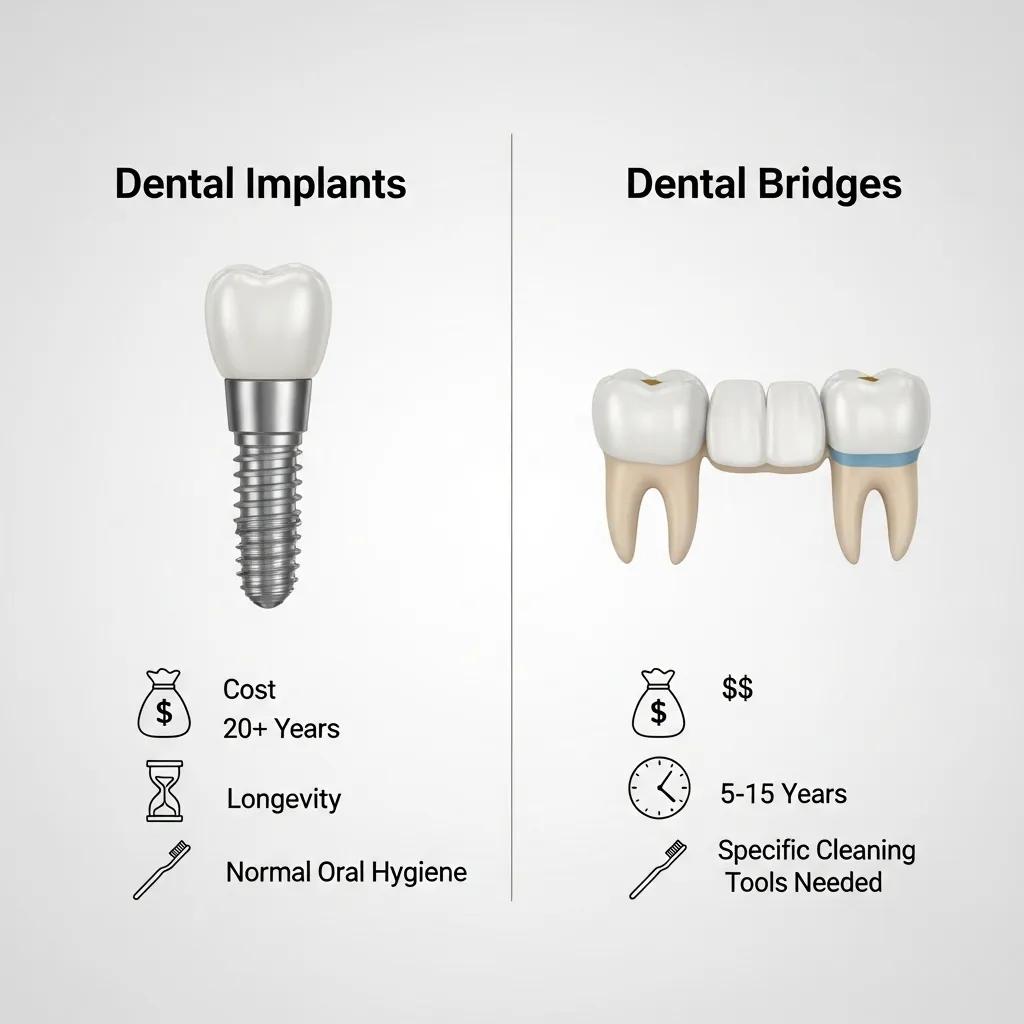
Comparing long‑term cost means looking past the sticker price to lifespan, maintenance, and indirect expenses—like treatment for neighboring teeth or later grafting. Implants usually carry higher up‑front costs but can last decades with relatively low maintenance. Bridges typically need replacement every 7–15 years and may create additional costs if abutment teeth deteriorate. Modeling 10‑ and 20‑year scenarios with realistic replacement and maintenance assumptions helps clarify lifetime value. The table below highlights typical initial cost ranges, expected lifespans, and common maintenance notes to help you evaluate value beyond the initial price tag.
Different restoration choices have distinct lifetime cost and maintenance profiles:
Restoration Type
Typical Initial Cost Range (USD)
Expected Lifespan
Common Maintenance / Replacement Notes
Single Dental Implant (post + crown)
$1,500–$6,000 per tooth
15–25+ years (often lifetime)
Low routine maintenance; crown may need replacement over decades
Traditional Fixed Bridge (per span)
$1,000–$3,500 per span
7–15 years
Requires replacement; risk to abutment teeth increases future costs
Implant-Supported Bridge (multi-unit)
$4,000–$15,000 per span
15–25+ years
Higher initial cost but fewer replacements if implants integrate well
This side‑by‑side shows why implants often provide better long‑term value—especially when bone preservation matters—though individual circumstances and budgets may make bridges the sensible short‑term choice. For an accurate local estimate that includes imaging, grafting, and insurance, schedule a Free Dental Implant Consult or Free Denture Consultation at Dentist in Denton – Dentures and Dental Implants to receive a written, personalized cost projection.
What Are the Long-Term Costs of Dental Implants vs. Bridges?
To illustrate, compare a midrange single implant with crown to a 3‑unit traditional bridge replacing one tooth over ten years. The implant’s higher initial price can be offset by a lower chance of replacement and fewer indirect procedures during that period. Real outcomes depend on crown wear, repairs, and the health of adjacent teeth; bridges can require recementation, new crowns, or root canal treatment on abutments. A free consult can produce numbers tailored to your mouth and local fees so you can model your own 10‑ or 20‑year scenario.
Cost-Utility Analysis: Dental Implants vs. Fixed Prostheses
1. When replacing a single missing tooth, patients often weigh effectiveness against limited finances. This study evaluates implant treatment as a surgical‑prosthetic option for losing a molar.
2. The analysis uses a cost‑utility approach from the patient’s perspective, comparing an implant‑supported single crown to a three‑unit fixed dental prosthesis over a 30‑year horizon modeled with Markov techniques.
3. Modeling results show the implant‑supported single crown provided 15.31 quality‑adjusted prosthesis years (QAPY) after 30 years. The incremental cost‑utility ratio was USD −1,434.
4. These findings suggest that, over three decades, implant treatment may be more cost‑effective than a three‑unit fixed prosthesis.
5. Advances in dental care raise overall costs, but improved quality of care and new technologies—such as implantology—can change value calculations. Financial concerns remain central for many patients, though aesthetics and durability also influence treatment choice.
Cost-utility analysis of an implant treatment in dentistry, 2021
The cited cost‑utility analysis indicates implants can be more cost‑effective than fixed prostheses over a 30‑year period, delivering more quality‑adjusted prosthesis years at a lower incremental cost in the modeled scenario.
How Does Longevity Affect the Overall Cost of Implants and Bridges?
Longevity alters the math: implants that function for 15–25+ years reduce the frequency of large restorative expenses and lower cumulative out‑of‑pocket costs compared with bridges that commonly need replacement every 7–15 years. Because implants preserve bone, they can also prevent future costs associated with bone loss, such as augmentation for later restorations. In simple terms, fewer replacements and fewer secondary procedures usually improve cost‑effectiveness. When deciding, weigh the sticker price against expected replacement cycles and the downstream benefits of bone preservation.
What Are the Pros and Cons of Dental Implants vs. Bridges?
Every restoration involves tradeoffs among durability, invasiveness, cost, and effects on surrounding teeth and bone. Implants offer lasting stability, maintain jawbone, and feel more like natural teeth but require surgery, a longer timeline, and a larger up‑front investment. Bridges are quicker and often less expensive initially, yet they alter adjacent teeth and typically need replacement sooner. The short list below summarizes the main clinical and patient‑experience advantages and drawbacks to help you compare.
Implant Advantages: Replace the tooth root, preserve bone, and offer long durability with high success rates.
Implant Considerations: Require surgery, take months to complete, and usually cost more up front.
Bridge Advantages: Faster timeline, often lower initial cost, and predictable esthetic results.
Bridge Considerations: Require preparation of adjacent teeth, have shorter lifespans, and may incur higher long‑term costs due to replacements.
These points show why your goals—budget, timeline, and desire to protect neighboring teeth—should guide the decision; the next sections go into more detail to help you choose.
What Are the Advantages of Dental Implants?
Clinically, implants act like natural roots, which maintains jawbone, supports facial structure, and provides strong chewing support without loading neighboring teeth. Patients typically report that implants feel and function closer to real teeth, and routine hygiene is straightforward—individual crowns are flossed just like natural teeth. High survival rates in healthy patients mean implants can improve quality of life and reduce the need for repetitive restorative cycles tied to bridge replacements or abutment failures.
What Are the Disadvantages of Dental Bridges?
Bridges can compromise healthy neighboring teeth because tooth‑supported bridges require removing enamel for crowns, which increases the risk of sensitivity, decay, or future root canals. Bridges also alter how bite forces distribute, which can accelerate wear and lead to earlier replacement. Cleaning around pontics can be more challenging and, if not done well, raise the risk of gum disease. While bridges often cost less initially, their finite lifespan and potential for damage to abutment teeth can create higher cumulative costs over time.
How Do Patient Factors Influence the Choice Between Implants and Bridges?
Your individual situation determines the best option: number and location of missing teeth, bone quantity and quality, overall health (for example, diabetes control or smoking), budget, and desired timeline all matter. For a single front tooth where esthetics is crucial, implants are often the best long‑term choice if bone and soft tissue allow. For back molars under heavy bite forces, implants may better protect neighboring teeth. If adjacent teeth already need crowns or a patient prefers a faster, non‑surgical route, a bridge can be a practical interim or long‑term solution. A simple checklist helps match your case to recommended options.
Bone quantity and whether grafting will likely be needed.
Condition and restorability of neighboring teeth.
Medical history and habits that affect healing.
Budget constraints and willingness to invest in long‑term solutions.
These criteria guide personalized treatment planning and lead to different recommendations for single versus multiple missing teeth, discussed next.
Which Dental Solution Is Best for Single vs. Multiple Missing Teeth?
For a single missing tooth, an implant is frequently preferred when bone and health permit because it protects adjacent teeth and preserves bone. For multiple adjacent missing teeth, options include multiple individual implants, an implant‑supported bridge, or a traditional multi‑unit fixed bridge—each option differs in cost, time, and maintenance. Full‑arch cases commonly use implant‑supported dentures or full‑arch implant protocols for maximum stability. The best choice balances clinical feasibility, long‑term upkeep, esthetics, and budget; a free consult helps compare projected outcomes and costs for your case.
How Does Bone Health Affect Implant or Bridge Suitability?
Bone quality and quantity directly affect implant candidacy and may require adjunctive procedures like bone grafting or sinus lifts, which add cost and time but enable implant placement where bone is otherwise insufficient. Bridges don’t need grafting because they anchor to teeth, making them attractive when bone loss is advanced or when patients want to avoid surgery. However, bridges don’t stop ongoing bone resorption, which can alter esthetics and fit over time. Knowing the bone implications helps weigh the convenience of a bridge against the long‑term protective benefits of an implant.
What Insurance and Financing Options Are Available for Dental Implants and Bridges in Denton, TX?
Insurance coverage for implants versus bridges varies. Many PPO plans offer partial benefits for crowns and bridges but treat implants separately—with limited benefits or exclusions. Expect benefit checks and pre‑authorizations for larger procedures to clarify your out‑of‑pocket responsibility. Local financing can spread costs through monthly plans or third‑party financing; Dentist in Denton – Dentures and Dental Implants accepts most PPO plans and offers flexible financing options. A free consult with a written estimate is the most reliable way to understand local coverage and payment terms.
Below is a compact table comparing common local financing and insurance options with typical coverage patterns so Denton patients can quickly evaluate ways to afford care.
Option
Typical Coverage / Terms
Practical Note
PPO Dental Insurance
Partial coverage for crowns/bridges; implant coverage varies
Bring insurance details to your consult for a benefit check
Flexible Financing Plans
Monthly payment options or third‑party financing with varying APRs
Financing spreads cost and reduces up‑front burden
Use the consult to get a written estimate and discuss financing
In-Office Payment Options
May include phased treatment billing
Discuss staged care at your consult
In short, insurance rarely covers implants in full, but financing options can make them attainable. Schedule a Free Dental Implant Consult or Free Denture Consultation to explore payment plans and get a tailored cost breakdown from Dentist in Denton – Dentures and Dental Implants.
Which Insurance Plans Cover Dental Implants and Bridges?
Most PPO plans include some restorative benefits for crowns and bridges, but implant coverage varies and may be limited or excluded. Coverage often depends on whether the insurer classifies an implant as medically necessary versus elective. Pre‑authorization and a benefit check clarify what an insurer will pay. Bring your insurance card and prior records to the free consult so our team can run benefits and outline your likely out‑of‑pocket costs, including annual maximums, waiting periods, and frequency limits.
What Flexible Financing Options Does Dentist in Denton Offer?
Dentist in Denton – Dentures and Dental Implants accepts most PPO plans and offers flexible financing to help patients manage implant and bridge costs. Specific terms are discussed during the free consult so we can match treatment scope with monthly payment preferences. Financing may include in‑office phased billing or third‑party lending that breaks large investments into manageable payments. During your Free Dental Implant Consult or Free Denture Consultation we’ll review financing pathways alongside a written estimate so you can choose the option that fits your budget without pressure.
What Are the Key Differences in Procedure and Recovery Between Implants and Bridges?
Procedures and recovery differ significantly. Implants require surgical placement of a post and a healing period for osseointegration before the final crown is attached. Bridges involve tooth preparation, impressions or scans, temporization, and faster final cementation across fewer visits. Implant recovery may include some swelling and a short post‑op period, with osseointegration taking several months; bridge treatment usually completes in a few weeks and doesn’t involve bone surgery, but it permanently alters abutment teeth. The table below summarizes steps and typical timelines so you can plan visits, healing, and interim care.
Tooth preparation → impression/scan → temporization → final cementation
2–6 weeks; fewer surgical steps
Bone Graft
Graft placement → healing → implant placement
Adds 3–6 months depending on graft size
In short, bridges give a quicker timeline, while implants require staged surgical steps but offer long‑term structural benefits and bone preservation. The following sections expand on surgical and prosthetic workflows.
How Is the Dental Implant Procedure Performed?
Implant treatment starts with diagnostic imaging and planning, followed by surgical placement of the implant post into the jaw under local anesthesia (with sedation available if needed). After placement, a healing period allows the implant to integrate with bone; a temporary restoration can be used for esthetics and function during this time. Integration usually takes a few months, depending on bone quality and any grafting. Once stable, an abutment is attached and a custom crown is fabricated and placed. We provide post‑op care instructions, oral hygiene guidance, and periodic follow‑ups to track integration and prosthetic performance.
What Does the Dental Bridge Procedure Involve?
A bridge requires preparing the abutment teeth by removing enamel to fit crowns, taking impressions or scans, placing a temporary bridge for function and esthetics, and then delivering the final cemented prosthesis when the lab work is complete. The process takes several appointments over a few weeks and avoids bone surgery, shortening recovery. Good hygiene under the pontic and around abutments is essential to prevent decay and gum problems. Because the procedure alters natural teeth, protecting the long‑term health of abutments is a key planning consideration.
How Can You Schedule a Free Consultation to Decide Between Dental Implants and Bridges?
Booking a focused, no‑pressure consult turns general comparisons into a personalized plan with exact costs, timelines, and insurance/financing options. A standard free consult includes an exam, review of your dental and medical history, any needed imaging or records review, and a written treatment plan with pricing and financing options. To get the most from your visit, bring your insurance card and any recent dental x‑rays or records. During the consult, clinicians evaluate bone status, adjacent teeth, and your priorities—function, esthetics, and budget—to recommend the best choice. Dentist in Denton – Dentures and Dental Implants lists a “$79 FREE DENTAL CONSULTATION” and offers Free Dental Implant Consult and Free Denture Consultation options to produce individualized estimates and discuss financing.
The free consult workflow and how to prepare:
Intake and Brief History: Our staff collect medical and dental history to spot factors that affect treatment and healing.
Examination and Imaging Review: A clinical exam and any needed x‑rays or scans assess bone and tooth status.
Treatment Options and Estimate: The clinician explains options (implant vs. bridge), realistic timelines, and provides a written cost breakdown with financing choices.
How Do Free Dental Implant and Bridge Consultations Work at Dentist in Denton?
At Dentist in Denton – Dentures and Dental Implants, free consultations assess whether you’re a candidate for implants or bridges through an intake, clinical exam, and review of imaging when available. The goal is to present clear, personalized options, realistic timelines, and financial plans. Consults are educational and non‑pressured: we explain any needed adjunctive procedures (like bone grafts), present expected lifespans and maintenance, and provide a written estimate. We also review your insurance benefits and available financing so you can compare immediate costs versus long‑term value and make an informed choice.
How to Book Your Free Dental Consult in Denton, TX?
To book a free consult, choose the $79 FREE DENTAL CONSULTATION or select a Free Dental Implant Consult or Free Denture Consultation and bring your insurance information and any recent records; the office will confirm logistics and outline what to expect at your appointment.
When scheduling, ask which imaging will be done and whether any pre‑visit forms are needed to speed your visit.
After booking, you’ll receive a confirmation with arrival instructions and information about how the consult will deliver a written estimate and financing discussion.
Scheduling via our online portal or by phone helps secure your preferred appointment time and lets staff note any consult preferences.
Choose the consult type: $79 FREE DENTAL CONSULTATION, Free Dental Implant Consult, or Free Denture Consultation.
Prepare documents: Bring your insurance card and any prior dental imaging or records.
Attend consult: Receive an exam, imaging if needed, personalized treatment options, a written estimate, and a financing conversation.
This simple booking and preparation process moves you from research to action so you can compare options with clear local pricing and no surprises.
Frequently Asked Questions
What Factors Should I Consider When Choosing Between Implants and Bridges?
Consider the number and location of missing teeth, bone quality, health of adjacent teeth, budget, and timeline. Implants usually offer better long‑term value and preserve bone; bridges can be a faster, non‑surgical option. Your daily oral hygiene habits also affect longevity. A dental consultation will clarify the best choice for your mouth.
How Long Does the Dental Implant Procedure Take?
Implant treatment typically spans several months. The post is placed surgically, followed by osseointegration, which commonly takes 3–6 months. After integration, an abutment is attached and a custom crown is placed. If bone grafting is needed, add an extra 3–6 months. Bridges, by contrast, usually finish in a few weeks.
Are There Any Dietary Restrictions After Getting Implants or Bridges?
Yes. After implant surgery, stick to soft foods and avoid hard or chewy items for several weeks to support healing and integration. After receiving a bridge, be cautious with very hard foods until you’re comfortable. Once fully healed, most people return to a normal diet, but consistent oral hygiene remains essential for longevity.
What Is the Success Rate of Dental Implants Compared to Bridges?
Implants generally show higher long‑term success. Studies report implant success rates around 90–95% over ten years when placed in healthy bone and maintained properly. Traditional bridges often need replacement every 7–15 years depending on abutment health and oral care. Actual longevity varies with individual circumstances.
Can I Get Implants or Bridges if I Have Gum Disease?
Active gum disease complicates both options. For implants, gum disease must be treated before placement to reduce the risk of failure. For bridges, healthy abutment teeth and gums are essential. A dental professional can assess your gum health and recommend appropriate treatment before restorative work.
What Maintenance Is Required for Implants and Bridges?
Both require regular maintenance. Implants need routine dental checkups and excellent oral hygiene to prevent peri‑implant disease and preserve bone. Bridges need careful cleaning around abutments to avoid decay and gum problems. Regular professional cleanings and exams help catch issues early.
How Do I Know If I Am a Good Candidate for Implants or Bridges?
Candidacy depends on the number and location of missing teeth, bone quality, and the health of surrounding teeth. Patients with sufficient bone and good oral health are often good implant candidates; those with compromised adjacent teeth or who prefer a non‑surgical route may choose a bridge. A consultation with imaging provides a personalized recommendation.
Conclusion
Deciding between implants and bridges means weighing near‑term cost, long‑term value, and what’s best for your oral health. Implants offer lasting durability and preserve bone, while bridges can be faster and less invasive up front. For guidance tailored to your mouth and budget, schedule a free consultation with Dentist in Denton – Dentures and Dental Implants. Take the first step toward restoring your smile and confidence with a clear, written plan.