Dental Implant Patient Reviews Dallas: From Doubt to Confidence Through Real Patient Testimonials
Real patient testimonials help prospective dental implant patients move from doubt to confident decisions by showing real outcomes, typical recovery patterns, and practical trade-offs. This article explores how narratives from Dallas-area patients clarify common concerns about pain, cost, procedure complexity, and long-term value, and how those personal reports change decision-making for restorative dentistry. Readers will learn what doubts most often stop people from choosing dental implants, how testimonials function as social proof, the key benefits patients report after implants, and the local success-rate context using recent review data. The piece also explains how patient experiences address anxiety and natural-feel questions, paints a picture of everyday life after implants, and maps a clear path to action via a Free Dental consultation. Throughout, targeted terms such as dental implants, dental implants in Dallas, dental implant patient testimonials, and free dental implant consult Dallas are used to connect search intent to practical next steps. By the end you should feel equipped to evaluate the evidence, compare restorative options like implant-supported dentures and single-tooth implants, and know exactly what to expect when arranging a consult.
What Are the Common Doubts Patients Have Before Choosing Dental Implants?
Dental implant candidacy often begins with doubt because the treatment sits at the intersection of oral surgery and restorative dentistry, which feels both technical and permanent to many patients. The mechanism of concern typically centers on perceived invasiveness — placing a titanium implant post into jawbone — and whether the osseointegration process will succeed, which directly affects expected longevity and function. Patients weigh these biological and mechanical factors against practical concerns such as cost, the number of appointments, and downtime, so understanding the root of doubt helps explain why testimonials carry weight in the decision. The next paragraphs break down the emotional and financial doubts patients voice and show how peer accounts reduce uncertainty by describing real experiences.
What Fears and Questions Do Dallas Patients Commonly Face?
Many Dallas patients express fear about pain during and after implant placement, questions about anesthesia and sedation options, and uncertainty about how recovery will affect work and family life. These emotional concerns are compounded by trust questions: who will perform the surgery, what qualifications and follow-up care are provided, and how predictable are outcomes for someone with their specific oral health. Reports from local review aggregations often reveal that procedural details, such as whether sedation was offered and how pain was managed, are decisive in shifting a reader’s perception from anxious to reassured. Understanding these fears sets up why narrative detail—describing actual recovery timelines and support from clinic staff—functions as an effective reassurance mechanism in testimonials.
How Do Cost and Procedure Complexity Affect Patient Decisions?
Perceived cost and the multi-step nature of implants—consultation, imaging, surgical placement, healing, and final restoration—are major deterrents that push patients to seek peer validation before committing. Many potential patients assume implants are prohibitively expensive and worry about financing, leading them to favor less invasive or lower-cost options unless they find convincing stories showing long-term value. Testimonials that explicitly discuss financing options, staged treatment plans, or comparative lifetime costs versus dentures can recalibrate expectations and make implants seem attainable. This economic context explains why clear, structured patient accounts about budgeting and the consult stage are especially persuasive for Dallas-area decision-makers.
Dental Implant Treatment Decisions: Cost and Patient Considerations
The aim of this study is to examine how clinicians and patients negotiate clinical need and treatment decisions within a context of finite resources. Dental implant treatment is an effective treatment for missing teeth, but is only available via the NHS in some specific clinical circumstances. The majority of people who receive this treatment therefore pay privately, often at substantial cost to themselves. People are used to paying towards dental treatment costs. However, dental implant treatment is much more expensive than existing treatments – such as removable dentures. We know very little about how dentists make decisions about whether to offer such treatments, or what patients consider when deciding whether or not to pay for them.
Paying for treatments? Influences on negotiating clinical need and decision-making for dental implant treatment, CE Exley, 2009
How Do Real Patient Testimonials Build Confidence in Dental Implant Choices?
Testimonials build confidence through social proof, detailed process narratives, and by setting realistic expectations about pain, function, and appearance. Mechanically, when a reader sees multiple independent accounts that describe the same positive outcome—improved chewing, restored smile, minimal unexpected complications—that pattern functions as an informal success-rate signal and reduces perceived risk. Multimedia elements such as before-and-after photos or video transcripts add credibility by linking visual evidence to narrative claims, and structured summaries of aggregated review metrics help translate subjective satisfaction into actionable trust. The following subsections examine the narrative patterns seen in Dallas reviews and how specific testimonial content nudges readers toward scheduling a consult.
What Stories Do Dallas Patients Share About Overcoming Doubt?
Dallas patient narratives commonly follow a recognizable arc: initial doubt due to fear or cost, a consult that clarified options, surgery with manageable discomfort, and a recovery period followed by meaningful functional and psychosocial improvements. Many reviews emphasize turning points such as a clear treatment plan or a supportive clinical team that explained the osseointegration timeline, which reframed an intimidating procedure into an intelligible sequence of steps. Reports also detail small measurable outcomes—returning to eating certain foods or smiling without embarrassment—that concretize benefits beyond abstract claims of “feeling better.” These composite journeys illustrate how layered testimonial detail, from consult to long-term life changes, helps readers imagine a similar successful path for themselves.
How Do Testimonials Influence Patient Trust and Decision-Making?
Testimonials influence trust by repeatedly signaling consistent themes: effective pain control, predictable healing timelines, and durable outcomes that match patient goals like improved chewing ability or confidence. When multiple independent reviewers describe similar satisfaction with provider communication, follow-up care, and functional results, prospective patients infer competence and lower risk. Quantitative review signals—such as an average rating and the number of recent reviews—support qualitative stories by showing breadth of positive experience across a clinic’s patient base. Together, narrative detail plus aggregated sentiment creates a persuasive package that converts readers’ interest into action, often motivating them to request a Free Dental consultation to confirm personal eligibility.
Get Patient to schedule an appointment for a Free Dental Consult.
What Are the Key Benefits Highlighted in Dental Implant Success Stories Dallas?
Dental implant success stories in Dallas repeatedly emphasize three categories of benefits: functional improvement, aesthetic renewal, and long-term oral health preservation. Functionally, patients report restored chewing ability and clearer speech; aesthetically, they describe restored smiles and easier social interactions; medically, implants help preserve jawbone structure via osseointegration, supporting overall oral health. These benefits are described in both short-form reviews and longer patient narratives and commonly reference specific daily-life improvements such as eating previously avoided foods, speaking in public without self-consciousness, and reduced reliance on removable prosthetics. Below is a structured table that summarizes the most frequently reported benefits, which helps translate subjective testimonials into measurable outcomes.
Reported Benefit
How It’s Measured
Typical Reported Outcome
Confidence & Social Comfort
Patient-reported social engagement
Increased smiling and participation in social events
Chewing Ability
Return to varied diet items
Ability to eat apples, steak, and other previously avoided foods
Appearance & Aesthetics
Visual comparison and photos
Natural-looking restorations matched to surrounding teeth
Long-term Oral Health
Bone preservation indicators
Reduced bone loss risk versus removable dentures
These comparisons show how testimonial language aligns with concrete functional and psychosocial outcomes that matter to patients.
Dental implant testimonials often make the benefits tangible through brief examples and patient-voiced descriptions of regained capabilities. Readers value accounts that quantify changes—such as eating certain foods again—because they convert abstract benefits into specific lifestyle changes. Testimonials that include before-and-after photos or describe exact behaviors regained make the value proposition of implants clearer and more persuasive. The next section examines long-term quality-of-life improvements patients report and how those claims align with broader industry success-rate data.
How Do Implants Improve Confidence, Chewing Ability, and Appearance?
Implants replace lost tooth structure with a titanium post and crown system that functions similarly to a natural tooth, so patients commonly describe immediate improvements in bite stability and food handling. These functional gains directly influence confidence: when chewing becomes reliable and dentures are no longer a worry, many patients report smiling more and engaging in social situations without self-consciousness. Aesthetic improvements stem from crowns that match color and contour of neighboring teeth, which helps integrate restorations into the smile line and reduces stigma associated with tooth loss. Practical examples cited in reviews include returning to communal meals without avoidance and feeling comfortable in close-up photos, which together make a persuasive case for the transformative potential of implants.
What Long-Term Quality of Life Improvements Do Patients Experience?
Over months and years following implant placement, patients report durable improvements such as simplified oral hygiene routines, consistent chewing performance, and fewer prosthetic adjustments than with removable options. This long-term quality-of-life improvement ties to the biomechanical stability provided by osseointegration; when the titanium post bonds to bone, the restoration behaves like a permanent part of the mouth, reducing worry about shifting or slipping. Testimonials often reference the comfort of maintenance routines and a declining need for repairs or replacements, which shifts the value calculation from short-term cost to long-term durability. These long-horizon outcomes are central to patient decisions that prioritize lifetime function and self-image.
How Successful Are Dental Implants According to Dallas Patient Reviews?
Success in dental implant care is best understood as a combination of clinical survival rates and patient-reported satisfaction; together these define real-world effectiveness. Clinically, modern implant systems typically report survival figures in the mid-90s percent range over multi-year follow-up, indicating high durability when performed and maintained correctly. Locally, aggregated review data provides an additional lens: a high average review rating with a substantial number of recent reviews suggests consistent positive patient experience in the Dallas area. The ensuing table summarizes success-rate claims and local review metrics, translating technical survival figures into the patient-perceived effectiveness reported in area testimonials.
Metric
Definition
Reported Value / Local Signal
Clinical Survival Rate
Percent of implants intact after several years
Typical range 95–98% (industry standard)
Local Review Average
Patient satisfaction aggregated across reviews
Local average rating 4.7 stars, 443 reviews (April 2024 snapshot)
Patient-Perceived Effectiveness
Long-term functional satisfaction
High frequency of comments about chewing and comfort
What Is the Latest Success Rate of Dental Implants in Dallas?
Current clinical literature places dental implant survival commonly between 95% and 98% over five to ten years when performed under appropriate protocols and maintained with good oral hygiene. Translating this to a Dallas patient context, local review sentiment and high average ratings serve as corroborating evidence that many patients experience outcomes consistent with those clinical benchmarks. While individual health factors and case complexity influence prognosis, the combined signal—strong clinical rates plus favorable local reviews—gives prospective patients a reasonable expectation of long-term success. This numeric framing reduces uncertainty and helps people compare implants with alternative restorative options like bridges or dentures.
How Do Patient Satisfaction Ratings Reflect Implant Effectiveness?
High patient satisfaction ratings typically cluster around themes of communication, predictability of outcomes, and post-operative support, indicating that perceived effectiveness is as much about clinical results as it is about the care experience. Reviews that praise staff responsiveness, clear explanation of stages, and supportive follow-up care often report better subjective outcomes, suggesting that practice processes influence both recovery and satisfaction. In Dallas reviews, common satisfaction themes include minimal unexpected complications, helpful scheduling, and follow-up that addresses concerns promptly, which collectively reflect both effectiveness and a positive care experience. These recurring themes in patient feedback help readers infer which aspects of care contribute most to successful implant journeys.
How Do Patient Experiences Address Common Dental Implant Concerns?
Actual patient experiences frequently provide concrete answers to the most common implant concerns—pain, recovery timeline, longevity, and whether implants feel natural—by describing what they felt and how they managed recovery. These accounts often include procedural details such as use of local anesthesia or sedation options, staggered treatment plans for complex cases, and routine aftercare steps that minimized complications. Such descriptions demystify the clinical process and help future patients set realistic expectations for pain management and function. Below, sections examine anxiety management and long-term natural-feel perceptions as reported by patients in the Dallas area.
How Do Patients Overcome Anxiety and Fear of Pain?
Patients commonly report that pre-procedure counseling, available sedation options, and attentive staff significantly reduce anxiety and lead to lower-than-expected pain experiences. Practical coping strategies mentioned include staged treatment (doing one implant at a time), using sedation dentistry for those with high anxiety, and receiving detailed at-home care instructions to manage discomfort during early healing. Many reviewers specifically highlight the role of clear communication—knowing what to expect at each step—as the factor that lowered fear and improved perceived control. These practical approaches demonstrate that anxiety and pain fears are addressable through both clinical techniques and supportive team behavior.
Introducing high‐cost health care to patients: dentists’ accounts of offering dental implant treatment. This paper explores the challenges and strategies involved where a large personal financial investment by the patient is required. It examines how dentists present and discuss dental implant treatment (DIT) as an option for patients, considering the financial implications and patient decision-making processes.
Introducing high‐cost health care to patients: dentists’ accounts of offering dental implant treatment, CR Vernazza, 2015
What Do Patients Say About Implant Longevity and Natural Feel?
Patient descriptions of implant longevity often emphasize perceived permanence and a return to normal eating and speech, with many noting that restorations feel similar to natural teeth after the healing phase. Comments about a “natural feel” typically reference stability under bite forces, absence of movement, and comfort when chewing a range of foods, which together validate the mechanical success of the implant-abutment-crown-system. Patients also describe maintenance behaviors—regular hygiene, periodic professional check-ups—as contributing factors to long-term success, aligning anecdotal reports with established clinical best practices. These patient-reported behaviors reinforce the expectation that implants can deliver lasting, natural-feeling function when paired with appropriate care.
What Does Life After Dental Implants Look Like According to Dallas Patients?
Life after dental implants as described by Dallas-area patients centers on restored routines, renewed confidence, and simpler long-term maintenance compared with removable prosthetics. Socially, many report increased willingness to smile, speak, and dine in public without worry, which influences work, relationships, and day-to-day comfort. Functionally, patients highlight regained ability to eat a broader diet and improved comfort during chewing, which affects nutrition and lifestyle. The next subsections explore social confidence and functional improvements in more detail so prospective patients can picture the practical and emotional outcomes implants provide.
How Do Patients Describe Their Smile and Social Confidence Changes?
Reviews commonly describe regained confidence in social settings—attending events, accepting photographs, and speaking in meetings—after losing the worry associated with missing or unstable teeth. The psychological mechanism is straightforward: stable, natural-looking restorations reduce self-consciousness and permit more spontaneous smiling, which in turn improves social interactions and perceived quality of life. Patients also emphasize subtle changes such as reduced tendency to cover their mouth when speaking or laughing, indicating that implants affect both large and small behavioral shifts. These psychosocial reports help readers understand that the benefits extend beyond mechanics into everyday social functioning.
What Functional Improvements Do Patients Notice in Daily Life?
Functional improvements reported in testimonials include better ability to bite and chew a range of foods, increased clarity of speech in some cases, and comfort during prolonged meals without slippage or soreness. These gains translate into lifestyle changes: reintroducing nutritious foods, feeling comfortable in restaurants, and avoiding social avoidance linked to dental embarrassment. Patients also note time savings from fewer prosthetic adjustments and less daily worry about appliance maintenance, which together increase the perceived convenience of implant-supported solutions. These specific functional outcomes make the long-term value proposition of implants tangible for those weighing options.
How Can You Start Your Journey From Doubt to Confidence With a Free Dental Implant Consult?
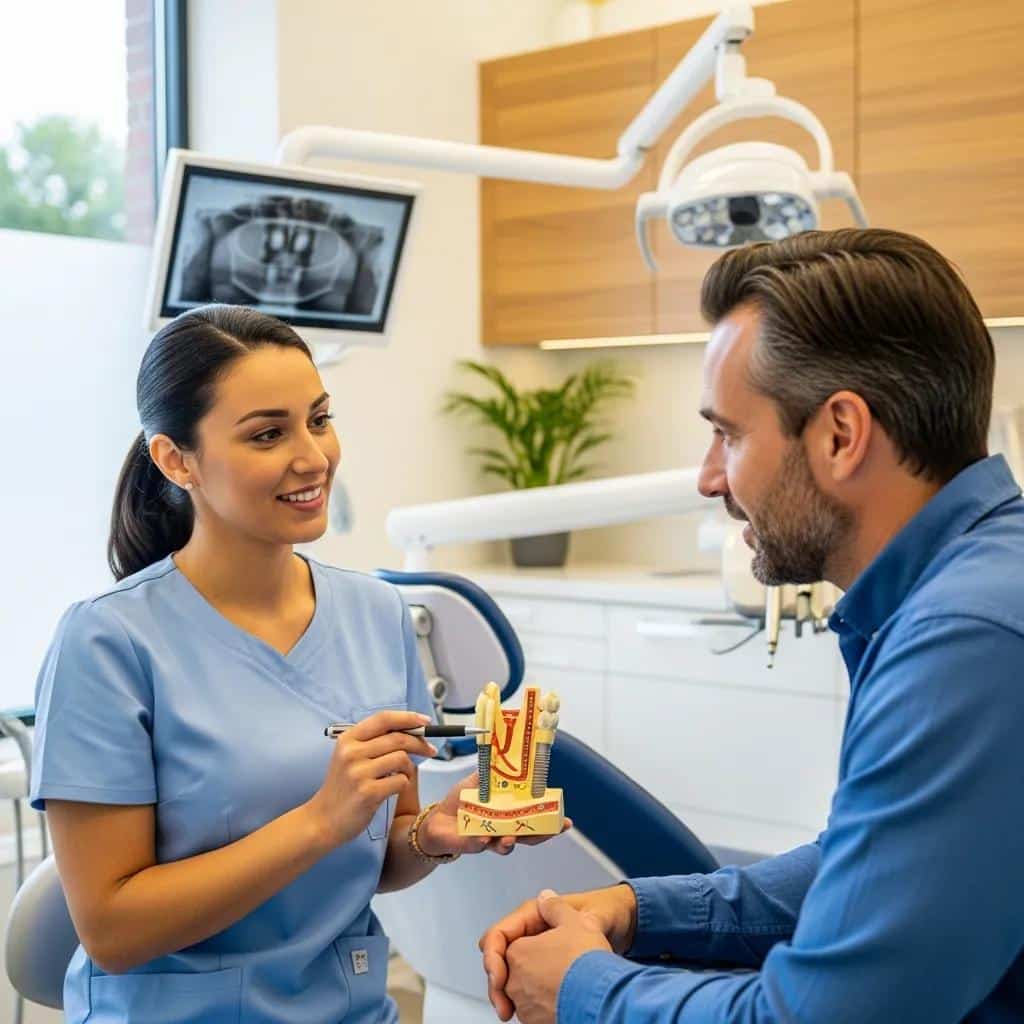
A clear path from initial doubt to informed decision-making begins with a structured free consult that provides assessment, imaging, and a personalized treatment plan to set realistic expectations and next steps. The consultation typically includes an oral exam, discussion of restorative options (single-tooth implant, implant-supported denture, full-arch solutions like All-on-4 style implants), imaging as indicated, and a treatment timeline that addresses pain control, financing, and follow-up care. Presenting these components up front reduces cognitive load for patients and makes the process more navigable; testimonials frequently cite the consult as the pivotal moment when doubt shifted to confidence. The table below outlines consult components to set clear expectations and help prospective patients prepare questions.
Consultation Component
Purpose
What Patients Gain
Oral Examination
Assess tissue and bone health
Immediate feedback on candidacy
Imaging (X-rays/CBCT if needed)
Visualize bone structure and planning
Accurate treatment planning
Treatment Options Review
Explain single-tooth vs. full-arch approaches
Understand trade-offs and timeline
Financing & Scheduling Discussion
Outline costs and appointment sequence
Practical path to access care
What Should You Expect During a Free Dental Implant Consultation?
During a free consult, expect a comprehensive exam that defines your candidacy by assessing gum health and bone levels, followed by imaging when needed to guide planning, and a clear discussion of implant options, timelines, and pain-management strategies. Clinicians typically walk through the sequence—consult, surgical placement, healing/osseointegration, and final restoration—while addressing individualized questions about anesthesia and expected time off work. Patients report that transparent explanations during this stage significantly reduce anxiety because they convert abstract fears into a checklist of concrete steps. Bringing a list of priorities (aesthetic goals, budget constraints, and work-related timing) helps ensure the consult covers the factors that matter most to you.
Initial Exam: Clinician assesses teeth, gums, and bone to determine implant candidacy.
Imaging Review: Diagnostic images clarify bone quantity and ideal implant positioning.
Treatment Plan: Options are reviewed, including single-tooth, implant-supported dentures, or full-arch solutions.
Financial Discussion: Available payment or staged-treatment options are outlined to match personal budgets.
These steps set expectations and provide a decision-making framework; patients consistently cite this consult clarity as a turning point from doubt to action.
For those ready to take the next step, Affordable Dentist Near Me of Dallas offers a Free Dental consultation and Free implants consultation to help you evaluate candidacy and receive a personalized plan in a comforting environment with EVERYDAY LOW FEES. The practice is located at 14902 Preston Road STE 401 Dallas, Texas 75254 and provides consults that many local reviewers describe as informative and reassuring. Get Patient to schedule an appointment for a Free Dental Consult.
How Do Dallas Patients Schedule and Benefit From Free Consults?
Dallas patients report scheduling ease through online booking systems or direct clinic contact and describe immediate benefits from the consult such as reduced anxiety, a clear roadmap for treatment, and transparent cost discussions. The consult often eliminates surprises by addressing both clinical and logistical questions—what kind of restoration fits the patient’s lifestyle, how many visits are required, and how pain will be managed—so attendees leave with actionable next steps. Testimonials note that the consult’s informational value frequently leads to patients feeling confident enough to proceed with staged treatment plans tailored to their budget and timing constraints. This practical clarity helps convert informed interest into scheduled care.
What Are the Most Frequently Asked Questions About Dental Implants From Dallas Patients?
Dallas patients most often ask about implant lifespan, whether implants feel natural, the pain involved, and how implants compare to dentures or bridges in daily life. Short, authoritative answers that combine clinical expectation and patient-experience signals perform well for prospective patients seeking quick reassurance. The FAQ-style responses below target those high-frequency questions with concise evidence-based answers and referral to deeper sections above for readers who want detailed context.
How Long Do Dental Implants Last and Are They Worth It?
Dental implants typically last decades with proper care, often offering a long-term solution that outlasts removable prosthetics and many bridge restorations, which is why many patients consider them worth the initial investment. Clinical survival rates commonly fall between 95–98% over multi-year follow-up, and patient reports emphasize reduced maintenance and a return to normal function as key components of perceived value. When assessing “worth,” consider lifetime cost, quality of life improvements such as restored chewing ability and confidence, and reduced need for future prosthetic adjustments; for many patients, these factors justify choosing implants over temporary or removable alternatives.
Can Dental Implants Feel Natural and Support Normal Eating?
Yes—when properly planned and executed, dental implants often feel and function like natural teeth, enabling patients to eat a wide range of foods without instability or discomfort. Patient testimonials highlight restored ability to consume items previously avoided, such as whole fruits and meats, and describe implants as indistinguishable from natural teeth after healing. The natural feel stems from the stable anchoring of the implant post in bone and the precisely designed crown, and longevity is supported by good oral hygiene and periodic professional maintenance. These patient experiences align with clinical expectations, making implants a practical choice for restoring both form and function.
Common patient questions answered: How long will the implant process take? The timeline varies, but consult and imaging clarify individualized schedules.Will it hurt? Pain is typically manageable with modern anesthesia and aftercare protocols.How long do implants last? With proper care, implants commonly last decades and often outlast alternatives.
Durability: Implants are a long-term solution that can last decades with good care.
Functionality: They commonly restore near-natural chewing and speech function.
Comfort: After healing, many patients report comfort comparable to natural teeth.
These FAQ items are designed to address the most pressing queries and guide readers toward scheduling a Free Dental consultation if they seek personalized answers.
Ask about candidacy during the Free Dental consultation: Bring medical history and questions about budget and timeline.
Request imaging if recommended: Accurate imaging leads to predictable planning.
Discuss anesthesia preferences: Knowing sedation options can reduce anxiety and improve comfort.
Oral Exam
Yes (Free Dental consultation)
Immediate assessment of candidacy
Imaging
As indicated
Accurate surgical planning
Treatment Options Review
Yes (Free implants consultation)
Clear comparison of restorative choices
Get Patient to schedule an appointment for a Free Dental Consult.