Top Dental Implants in Longview: Popular Brands Reviewed
Navigating Implant Choices: A Review Comparison of Popular Dental Implant Brands and Types for Informed Patient Decisions
Dental implants are replacements for missing teeth that restore function and appearance by integrating a biocompatible fixture into the jawbone, and choosing the right brand and implant type directly affects long-term success, healing time, and aesthetic outcome. This article helps patients aged roughly 40–60 understand why brand technology, implant type, and material matter, and it frames practical decisions around current evidence, common clinical pathways, and local cost considerations in Longview, TX. Many patients feel overwhelmed by brand names like Straumann, Nobel Biocare, Dentsply Sirona, and Zimmer Biomet and by choices such as endosteal, mini, All-on-4, or zygomatic solutions; this guide distills the defining attributes and trade-offs so readers can match options to their oral health, bone quality, and budget. You will find brand-level comparisons, clear descriptions of implant types with pros and cons, a focused titanium-versus-zirconia comparison, cost drivers specific to Longview, and a step-by-step decision checklist that includes what to expect at consultation and how to care for implants after placement. Throughout the article, related concepts such as osseointegration, bone grafting, CAD/CAM prosthetics, and implant financing are integrated so you can make evidence-informed choices and prepare effective questions for your clinician.
Which Are the Best Dental Implant Brands in 2025?
A brand matters because its implant design, material science, and surface technology influence primary stability, osseointegration speed, and restorative compatibility; understanding these differences helps patients pick systems with documented performance for their clinical needs. Recent trends in 2025 emphasize surface treatments that accelerate bone integration, alloy and ceramic innovations that improve strength-to-weight ratios, and digital workflows that streamline prosthetic fit. Patients typically prioritize brands that combine clinical evidence with availability of prosthetic components and technical support, while clinicians often balance that against cost and case-specific indications. The following brand snapshots summarize why clinicians recommend particular manufacturers for common use-cases and highlight mid-tier options for patients seeking value.
Different implant systems emphasize distinct technologies and clinical benefits:
Straumann is frequently chosen for material innovation and surface treatments that support faster osseointegration.
Nobel Biocare is known for prosthetic-driven design, especially in full-arch restorations like All-on-4 workflows.
Dentsply Sirona and Zimmer Biomet focus on digital integration and system consistency for predictable restorative outcomes.
These brand-level distinctions lead naturally to a quick, scannable comparison to guide patient questions during consultation.
Brand
Key Technology / Material
Benefit / Typical Use Case
Straumann
Roxolid alloy; SLActive surface
Higher strength-to-size ratio and favorable early osseointegration for tighter situations
Nobel Biocare
Prosthetic-driven designs; All-on-4 protocols
Full-arch immediate-load workflows and versatile angled implant options
Dentsply Sirona
Digital prosthetic integration and components
Streamlined CAD/CAM workflows for accurate restorative fit and efficient lab communication
Zimmer Biomet
Engineered platform consistency
Predictable component compatibility and a broad range of implant geometries
BioHorizons / MegaGen (value tier)
Cost-focused systems with clinical track records
Viable options for budget-conscious patients when clinician expertise matches case needs
This table clarifies typical clinical rationales by brand and helps patients prioritize which attributes—surface treatment, prosthetic workflow, or cost positioning—matter most for their case. The next section explains the main implant types and why the placement method often matters more than brand alone.
What Makes Straumann Implants a Leading Choice?
Straumann’s reputation rests on material innovations and implant surface science that are designed to promote reliable osseointegration and mechanical strength, and these technologies translate into clinical benefits in many single-tooth and multi-unit cases. The company’s alloy options and optimized surface treatments aim to improve initial stability and support early loading protocols when bone quality permits, which is important for patients who want shorter restorative timelines. Clinicians may prefer Straumann in situations where a high strength-to-diameter ratio is needed or where documented early integration data influences treatment sequencing. Understanding Straumann’s strengths helps patients ask targeted questions about healing timelines, implant diameter choices, and how prosthetic components will attach to the fixture.
Straumann’s focus on materials and surfaces frames an important clinical trade-off: advanced surface technology can speed integration, but clinician skill and patient bone biology remain decisive. This leads into how Nobel Biocare approaches prosthetic-driven innovation for complex rehabilitations.
Straumann Implants: SLActive Surface for Enhanced Osseointegration
Comparisons using Straumann SLA surface implants have shown that the SLActive surface, which is hydrophilic and has a nanostructured, negatively charged surface, is another major factor influencing osseointegration.
Immediate and early non‐occlusal loading of Straumann implants with a chemically modified surface (SLActive) in the posterior mandible and maxilla: interim results …, J Korostoff, 2008
How Do Nobel Biocare Implants Compare in Innovation and Design?
Nobel Biocare emphasizes prosthetic-driven implant designs and became widely recognized for the All-on-4 concept, which prioritizes full-arch rehabilitation using tilted posterior implants to maximize existing bone. That approach reduces the need for grafting in many cases and supports immediate provisionalization, offering faster functional and aesthetic restoration for patients with extensive tooth loss. Nobel’s design philosophy links implant geometry closely to restorative outcomes, which is valuable in planning full-arch or heavily restored cases where component compatibility and prosthetic emergence profiles are critical. For patients considering full-arch rehabilitation, Nobel’s systems are often presented as an option when clinicians evaluate the balance between surgical complexity and implant-supported prosthetic stability.
Nobel’s prosthetic emphasis naturally raises questions about how digital planning and implant geometry intersect with patient-specific factors, which ties into the next comparison of digital-friendly systems like Dentsply Sirona and mechanically consistent systems like Zimmer Biomet.
What Are the Key Benefits of Dentsply Sirona and Zimmer Biomet Implants?
Dentsply Sirona integrates digital prosthetic workflows and component ecosystems that streamline the transition from imaging to restorative manufacturing, making it efficient for practices using CAD/CAM prosthetics and in-house digital planning. This integration reduces steps between surgical placement and final restoration, improving predictability of the prosthetic fit. Zimmer Biomet, by contrast, emphasizes engineering consistency and a broad component portfolio, which helps clinicians tailor solutions across diverse clinical geometries and attachment needs. Both brands deliver strengths: Dentsply Sirona enhances digital prosthetic accuracy, while Zimmer Biomet provides system flexibility and component reliability that experienced clinicians can leverage across case types.
These complementary strengths show that brand choice often aligns with a practice’s workflow—prosthetic-driven digital labs versus system-focused clinical engineering—so patients should ask clinicians about the practice’s restorative workflow and how it impacts timelines and long-term maintenance.
Which Affordable Dental Implant Brands Offer Quality and Value?
Several mid-tier and value-focused manufacturers provide clinically acceptable implant solutions that lower upfront costs while maintaining reasonable performance when case selection is appropriate, and these systems are often suitable for straightforward single-tooth replacements or implant-stabilized dentures. Value brands typically trade some proprietary technology or long-term outcome data for immediate cost savings, but when used by experienced clinicians in appropriate indications they can deliver satisfactory outcomes. Patients should weigh warranty provisions, component availability, and the clinician’s familiarity with a given system when considering value options. For many patients, a transparent conversation about expected longevity, maintenance needs, and local support for prosthetic repairs clarifies when a mid-tier brand is an effective value choice.
Selecting a value brand requires careful alignment of clinician skill, case complexity, and the patient’s cost priorities, which transitions into describing the main implant types and how choice of type influences outcomes.
What Are the Main Types of Dental Implants and Their Pros and Cons?
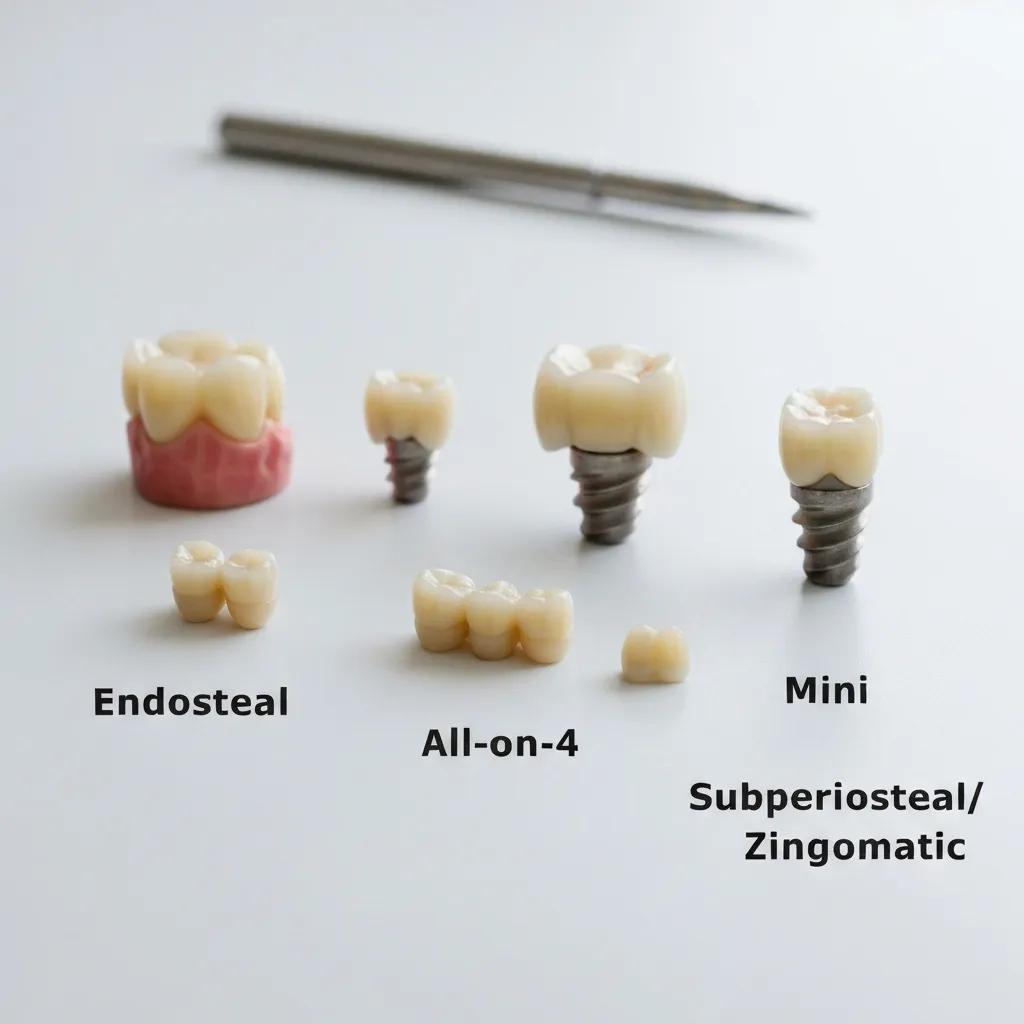
Implant type determines surgical approach, invasiveness, healing trajectory, and suitability for different bone conditions, so defining each type and its trade-offs helps patients match therapy to their oral health and expectations. The most common types include endosteal implants (standard screw-type placed into bone), mini implants (reduced diameter for denture stabilization), All-on-4 full-arch concepts, and specialized options like subperiosteal or zygomatic implants for severe bone loss. Understanding placement method, recovery profile, and typical indications allows patients to prioritize options that minimize grafting, reduce surgical complexity, or prioritize restoration aesthetics depending on their case. Below is a concise comparison of types and then deeper explanations of each.
Endosteal implants: standard screw-type fixtures placed into jawbone for single crowns, bridges, or supports.
Mini dental implants: narrow-diameter fixtures used primarily to stabilize removable prostheses.
All-on-4: strategic angled implant placement to support a full-arch prosthesis using four implants.
Subperiosteal and zygomatic implants: alternatives for severe maxillary bone loss that avoid extensive grafting.
Implant Type
Placement / Procedure
Pros / Cons / Ideal Candidate
Endosteal (root-form)
Placed into jawbone, requires sufficient bone
Pros: wide evidence base, durable; Cons: may need grafting; Ideal: most standard cases
Mini dental implants
Narrow-diameter fixtures, often for denture retention
Subperiosteal sits on bone; zygomatic anchors in cheekbone
Pros: avoids grafting for severe loss; Cons: more complex surgery; Ideal: severe maxillary atrophy
This table clarifies trade-offs so patients can see how invasiveness, cost, and expected durability vary by type. Next, each type is unpacked with practical details to inform realistic expectations.
How Do Endosteal Implants Work and Who Are They Best For?
Endosteal implants are the most commonly used design; they involve inserting a titanium or zirconia fixture into the jawbone where osseointegration—direct structural connection between bone and implant—occurs over weeks to months. This approach supports single crowns, bridges, and multi-unit restorations because the fixture functions like a natural tooth root and provides predictable load transfer to bone. Ideal candidates have sufficient bone volume and density or are able to undergo grafting when needed, and patient systemic health factors (e.g., well-controlled diabetes, non-smoking) improve predictability. Clinicians favor endosteal implants for their strong evidence base and versatile restorative options, which often makes them the default starting point in treatment planning.
Endosteal implants set the baseline for most implant decisions and they highlight why material choice and surface technology matter, which leads into a practical comparison of mini implants and when lower-diameter options are appropriate.
Straumann SLActive Implants: Improving Osseointegration and Clinical Success
From the outset, there have been constant efforts to improve osseointegration by modifying the surface of dental implants. The SLActive surface of Straumann implants has been shown to improve BIC and bone apposition, which may also improve the clinical success rate by accelerating BIC and bone.
Immediate and early loading of Straumann implants with a chemically modified surface (SLActive) in the posterior mandible and maxilla: 1‐year results from a …, 2008
What Are the Advantages and Limitations of Mini Dental Implants?
Mini dental implants are narrower fixtures designed for less invasive placement, often used to stabilize lower dentures or as provisional anchors. Their advantages include reduced surgical time, often avoidance of extensive grafting, and lower upfront cost compared with standard-diameter implants; these features make them attractive for patients seeking immediate denture retention improvements. Limitations include lower long-term load capacity and less suitability for single-tooth definitive restorations in high bite-force areas. Mini implants are best for patients who prioritize minimally invasive solutions for removable prosthesis stabilization and who accept potential trade-offs in longevity and load tolerance compared with standard implants.
Understanding the mini implant trade-offs clarifies when patients might prefer full-arch strategies like All-on-4 for durable fixed restorations, which is explored next.
How Does the All-on-4 Implant Procedure Benefit Full Arch Replacement?
The All-on-4 concept uses four implants, often with posterior implants tilted to engage better bone, to support a fixed full-arch prosthesis, and it is designed to minimize the need for bone grafting while enabling early function. Benefits include fewer surgical sites compared with multiple individual implants, faster restoration of chewing ability, and sometimes immediate provisional prostheses that restore aesthetics and function quickly. The procedure is suited for patients with generalized tooth loss or failing dentitions who prefer a fixed prosthesis and wish to avoid multi-stage grafting; however, it requires precise planning and a coordinated prosthetic workflow. All-on-4 scenarios emphasize prosthetic stability and patient expectations about maintenance, which patients should discuss thoroughly with their clinician.
Full-arch strategies reduce the number of required implants but introduce prosthetic complexity, so they contrast with subperiosteal and zygomatic options used when bone loss is severe, which we cover next.
When Are Subperiosteal and Zygomatic Implants Recommended?
Subperiosteal and zygomatic implants are specialist options reserved for severe jawbone atrophy where standard endosteal placement would be impossible or would require extensive grafting, and they are chosen to avoid prolonged grafting timelines. Subperiosteal implants rest on the bone under the periosteum and can support prosthetics when vertical bone height is insufficient, while zygomatic implants anchor in the zygomatic (cheek) bone to provide secure fixation for maxillary restorations. Both approaches are more surgically complex and carry higher risk profiles, so they are typically considered after conservative options are evaluated or when patients prefer to avoid multiple grafting procedures. These specialized techniques highlight that complex cases often require referral to experienced surgical teams and a careful discussion of risks, benefits, and expected maintenance.
Severe bone loss options underscore the importance of material choice in implant performance, which brings us to comparing titanium and zirconia implants.
How Do Titanium and Zirconia Dental Implants Compare?
Titanium and zirconia are the two principal implant materials and they differ in longevity evidence, tissue response, and aesthetic outcomes; a direct comparison helps patients select the material best aligned with allergy concerns, aesthetic goals, and long-term expectations. Titanium has a long clinical track record with robust long-term survival rates across a wide range of indications, while zirconia offers a metal-free option with superior aesthetics in the soft-tissue zone and potential benefits for patients with metal sensitivities. The following sections compare longevity and biocompatibility, then address material selection for allergic or aesthetic priorities so patients can weigh evidence against individual preferences.
Titanium: decades of clinical evidence and high survival rates, highly versatile across indications.
Zirconia: aesthetic advantage in thin biotypes and for metal-sensitive patients, growing clinical data.
Decision driver: case complexity and soft-tissue aesthetic demands often determine material choice.
What Are the Longevity and Biocompatibility Differences Between Titanium and Zirconia?
Titanium implants have a long-established track record with success rates commonly reported above 90–95% in many studies when placed and maintained properly, reflecting decades of accumulated clinical data. Titanium’s biocompatibility supports stable osseointegration in a wide range of bone qualities, and its ability to be alloyed and surface-treated has improved early stability and long-term outcomes. Zirconia implants, while historically newer, show promising mid-term survival and excellent soft-tissue response with low plaque affinity, but long-term comparative data are still maturing relative to titanium. Patients should consider that clinician experience with a chosen material and the specific clinical indication (single tooth vs. multi-unit vs. full arch) significantly influences longevity and that ongoing maintenance and oral hygiene remain critical regardless of material.
The balance between established long-term data and growing zirconia evidence leads to the practical matter of material suitability for metal allergies or high-aesthetic zones.
Dental Implant Surface Modifications: Accelerating Osseointegration with Straumann SLActive
In a minipig model, OsseoSpeed implants and Straumann Bone Level implants with a modified surface showed a significantly higher BIC compared to implants with a machined surface, thereby contributing to an acceleration of osseointegration [67]. Biological responses to SLActive surfaces have been investigated and showed a positive effect on early bone healing.
Impact of dental implant surface modifications on osseointegration, 2016
Which Material Is Better for Patients with Metal Allergies or Aesthetic Goals?
For patients with documented metal sensitivities or who prioritize a metal-free restorative path, zirconia offers a ceramic alternative that reduces exposure to metallic elements and provides superior white-colored subgingival profiles, which can be advantageous in thin gingival biotypes. Titanium remains the default where overwhelming clinical evidence, mechanical predictability, and component availability are decisive—particularly in high-load posterior regions or complex multi-unit restorations. Aesthetic zone cases often weigh zirconia’s color advantage against titanium’s established component modularity; many clinicians choose titanium fixtures with ceramic abutments to combine titanium’s strength with improved aesthetics. Ultimately, the best material depends on case-specific biomechanical demands, soft-tissue thickness, and the clinician’s restorative plan.
Material choice thus becomes one of several decision factors that also drive cost in a local context, which is the next major consideration for Longview patients.
What Factors Affect Dental Implant Costs in Longview, TX?
Dental implant costs reflect multiple components—implant fixtures, abutments, crowns or prosthetics, imaging, surgical time, and potential grafting—and local cost ranges vary with brand choice, material, and procedural complexity; understanding these drivers helps patients plan financially and evaluate value. In Longview, TX, local market dynamics, clinic pricing models, and available financing influence out-of-pocket expenses, and a transparent breakdown allows patients to compare estimates more meaningfully. Below is a cost-driver table that clarifies what each factor affects and how it typically alters pricing, followed by practical tips on financing and maximizing value, including how a local practice can support cost transparency and payment options.
Cost Factor
What It Affects
Typical Effect on Price / Local Consideration
Number of implants
Total surgical and prosthetic components
More implants increase fixture, abutment, and crown costs proportionally
Implant brand/material
Fixture price and abutment compatibility
Premium brands or zirconia components typically raise implant material cost
Bone grafting / sinus lift
Surgical complexity and site preparation
Grafting adds significant procedural and material expenses
Surgical complexity / specialist referral
Provider fees and operating time
Complex anatomy or zygomatic approaches increase fees and facility costs
Prosthetic type (single crown vs full-arch)
Laboratory and restorative costs
Full-arch prosthetics involve higher lab and fabrication expenses
This table clarifies how each element contributes to a treatment estimate and why quotes can vary between practices. The next paragraphs explain examples of relative costs, financing options, and practical value strategies for Longview patients.
How Do Implant Type, Brand, and Procedure Influence Pricing?
A single endosteal implant with a crown typically has different cost components than a full-arch All-on-4 restoration; the single implant’s expenses include fixture, abutment, and crown, whereas a full-arch case bundles multiple fixtures, complex prosthetics, and lab fees, often making full-arch solutions more expensive upfront despite per-tooth savings. Brand choice affects fixture and abutment pricing—premium systems with proprietary components generally cost more than value-tier systems—while material selection (titanium vs zirconia abutments or crowns) also impacts lab fees and restorative pricing. Surgical complexity, such as the need for simultaneous bone grafting or sinus augmentation, adds separate surgical and graft-material costs and can extend treatment timelines. These examples show why patients should request detailed, itemized estimates that separate implant components, prosthetic fees, and ancillary surgical costs.
What Financing and Insurance Options Are Available for Dental Implants in Longview?
Patients often combine personal savings, dental insurance where applicable, and third-party financing to cover implant treatment; some clinics offer in-house payment plans or work with financing partners to spread payments over months. Insurance coverage for implants varies and often limits benefits to specific restorative codes, so verifying coverage details and preauthorization is essential before committing to treatment. Affordable Dentist Near Me of Longview emphasizes cost transparency and commonly discusses financing options during consultation to help patients understand payment routes and schedule treatment according to budget constraints. Patients are advised to obtain pre-treatment estimates, ask about phased treatment plans, and compare financing terms to ensure predictable monthly payments and minimal surprises.
How Can Patients Maximize Value When Choosing Dental Implants?
Maximizing value involves balancing upfront cost with long-term durability, provider expertise, and included follow-up care—patients should prioritize warranty terms, recall schedules, and restoration guarantees in addition to initial price. Selecting a clinician experienced with the chosen implant system and asking about complication rates and restorative workflows can reduce the risk of downstream costs related to repairs or prosthetic replacement. Patients should request itemized estimates, inquire about bundled care options (surgical + restoration), and consider phased treatment to spread costs while addressing immediate functional needs. Ultimately, questions about clinician experience, component availability, and post-operative support help patients identify options that offer the best long-term return on investment.
With cost drivers and financing in mind, patients need a clear decision-making workflow, which we outline in the next major section that includes practical assessments and what to expect at consultation.
How Can Patients Choose the Right Dental Implant for Their Needs?
Choosing the right implant requires integrating clinical assessments—bone quality, medical history, and functional/aesthetic goals—with an understanding of implant types, material trade-offs, and realistic budget constraints; a structured decision process reduces uncertainty and supports informed consent. Key steps include diagnostic imaging, medical risk assessment, review of restorative goals, and a discussion of timelines and financing. Below is a practical checklist and discussion of common assessments for patients aged 40–60, followed by a clinic workflow illustration drawn from typical local practice patterns and post-procedure care guidance to support long-term success.
Diagnostic imaging (X-rays or CBCT) to assess bone volume and anatomy.
Medical history review for factors affecting healing (e.g., diabetes, smoking).
Restorative planning to align implant choice with prosthetic outcomes.
These steps set the stage for how clinicians determine suitability and tailor treatment recommendations, which we unpack in the H3 subsections below.
What Assessments Determine Implant Suitability for Patients Aged 40-60?
For patients in the 40–60 age range, clinicians typically use panoramic X-rays or cone-beam CT scans to evaluate bone volume, density, and critical anatomical landmarks, ensuring implants can be placed in a position that supports long-term load. Medical history screening includes assessing chronic conditions that affect healing—such as poorly controlled diabetes—or medications that influence bone metabolism, and lifestyle factors like smoking are discussed because they can reduce success rates. Functional needs and aesthetic goals—whether the patient desires fixed restorations or denture stabilization—also guide implant selection and prosthetic planning. These assessments collectively determine whether standard endosteal implants are suitable or whether alternative approaches (grafting, All-on-4, zygomatic) are required.
A clear assessment protocol ensures the recommended implant type and material align with both clinical constraints and patient priorities, which leads into an illustrative clinic workflow example.
What Is the Consultation and Treatment Process at Affordable Dentist Near Me of Longview?
Affordable Dentist Near Me of Longview is a local dental practice focused on providing accessible implant care, and their documented approach centers on offering cost-transparent options and patient-friendly pathways from consultation to restoration. Typical informational flows at community practices include an initial consult to review medical history and goals, diagnostic imaging to evaluate bone and anatomy, a collaborative treatment plan that outlines procedural steps and timelines, and a financing discussion that helps patients understand payment options. This neutral description aligns with local practice expectations and illustrates how clinics balance clinical planning with affordability for patients in the Longview area.
Describing the clinic’s workflow helps patients know what to prepare for at their appointment and naturally points to post-procedure care and maintenance recommendations.
How Should Patients Care for Their Dental Implants Post-Procedure?
Post-procedure care focuses on promoting healing and protecting the implant during osseointegration through gentle hygiene, short-term dietary adjustments, and scheduled follow-ups to monitor integration and soft-tissue health. Daily home care should emphasize gentle brushing with a soft-bristled brush and interdental cleaning around abutments once the restorative phase begins, while short-term measures after surgery typically include avoiding hard chewing on the surgical side until integration is confirmed. Regular professional maintenance visits—often more frequent in the first year—allow clinicians to check stability, address soft-tissue inflammation, and perform prosthetic adjustments if needed. Patients should watch for warning signs such as increasing pain, swelling, or persistent bleeding and contact their clinician promptly if these occur.
Good aftercare reduces complication risk and supports long-term success, and the next major section addresses common patient questions that often arise when choosing brands and types.
What Are Common Patient Questions About Dental Implant Brands and Types?
Patients frequently ask straightforward questions aimed at simplifying complex choices: which brand is best, how types compare, whether one brand outperforms another, and how long implants last; short, direct answers help patients build practical expectations for their treatment. This FAQ-style section provides concise, evidence-oriented responses to the most common patient queries and flags the main variables—case specifics, clinician experience, and maintenance—that determine long-term outcomes.
Which Dental Implant Brand Is Considered the Best?
There is no single “best” dental implant brand for all patients because outcome differences depend more on clinician experience, case selection, and restorative planning than brand alone; leading brands like Straumann, Nobel Biocare, Dentsply Sirona, and Zimmer Biomet are often recommended because they combine technology, component availability, and clinical evidence. Patients should prioritize a brand that their clinician uses regularly and can support with compatible prosthetic parts and documented outcomes, rather than pursuing a brand name in isolation. Asking clinicians about their personal success rates, maintenance policies, and component availability provides actionable information that matters more than marketing claims.
Recognizing that brand is one of several interlocking decision factors prompts a concise types-based comparison.
What Are the Pros and Cons of Different Dental Implant Types?
Endosteal Implants: Pros—broad evidence base and versatility; Cons—may require grafting and longer timelines.
Mini Dental Implants: Pros—less invasive and lower cost; Cons—limited load capacity and potentially shorter lifespan under heavy loads.
All-on-4: Pros—fewer implants and often avoids grafting for full-arch cases; Cons—complex prosthetics and high upfront lab costs.
Subperiosteal / Zygomatic: Pros—solutions for severe bone loss without extensive grafting; Cons—surgical complexity and specialist referral required.
This list clarifies key trade-offs and helps patients match implant type to their clinical and lifestyle needs.
Are Zimmer Implants Better Than Straumann?
“Better” depends on the clinical scenario: Straumann stands out for material innovations and surface science that can enhance early integration, while Zimmer Biomet is prized for engineered component consistency and a broad product portfolio that supports diverse surgical needs. In practice, clinician familiarity with a system and the local availability of prosthetic components often outweigh nominal brand differences; a clinician comfortable with either system can typically achieve excellent outcomes. Patients should ask their clinician which system they use most and why, focusing on the clinician’s experience and the system’s fit for the specific restorative plan.
Comparative brand questions often lead to lifespan and success-rate concerns, which the next item addresses directly.
How Long Do Dental Implants Last and What Affects Their Success?
With proper placement, restoration, and ongoing maintenance, dental implants commonly last decades, with many studies reporting survival rates above 90–95% over the first 10 years; however, long-term success depends on oral hygiene, systemic health, smoking status, and regular professional follow-up. Mechanical complications or peri-implant inflammation can reduce lifespan, so preventive maintenance, controlling medical risk factors, and timely prosthetic care are essential. Patients should view implant care as a partnership: clinician technique and follow-up combined with patient hygiene and lifestyle choices determine longevity. Regular recall visits and prompt attention to symptoms like mobility or persistent discomfort maximize the chance of long-term success.
How Does Affordable Dentist Near Me of Longview Provide Expert Dental Implant Services?
Affordable Dentist Near Me of Longview positions itself as a community practice offering accessible dental care with a focus on dental implants and denture services, and the practice emphasizes cost-effective solutions for local patients. Documented information indicates the Longview location provides dental implants and denture services as primary offerings, and that the practice aims to make implant care approachable for patients in the 40–60 age range through transparent discussions about options and financing. The following subsections explain how prospective patients can verify brand partnerships, what typical patient benefits from implant therapy look like in practice, and how to inquire about affordability in a way that supports shared decision-making.
This local positioning supports patients who want clarity on services and costs before scheduling a consult.
What Are the Clinic’s Partnerships with Leading Implant Brands?
Publicly available material does not assert specific manufacturer partnerships for the Longview location, so patients should ask the clinic directly which implant systems they use and whether the practice stocks compatible prosthetic components; clinics commonly work with multiple implant manufacturers to match systems to case requirements. It is reasonable for patients to request the brand name of proposed implants and to ask about component warranties and availability for future restorative maintenance. Verifying these details during consultation helps ensure prosthetic parts and repair options are accessible locally over the long term.
Asking about brand and parts availability leads naturally into expected patient outcomes and benefits.
How Have Local Patients Benefited from Our Implant Solutions?
While specific anonymized case studies are not presented here, typical patient benefits from implant therapy at community clinics include restored chewing function, improved speech and confidence, and the ability to switch from unstable removable prostheses to fixed or more stable restorations. Many patients report better nutrition and quality of life after implants stabilize their bite, and clinicians prioritize predictable outcomes by matching implant type and material to the patient’s bone and restorative goals. Prospective patients should inquire during consultation about realistic functional and aesthetic outcomes for their specific case and request before/after examples or references that the clinic may provide under appropriate consent.
Local benefit descriptions naturally lead to how the clinic addresses accessibility and affordability for Longview residents.
What Makes Our Dental Implant Services Accessible and Affordable in Longview?
Affordable Dentist Near Me of Longview emphasizes accessible care by presenting cost-transparent options and discussing financing during treatment planning, reflecting a local commitment to making implant care feasible for patients who might otherwise delay treatment. While specific in-house financing details are not listed here, patients can expect a consultation conversation about payment plans, phased treatment options, and potential third-party financing to fit budgets. The most practical next step is to schedule a consult to review an itemized treatment estimate and financing options that align with personal finances, enabling patients to compare value across providers and treatment approaches.
This local accessibility note completes the planned clinic integration and supports patients in taking the next step toward care.