Dental Implant vs Bridge Cost: Your Practical Guide to Choosing Restorative Options in Denton, TX
Choosing between a dental implant and a bridge is one of the most common decisions people face when replacing a missing tooth. Understanding the trade-offs between immediate price and long-term value will help you make the right choice for your smile and your budget. This guide explains what implants and bridges are, how each treatment works, and the clinical and financial factors that typically affect cost here in Denton, TX. You’ll find local cost ranges, insurance and financing context, realistic 5/10/20-year scenarios, and a simple decision framework that ties jawbone health and maintenance needs to lifetime expense. We also include comparison tables, clear pros and cons, and step-by-step prep tips so you can weigh short-term affordability against long-term outcomes. At the end, we outline how to get a personalized plan in Denton.
What Are Dental Implants and How Do They Work?
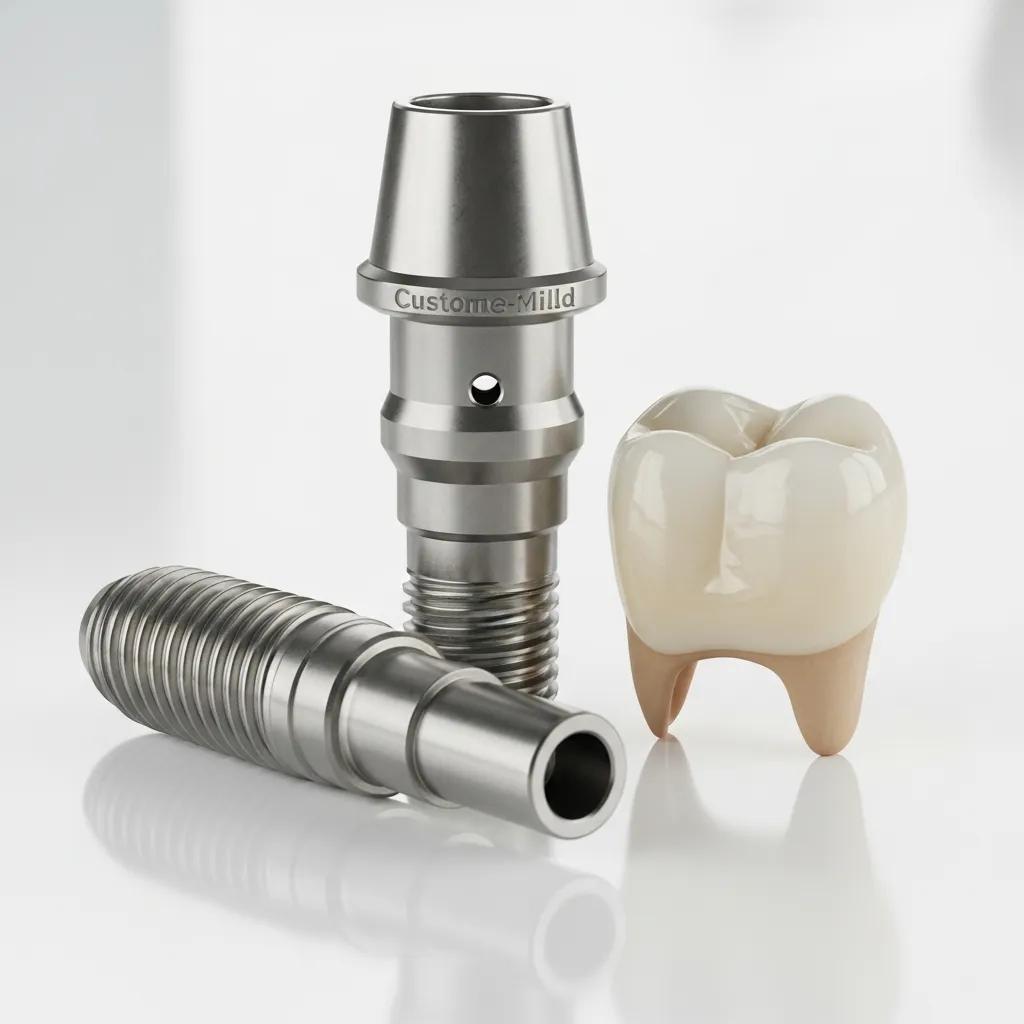
Dental implants replace a missing tooth by recreating its root and the visible portion of the tooth. A biocompatible post—usually titanium or zirconia—is surgically placed into the jawbone and fuses with the bone through osseointegration. An abutment connects the post to a crown (or to a bridge prosthetic), restoring chewing function and appearance. Because implants act like natural roots, they help preserve surrounding teeth and support jawbone health. Typical steps include an exam and imaging, implant placement, a healing period for integration, and the final restoration with a crown or bridge. Timelines vary by case but often span several months from the first visit to the finished tooth. Knowing the parts and steps helps explain how implants affect both cost and outcomes over time.
What Components Make Up a Dental Implant?
A typical implant restoration has three main pieces: the implant post, the abutment, and the crown. The post (usually titanium or zirconia) functions as the root and its material affects biocompatibility and aesthetics—titanium for a long record of success, zirconia for a metal-free option. The abutment links the post to the crown and can be prefabricated or custom-made; a custom abutment can improve how the restoration meets the gum line but usually adds to cost. The crown restores the visible tooth and is commonly porcelain-fused-to-metal or all-ceramic; materials differ in durability, appearance, and lab fees. Because these pieces—and the surgical work—are billed separately, implant estimates often itemize surgical fees, component costs, and prosthetic charges.
What Are the Key Benefits of Dental Implants Beyond Cost?
Beyond the price tag, implants offer clinical advantages that affect long-term oral health and future costs. They preserve jawbone by replacing the root and restoring functional loading, which helps slow bone resorption that follows tooth loss. Implants provide stable chewing function and avoid altering healthy neighboring teeth, a common drawback of traditional bridges. With proper case selection and maintenance, implants have high success rates and often need fewer replacements than alternatives—an outcome that can improve lifetime cost-effectiveness. These biological and functional benefits help explain when implants are the preferred option.
What Are Dental Bridges and What Types Are Available?
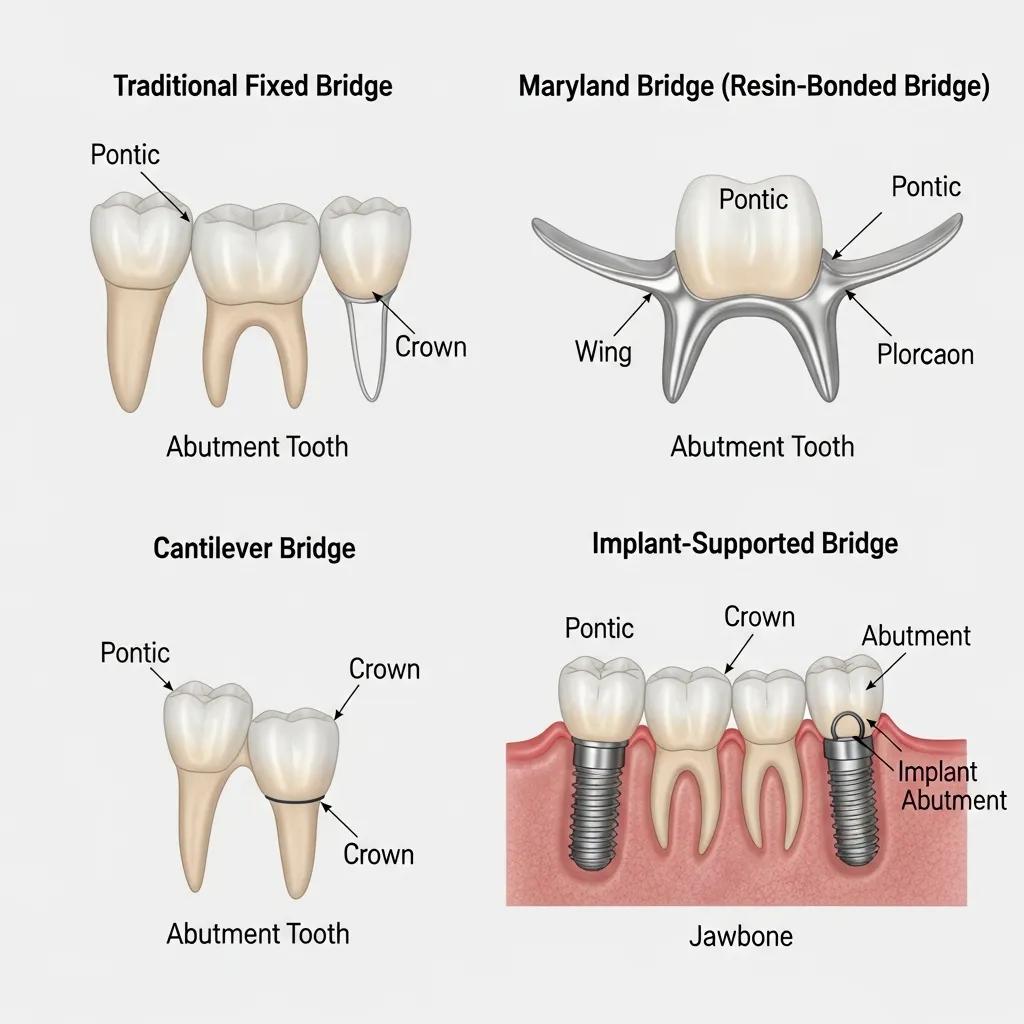
A dental bridge fills a gap by anchoring a replacement tooth (pontic) to adjacent teeth or implants. Bridge types determine how much tooth preparation and invasiveness are involved: traditional fixed bridges rely on crowns placed on neighboring teeth, Maryland bridges use a bonded wing to conserve tooth structure, cantilever bridges attach to only one adjacent tooth, and implant-supported bridges combine implants with pontics for added strength. Bridge treatment usually involves tooth prep, impressions, and a lab-made prosthesis, and it can often be completed faster than a full implant workflow because no osseointegration period is needed when implants aren’t used. Knowing the types of bridges helps you weigh invasiveness, longevity, and cost trade-offs.
What Are the Different Types of Dental Bridges?
Traditional Fixed Bridge: Uses crowns on both adjacent teeth to support a pontic. Durable but requires reshaping healthy tooth structure.
Maryland Bridge: Has a metal or ceramic wing bonded to the backs of adjacent teeth, preserving tooth structure but usually less durable under heavy chewing forces.
Cantilever Bridge: Anchored to a single adjacent tooth. Useful when space or the condition of neighboring teeth limits options, but it places more force on one abutment.
Implant-Supported Bridge: Uses implants to support pontics for replacing multiple adjacent teeth without relying on natural tooth anchors—offering increased longevity and tooth preservation.
What Are the Benefits of Dental Bridges Compared to Implants?
Bridges are often faster and less expensive up front, making them a practical choice for patients who want a quicker timeline or face budget limits. A traditional bridge can usually be completed in weeks rather than months since it avoids surgical implant placement and healing time. For patients who are not candidates for surgery or who prefer to avoid bone grafting, a bridge restores function and appearance without additional procedures. Insurance plans may also be more likely to cover bridges. The trade-offs are that bridges typically require replacement sooner and involve modifying adjacent teeth—factors that affect long-term oral health and overall cost.
How Do Dental Implant and Bridge Costs Compare in Denton, TX?
Comparing implant vs bridge cost in Denton means separating upfront fees and componentized charges, then factoring in local cost drivers like lab work, imaging, and possible grafting. Prices vary by practice and case complexity. For implants, major cost drivers are the surgical placement, the abutment and crown, and any preparatory procedures such as bone grafts or extractions. For bridges, costs depend on the number of units, crown and pontic materials, and whether the abutment teeth need root canal or periodontal work. Presenting typical Denton ranges and clear examples—single-tooth implant versus 3-unit bridge versus implant-supported bridge—gives practical context for local decision-making.
What Are the Average Upfront Costs for Implants vs. Bridges?
Below is a Denton-focused snapshot of common upfront cost ranges, noting what is usually included in quotes and what may be additional. These are planning estimates and will vary by clinical needs.
Treatment Scenario
Typical Components Included
Approximate Denton-Upfront Cost Range
Single-tooth implant
Implant post, abutment, crown (may exclude bone graft/sinus lift)
$2,000 – $4,500
3-unit traditional bridge
Two abutment crowns + pontic, lab fees, tooth prep
$1,200 – $3,000
Implant-supported bridge (per implant)
Implant post, abutment, laboratory-supported prosthetic
$3,500 – $6,000 (per implant)
Maryland/resin-bonded bridge
Pontic with bonded wing(s)
$900 – $2,000
This comparison shows that single-tooth implants usually have higher upfront costs than traditional bridges, while implant-supported bridges combine implant investment with prosthetic fees. Remember: surgical fees, CBCT imaging, and any bone grafting are often itemized separately and can increase the total.
How you pay—insurance and financing—will shape monthly costs and out-of-pocket responsibility.
How Do Financing and Insurance Affect Dental Implant and Bridge Costs?
Insurance (especially PPO dental plans) and financing options can change how the cost feels by reducing upfront payment or spreading it out over time. PPO plans commonly provide partial coverage for bridges; implant coverage varies widely and is frequently limited or excluded, so it’s important to check your benefits. Financing options—third-party medical/dental lenders, in-house payment plans, or low-interest programs—can turn a large upfront implant cost into manageable monthly payments. Bring your insurance card and financing questions to your consult so staff can estimate your actual out-of-pocket cost.
Payment Factor
Typical Insurance/Financing Impact
PPO dental insurance
More likely to cover part of bridge costs; implant coverage varies by plan
In-house financing
May offer flexible monthly plans to reduce immediate out-of-pocket burden
Third-party financing
Extends terms and spreads cost, sometimes with promotional rates based on credit
Pre-authorization
Essential to confirm exact benefits and patient responsibility
Understanding these payment differences helps you balance short-term affordability with long-term value. Verify benefits and discuss payment options during treatment planning so your budget and oral-health goals align.
What Is the Long-Term Value of Dental Implants Versus Bridges?
Long-term value looks beyond the initial price to expected lifespan, maintenance costs, and how each option affects future dental needs. Over 10–20 years, implants often become more cost-effective because they usually last longer with fewer major replacements, and they help prevent bone loss that could complicate future care. Bridges commonly need replacement every 8–15 years due to wear, decay under abutments, or changes in neighboring teeth. Maintenance—regular hygiene, occasional repairs, and replacement cycles—adds up differently for each option, and implants’ durability can offset their higher initial cost. Factoring in jawbone preservation and the potential need for future grafting completes the long-term financial picture.
How Do Longevity and Maintenance Costs Differ Between Implants and Bridges?
These illustrative totals show how replacement cycles and repair risk can raise bridge-related costs over time, while implants generally need fewer major replacements. Individual results vary—an early bridge failure due to decay or fracture will increase costs quickly—so use these scenarios as planning tools rather than guarantees.
Research often finds that implants offer better long-term cost-effectiveness because they last longer and reduce the need for repeat prosthetics compared with bridges.
Cost-Effectiveness of Dental Implants vs. Bridges for Single Tooth Replacement
This study models the long-term costs and effectiveness of using a dental implant as first-line treatment for a single missing tooth and compares it to bridge-based strategies.
Cost‐effectiveness modeling of dental implant vs. bridge, 2009
How Does Jawbone Health Impact Long-Term Oral Health and Costs?
Jawbone preservation strongly influences long-term outcomes because bone resorption after tooth loss can alter facial support, limit future options, and make implant placement more complex and costly. Natural tooth roots apply functional load that helps maintain bone volume; when a tooth is missing, that stimulus disappears and bone gradually resorbs. Implants restore functional loading to the ridge, slowing resorption and preserving the alveolar bone. Maintaining bone volume reduces the likelihood of later augmentation procedures and keeps future restorative choices simpler and more predictable. For this reason, thinking about bone health today is an important part of weighing future costs.
Systematic reviews indicate that while both approaches have costs, implants often provide better long-term value and patient benefits.
Long-Term Economic Comparison: Dental Implants vs. Fixed Bridges
This review compares the long-term financial and clinical outcomes of single-tooth implants and short-span fixed dental prostheses, considering fees, complications, and patient benefits over time.
Implants versus short‐span fixed bridges: survival, complications, patients’ benefits. A systematic review on economic aspects, 2012
Because long-term financial and biological factors matter, a personalized clinical assessment—starting with bone evaluation—helps create a plan that fits your goals and budget.
Which Dental Solution Is Best for You? Factors to Consider When Choosing Implants or Bridges
Your best choice depends on budget, current oral health, lifestyle, timeline, and long-term goals. A simple checklist can turn clinical factors into a clear recommendation: start with bone density and gum health, then layer in budget limits, tolerance for treatment time, and lifestyle needs like sports or aesthetic priorities. Comparing common case examples—such as a single missing tooth in a healthy younger adult versus multiple adjacent losses in an older patient with limited funds—helps clarify which option usually fits best. Using this decision flow reduces uncertainty and ties clinical findings to financial planning.
How Do Budget, Oral Health, and Lifestyle Influence Your Choice?
Younger active adult with healthy bone: Implants are often recommended for longevity and bone preservation; financing can make the upfront cost workable.
Middle-aged patient with adjacent teeth already needing crowns: A traditional bridge may be practical if the neighboring teeth will be restored anyway.
Older patient on a fixed income with limited bone: A conservative bridge or a hybrid approach (with grafting assessed) may be selected based on overall health and budget.
These profiles show how financing can manage budget limits, how bone density determines candidacy, and how lifestyle affects prosthetic choice. A focused evaluation will point you to the right path.
For many patients, private dental implant treatment represents a substantial expense, so careful financial planning and informed decision-making are important.
Navigating Costs and Decisions for Private Dental Implant Treatment
This paper examines how patients and dentists negotiate clinical need and the decision to pursue private implant treatment, which is often paid for out of pocket and can be expensive compared with other options.
Paying for treatments? Influences on negotiating clinical need and decision-making for dental implant treatment, CE Exley, 2009
Why Is Scheduling a Free Consultation Important for Your Dental Decision?
A clinical consultation gives you targeted imaging, a bone and tissue assessment, and a tailored cost estimate that factors in your insurance and financing—details a generic price list can’t provide. During a consult, the clinician evaluates your bite, neighboring teeth, and whether grafting or periodontal care is needed, then lays out a clear timeline and costs for recommended options. Staff can also review financing choices and run an insurance pre-authorization so you know expected monthly payments and out-of-pocket responsibility. The consult reduces uncertainty and produces a treatment plan aligned with both your oral-health goals and your budget. Schedule a free consult
This personalized step turns general comparison into a clear, actionable recommendation.
How Can You Schedule a Free Dental Implant or Bridge Consultation in Denton, TX?
Booking a consult in Denton is easiest when you come prepared. Bring your dental insurance card, any recent dental records or x-rays, a list of medications, and relevant medical history. Expect an exam, focused imaging (often radiographs or a CBCT if implant planning is likely), and a conversation about materials, timelines, and financing. A free consult gives you a case-specific estimate and a chance to ask targeted questions about maintenance and expected lifespan.
What to Expect During Your Free Dental Implant Consultation?
At the consult you’ll receive a clinical exam, any needed imaging to assess bone and adjacent teeth, and a patient-centered review of restorative options and their timelines. The dentist will explain implant candidacy, whether bone grafting or periodontal treatment is needed, and the surgical and prosthetic steps if an implant is recommended. Cost estimates become clearer once imaging and sequencing are finalized, and staff will typically review financing alternatives and common insurance behaviors. The consult is educational and non-pressured so you can decide with confidence.
How to Prepare for Your Dental Bridge Consultation?
Preparing for a bridge consult is straightforward: bring recent dental records, a list of medications, and your insurance information so the practice can pre-authorize benefits and give an accurate estimate. Expect the clinician to check the abutment teeth for restorability, look for decay or root-canal needs, and discuss material choices for crowns and pontics that affect longevity and appearance. Ask about temporary restorations and typical lab turnaround times so you understand the short-term timeline. Being prepared helps the team deliver a reliable treatment plan and cost projection.
When you’re ready to move forward in Denton, having your documents and questions ready speeds scheduling and benefits verification—call ahead with insurance details to help the team provide an accurate estimate.
What Are Common Patient Questions About Dental Implant and Bridge Costs?
Patients often ask whether implants are worth the higher upfront cost, how insurance handles each option, and what maintenance is required. Short, direct answers with a brief explanation help when you need quick clarity or want talking points for your consult. Below are common questions and concise responses to guide your next steps.
Is a Dental Implant or Bridge More Cost-Effective Long Term?
Short answer: implants are often more cost-effective over 10–20 years despite higher upfront costs because they typically need fewer major replacements and avoid bone-loss–related procedures. Implants’ longevity reduces repeated prosthetic cycles that raise cumulative bridge costs, and preserving bone can eliminate future grafting expenses. That said, outcomes depend on oral hygiene, overall health, and bite forces—so individual risk factors should be considered during treatment planning. Use cumulative cost estimates to compare scenarios and discuss financing to see how payment terms affect short-term affordability.
Does Dental Insurance Cover Implants or Bridges More Often?
Coverage varies by plan, but many PPO dental policies are more likely to partially cover bridges since they’re a conventional restorative procedure. Implant coverage is inconsistent and sometimes excluded. Obtain a pre-determination from your insurer for both options because plan rules, annual maximums, and waiting periods will change your out-of-pocket costs. If implant coverage is limited, financing or phased treatment can help bridge the affordability gap. Bring insurance information to your consult so staff can run benefits and show exact patient responsibility.
Where Can You Find Trusted Dental Implant and Bridge Services in Denton, TX?
When choosing a provider for complex restorative work, local trust signals and clear practice capabilities matter. Predictable treatment depends on clinician experience, imaging and lab partnerships, and a patient-focused care model. Practices that offer coordinated restorative services can simplify sequencing between extractions, grafting, implant placement, and final prosthetics—sometimes saving time and reducing coordination headaches. Look for teams that discuss financing openly, accept PPO insurance, and create a comfortable, educational environment where questions are welcomed.
Who Are the Experienced Dentists Providing These Services?
Dentist in Denton – Dentures & Dental Implants lists clinicians who provide local implant and denture services, including Dr. Mike Pham and Dr. Vo as part of the care team. During your consult, ask about each clinician’s implant experience, case examples, and treatment philosophy to confirm a good fit. Questions about restorative workflows, lab partners, and imaging capabilities will clarify how your case will be handled from diagnosis through final restoration.
What Makes Dentist in Denton a One-Stop Shop for Dental Solutions?
The practice offers comprehensive restorative services—cleanings, dentures, and dental implants—combined with an education-first approach, PPO insurance acceptance, and flexible financing options to improve access to care. Those elements create a streamlined patient journey from diagnosis to final restoration, which helps when coordinated procedures like grafting or temporization are needed. If you’re ready to explore options and get a tailored estimate, schedule a free consult or call the team at 602-834-0381. A clear, personalized consult reduces uncertainty and helps match restorative choices to both oral-health goals and budget.
Comprehensive Services: Restorative care including implants, dentures, and routine maintenance simplifies coordination.
Patient-Focused Care: Education-based consultations help you understand options and financial pathways.
5190 Western Center Blvd, Haltom City, TX 76137; 3969 Teasley Ln, Denton, TX 76210. Call 602-834-0381 to speak with staff about scheduling and benefits verification.
What to Bring to the Consult: Insurance card, list of medications, prior dental records.
What the Practice Provides: Clinical exam, necessary imaging, personalized cost estimate.
How the Team Supports Financing: Discussion of in-house plans and third-party options to spread payments.
This practical checklist helps you arrive ready and speeds the consult process.
Service Area
What the Practice Offers
Patient Benefit
Restorative Implants
Implant planning, placement, and prosthetic restoration
Single-provider continuity and simplified coordination
Dentures & Prosthetics
Denture fabrication and implant-retained options
Customized fit and restored function
Insurance & Financing
PPO acceptance and flexible payment options
Lower upfront burden and clearer out-of-pocket planning
These summaries show what to expect from a local provider and how a one-stop model can streamline complex restorative cases.
Ask About Financing Options: Make sure you understand monthly obligations and available terms.
Request Benefit Pre-authorization: Confirm exact insurance coverage and patient responsibility.
Discuss Long-Term Maintenance: Learn about routine care and potential future costs.
5190 Western Center Blvd, Haltom City, TX 76137; 3969 Teasley Ln, Denton, TX 76210. Phone: 602-834-0381.
This article has covered definitions, component and procedural details, Denton-specific cost ranges, insurance and financing context, cumulative cost comparisons, and practical next steps so you can weigh implant versus bridge options with both short-term budgets and long-term oral-health goals in mind.
Frequently Asked Questions
What Factors Should I Consider When Choosing Between Implants and Bridges?
Consider your oral health, budget, and lifestyle. Check bone density and gum health to see if you’re a good implant candidate. If budget is tight, a bridge may be more affordable initially. Think about daily activities—if you’re active, implants offer more long-term stability. A focused exam with your dentist will align clinical needs with your financial and personal goals.
How Long Do Dental Implants and Bridges Typically Last?
With good care, implants can last for decades and often outlive bridges. Bridges typically need replacement every 8–15 years, depending on wear, decay under abutments, and the condition of nearby teeth. Regular check-ups and excellent oral hygiene influence the lifespan of both options.
What Are the Maintenance Requirements for Implants and Bridges?
Implants need the same daily care as natural teeth—brushing, flossing, and routine dental visits—and occasionally may require adjustments or repairs. Bridges require careful hygiene around supporting teeth and can need more frequent maintenance or replacement due to wear or decay. Follow your dentist’s recommendations to maximize longevity.
Can I Get a Dental Implant if I Have Insufficient Bone Density?
Often yes—patients with low bone density can sometimes receive implants, but they may need bone grafting to build a stable foundation first. Bone grafting adds procedure time and cost but can make implant placement possible. Your dentist will evaluate your bone and recommend the safest path forward.
Are There Any Risks Associated with Dental Implants or Bridges?
Both options carry risks. Implants can have complications such as infection, nerve irritation, or failure if not properly planned or maintained. Bridges can cause issues with the supporting teeth, including decay or fracture. Discuss potential risks with your dentist and follow care instructions to minimize complications.
How Do I Know Which Option Is Right for Me?
Choosing between implants and bridges requires assessing oral health, finances, and personal preferences. A thorough consultation will examine your bone, gum health, and aesthetic goals and produce tailored recommendations that match your lifestyle and long-term oral-health plan.
Conclusion
Deciding between dental implants and bridges means balancing upfront cost against long-term function, durability, and bone preservation. Understanding the clinical differences and financial implications helps you make an informed choice that fits your life and budget. To explore a personalized plan, financing options, and exact insurance estimates, schedule a free consultation with our team. Take the next step toward restoring your smile by reaching out today.