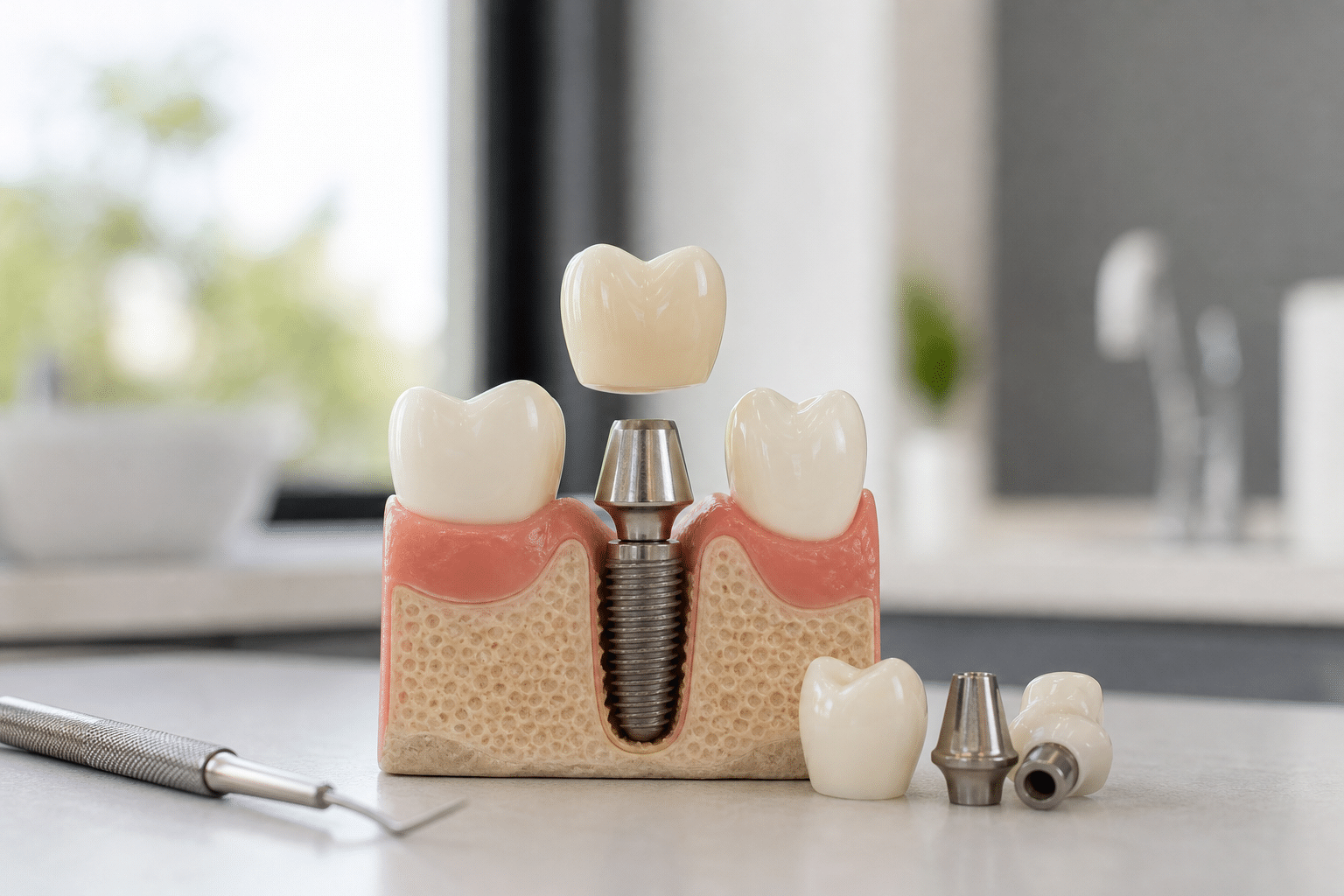
Abutment dentistry covers the selection, placement, and healing of the connector piece that links the implant fixture anchored in your jawbone to the visible crown above your gumline. That connector is the dental abutment, and without it the crown has nothing secure to attach to. It is a critical step in any implant or bridge restoration.
Most people researching implants focus on the implant post or the crown. The abutment sits between those two pieces and does the structural work of holding everything together. Understanding how it works, what it's made of, and how it fits into your treatment timeline helps you ask better questions and make more confident decisions before you ever sit in the chair.
What Is an Abutment in Dentistry?
An abutment is the connector that bridges the gap between the implant fixture in your bone and the crown or prosthetic tooth you see in the mirror. Think of it as the neck of the restoration: the implant is the root, the crown is the visible tooth, and the abutment is the piece that lets them work together.
The implant fixture itself is a small, screw-like post, usually made of titanium, that a dentist places surgically into your jawbone. Over the following months, the bone fuses around it in a process called osseointegration. The abutment is a separate component attached to the top of that post once healing is complete, or sometimes at the same appointment depending on your treatment plan.
The word "abutment" actually comes from structural engineering. In abutments architecture and abutments construction, the term describes the supports at each end of a bridge that bear the load and transfer it to the ground. The dental use borrows that same concept: the abutment bears the force of chewing and transfers it down through the implant into the bone. It's a useful analogy, but dental abutments are precision clinical components, not construction materials.
Abutments come in two broad categories. Stock abutments are prefabricated in standard shapes and sizes, which makes them faster and generally less complex to place. Custom abutments are milled or cast to match the exact angle and contour of your implant site, which matters most when the implant was placed at an angle or when the restoration is in a highly visible part of your smile.
The abutment meaning, in short, is this: it's the piece your dentist selects and places to give your crown a stable, precisely shaped foundation. Get that piece right, and the rest of the restoration follows.
How Does an Abutment of a Bridge Differ from an Implant Abutment?
When dentists talk about the abutment of a bridge, they mean something slightly different from an implant abutment. Both serve the same load-bearing purpose, but the structure underneath is different.
In a traditional dental bridge, the abutment teeth are the natural teeth on either side of the gap. The dentist reshapes those teeth by removing some enamel, then fits them with crowns that anchor the bridge in place. The false tooth in the middle, called a pontic, hangs between those two crowned abutment teeth. No implant is involved. The types of abutment in bridge work include the end abutments at each side of the gap and, in longer bridges, a pier abutment, which is a natural tooth or implant placed in the middle of a multi-unit bridge to provide extra support along a longer span.
A pier abutment matters because a long bridge without middle support can flex under chewing forces, stressing the cement or the natural teeth holding it. Adding a pier abutment distributes that load more evenly, much like a mid-span support column in a long bridge in civil construction.
Implant abutments work differently. Instead of relying on neighboring teeth, the abutment attaches directly to a titanium post that's fused with your bone. That means no healthy teeth need to be reshaped to support the restoration.
One option used in implant dentistry is the UCLA-type abutment, a castable component used for custom fabrication of screw-retained crowns directly to the implant head. Per for.org and dpes.dentistry.utoronto.ca, this type of abutment is commonly used but may carry higher risks of interface issues compared to CAD/CAM-milled options because of the laboratory handling involved.
If you want a broader look at how bridges, implants, and other replacement options compare side by side, the guide to tooth replacement options covers each approach in detail.
What Materials Are Used for Dental Abutments?
The two materials you'll hear about most are titanium and zirconia. Each has a clear use case, and your dentist's choice depends on where the implant sits in your mouth and what the final crown will look like.
Titanium is the standard for most implant abutments. It's biocompatible, strong, and well-studied. The connection design between the abutment and the implant body matters here. According to a 2020 literature review in the International Journal of Environmental Research and Public Health, the loosening rate for external hexagon implant connections ranges between 6% and 48%. That range is wide because it reflects differences in connection geometry, torque applied during placement, and loading conditions. It applies specifically to external hexagon connections, not to implant abutments in general.
Morse taper conical connections, where the abutment tapers into the implant body like a cone fitting into a socket, perform differently. Research indicates that Morse taper conical abutments have a cumulative survival rate of 98.23%. That figure is directional evidence of strong long-term performance, though individual outcomes still vary by case.
Several modern implant systems also build in a small amount of rotational freedom between the abutment and implant, ranging from 4 to 12 degrees. That flexibility can help the abutment seat properly during placement without overtorquing the connection.
Zirconia is the preferred material when the implant is in the aesthetic zone, meaning the front teeth that show when you smile. Titanium's gray color can sometimes show through thin gum tissue, creating a shadow at the gumline. Zirconia is tooth-colored, so it blends with the surrounding tissue and the final crown. The tradeoff is that zirconia is more brittle than titanium, which is why dentists generally reserve it for lower-stress positions in the mouth.
Costs vary depending on material and the complexity of fabrication. Custom zirconia abutments are typically more involved to produce than stock titanium options, and your dentist will factor that into the treatment plan discussion.
The Step-by-Step Process of Abutment Dentistry
Implant treatment moves through several distinct stages, and the abutment is placed roughly in the middle of that sequence. Knowing what happens at each step helps you plan your schedule and understand why the process takes the time it does.
-
Get imaging and develop a treatment plan. Your dentist takes X-rays or a cone-beam CT scan to assess bone density, measure available bone height and width, and map the position of nerves and sinuses. This imaging determines which implant dimensions fit your anatomy and where the fixture needs to go. A written treatment plan with fees is prepared before any work begins.
-
Place the implant fixture surgically. The dentist makes a small incision in the gum, drills a precise channel into the jawbone, and seats the titanium post. The gum is then closed over or around the implant. You go home with a temporary restoration or a healing cap covering the site. For a detailed walkthrough of what to expect on the day of surgery, the dental implant procedure guide covers each stage from numbing to post-op care.
-
Allow osseointegration to complete. The bone grows around and fuses to the implant surface over a period of two to six months. This is the longest phase of treatment. You are not in the office much during this time, but the biological work happening in your jaw is what gives the entire restoration its stability. A 12-month study published in Clinical Oral Investigations recorded marginal bone loss as low as 0.13 ± 0.11 mm for 3 mm abutments placed immediately at the time of surgery, suggesting that early placement can support minimal bone change around the implant site.
-
Place the abutment. Once osseointegration is confirmed, the dentist reopens the gum tissue if needed, removes the healing cap, and attaches the abutment to the top of the implant post. The abutment is torqued to a specific setting using a calibrated tool to ensure a stable connection. If a custom abutment is being used, impressions or a digital scan taken at an earlier visit will have already gone to the lab so the component is ready when you arrive.
-
Allow gum tissue to heal around the abutment. A healing period follows placement. The soft tissue shapes itself around the abutment collar, forming the contour that the final crown will emerge from. This stage is covered in more detail in the next section.
-
Take a final impression or digital scan. Once the gum has healed and stabilized, your dentist captures the exact shape of the abutment and the surrounding tissue. That record goes to the lab, where the permanent crown is fabricated to fit precisely over the abutment.
-
Deliver and seat the final crown. The crown is attached to the abutment, checked for fit, bite alignment, and appearance, then secured in place. Your dentist confirms that the margins are sealed and that your bite distributes force evenly across the restoration. To understand how crown stability is maintained over time, the overview of dental implant crown stability explains what factors affect long-term performance.
The full sequence from implant surgery to final crown typically spans several months. Most of that time is waiting, not active treatment.
How Long Does It Take Between Abutment Placement and Your Crown?
After abutment placement, the standard healing time for gum tissue is 4 to 6 weeks, according to UMass Memorial Health. During that window, the soft tissue closes and molds itself around the abutment collar, creating the natural-looking emergence profile that makes the final crown look like it grows from the gum rather than sitting on top of it.
Several factors can shorten or extend that window. Gum tissue that was surgically reopened to expose the implant may need a little more time than tissue that was never fully closed. Your overall healing rate, any history of gum disease, and how well you keep the site clean all play a role. Your dentist will check the tissue at a follow-up visit before scheduling the impression appointment.
It's important to keep this healing period separate from the osseointegration timeline. The 4 to 6 weeks applies to gum tissue only. The bone-to-implant fusion that happens before the abutment is even placed takes two to six months on its own. Total treatment time from the day of implant surgery to the day you receive your permanent crown is typically somewhere between four months on the shorter end and eight or more months for cases that required bone grafting or had slower healing.
If you want a fuller picture of the restorative phases and what drives timing at each one, the restorative stages of dental implants breaks down each phase in plain terms.
Screw-Retained vs. Cement-Retained Crowns: What the Difference Means for You
Once your abutment is in place, your dentist attaches the final crown using one of two methods. The choice affects how the crown is maintained and what happens if it ever needs to come off.
Screw-retained crowns attach directly through a small access hole in the biting surface of the crown. A screw passes through the crown and into the abutment or implant body, holding everything together mechanically. The access hole is then sealed with a tooth-colored composite. The main advantage is retrievability: if the crown chips, the abutment needs adjustment, or the implant requires evaluation years down the line, the dentist can unscrew the crown without damaging it. The tradeoff is that the access hole must be placed in a position that works mechanically, which can occasionally affect where it sits on the visible surface of the tooth.
Cement-retained crowns sit over the abutment like a cap over a post, held in place with dental cement. The surface of the crown has no access hole, which can give a cleaner appearance in some cases. The concern with cement retention is excess cement. If any cement squeezes out below the gumline during seating and is not fully removed, it can irritate the surrounding tissue and contribute to peri-implant problems over time.
For most straightforward single-tooth restorations, both methods work well when placed correctly. Screw retention is often preferred when retrievability matters most, particularly for implants in complex positions or for patients who may need future adjustments. Your dentist will recommend the approach that fits your anatomy, the abutment type selected, and the position of the implant in your mouth. Asking which method is planned and why is a reasonable question to bring to your consultation.
Finding Abutment Dentistry Near You in Texas
Texas patients looking for implant and abutment care have a straightforward option close to home. Affordable Dentist Near Me (ADNM) is an independent, Texas-owned dental group with 17 offices across the Dallas, Fort Worth Metroplex, East Texas, and Central Texas. Locations span Fort Worth, Haltom City, Keller, Denton, Crowley, Cleburne, Granbury, Mansfield, Grand Prairie, Duncanville, Lancaster, Dallas, two Tyler offices, Longview, Waco, and Wichita Falls.
Every office is open Monday through Friday, 9 AM to 6 PM, and holds same-day appointments for new patients and dental emergencies. A written treatment plan with exact fees is confirmed before any work begins.
If you are weighing implants, a bridge, or another path to replacing a missing tooth, a consultation is the practical first step toward understanding which abutment approach fits your situation.
FAQs
What are teeth abutments and do I always need one?
A dental abutment is the connector piece that attaches to the top of your implant post and gives the crown a stable surface to anchor to. You need one any time a crown is placed over an implant. The only exception is a one-piece implant system where the abutment and post are manufactured as a single unit, but those are less common. For traditional two-piece implant systems, the abutment is not optional.
Can an abutment be placed at the same time as the implant?
Yes, in some cases. When bone density and implant stability are strong enough at the time of surgery, a dentist may place a healing abutment or even a temporary abutment during the same appointment as the implant fixture. This approach, sometimes called immediate loading or same-day placement, can reduce the total number of appointments. Not every patient qualifies, and your dentist will confirm eligibility based on your imaging and bone quality before recommending it.
What happens if an abutment becomes loose?
A loose abutment usually causes a noticeable wobble or clicking sensation in the crown. You should contact your dentist promptly rather than waiting, because a loose connection allows micromovement that can irritate surrounding tissue and, over time, stress the implant fixture itself. In most cases the dentist retorques the abutment screw to the correct specification and reseals the access point. The sooner you address it, the less likely it is to cause secondary problems.
Is the abutment procedure painful?
The abutment placement appointment is typically done under local anesthetic, so you should not feel pain during the procedure itself. Some soreness and mild swelling around the gum tissue are normal for a few days afterward and usually respond well to over-the-counter pain relief. If the implant site was surgically reopened to expose the post, recovery is similar to a minor soft-tissue procedure. Most patients return to normal activity the same day or the next morning.
How do I care for my gums during the healing period after abutment placement?
Keep the area clean but gentle. Brush carefully around the abutment collar using a soft-bristled brush, and rinse with an antimicrobial mouthwash your dentist recommends. Avoid probing the site with your tongue or fingers. Stick to soft foods for the first week or two to avoid putting direct pressure on the healing tissue. Attend any scheduled follow-up visits so your dentist can confirm the gum contour is forming correctly before taking the final impression.
Conclusion
A dental abutment is the connector that makes the rest of an implant restoration possible. It links the titanium post fused to your bone to the crown you see and use every day. The material, connection type, and crown attachment method all affect how the restoration performs over time, and each decision point is worth discussing with your dentist before treatment begins.
If you are at the research stage, the most useful next step is a consultation where your bone structure can be assessed and a treatment plan with real fees can be put in front of you. Bring your questions about abutment type, crown attachment method, and timeline. Knowing what to ask puts you in a much stronger position to move forward with confidence.