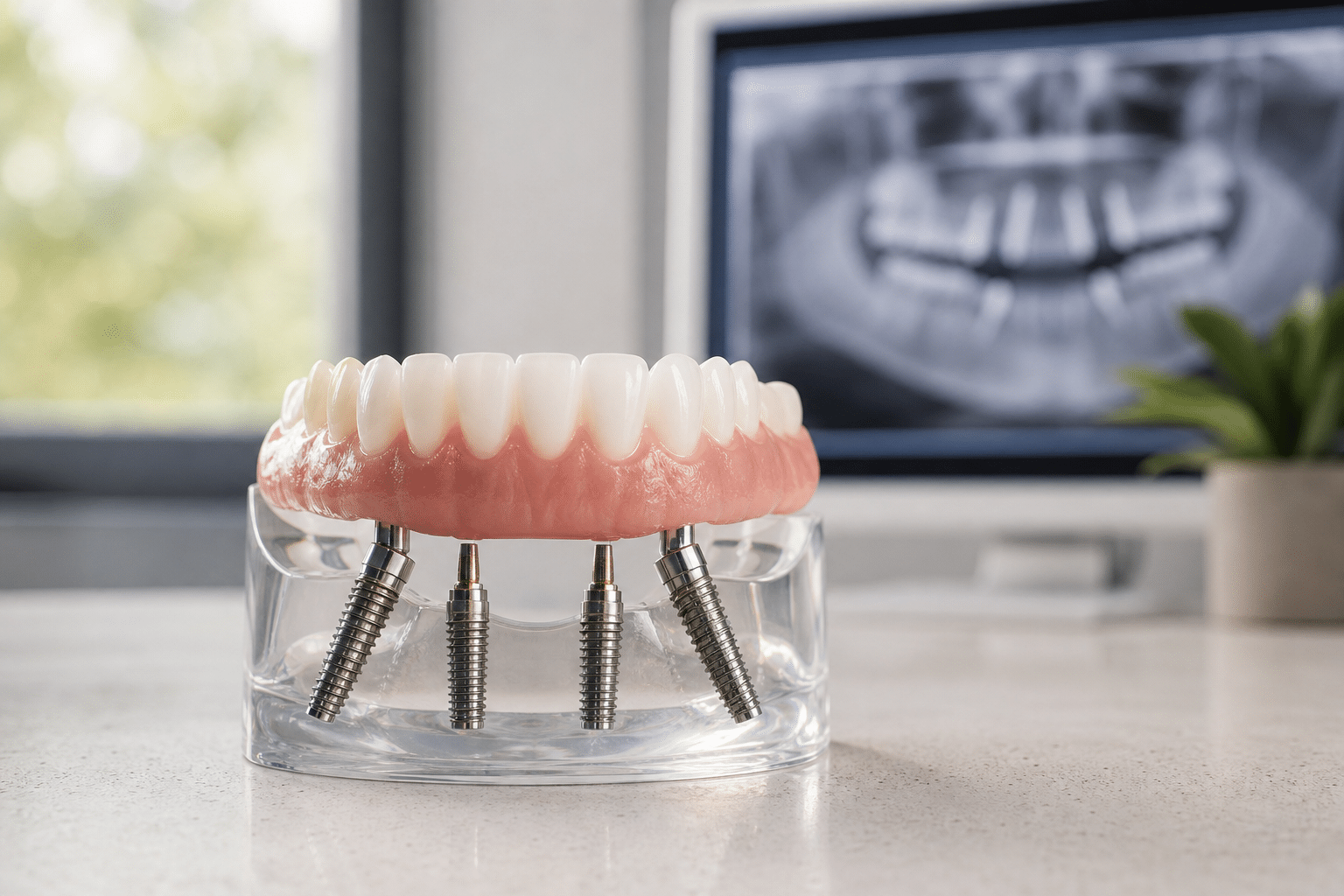
All-on-4 dental implants replace a full arch of teeth using four titanium posts, two placed straight at the front of the jaw and two angled toward the back to maximize contact with available bone. Patients receive a temporary fixed bridge within 24 to 48 hours of surgery, then a permanent restoration after three to six months of healing. This guide walks you through every stage of the process, from your first scan to your final bridge, so you arrive at your consultation already informed.
What Are All-on-Four Dental Implants?
All-on-4 is a full-arch tooth-replacement system that uses four strategically placed titanium implants to support a fixed bridge of 10 to 14 teeth. Two implants go in straight at the front of the jaw, where bone density is typically highest. The other two are angled up to 45 degrees at the rear, which spreads the load across more bone and often eliminates the need for bone grafting before surgery.
That angled design is what sets All-on-4 apart from traditional implant approaches. Replacing a full arch the conventional way typically requires six or more implants and, in many cases, bone grafts to build up volume first. All-on-4 sidesteps that in most cases by working with the bone you already have.
The restoration comes in two stages. You leave surgery with a provisional bridge, usually made from acrylic or PMMA (polymethyl methacrylate), that looks and functions like real teeth from day one. After the implants fuse with your jawbone, a process called osseointegration, that temporary bridge is replaced with a final, more durable restoration, typically zirconia.
Research backs the concept's reliability. A systematic review of 24 studies found a survival rate of 99.8% for All-on-4 implants after more than 24 months in function.
All-on-4 Dental Implants Step by Step: From Consultation to Final Bridge
The All-on-4 process has five distinct clinical stages. Knowing what happens at each one helps you prepare, ask the right questions, and avoid surprises along the way.
-
Complete a 3D cone-beam CT scan and digital assessment to map bone density and anatomy. Before any surgery is scheduled, your dentist takes a cone-beam CT scan of your jaw. This three-dimensional image shows bone height, width, and density in detail that a standard X-ray cannot provide. The digital assessment lets the surgical team plan exactly where each implant will go and confirm whether the angled-implant approach is feasible without bone grafting. This appointment also covers your medical history, any medications that could affect healing, and a full treatment plan with fees confirmed in writing before you commit.
-
Undergo surgery to extract failing teeth and place four implants, including two angled posterior posts. On surgery day, any remaining teeth in the arch are removed and the four implants are placed in a single procedure. The two rear implants are tilted to reach denser bone further back in the jaw. Most patients receive IV sedation or general anesthesia, so the procedure itself is not painful. Expect the appointment to take two to four hours depending on the complexity of your case.
-
Attach a temporary fixed bridge within 24 to 48 hours of the surgery for immediate function. This is the "immediate loading" part of All-on-4. Rather than waiting months with no teeth, you receive a provisional bridge the same day or the day after surgery. It is screwed into the implants, not removable like a denture. Research confirms that immediate loading produces significantly lower marginal bone loss (0.54 ± 0.17 mm) compared to delayed loading protocols, which means attaching the bridge quickly is clinically beneficial, not just convenient.
-
Maintain a soft-food diet for three to six months to allow the implants to fuse with the jawbone. Osseointegration, the process by which bone grows around and bonds to the titanium posts, takes time. During this phase you eat soft foods: eggs, fish, cooked vegetables, yogurt, pasta. Hard, crunchy, or chewy foods put stress on the implants before the bond is complete and can cause failure. You also need to keep the bridge and the tissue underneath it clean. A consistent daily routine matters here, and the detailed guide on how to clean all on four dental implants walks through the exact tools and technique to use during this critical healing window.
-
Replace the temporary teeth with a final, durable restoration like zirconia after healing is complete. Once your dentist confirms through imaging that osseointegration is successful, the provisional bridge is removed and a permanent prosthetic is fitted. Zirconia is the most common choice for the final restoration because of its strength and natural appearance. This appointment also includes bite adjustments and a final polish.
How Much Do All-on-4 Dental Implants Cost?
Cost is one of the first questions patients ask, and the honest answer is that the range is wide. According to CareCredit survey data reported by Dental Roundup, the national average cost for All-on-4 dental implants in the U.S. is $15,176. A separate estimate puts the cost of an acrylic resin over titanium bar restoration at a significantly higher figure per arch. These figures reflect different material tiers and possibly different arch counts, so treat them as the low and high ends of a realistic national range rather than a single definitive number.
What Drives the Price Difference?
Several factors push your total up or down:
- Material choice. An acrylic provisional bridge costs less to fabricate than a full-arch zirconia restoration. If you upgrade to zirconia for the final bridge, that adds to the total.
- Bone grafting. All-on-4 is designed to avoid grafting in most cases, but patients with significant bone loss may still need it. Each graft adds cost and extends the timeline.
- Anesthesia type. IV sedation and general anesthesia cost more than local anesthesia with oral sedation.
- Geographic market. Dental fees in major metro areas tend to run higher than in smaller cities or rural markets.
- Number of arches. Replacing both upper and lower arches roughly doubles the cost.
Does Dental Insurance Cover All-on-4?
Most dental insurance plans classify All-on-4 as a major restorative procedure and cover only a portion, if anything at all. Annual maximums on most plans fall well below the total cost of a single arch, so insurance rarely covers the full treatment. Some plans do pay toward individual components, such as extractions or bone grafts, which can reduce your out-of-pocket amount even when the implants themselves are excluded.
Medicaid coverage for implants is limited in most states. For a detailed breakdown of what Medicaid may and may not cover, the Medicaid dental implants coverage guide explains the rules in plain terms. Financing plans that spread the cost over time are often the most practical path for patients without comprehensive coverage. If you are still weighing All-on-4 against other options, the tooth replacement options comparison guide lays out how the main approaches differ in cost, procedure, and long-term maintenance.
Provisional vs. Final Prosthetics: PMMA vs. Zirconia
Your All-on-4 journey involves two distinct bridges, not one. The provisional bridge you leave surgery with and the final restoration placed after healing are made from different materials, serve different purposes, and behave differently in your mouth.
The provisional bridge is typically made from PMMA (polymethyl methacrylate), a dense acrylic. It is fabricated quickly, costs less than a permanent restoration, and is designed to absorb the minor flexing forces that occur while your implants are still fusing with bone. That flexibility is actually useful during osseointegration: a slightly more forgiving material puts less stress on the implant-bone interface while healing is underway.
The final restoration, usually zirconia, is a different category of material entirely. Zirconia is a ceramic that resists chipping, staining, and wear far better than acrylic. It also looks more like natural enamel under different lighting conditions. The trade-off is that zirconia is harder and less forgiving of impact, which is why dentists wait until healing is confirmed before placing it.
The table below summarizes the key differences.
| Feature |
PMMA / Acrylic Provisional |
Zirconia Final Restoration |
| Purpose |
Protect implants and restore function during healing |
Serve as the long-term, permanent prosthetic |
| Timeline |
Placed within 24 to 48 hours of surgery |
Placed after three to six months of confirmed osseointegration |
| Shock absorption |
High, cushions implants during bone integration |
Lower, rigid material transfers more force directly |
| Durability |
Moderate, prone to chipping and staining over time |
High, resists wear, staining, and fracture |
| Aesthetics |
Natural-looking but less translucent than zirconia |
Closely mimics natural tooth enamel in color and light response |
| Repairability |
Easier and less expensive to repair chairside |
More difficult to repair, often requires lab fabrication |
Your dentist will confirm through imaging when osseointegration is complete before scheduling the switch. Most patients move to their final restoration between three and six months post-surgery.
What Are the Disadvantages of All-on-4 Dental Implants?
All-on-4 has strong clinical outcomes, but it comes with real trade-offs. Understanding the downsides before you commit helps you set accurate expectations and plan for what recovery and long-term maintenance actually involve.
-
High mechanical complication rate for provisional bridges. Long-term data from the MALO Clinic shows that 90.1% of patients experience mechanical complications with their provisional All-on-4 prostheses. These complications include fractures, chipping, and screw loosening in the temporary bridge, not the implants themselves. The provisional bridge is designed as a transitional device, and this figure reflects how much stress a full-arch prosthetic absorbs during daily use. It does not mean the implants fail at that rate.
-
Systemic health conditions increase failure risk. Uncontrolled diabetes, active autoimmune conditions, and heavy smoking all impair the bone-healing process that makes osseointegration possible. Patients with these conditions face a higher risk of implant failure and may need medical clearance or lifestyle changes before surgery is approved.
-
Irreversibility. Once failing teeth are extracted and implants are placed, the process cannot be undone. If an implant fails, the treatment path becomes significantly more complex and costly.
-
Long-term maintenance commitment. All-on-4 is not a one-time procedure. The final restoration will eventually need adjustment, repair, or replacement, typically after 10 to 20 years depending on material and care. Screws can loosen and require retightening. These maintenance visits add to the total cost of ownership over time.
-
Dietary and hygiene restrictions during healing. The three-to-six-month soft-diet phase is a real lifestyle adjustment. Patients who do not follow dietary guidelines or maintain proper hygiene around the bridge risk implant failure before osseointegration is complete.
Consult with your dentist about your specific health history before deciding whether All-on-4 is the right path for you.
How Long Do All-on-4 Dental Implants Last? Success Rates Explained
All-on-4 implants are among the most studied full-arch restoration systems available, and the survival data is strong. A systematic review of 24 studies found a 99.8% survival rate for All-on-4 implants after more than 24 months in function. That figure covers the implant posts themselves, not the prosthetic bridge placed on top.
Longer-term data adds useful context. A 12-year retrospective study of computer-guided All-on-4 treatments reported a 92.5% cumulative survival rate for implants over that period. The decline from the two-year figure reflects the reality that a small percentage of implants fail over a longer horizon, most often due to infection, bone loss, or systemic health changes rather than implant design.
What Patients Can Do to Protect Longevity
Several factors within your control directly affect how long your implants last:
- Consistent oral hygiene. Bacteria accumulate around implant posts just as they do around natural teeth. Daily cleaning under and around the bridge is not optional.
- Regular professional maintenance. Twice-yearly checkups let your dentist catch screw loosening, tissue inflammation, or early bone changes before they become serious problems.
- Avoiding high-impact habits. Grinding your teeth at night puts repeated stress on both the implants and the prosthetic. A night guard can protect the restoration significantly.
- Managing systemic health. Keeping conditions like diabetes well controlled supports the bone health that keeps implants stable over decades.
Twice-yearly checkups and daily cleaning with a water flosser or interdental brush are the two most important maintenance habits for protecting your implants over the long term.
Getting All-on-4 Implants at Affordable Dentist Near Me
Affordable Dentist Near Me (ADNM) is an independent, Texas-owned dental group serving the Dallas-Fort Worth Metroplex, East Texas, and Central Texas. New patients receive a free exam and X-rays, and a written treatment plan with exact fees is confirmed before any work begins. That transparency matters especially for All-on-4, where the total cost depends on your bone condition, the number of arches, and your final material choice.
ADNM accepts most major PPO dental plans as well as Medicaid and CHIP for covered services, and offers in-house financing options (subject to credit approval) for patients who need to spread the cost over time. Spanish-speaking staff and same-day appointments are available, so you can get imaging, a treatment plan, and a clear cost estimate in a single visit.
Prices and plan limits verified as of October 2026.
FAQs
Can you eat normally with All-on-4 dental implants?
During the three-to-six-month healing phase, you follow a soft-food diet: eggs, fish, cooked vegetables, yogurt, and pasta. Hard, crunchy, or chewy foods can stress the implants before osseointegration is complete. Once your dentist confirms healing and places the final restoration, most patients return to a normal diet. Very hard foods like ice or hard candy are still worth avoiding to protect the prosthetic long-term.
Is bone grafting always required before All-on-4 surgery?
No. The angled rear implants in the All-on-4 design reach denser bone further back in the jaw, which is specifically intended to reduce or eliminate the need for grafting. Most patients with adequate existing bone volume do not need a graft. However, patients with significant bone loss from long-term tooth loss or gum disease may still require grafting before implants can be placed safely.
Does dental insurance cover any part of All-on-4 treatment?
Most dental plans classify All-on-4 as a major restorative procedure. Annual plan maximums typically fall well below the total cost of a single arch, so full coverage is uncommon. Some plans do pay toward individual components such as extractions or bone grafts. Requesting a pre-treatment estimate from your insurer before you commit tells you exactly what will and will not be reimbursed.
What systemic health conditions can increase the risk of All-on-4 implant failure?
Uncontrolled diabetes is one of the most significant risk factors because high blood sugar impairs bone healing and increases infection risk. Heavy smoking reduces blood flow to the jaw and slows osseointegration. Active autoimmune conditions and patients on long-term bisphosphonate medications (used to treat osteoporosis) also face elevated risk. Your dentist will review your full medical history and may require medical clearance or condition management before approving surgery.
How is All-on-4 different from All-on-6?
All-on-4 uses four implants per arch, two straight at the front and two angled at the rear. All-on-6 places six implants, typically all at straighter angles, distributing the load across more anchor points. All-on-6 may be recommended for patients with heavier bite forces or greater bone volume who can support the additional implants. All-on-4 remains the more widely studied option, with strong long-term survival data, while All-on-6 is generally considered when additional support is clinically indicated.
Conclusion
All-on-4 dental implants offer a fixed, full-arch restoration supported by four titanium posts, with a temporary bridge placed within 48 hours of surgery and a permanent restoration after three to six months of healing. National costs vary widely by materials, bone condition, and how many arches you replace. The implant survival data is strong, but the provisional bridge carries a high mechanical complication rate, so understanding the two-stage process and its maintenance demands is essential before you decide.
Your most useful next step is a consultation that includes a cone-beam CT scan. That imaging shows whether your bone volume supports the angled-implant approach without grafting, which is the single biggest variable in both cost and timeline. Bring your insurance information and a list of any medications or health conditions so your dentist can give you an accurate treatment plan and a written fee estimate in the same visit.