Dental implants do not usually set off airport metal detectors, so you can generally pass through security without any special preparation for your teeth. An alarm or additional screening is still possible, and having dental implants does not exempt you from the airport’s normal security checks.
TL;DR
Do dental implants set off metal detectors? Usually not, but no dental material guarantees an alarm-free screening.
TSA screening instructions take priority; explain your dental implants if an officer asks about implanted metal.
Titanium dental implants contain metal; zirconia implant posts are ceramic, but other restoration components can contain metal.
Affordable Dentist Near Me provides dental implant care for families in its Texas service communities, not airport screening clearance.
Why this matters
Airport security should not determine whether you replace a missing tooth. The useful distinction is between a dental implant containing metal and that implant producing enough of a response to trigger a particular detector.
For families considering implant treatment, Affordable Dentist Near Me provides general, cosmetic and restorative dental care in Fort Worth, Dallas, Houston, Waco, Grand Prairie and Crowley. Ask your dentist about the materials in your restoration; ask airport security staff about screening procedures. Those are separate responsibilities.
Do dental implants set off metal detectors at the airport?
Dental implants usually pass through airport metal detectors without triggering an alarm. Their small size and the way screening equipment responds to metal help explain why having an implant does not automatically mean extra screening.
Titanium is a metal, even though it is not strongly attracted to an ordinary magnet. Airport metal detectors do not work simply by checking whether something sticks to a magnet, so the explanation that titanium is nonmagnetic and therefore undetectable is incorrect.
For 2026 travel planning, distinguish the equipment you encounter rather than treating every scanner as a metal detector:
Screening method
What it checks
What it means for dental implants
Limitation
Walk-through metal detector
A response to metal passing through its detection field
Small dental components usually do not trigger an alarm
A particular screening outcome cannot be guaranteed
Body scanner
Potential threats concealed on the body, including nonmetallic items
It is not simply a test for metal in your teeth
An officer can still need to resolve a flagged area
Handheld metal detector
A localized response to metal
Tell the officer about dental implants if asked
It does not identify your dental material or diagnose a dental problem
TSA’s public guidance on implants and internal medical devices explains that travelers can require additional screening when a device triggers an alarm. That general guidance does not mean dental implants routinely cause alarms, and it does not provide a guaranteed exemption for dental work.
Titanium dental implants: metal does not mean an automatic alarm
Titanium and titanium alloys are widely used for dental implant posts. A post sits in the jaw and supports the replacement tooth through connecting components.
The practical advantage of titanium is its established use in implant dentistry, not an airport-security promise. It remains metal, and a metal detector’s response depends on more than the material’s name.
Do not confuse the implant post with the entire replacement tooth. The visible crown and the connector beneath it can use different materials, so saying you have a titanium implant does not describe every component in your mouth.
Ask for a description of the complete restoration if you want an accurate material record. That information is more useful for future dental care than a broad claim that your teeth are metal-free or scanner-proof.
Zirconia dental implants: ceramic posts do not describe every component
Zirconia is a ceramic material used in some dental implants. A zirconia implant post is not a metal post, but that alone does not establish the composition of every part of the restoration.
A zirconia crown is also different from a zirconia implant. You can have a zirconia crown supported by a titanium implant, so the word zirconia on a treatment discussion does not necessarily mean the part in your jaw is ceramic.
The distinction matters when comparing treatment plans. A ceramic component provides a different material option, but choosing it requires a clinical discussion about your mouth, the proposed restoration and its maintenance—not just your travel schedule.
Do not select an implant material solely to avoid airport screening. Neither a ceramic post nor a metal-free claim guarantees that you will never be selected for an additional security check.
Why airport screening results vary
There is no reliable rule that a particular number of dental implants guarantees an alarm—or guarantees that you will avoid one. Screening depends on the equipment and the circumstances, not simply whether you have replacement teeth.
These factors explain why travelers do not all have the same experience:
Screening equipment: A walk-through detector, a body scanner and a handheld detector perform different checks.
Metal composition: The implant post, connectors and replacement teeth do not necessarily contain the same materials.
Amount and arrangement: A small dental component is not equivalent to a large metal object, and size alone does not predict a screening result.
Other belongings: Clothing fasteners, jewelry and items left in pockets can contribute to an alarm unrelated to dental work.
Screening procedures: Officers must resolve alarms and can conduct additional checks for reasons unrelated to your implant.
For your 2026 trip, follow the instructions at the checkpoint rather than another traveler’s account of what happened at a different airport. An uneventful previous flight is reassuring, but it is not a promise about your next screening.
What should you do at airport security with dental implants?
You usually do not need a special airport routine for fixed dental implants. Prepare for normal screening and explain your dental work if it becomes relevant.
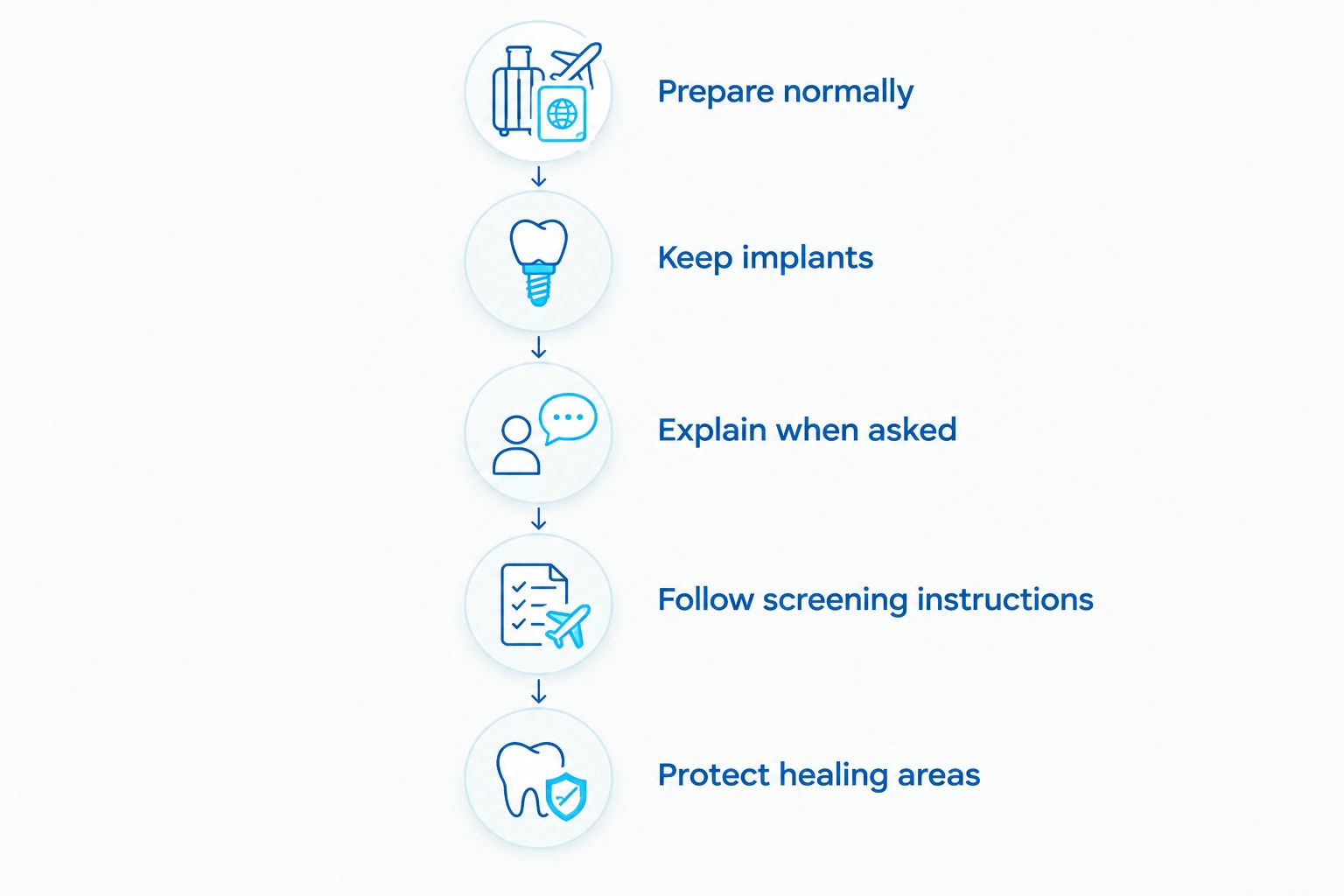
Prepare normally. Follow the checkpoint instructions for your belongings, clothing and pockets. Do not assume an alarm comes from your teeth before an officer checks other possible causes.
Keep implants in place. A fixed dental implant is not something you remove for screening. Do not loosen a crown, bridge or implant attachment to prepare for a flight.
Explain when asked. If an officer asks about implanted metal or an alarm near your head, state plainly that you have dental implants. Avoid guessing the material if you do not know it.
Follow screening instructions. Allow the officer to explain the next step. Having an implant does not automatically eliminate the need to resolve an alarm.
Protect healing areas. If you recently had surgery and a screening step raises a concern, explain the recent procedure before it happens. Ask your treating dentist about travel and recovery before leaving home.
The aim is straightforward: cooperate with screening without treating a dental implant as a removable accessory. You do not need to prove the full history of your dental treatment merely to explain that an implant is present.
Keep fixed dental work in place and explain your implants if screening staff ask.
Do you need a dental implant card to fly?
You generally do not need a dental implant card simply to pass through airport security. A dental record can help you explain your treatment, but it does not replace screening or require an officer to waive a check.
If your dentist has supplied an implant record, keep a copy somewhere accessible while traveling. Its main practical value is identifying your implant system or treatment if you need dental care away from home.
For 2026 travel, separate a useful medical record from an official travel requirement. Do not pay for a document on the assumption that showing it will guarantee passage through security without additional screening.
Can airport scanners damage dental implants?
Routine airport security screening is not expected to damage a properly placed dental implant. Passing through a detector does not mean the implant is being pulled out of your jaw or loosened.
Airport screening is not the same as a medical MRI examination. If you are scheduled for an MRI, give the imaging team your implant information and follow that team’s safety instructions rather than applying airport advice to medical equipment.
Pain, movement or a change in your bite after a trip deserves a dental assessment. Do not assume a security scanner caused the problem, and do not attempt to tighten or adjust the restoration yourself.
Can you fly soon after dental implant surgery?
Passing through security and being ready to fly after surgery are different questions. Your dentist must assess travel timing based on the procedure, your recovery and any additional treatment, such as bone grafting or a sinus-related procedure.
Before booking travel around implant surgery, discuss:
Your departure date and whether follow-up care is needed before you leave.
Any bleeding, swelling or pain that needs assessment.
Your medication instructions and how to follow them during travel.
Food choices and cleaning instructions while your mouth heals.
Who to contact if a temporary tooth or restoration becomes loose.
For a 2026 itinerary, arrange the recovery discussion before departure rather than relying on a general online waiting period. Your treating dentist’s instructions take priority over a travel checklist. Seek urgent care for trouble breathing or swallowing, rapidly worsening swelling or uncontrolled bleeding.
What should you ask your dentist before traveling?
Ask questions that help you care for your mouth away from home. Knowing your treatment details is useful; trying to obtain a promise about every airport detector is not.
Start with whether your replacement teeth are fixed or removable, which parts contain metal, and what you should do if something feels loose. Also ask whether your current stage of healing requires a review before you leave.
Affordable Dentist Near Me is best for families in its Texas service communities seeking local dental implant care, not airport screening clearance. The practice provides implant and other restorative dental services; its dental team can address treatment questions, while security officers determine screening procedures.
The benefit of a pretravel dental discussion is a care plan for your actual restoration. Its limit is equally clear: no dentist can guarantee that an airport will never conduct an additional check.
Discuss Your Implant Care Before Travel
Ask about implant materials, recovery instructions and care while you are away.
Do dental implants set off metal detectors at the airport?
Dental implants usually do not set off airport metal detectors. An alarm or additional screening is still possible, so follow checkpoint instructions and mention your implants if an officer asks.
Do I have to tell TSA that I have dental implants?
You usually do not need a special announcement solely because you have dental implants. Tell the officer if asked about implanted metal, if an alarm needs resolving, or if recent surgery creates a screening concern.
Do titanium dental implants contain metal?
Titanium dental implants contain metal. Titanium’s weak response to an ordinary magnet does not make it undetectable by airport security equipment.
Are zirconia implants completely metal-free?
A zirconia implant post is ceramic, but the complete restoration needs to be checked before describing it as metal-free. A zirconia crown can also sit on a titanium implant.
Do I need a dentist’s letter to fly with implants?
You generally do not need a dentist’s letter just because you have dental implants. Treatment records can be useful if you need dental care during your trip, but they do not replace airport screening.
Can an airport scanner loosen a dental implant?
Routine airport screening is not expected to loosen a properly placed dental implant. If your implant or replacement tooth moves or hurts, contact a dentist rather than assuming the scanner caused it.
Can I remove an implant-supported tooth before security?
Do not remove fixed implant-supported teeth for airport security. If you have a removable appliance, follow your dentist’s instructions for handling it and ask the security officer for guidance if needed.
Can Affordable Dentist Near Me help me prepare for travel after implant treatment?
Affordable Dentist Near Me provides dental implant and restorative care in its Texas service communities. Ask the office about your treatment materials, healing instructions and whether you need a dental review before departure.
One last thing
The material of your visible crown does not necessarily identify the material of the implant beneath it. If you want one useful item before a 2026 trip, request a simple treatment summary that distinguishes the implant post, connector and replacement tooth.
Keep that summary for dental care, not as a security pass. Affordable Dentist Near Me patients should direct questions about their own restoration to the office; travelers should follow the instructions of the security team at their departure airport.