All-on-4 recovery time has two stages: early soreness and swelling settle over days to weeks, while the implants bond with your jawbone over months. Feeling comfortable does not mean your implants are ready for unrestricted chewing. For treatment planned in 2026, arrange time to rest and follow your dentist’s instructions until the healing checks confirm you can progress.
TL;DR
All-on-4 recovery time includes early recovery and longer bone healing; comfort alone does not confirm readiness for normal chewing.
Temporary teeth restore appearance during implant healing, but they do not remove food restrictions.
Worsening pain, persistent bleeding, or a moving bridge requires prompt contact with your treating dentist.
Affordable Dentist Near Me serves Texas families seeking general, cosmetic, and restorative dental care.
How long does it take to recover from all-on-4 dental implants?
Expect recovery in stages, not one finish date. The surgical wounds, your ability to manage everyday activities, and the bond between bone and implants recover on different schedules.
Cleveland Clinic’s patient guidance on dental implant surgery describes bone healing as taking about 3 to 9 months. That is general implant guidance, not an All-on-4-specific promise or a deadline for receiving your final teeth. Your dentist sets your schedule using the condition of your jaw, the stability of the implants, and your healing progress.
Recovery stage
What you are recovering from
What determines your next step
Early recovery
Surgery, swelling, soreness, and any tooth extractions
Symptoms improve and you can manage fluids, food, and prescribed care
Gum healing
Healing around the surgical sites
Your dentist checks the tissues and cleaning routine
Bone healing
Bone attaching to the implant surfaces
Your dentist assesses implant stability and healing
Final restoration
Moving from temporary teeth to the planned long-term bridge
The implants and surrounding tissues are ready
Affordable Dentist Near Me provides general, cosmetic, and restorative dental care for families in several Texas cities. Before committing to treatment, ask your treating dentist to explain these recovery stages separately.
Why this matters
A new set of teeth can look ready before the bone underneath is ready. Appearance is not a healing test. Chewing beyond your dentist’s instructions puts pressure on implants during a period when protecting them matters.
For your 2026 treatment plan, ask for separate guidance on returning to work, changing your diet, cleaning around the bridge, and receiving final teeth. A single recovery estimate does not answer all of those questions.
The most useful schedule tells you what you can do now, what remains restricted, and how the dentist will decide when restrictions end. Keep that schedule with your aftercare instructions rather than relying on a calendar reminder alone.
Early recovery: rest, swelling, and everyday activities
During early recovery, expect some soreness, swelling, bruising, and minor bleeding after surgery. The extent depends partly on whether your appointment includes extractions or additional procedures. Your discharge instructions should explain how to manage these symptoms and when to call.
Swelling after oral surgery commonly reaches its highest point around 48 to 72 hours. That general pattern helps explain why you can look more swollen after the first day, but it does not make every change normal. Rapidly increasing swelling, fever, or difficulty swallowing needs medical attention.
Plan for help getting home if you receive sedation, and follow the sedation team’s restrictions on driving and important decisions. Do not assume that being awake means the medication has fully worn off.
Use prescribed or recommended medicines exactly as directed. Ask your dentist or pharmacist before combining pain medicines, especially if you take other medications or have a medical condition. Do not start leftover antibiotics or change prescribed doses yourself.
When can you return to work after All-on-4?
Returning to work depends on your symptoms, medication effects, and job duties, not simply the procedure name. Desk work creates different demands from lifting, bending, prolonged speaking, or operating machinery.
Ask your dentist for clearance that matches your actual job. If you still need a medicine that affects alertness, cannot comfortably drink and eat, or have ongoing bleeding, returning to work is not the immediate priority.
Gum healing: comfortable does not mean fully healed
Your gums can feel better while the implants still need protection. Soreness fading is encouraging, but it does not confirm that your jawbone has finished attaching to the implants.
At follow-up visits, the dentist checks the healing tissues, your bite, and the condition of your temporary teeth. Report any area where the bridge rubs, food repeatedly catches, or cleaning feels impossible. Small adjustments belong with your dental team, not a home repair attempt.
Keep your scheduled reviews even when you feel well. A healing check provides information that you cannot get by looking in a mirror or pressing on the teeth.
How should you clean around the healing implants?
Use the cleaning method your surgical team demonstrates. The right approach depends on the surgical sites and the design of your temporary bridge. Ask which areas to brush, whether to use a prescribed rinse, and when to start cleaning underneath the bridge.
The American Dental Association recommends brushing natural teeth for 2 minutes, twice daily, using fluoride toothpaste. That general advice does not replace postoperative instructions for a surgical area. Ask how to maintain the rest of your mouth without disturbing healing tissues.
Do not force floss or a water flosser under a new bridge before your dentist approves the tool and technique. If you cannot reach an area comfortably, request a demonstration rather than guessing.
Bone healing: the longer part of All-on-4 recovery
Bone healing is the part of recovery that continues after you feel more like yourself. The implant surfaces need to develop a stable connection with the surrounding bone before the dentist permits the next stage of treatment.
The 3 to 9 months described in Cleveland Clinic’s general implant guidance illustrates why recovery cannot be measured only by pain. It is not a guarantee that every All-on-4 patient will follow that schedule. Additional surgery, existing health conditions, and the condition of the jaw affect individual planning.
For All-on-4 treatment in 2026, ask what your dentist will assess before changing your chewing restrictions or fitting final teeth. The decision should follow your healing findings, not a date you found online.
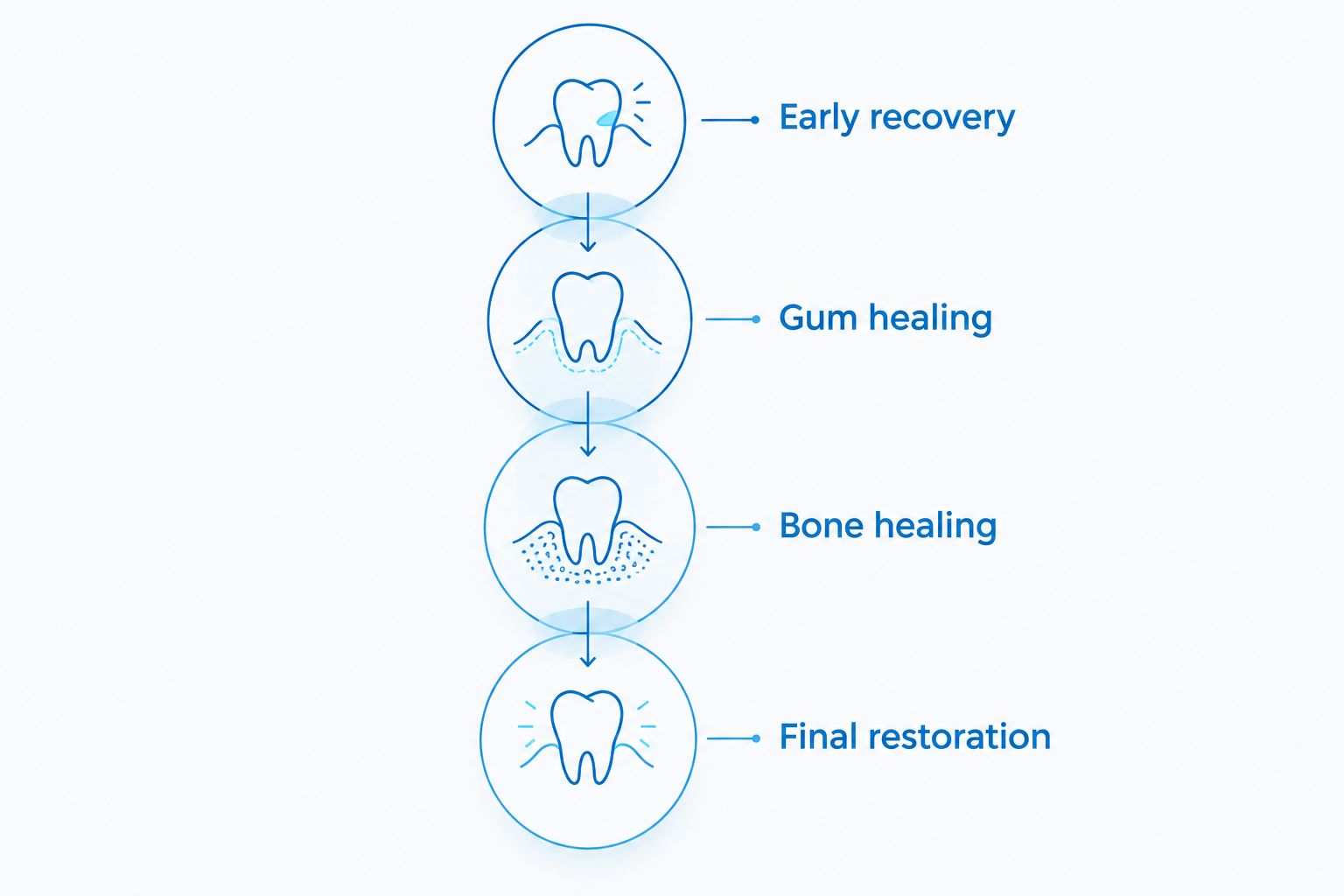
The sequence is straightforward: early recovery, gum healing, bone healing, then the final restoration when appropriate. These stages overlap; they are not separate appointments with fixed deadlines.
Feeling better happens before your dentist confirms readiness for the final restoration.
Temporary teeth versus final teeth during recovery
A temporary bridge and a final bridge serve different purposes. Receiving temporary teeth soon after surgery does not mean you have completed recovery, and immediate placement is not appropriate for every patient.
Restoration
Best for
Benefit
Limitation
Temporary bridge
The healing phase when your dentist approves attachment
Provides teeth while the implants heal
Requires care and chewing restrictions; appearance and bite can need adjustment
Final bridge
Longer-term use after your dentist confirms readiness
Provides the planned long-term restoration
Still needs daily cleaning, professional checks, and attention to bite problems
Same-day teeth are not the same as same-day healing. Your dentist must decide whether the implants have enough initial stability to support a temporary bridge and what restrictions apply afterward.
Before treatment, ask whether your plan includes temporary teeth, how adjustments are handled, and what happens if the dentist decides that attachment should wait. Understanding that possibility makes the recovery plan clearer without treating a particular outcome as guaranteed.
Why All-on-4 recovery time varies
These factors change the recovery plan and explain why another patient’s timeline is not your deadline:
Extractions and additional surgery: Removing teeth or adding bone treatment changes the surgical work and aftercare requirements.
Bone condition and implant stability: Your dentist assesses whether the implants can support a temporary bridge and when chewing can progress.
Smoking and nicotine exposure: Smoking interferes with healing and increases implant complications. Discuss stopping before surgery and throughout recovery.
Diabetes and other health conditions: Blood sugar control and conditions that affect healing belong in the treatment assessment.
Medicines and sedation: Your medication list affects surgical planning, pain management, and restrictions after your appointment.
Cleaning and chewing habits: Following aftercare instructions protects the tissues and avoids unnecessary pressure during healing.
Give your dentist a complete medication and health history before surgery. Do not stop prescribed medicines on your own, including blood thinners or medicines used for chronic conditions.
What can you eat while All-on-4 implants heal?
Choose foods that match the texture your dentist permits. Being able to bite something does not mean it is safe for healing implants. A temporary bridge can make chewing feel possible before the underlying support is ready.
Soft choices include smooth yogurt, mashed vegetables, soft eggs, and blended soups cooled to a comfortable temperature. Avoid hard, crunchy, sticky, or tough foods until your dentist clears them. Food texture matters more than whether an item is generally considered healthy.
Ask your dentist to demonstrate what “soft” means for your particular plan. Clarify whether you should avoid chewing altogether at first, which foods require modification, and how to progress without putting the implants under excessive pressure.
Keep fluids and nutrition a priority. If pain, nausea, or difficulty swallowing prevents you from drinking or eating adequately, contact your care team instead of waiting for the next scheduled review.
When should you call about recovery symptoms?
Symptoms should generally move toward improvement after the early postoperative period. Call your treating dentist when pain or swelling worsens after improving, bleeding persists despite following instructions, or the bridge feels loose.
Other reasons to call include pus, fever, a persistent unpleasant taste with worsening symptoms, or numbness that continues beyond what your surgical team told you to expect. Do not attempt to tighten, file, or glue a bridge yourself.
Seek emergency medical care for difficulty breathing or swallowing, rapidly spreading swelling, or heavy bleeding that does not stop. Those problems are not routine recovery milestones.
For a separate explanation of complications, read whether All-on-4 dental implants can fail. A symptom does not establish implant failure; it establishes a reason for assessment.
Prepare your recovery plan before surgery
For treatment in 2026, make these arrangements before your surgical appointment:
Confirm transport. Follow the sedation team’s instructions about an escort and supervision afterward.
Arrange recovery time. Explain your work duties so your dentist can advise on activity restrictions.
Prepare food. Have suitable textures ready and clarify how long restrictions apply to your plan.
Review medicines. Confirm what to take, what to avoid, and whom to contact about side effects.
Book follow-ups. Know when your healing checks occur and how to reach the treating team between visits.
Affordable Dentist Near Me is for Texas families seeking general, cosmetic, and restorative dental care. Ask the office about implant assessment and your individual recovery needs; this guide does not establish whether All-on-4 is offered or appropriate for you.
Discuss your dental care needs
Ask about implant assessment, aftercare instructions, and your individual recovery plan.
How long does All-on-4 recovery take before I feel normal?
Early All-on-4 recovery takes days to weeks, while bone healing continues over months. Your symptoms, additional procedures, and work demands determine when you can resume everyday activities.
Does getting teeth on the same day mean the implants are healed?
No, same-day teeth do not mean the implants are healed. A temporary bridge can be attached when your dentist considers the implants stable enough, but chewing restrictions still apply.
How long does the bone take to heal around dental implants?
About 3 to 9 months is the bone-healing period described in Cleveland Clinic’s general dental implant guidance. Your All-on-4 dentist determines your actual schedule through healing checks rather than using that range as a guarantee.
When can I eat normally after All-on-4 surgery?
You can return to normal chewing when your dentist clears you, not simply when soreness stops. Follow the prescribed food textures while the implants heal.
Is swelling worse a few days after implant surgery?
Swelling after oral surgery commonly peaks around 48 to 72 hours. Contact your dentist for rapidly increasing swelling, fever, or symptoms that worsen after improving; breathing or swallowing difficulty needs emergency care.
Can I smoke while my All-on-4 implants heal?
Smoking interferes with healing and increases implant complications. Discuss a stopping plan with your dentist before surgery and follow the instructions throughout recovery.
What should I do if my temporary implant bridge moves?
Contact your treating dentist promptly if the temporary bridge moves. Avoid chewing on it and do not attempt to tighten or repair it yourself.
Can Affordable Dentist Near Me help me understand implant recovery?
Affordable Dentist Near Me provides restorative dental care, including implants. Contact the office to ask about assessment and aftercare; the treating dentist determines which procedures fit your needs.
One last thing
Ask for the clearance rules, not just the recovery date. Before leaving surgery, know what must happen before you drive, return to work, change food textures, and move to final teeth.
For your 2026 recovery, a written plan tied to symptoms and clinical checks is more useful than a countdown. The milestone that matters is your dentist confirming that the tissues and implants are ready for the next step.