Best overall for a small chip: dental bonding. Best for a tiny rough edge: smoothing. Best for substantial damage: a crown. This 2026 guide compares five chipped tooth repair options, including fragment reattachment and veneers, so you can discuss the right repair with your dentist.
TL;DR
Dental bonding leads chipped tooth repair options for small chips when enough healthy tooth remains.
Smoothing suits tiny enamel chips; crowns protect teeth with more substantial damage.
Fragment reattachment deserves consideration when you recover the broken piece; veneers address selected front-tooth appearance concerns.
Affordable Dentist Near Me provides general, cosmetic, and restorative dental care for Texas families.
Get a dental examination before choosing a repair, even when the chipped tooth does not hurt.
Why this matters
A chipped tooth is not automatically a cosmetic problem. A small-looking break can expose sensitive tooth structure, while a larger fracture can affect the nerve or weaken the tooth under chewing pressure.
Affordable Dentist Near Me provides general, cosmetic, and restorative dental care for families in Fort Worth, Dallas, Houston, Waco, Grand Prairie, and Crowley. The right starting point is an examination—not choosing the repair that looks simplest in a photograph.
For chipped tooth repair in 2026, choose the least extensive treatment that adequately restores and protects the tooth. Appearance matters, but the depth of the break and the strength of the remaining tooth come first.
What makes the best chipped tooth repair options
Use these five criteria to compare a dentist’s recommendations:
Damage depth: An enamel-only chip needs a different approach from a fracture involving the nerve.
Remaining tooth strength: A repair needs enough sound tooth structure to support it.
Bite pressure: Front-tooth edges and back-tooth chewing surfaces face different demands.
Natural appearance: Color, shape, and the position of the chip determine how visible the repair will be.
Tooth preservation: Removing healthy tooth structure needs a clear reason, especially when a smaller repair would work.
A photograph cannot establish all five. Your dentist checks the tooth, your bite, and signs of deeper injury, with imaging or other tests when needed.
Chipped tooth repairs at a glance
These 5 treatment options address different problems. The ranking starts with a common conservative repair, not a claim that every chipped tooth needs the same treatment.
Rank and option
Best for
Standout feature
Key limitation
1. Dental bonding
A small chip needing replacement material
Tooth-colored material rebuilds the missing edge
Can stain, wear, or chip
2. Smoothing and contouring
A tiny, shallow enamel chip
Smooths a rough edge without adding material
Cannot rebuild missing tooth structure
3. Fragment reattachment
A suitable recovered tooth fragment
Uses the original tooth piece
Depends on the fragment and fracture condition
4. Dental veneer
A front-tooth chip with broader appearance concerns
Covers the visible front surface
Often requires enamel removal
5. Dental crown
Substantial damage with weakened remaining structure
Covers and protects the remaining tooth
Requires more tooth preparation
1. Dental bonding: best repair for a small missing edge
Dental bonding uses tooth-colored resin to replace a chipped area. Your dentist shapes the material to fit the tooth and checks how the repaired edge meets the opposing teeth.
Bonding is a strong starting point for a small chip when the remaining tooth is healthy. It rebuilds an edge rather than simply shortening or smoothing it.
Dental bonding pros:
Replaces missing structure with tooth-colored material.
Usually preserves more healthy tooth than a crown.
Allows the dentist to adjust the repaired shape.
Dental bonding cons:
Resin can stain or lose its surface finish.
A repair can chip again, especially under heavy biting pressure.
Best for: A small front-tooth chip or another limited defect with adequate supporting tooth structure.
Ask whether your bite lands directly on the repaired edge. Grinding, nail biting, and opening packaging with your teeth can put the repair under avoidable stress.
Verdict: Hold until the tooth is examined; choose dental bonding when a small repair restores adequate shape and function.
2. Smoothing and contouring: best for a tiny enamel chip
Smoothing and contouring remove a small amount of enamel to soften a rough or uneven edge. This treatment does not replace the missing piece.
The distinction matters. If rebuilding the tooth’s original shape is necessary, smoothing alone will not do that job.
Smoothing and contouring pros:
Removes a sharp edge that catches your tongue or lip.
Does not introduce a separate restorative material.
Addresses minor unevenness without covering the tooth.
Smoothing and contouring cons:
Enamel removal is permanent.
It cannot treat a deep chip or replace a noticeable missing corner.
Best for: A very small enamel chip where slight reshaping leaves an acceptable tooth shape and bite.
Do not file a chipped tooth yourself. You cannot judge enamel thickness or hidden damage by touch, and removing more tooth structure can make the problem harder to repair.
Verdict: Hold for a dental assessment; choose smoothing only when the chip is shallow and rebuilding is unnecessary.
3. Fragment reattachment: best when you recover the broken piece
Fragment reattachment bonds a suitable broken piece back onto the tooth. The dentist evaluates the fragment, the fracture surface, and the remaining tooth before deciding whether this approach is appropriate.
Finding the piece gives you another option, not a guarantee. Keep the fragment moist in milk or saliva and bring it to the dentist; do not scrub it or attach it with household glue.
Fragment reattachment pros:
Uses the original tooth’s color and surface texture.
Preserves the natural shape when the fragment fits well.
Can avoid replacing the entire missing area with another material.
Fragment reattachment cons:
A missing, damaged, or poorly fitting fragment limits suitability.
The reattached piece can break away under stress.
Best for: A fracture with a recovered fragment that the dentist considers suitable for reattachment.
Tell the dentist how the injury happened and whether the tooth feels loose. A blow to the mouth can injure more than the visible edge.
Verdict: Hold the fragment moist and seek dental care; choose reattachment only after the dentist confirms a suitable fit and tooth condition.
4. Dental veneer: best for a chip with broader appearance concerns
A dental veneer covers the front surface of a tooth. It is an option when a front-tooth chip occurs alongside concerns about shape or color, provided the tooth is otherwise suitable.
A veneer is not the automatic next step after a small chip. In a 2026 treatment discussion, ask what a veneer would solve that a smaller bonding repair would not.
Dental veneer pros:
Changes the visible front surface and shape.
Addresses selected appearance concerns together.
Provides a tooth-colored covering for a suitable front tooth.
Dental veneer cons:
Preparation often removes enamel permanently.
A veneer can chip or come loose and need further treatment.
Best for: A suitable front tooth with a chip plus broader appearance concerns that justify covering its front surface.
A veneer does not replace treatment for decay, infection, or a deep fracture. Those findings change the treatment plan, even if your main concern is the appearance of your smile.
Verdict: Hold until tooth health and conservative alternatives are assessed; choose a veneer for a justified appearance-focused repair.
5. Dental crown: best for substantial structural damage
A dental crown covers the remaining visible tooth after preparation. It is useful when a larger break leaves the tooth too weakened for a smaller repair to provide adequate protection.
A crown and root canal treatment do different jobs. The crown restores coverage and shape; root canal treatment addresses an infected or irreversibly damaged nerve when that treatment is needed.
Dental crown pros:
Covers weakened remaining tooth structure.
Restores the shape of a substantially damaged tooth.
Provides coverage when a limited patch is inadequate.
Dental crown cons:
Requires removal of additional tooth structure for preparation.
Does not make every deep fracture repairable.
Best for: A tooth with substantial damage that remains suitable to restore.
Ask your dentist to explain why a crown is necessary. A fracture extending too far below the gum or into the root can change whether the tooth can be saved.
Verdict: Hold for a structural assessment; choose a crown when the remaining tooth needs coverage rather than a small repair.
How these repairs were ranked
The ranking prioritizes preserving healthy tooth structure while restoring useful shape and protecting the tooth. Bonding leads for a small missing edge; smoothing, reattachment, veneers, and crowns each serve a different clinical situation.
This is a treatment-fit comparison, not a product test or a replacement for diagnosis. The strongest recommendation is the one supported by your examination findings.
What to do before your dental visit
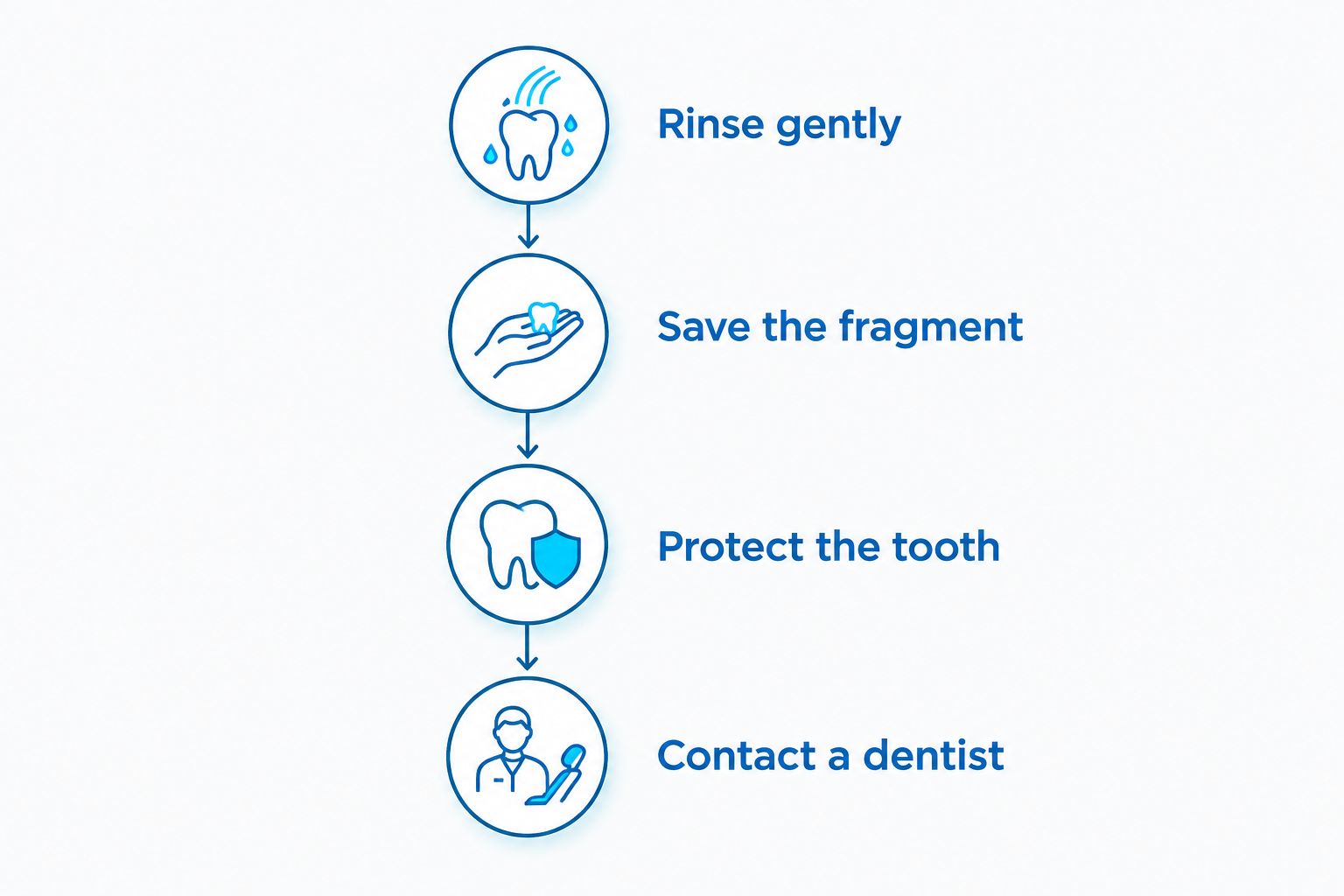
Take these steps after noticing a chip:
Rinse gently: Use warm water to clear the mouth without poking the damaged area.
Save the fragment: Keep a recovered piece moist and take it to the dentist.
Protect the tooth: Avoid chewing hard food on the affected side. Do not repeatedly test the edge with your fingers or tongue.
Contact a dentist: Describe the injury, pain, sensitivity, bleeding, swelling, or looseness.
Protect the tooth and bring any recovered fragment to the dental visit.
Get urgent dental attention for severe pain, a loose tooth, a visible pink or red area inside the break, or swelling. Difficulty breathing or swallowing, major facial injury, or uncontrolled bleeding requires emergency medical care.
A painless chip still needs assessment. Pain does not reliably tell you how deep a fracture extends.
Questions to ask at your 2026 appointment
Bring these 3 questions to your chipped tooth repair discussion:
What is damaged? Ask whether the break affects enamel only, deeper tooth structure, or the nerve.
What is the smallest adequate repair? Ask why bonding, smoothing, or another conservative option would or would not work.
What happens afterward? Ask about eating, cleaning, bite protection, and signs that need another visit.
Affordable Dentist Near Me provides general, cosmetic, and restorative dental care for families comparing chipped tooth repair options. Contact the office for information about an evaluation and ask for a written treatment plan before agreeing to care.
Discuss your chipped tooth
Ask about an evaluation and the treatment options appropriate for your tooth.
Start by asking whether dental bonding can adequately repair a small chip. For a tiny rough edge, smoothing deserves consideration; for substantial weakness, a crown serves a different purpose.
If you recovered the broken piece, bring it along. If appearance concerns extend beyond the chip, discuss whether a veneer adds enough benefit to justify the preparation.
For your 2026 decision, do not choose treatment by the size of the visible gap alone. The tooth’s remaining strength, nerve health, and bite determine which repair belongs on your shortlist.
FAQ
What’s the best way to fix a small chipped tooth?
Dental bonding is a leading option for a small chip that needs missing tooth structure replaced. A tiny enamel-only rough edge can instead need smoothing, depending on the examination.
Can a chipped tooth be fixed without a crown?
Yes, a chipped tooth can be repaired without a crown when enough healthy structure remains. Bonding, smoothing, or suitable fragment reattachment address selected chips without full coverage.
Is bonding better than a veneer for a chipped front tooth?
Bonding is the more conservative starting point for a small, isolated chip. A veneer addresses broader appearance concerns but often requires permanent enamel removal.
Does a chipped tooth need treatment if it doesn’t hurt?
A painless chipped tooth still needs a dental assessment. Lack of pain does not rule out a deeper fracture or a problem with the tooth’s strength.
Can I glue a chipped tooth back together at home?
No, do not use household glue to repair a tooth. Keep a recovered fragment moist in milk or saliva and bring it to the dentist for assessment.
Does every chipped tooth need a root canal?
No, a chipped tooth does not automatically need root canal treatment. That treatment is considered when the nerve is infected or irreversibly damaged, not simply because an edge is missing.
How do I compare chipped tooth repair options in 2026?
Compare repairs by damage depth, remaining tooth strength, bite pressure, appearance, and how much healthy tooth must be removed. Ask your dentist to explain why the recommended repair fits the examination findings.
One last thing
A repair does not eliminate the habit or bite force that caused the damage. If you grind your teeth or repeatedly chip the same edge, ask whether bite assessment or a protective guard belongs in the plan.
Keep brushing for 2 minutes twice daily with fluoride toothpaste, and clean between your teeth daily. Good cleaning protects the tooth around the repair; it does not make a damaged edge safe to ignore.