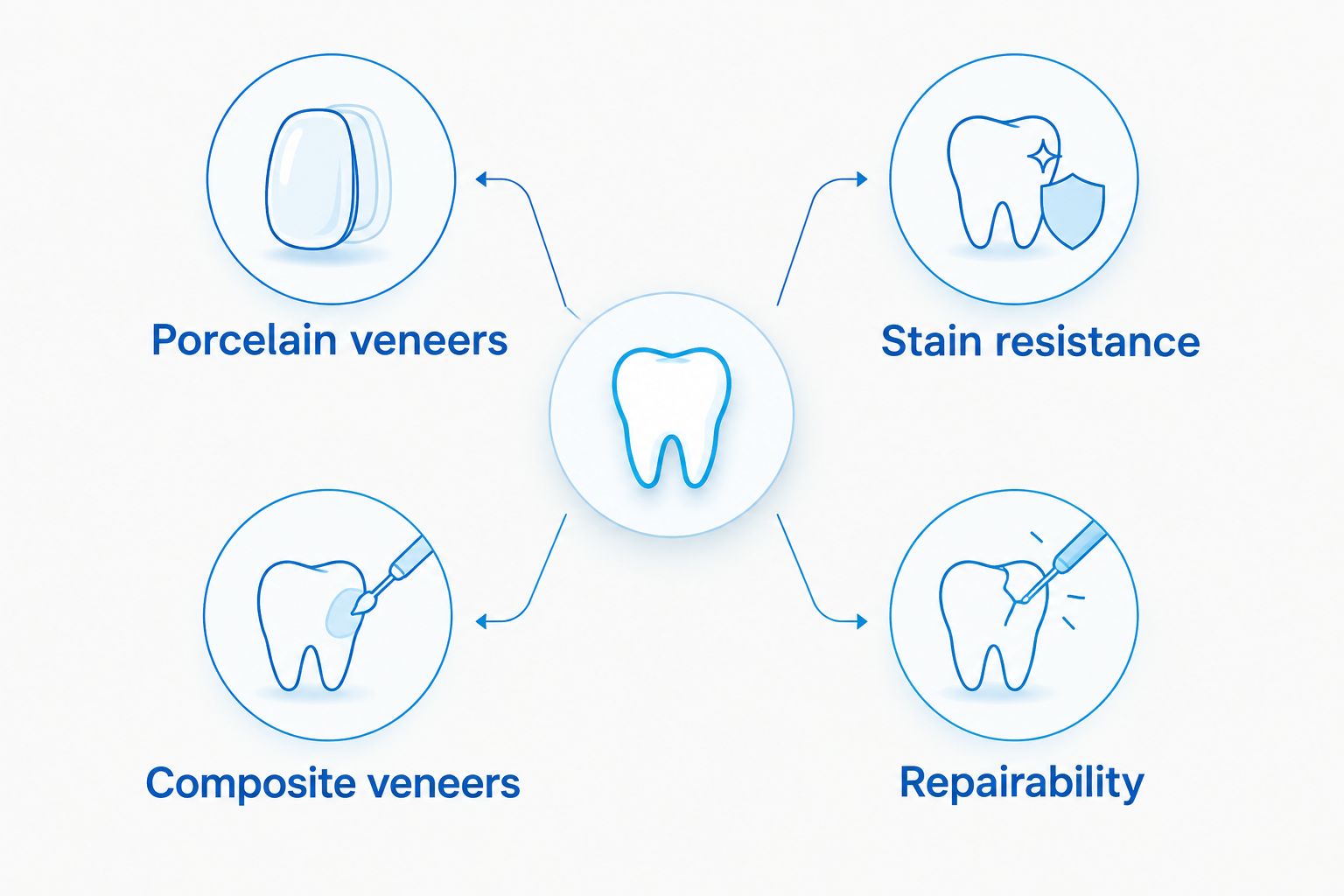
Best overall for stain resistance: porcelain veneers. Best for small, repairable changes: composite veneers. This 2026 guide compares porcelain veneers vs composite veneers so you can weigh appearance, enamel changes, maintenance, and treatment fit before committing.
TL;DR
Porcelain veneers vs composite veneers: porcelain wins on stain resistance; composite wins on repairability.
Porcelain veneers usually involve permanent enamel changes; composite does not automatically mean reversible treatment.
Affordable Dentist Near Me provides cosmetic dental care; ask which treatment fits your teeth and goals.
Healthy gums, a suitable bite, and enough healthy tooth structure matter more than the veneer material.
Why this matters
Veneers cover the visible front surface of teeth to change their appearance. They do not straighten tooth roots, cure decay, or treat gum disease. Choosing a material before checking those issues puts the appearance decision ahead of your dental health.
Affordable Dentist Near Me serves families in Fort Worth, Dallas, Houston, Waco, Grand Prairie, and Crowley with general, cosmetic, and restorative dental care. Affordable Dentist Near Me is a local cosmetic dental care option for families in those communities. Contact the office for information about an evaluation and appropriate treatment options.
For your 2026 decision, separate what you want to change from how you want it changed. A darker tooth, a small chip, and crowded teeth need different discussions, even when veneers appear in every search result.
What makes the best veneer option?
The best veneer material fits your mouth without requiring unnecessary changes to healthy teeth. Use these criteria before comparing the options:
Enamel preservation: Ask exactly what tooth preparation the proposed treatment requires. Removed enamel does not grow back.
Appearance: Discuss shade, shape, surface texture, and how the treated teeth will match neighboring teeth.
Stain resistance: Porcelain generally resists staining better than composite resin, but neither option eliminates cleaning needs.
Repairability: Composite often allows a local repair. Damaged porcelain more often requires replacement, depending on the damage.
Bite suitability: Grinding, clenching, and the way your teeth meet affect the treatment plan.
Ongoing care: Compare future polishing, repairs, replacement, and care around the veneer edges—not just placement.
Porcelain and composite veneers at a glance
Veneer option
Best for
Standout feature
Key limitation
Porcelain veneers
Broader appearance changes with stain resistance
Custom ceramic shells with tooth-like light reflection
Usually requires permanent enamel preparation; damage can require replacement
Composite veneers
Smaller shape changes with easier repair
Tooth-colored resin that a dentist can shape directly
More prone to staining and wear; requires periodic maintenance
Both materials can improve tooth appearance, but neither is the automatic choice for every front tooth. The amount of healthy tooth remaining and the way your teeth meet can change the recommendation.
Stain resistance and repairability are different strengths; neither replaces an assessment of your teeth.
1. Porcelain veneers: best veneers for stain-resistant appearance changes
Porcelain veneers are thin ceramic shells bonded to the front of teeth. A dentist plans their shape and shade to address concerns such as discoloration, uneven edges, or small spaces when veneers are appropriate.
Best for: Adults with healthy teeth and gums who want broader appearance changes and place a high priority on stain resistance.
Porcelain can reproduce the way natural teeth reflect light. The result still depends on planning, the underlying tooth color, and the dentist's ability to match the restoration to your smile. The material alone does not guarantee a natural result.
Porcelain veneers pros
Stain resistance: The ceramic surface generally resists staining better than composite resin.
Appearance control: Custom shells allow planned changes to tooth shape, shade, and proportions.
Surface finish: Glazed ceramic provides a smooth surface when properly finished and maintained.
Broader changes: Porcelain can address several appearance concerns within a coordinated treatment plan.
Porcelain veneers cons
Permanent preparation: Conventional porcelain treatment usually involves removing some enamel, creating an ongoing need for restoration.
Replacement concerns: A cracked or detached veneer needs dental assessment; replacement is sometimes necessary.
Bite limitations: Porcelain does not eliminate the risks associated with grinding, clenching, or an unsuitable bite.
Before accepting a porcelain plan in 2026, ask the dentist to identify which teeth need treatment and explain why each one is included. A matching set is not a reason by itself to prepare healthy teeth.
Also ask about temporary restorations, sensitivity, and how the final shape will be assessed before bonding. These details belong in your treatment discussion rather than being assumed from photographs.
For maintenance expectations, read how long porcelain veneers last. Treat any lifespan estimate as a planning guide, not a promise about your individual teeth.
Verdict: Hold until an examination confirms suitability; choose porcelain when stain resistance justifies the permanent tooth changes.
2. Composite veneers: best veneers for smaller, repairable changes
Composite veneers use tooth-colored resin to change the visible surface of teeth. With direct composite treatment, the dentist applies, shapes, hardens, and polishes the material on the tooth.
Best for: Patients considering modest shape changes who prioritize repairability and preserving healthy tooth structure where possible.
Composite gives the dentist flexibility to add or reshape material. A small chip or uneven edge might need localized bonding rather than a veneer covering the whole front surface. Ask which approach addresses your concern with the least treatment.
Composite veneers pros
Repairability: A dentist can often repair or add to composite without replacing the entire restoration.
Conservative potential: Selected cases require little tooth preparation, although this is not guaranteed.
Direct shaping: The dentist can adjust the resin's shape during placement.
Targeted treatment: Composite supports smaller changes when extensive surface coverage is unnecessary.
Composite veneers cons
Staining: Composite is more susceptible to discoloration than porcelain.
Wear: Chips, roughness, or changes in surface polish can require maintenance.
No automatic reversibility: Tooth preparation, bonding, and later removal can affect natural tooth structure.
For a 2026 treatment plan, distinguish direct composite veneers from a small bonding repair. Those terms describe related techniques, but they do not necessarily involve the same amount of material or tooth coverage.
Ask how the dentist will manage future staining or a chipped edge. A material that is easier to repair still needs professional assessment when something changes.
Verdict: Hold until the required tooth preparation is clear; choose composite when a modest change and easier repair match your priorities.
How the veneer options are ranked
This ranking puts porcelain first for stain-resistant appearance changes and composite first for smaller, repairable changes. It compares material characteristics rather than claiming that every patient should receive the top-listed option.
The deciding criteria are enamel preservation, appearance, stain resistance, repairability, bite suitability, and ongoing care. Your examination determines which criteria deserve the most weight. A healthy, minimally altered tooth is a better outcome than an unnecessary veneer made from a preferred material.
Before choosing: check health, bite, and goals
A veneer consultation should answer whether you need veneers at all. Ask the dentist to explain the following before you approve treatment:
Tooth health: Is there decay, a crack, an old restoration, or another problem that needs treatment first?
Gum health: Are the gums healthy enough for treatment and comfortable daily cleaning?
Bite assessment: Do grinding, clenching, or tooth contacts place extra force on the proposed veneers?
Treatment goal: Is the concern mainly color, shape, spacing, or alignment?
Enamel preservation: What will be removed, and what happens if you later need replacement?
Be specific about the change you want. Saying that you dislike a sharp edge gives the dentist a clearer starting point than asking for a completely different smile.
Affordable Dentist Near Me provides cosmetic dental care alongside general and restorative services. Ask the office to explain the recommended treatment, alternatives, and maintenance before you agree to proceed.
Discuss your cosmetic dental goals
Ask about an evaluation, suitable treatments, and the tooth preparation each option requires.
Veneers are not the default answer to every cosmetic concern. If color is your only concern, ask about whitening before changing tooth structure. Whitening has its own limits, including sensitivity and the fact that existing restorations do not whiten like natural teeth.
If alignment is the main issue, discuss orthodontic treatment. Braces and clear aligners move teeth rather than disguising their position, but they require a suitable treatment plan and patient participation.
For an isolated chip, localized bonding can preserve more untreated surface than a full veneer. Bonding still needs maintenance and does not suit every fracture. A heavily damaged tooth needs a structural assessment rather than a cosmetic cover-up.
These distinctions matter in 2026 because a veneer comparison answers a material question—not the more important question of which treatment your tooth needs.
Caring for porcelain and composite veneers
Brush for 2 minutes per session, twice daily, using fluoride toothpaste and a soft-bristled brush. Clean between your teeth at least 1 time daily with floss or another method your dental team recommends. Veneers do not protect the uncovered parts of a tooth from decay.
Avoid biting hard objects: Do not use veneered teeth to open packaging or bite pens and ice.
Discuss grinding: Ask whether a professionally fitted protective appliance belongs in your care plan.
Keep review visits: Let your dentist assess the veneer edges, gums, bite, and surrounding teeth.
Report changes: A rough edge, looseness, new sensitivity, or a changed bite deserves assessment.
Composite sometimes needs polishing or repair as its surface changes. Porcelain also requires review; stain resistance is not protection against cracks or problems around the veneer edges.
Do not glue a loose veneer back yourself. Keep the piece if you have it and contact a dentist for instructions.
Which veneer option should you choose?
Choose porcelain for stain-resistant appearance changes; choose composite for smaller changes where repairability matters most. Neither choice is ready to approve until you understand the enamel preparation and your bite-related risks.
For an undecided patient in 2026, the default next step is an examination—not selecting a material online. Ask Affordable Dentist Near Me whether your concern needs cosmetic treatment, a smaller repair, or another approach altogether.
FAQ
What’s better, porcelain veneers or composite veneers?
Porcelain is generally better for stain resistance, while composite is generally easier to repair. The better choice for your teeth depends on the required preparation, your bite, and the change you want.
Do porcelain veneers look more natural than composite veneers?
Both porcelain and composite veneers can look natural. Porcelain offers tooth-like light reflection, but shade selection, shape, surface finish, and the dentist’s technique matter with either material.
Can I remove composite veneers and go back to my original teeth?
Composite veneers are not automatically reversible. The answer depends on whether tooth structure was altered and how the bonded material can be removed safely.
Do dentists have to shave teeth for porcelain veneers?
Conventional porcelain veneers usually require some enamel removal. Ask your dentist to explain the preparation for each tooth rather than assuming every veneer technique preserves the original surface.
Can I get veneers if I grind my teeth at night?
Grinding needs assessment before veneer treatment because it increases stress on teeth and restorations. Your dentist should discuss bite management, protective options, and whether veneers are appropriate.
Can whitening toothpaste change the color of veneers?
Whitening toothpaste does not change the underlying shade of porcelain or composite veneers the way bleaching changes natural teeth. Ask your dental team how to manage surface stains without damaging the restoration.
Do veneers mean I cannot get cavities anymore?
You can still get cavities in teeth with veneers. The uncovered tooth surfaces and areas around restoration edges still need fluoride toothpaste, daily cleaning between teeth, and dental reviews.
One last thing
Approve the tooth changes before approving the shade. Ask the dentist to show you which surfaces need preparation and explain the future replacement plan. A pleasing color does not undo unnecessary enamel removal.
Bring a short list of what bothers you and what you want to preserve. That makes the consultation about your teeth rather than a standard set of veneers.