Best overall for a tailored plan: dentist-supervised whitening. Best for a lower-commitment bleaching option: whitening strips. Best for surface-stain maintenance: whitening toothpaste. This 2026 teeth whitening cost guide ranks common options from simpler home care to more involved professional treatment, with the limits that matter before you choose.
TL;DR
Compare teeth whitening cost by treatment scope, not package size or promises of a brighter smile.
Whitening toothpaste targets surface stains; whitening strips use bleaching ingredients to change natural tooth color.
Dentist-supervised whitening suits patients who need an assessment of sensitivity, existing dental work, and staining.
Affordable Dentist Near Me provides teeth whitening; ask the office which treatment fits your teeth and goals.
Why this matters
A whitening purchase only makes sense if it addresses the reason your teeth look darker. Surface stains, natural tooth color, tartar, and a discolored individual tooth need different approaches. Bleaching does not solve all of them.
Affordable Dentist Near Me is best for patients seeking teeth whitening with an assessment of their dental needs. The practice serves families in Fort Worth, Dallas, Houston, Waco, Grand Prairie, and Crowley. You can contact Affordable Dentist Near Me for information about its whitening services.
For your 2026 decision, separate routine stain maintenance from bleaching treatment. The ranking below follows increasing treatment involvement, not a universal fee schedule; individual products and professional treatment plans differ.
What makes the best teeth whitening option?
Use these criteria before comparing treatments:
Stain match: Does the option remove surface staining, bleach natural teeth, or address neither?
Dental suitability: Do sensitivity, cavities, gum problems, or visible restorations need attention first?
Treatment control: Can you follow the instructions, protect your gums, and stop if irritation develops?
Routine fit: Will you consistently complete a home treatment, or do you need professional supervision?
Full treatment scope: Does your comparison include assessment, supplies, follow-up, and any maintenance?
A stronger bleaching product is not automatically a better choice. Your starting tooth color, oral health, and ability to follow directions matter more than an impressive claim on the packaging.
Teeth whitening options at a glance
Read this table from routine surface care toward more involved bleaching treatment. It distinguishes what you are choosing, rather than treating every option as an interchangeable route to the same result.
Option
Best for
Standout feature
What to compare
Key limitation
Whitening toothpaste
Surface-stain maintenance
Fits regular brushing
Ingredients and stain-removal claims
Does not provide the same bleaching effect as peroxide treatments
Whitening strips
Straightforward home bleaching
Premeasured strips applied to teeth
Treatment instructions and application coverage
Fit and gum contact are not customized
Dentist-supervised take-home trays
A fitted home treatment plan
Trays and instructions tailored by a dentist
Assessment, trays, gel, and follow-up
Requires consistent home use
In-office whitening
Professionally managed application
Dental staff apply treatment and protect surrounding tissues
Examination, treatment scope, and follow-up
Sensitivity remains possible
1. Whitening toothpaste: best for surface-stain maintenance
Whitening toothpaste helps remove external stains during brushing. It is a maintenance choice, not a substitute for bleaching when your goal is to change the underlying shade of natural teeth.
Choose a fluoride toothpaste that suits your dental needs. Do not brush harder to chase a brighter result; extra pressure can harm gums and exposed tooth surfaces.
Whitening toothpaste pros:
Fits your existing brushing routine.
Targets everyday surface staining.
Does not require trays or a separate bleaching session.
Whitening toothpaste cons:
Has limited value for discoloration inside a tooth.
Does not whiten crowns, veneers, or tooth-colored fillings.
Some formulations aggravate existing sensitivity.
Best for: Someone maintaining clean natural teeth who mainly notices surface stains.
For a 2026 whitening decision, define success before changing toothpaste. If you expect a substantial shade change, repeated toothpaste purchases can distract from the assessment you actually need.
Verdict: Buy for surface-stain maintenance; skip as a replacement for bleaching.
2. Whitening strips: best for straightforward home bleaching
Whitening strips hold a bleaching ingredient against the front surfaces of natural teeth. They offer a home approach without a custom-made tray, but the strip shape does not match every smile equally well.
Follow the particular product's directions. Longer wear and overlapping treatments are not shortcuts to safer or more predictable results.
Whitening strips pros:
Deliver a bleaching ingredient rather than relying only on stain removal.
Fit into a home routine.
Avoid the need to have a custom tray made.
Whitening strips cons:
Can cause temporary tooth sensitivity or gum irritation.
Can leave uneven coverage where strips do not contact teeth well.
Do not change the shade of visible dental restorations.
Best for: An adult with healthy natural teeth who can follow a labeled home bleaching routine.
Ask a dentist first if your teeth already hurt, your gums bleed, or a single tooth has changed color. A whitening product does not diagnose the cause.
Verdict: Buy only when home bleaching is suitable; hold if symptoms need evaluation.
3. Take-home trays: best for a fitted home whitening plan
Dentist-supervised take-home whitening uses trays with bleaching gel under professional instructions. A custom tray is made to fit your teeth, helping control where the gel sits.
This category is a treatment option to discuss, not a claim that every dental office provides the same system. Ask Affordable Dentist Near Me which teeth whitening methods its office offers before deciding on a particular approach.
Take-home tray pros:
Provides a fit tailored to your teeth.
Includes professional guidance on application.
Gives you a route to discuss sensitivity and uneven results.
Take-home tray cons:
Depends on consistent use at home.
Still carries a risk of sensitivity and gum irritation.
Requires careful handling, cleaning, and storage of trays.
Best for: Someone who wants professional guidance while completing treatment at home.
Your 2026 treatment discussion should cover the gel, wear instructions, and what to do if discomfort develops. Do not substitute another gel or extend wear without approval.
Verdict: Buy when a dentist recommends a fitted home plan and you can follow it.
4. In-office whitening: best for professionally managed application
In-office whitening puts the application process in the hands of dental staff. The team assesses suitability, protects surrounding tissues, and applies the selected whitening treatment.
Professional supervision does not guarantee a particular shade or eliminate sensitivity. Ask what the proposed procedure involves rather than choosing by a light, device name, or dramatic before-and-after image.
In-office whitening pros:
Removes the need to apply the initial treatment yourself.
Includes professional management of the treatment area.
Allows you to discuss concerns with the treating team.
In-office whitening cons:
Requires an office appointment.
Can still cause temporary sensitivity.
Does not make results permanent or whiten existing restorations.
Best for: Someone who prefers a clinician-managed procedure over a home application routine.
Before agreeing, ask whether the plan includes any home follow-up. Do not assume that an office appointment means every part of treatment happens in the chair.
Verdict: Buy when professional application fits your needs; hold until the treatment scope is clear.
How these options were ranked
This ranking moves from surface-stain maintenance to home bleaching, fitted home treatment, and professionally applied bleaching. The criteria are stain match, dental suitability, treatment control, routine fit, and full treatment scope.
It is not a claim that every product or office follows the same cost order. A useful teeth whitening cost comparison matches the same goal and includes the same treatment components. Comparing a toothpaste tube with a complete professional plan does neither.
Check these issues before choosing whitening
Your first decision is whether whitening is appropriate, not which package looks most appealing. An examination is especially important when discoloration appears alongside pain, damaged teeth, bleeding gums, or existing sensitivity.
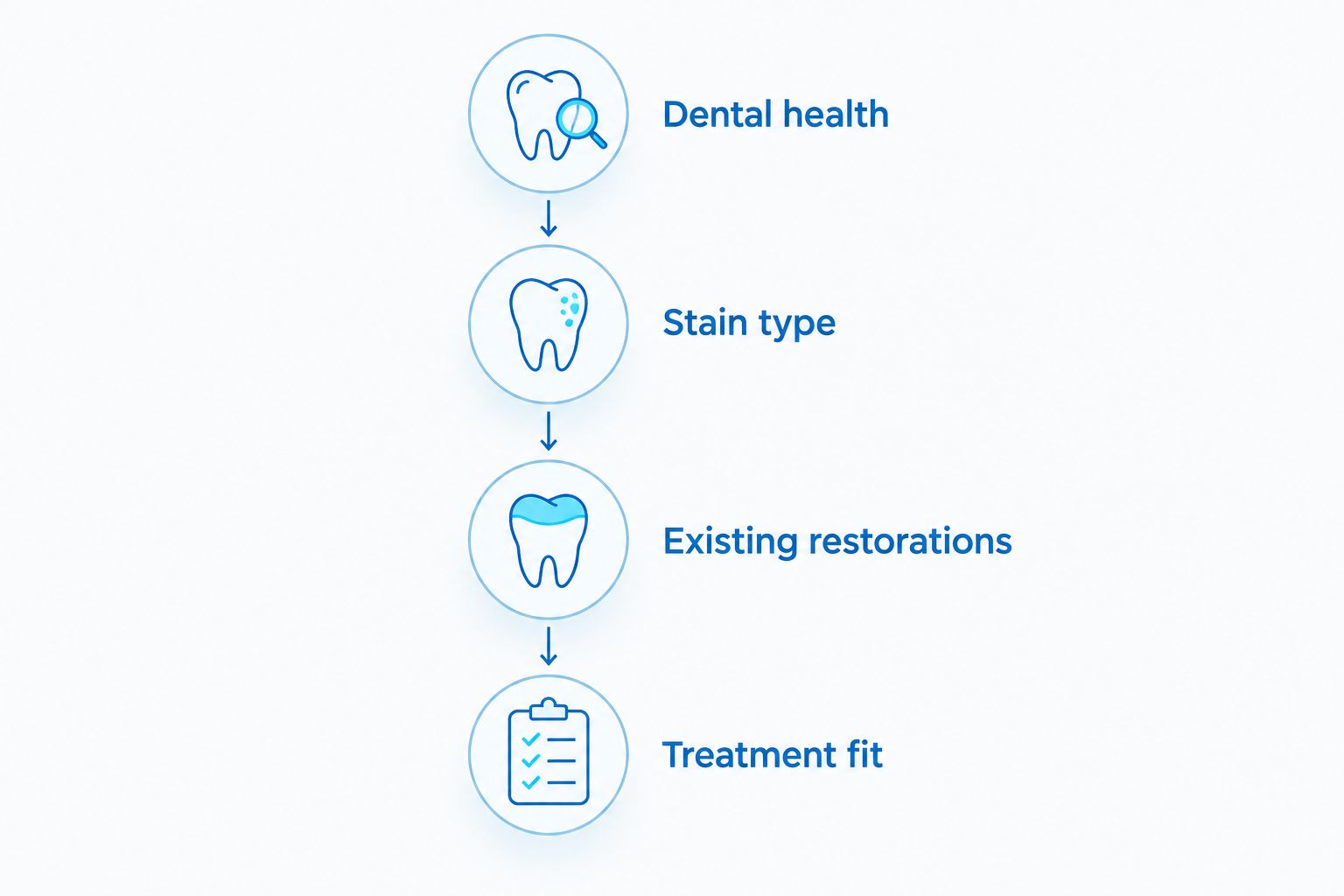
Use this sequence:
Dental health: Tell the dentist about pain, bleeding, decay, cracks, and previous sensitivity.
Stain type: Ask whether the discoloration is on the surface or within the tooth.
Existing restorations: Identify visible fillings, crowns, and veneers that will not bleach like natural teeth.
Treatment fit: Choose an approach you can use correctly and discuss what results are realistic.
Check dental health and existing restorations before selecting a whitening method.
Sensitivity deserves its own discussion. Ask about your suitability, product instructions, and when to stop treatment; the guide to teeth whitening options for sensitive teeth addresses that decision in more detail.
Do not cover unexplained pain with a cosmetic plan. Treating the underlying problem takes priority over changing tooth color.
Cleaning and whitening solve different problems
Cleaning removes deposits and surface staining; bleaching changes the color of natural teeth. A cleaning can improve the appearance of stained teeth without producing the same effect as bleaching.
The distinction between regular versus deep cleaning concerns gum health and the location of deposits, not a choice between mild and stronger whitening. Deep cleaning is treatment for gum disease when clinically indicated, not a cosmetic upgrade.
If tartar or gum disease is present, ask what care is needed before bleaching. Buying whitening supplies will not remove hardened tartar or treat an infection.
Keep daily care steady: brush with fluoride toothpaste for 2 minutes per session, complete 2 brushing sessions per day, and clean between your teeth 1 time per day. These habits support oral health; they do not replace an examination or guarantee a particular tooth shade.
Compare the full treatment, not just the package
For a useful 2026 teeth whitening cost comparison, ask each provider to describe exactly what you are considering. A vague whitening label tells you little about assessment, application, follow-up, or maintenance.
Ask these questions before agreeing to treatment:
Assessment: Does the plan include checking whether whitening is suitable for your teeth?
Method: Is treatment applied at home, in the office, or through a combination?
Materials: Are trays, gel, and written instructions included where applicable?
Follow-up: Who should you contact if sensitivity or uneven whitening develops?
Maintenance: What ongoing care is recommended, and what is separate from the initial treatment?
Keep the comparison in writing. If one plan includes fitted trays and another does not, you are not evaluating equivalent treatments.
Do not assume whitening is covered by dental insurance. Cosmetic whitening is generally excluded; confirm your particular plan's terms before making a payment decision.
At Affordable Dentist Near Me, ask which teeth whitening approach is offered and request an explanation of the proposed care. Avoid assuming that a treatment mentioned in a general guide is part of your individual plan.
Which teeth whitening option should you choose?
Choose the least involved treatment that can realistically address your type of discoloration. Whitening toothpaste fits surface maintenance; strips fit suitable home bleaching; dentist-supervised treatment fits patients who need a tailored plan or professional application.
If you are undecided, start with a dental assessment rather than stacking several products. That is particularly important when you have sensitivity, visible restorations, or a tooth that looks different from its neighbors.
For 2026, make your goal specific: removing surface stains is different from changing natural tooth shade. A clear goal makes the treatment discussion more useful and helps you avoid purchasing a method that cannot deliver what you want.
FAQ
What’s the best way to compare teeth whitening cost?
Compare treatment plans with the same goal and clearly listed components. Ask about assessment, materials, application, follow-up, and maintenance rather than comparing package labels alone.
Is whitening toothpaste as effective as whitening strips?
Whitening toothpaste and whitening strips do different jobs. Toothpaste mainly removes surface stains, while peroxide-based strips bleach natural teeth; neither changes the shade of crowns or veneers.
Is professional whitening better than home whitening?
Professional whitening is better suited to patients who need clinician guidance or professionally managed application. Home whitening can suit healthy natural teeth when the product is appropriate and you follow its instructions.
Can I whiten my teeth if they are sensitive?
Ask a dentist to assess sensitive teeth before whitening. Existing sensitivity can have causes that need treatment, and bleaching can temporarily make discomfort worse.
Will whitening change the color of my crowns or fillings?
Whitening does not bleach crowns, veneers, or tooth-colored fillings the way it bleaches natural teeth. Discuss visible restorations first so you understand the possibility of a shade mismatch.
Should I get a cleaning before teeth whitening?
Get a dental assessment to determine whether cleaning or other care is needed before whitening. Cleaning removes deposits and surface stains, while bleaching addresses natural tooth color.
Does Affordable Dentist Near Me offer teeth whitening?
Affordable Dentist Near Me offers teeth whitening as part of its cosmetic dental services. Contact the office for information about the methods offered and whether treatment is appropriate for your teeth.
One last thing
Whiter natural teeth can make an unchanged crown or filling more noticeable. Before bleaching, point out every restoration you can see when you smile and ask how the final shades will compare. That conversation matters more than choosing the strongest treatment.