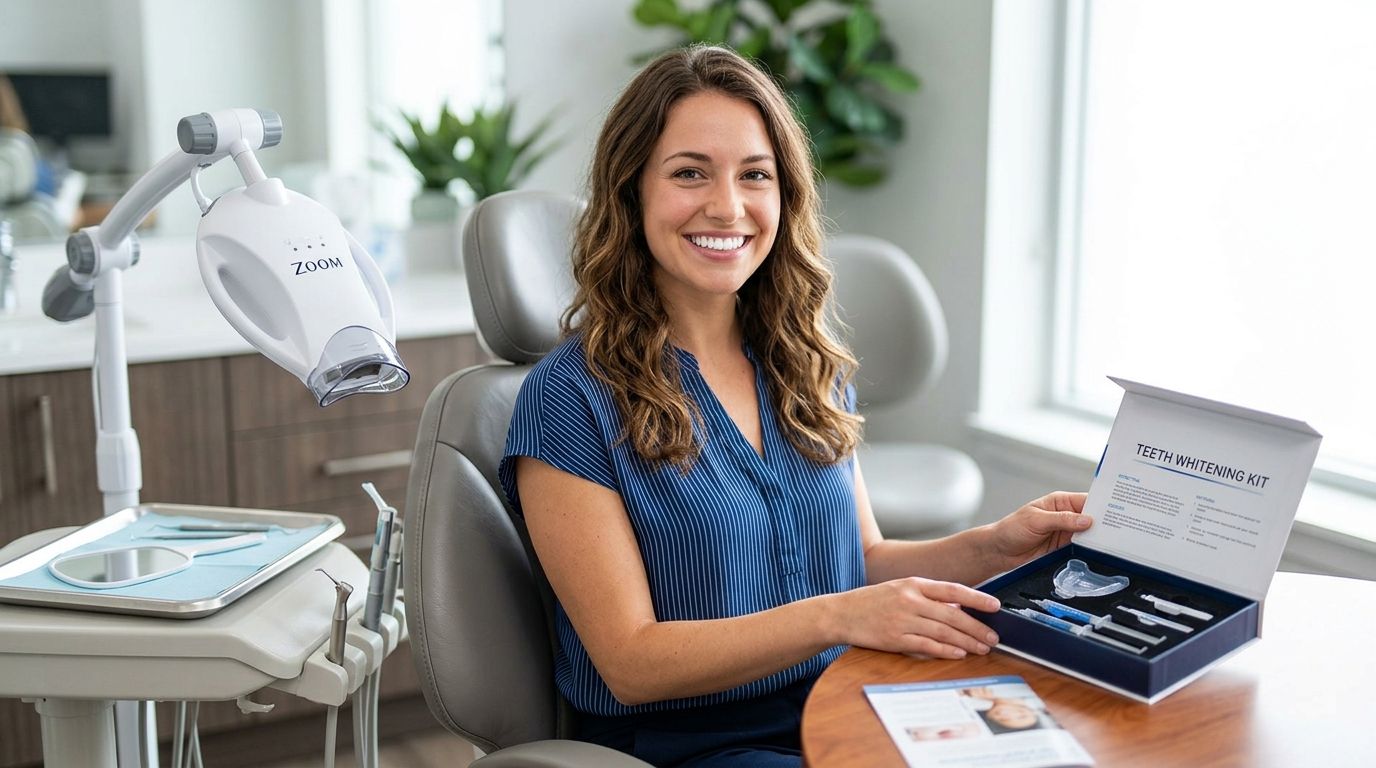
Teeth whitening in 2026 breaks down into five real options: in-office professional whitening, custom take-home trays from a dentist, over-the-counter strips, whitening toothpaste, and LED or laser-accelerated whitening. Each solves a different problem, and picking the wrong one wastes money or leaves you with uneven results.
TL;DR
- In-office professional whitening is the fastest of the best teeth whitening methods, done in one 60-90 minute visit.
- Custom take-home trays from a dentist give the best control over sensitivity while still whitening several shades.
- Over-the-counter strips are the budget pick among teeth whitening methods but coverage is uneven on crowded teeth.
- Whitening toothpaste only maintains a shade you already achieved; it cannot lighten stained enamel on its own.
- LED-accelerated whitening pairs with professional bleaching gel for stubborn, deep-set stains.
Best overall: in-office professional whitening. Best for sensitive teeth: custom take-home trays from a dentist. Best budget option: over-the-counter whitening strips.
Why this matters
Most people trying to figure out the best teeth whitening methods in 2026 are choosing between speed, cost, and how much tooth sensitivity they can tolerate. Drugstore products and dental-office treatments use the same core bleaching agents — hydrogen peroxide or carbamide peroxide — but the concentration, the fit against your teeth, and the supervision differ enormously. Affordable Dentist Near Me offers both in-office whitening and custom take-home trays across its Fort Worth, Dallas, Houston, Waco, Grand Prairie and Crowley locations, and the right pick depends on your timeline and your teeth, not just your budget.
Getting this wrong is common. People buy strips expecting professional-level results, or pay for an office visit when a two-week tray routine would have done the same job for less sensitivity. The comparison below sorts that out.
What makes the best teeth whitening method
- Speed of visible results — some methods work in one visit, others take weeks
- Control over sensitivity — custom-fit trays limit gel contact with gums; strips and generic trays don't
- Evenness of the shade change — coverage across crowded, gapped, or crowned teeth varies by method
- Professional supervision — a dentist can spot cavities or gum issues before bleaching makes them worse
- How long the results last — diet, smoking, and touch-up habits all affect this differently by method
- Cost relative to results — cheaper isn't better if you need three rounds of strips to match one office visit
Teeth whitening methods at a glance
| Method |
Best for |
Standout feature |
Key limitation |
| In-office professional whitening |
Fast results before an event |
Full results in one 60-90 minute visit |
Highest short-term cost, temporary sensitivity common |
| Custom take-home trays |
Controlling sensitivity while going professional-grade |
Trays fit your mouth exactly, gel strength adjustable |
Needs about two weeks of nightly use |
| Over-the-counter whitening strips |
Budget-conscious whitening |
Applies in under an hour a day for 10-14 days |
Uneven coverage on crowded or gapped teeth |
| Whitening toothpaste |
Maintaining an already-whitened smile |
Removes surface stain with everyday brushing |
Cannot lighten the natural tooth shade |
| LED/laser-accelerated whitening |
Stubborn, deep-set stains paired with professional bleach |
Light activates gel to speed the bleaching reaction |
Added cost with mixed evidence on how much faster it actually works |
1. In-office professional whitening: best teeth whitening method for fast results before an event
A dentist applies a high-concentration bleaching gel directly to your teeth, isolates your gums, and often uses a curing light to speed the reaction — all in a single 60 to 90 minute appointment. It's the method built for people with a wedding, interview, or photo shoot on the calendar and no time for a multi-week routine.
In-office professional whitening pros:
- Visible results in one visit, no daily compliance required
- A dentist checks for cavities and gum recession before bleaching
- Gel concentration is far higher than anything sold over the counter
In-office professional whitening cons:
- Temporary sensitivity to hot and cold is common for a day or two after
- Costs more upfront than any at-home option
- Results fade faster without a maintenance routine at home
Verdict: Buy if you need results this week and can tolerate some short-term sensitivity.
2. Custom take-home trays: best teeth whitening method for sensitive teeth
A dentist takes an impression of your mouth, fabricates trays that seal tightly against your gumline, and sends you home with professional-strength gel to wear nightly for roughly two weeks. The tight fit is the entire point — it keeps bleaching gel off your gums, which is where most whitening pain comes from.
Custom take-home tray pros:
- Sensitivity is far easier to control than with strips or generic trays
- Gel strength can be adjusted for people who react badly to standard concentrations
- Results rival in-office whitening once the full course is finished
Custom take-home tray cons:
- Takes about two weeks of consistent nightly use, not a single session
- Requires a dental appointment upfront for the impression
- Skipping nights stretches the timeline and can leave shade changes uneven
Verdict: Buy if sensitivity is your main concern or you don't need results overnight.
3. Over-the-counter whitening strips: best budget teeth whitening method
Thin, peroxide-coated strips press onto your front teeth for a set number of minutes a day, usually over a 10 to 14 day course. They're sold in every drugstore and don't require a dental visit, which makes them the default entry point for most people trying whitening for the first time.
Whitening strip pros:
- Lowest cost of any method that actually lightens tooth color
- No appointment needed, available everywhere
- Reasonable results on teeth that are relatively straight and evenly spaced
Whitening strip cons:
- Strips are cut to a generic shape, so coverage is uneven on crowded or gapped teeth
- Gum irritation is common since the strip isn't sealed against your gumline
- Weaker peroxide concentration means slower, less dramatic results than professional options
Verdict: Buy if budget is the deciding factor and your teeth are fairly evenly spaced.
4. Whitening toothpaste: best for maintaining a shade you already achieved
Whitening toothpaste relies on mild abrasives and sometimes a low dose of peroxide to lift surface stain from coffee, tea, and tobacco during normal brushing. It doesn't change the underlying color of your enamel — it just keeps stain from building back up on top of a shade you've already reached.
Whitening toothpaste pros:
- Fits into a routine you're already doing twice a day
- Cheapest option of any on this list by a wide margin
- Helps extend results from professional whitening or trays
Whitening toothpaste cons:
- Cannot lighten naturally yellow or stained enamel on its own
- Overuse of abrasive formulas can wear enamel over time
- Slowest and weakest of every method here for actual color change
Verdict: Hold as a maintenance step after a real whitening treatment, not as a stand-alone fix.
5. LED/laser-accelerated whitening: best for stubborn, deep-set stains
This is in-office whitening with an LED or laser light aimed at the gel during application, meant to speed up the chemical reaction that breaks down stain molecules. It's usually offered as an add-on to a professional whitening visit rather than a stand-alone service.
LED-accelerated whitening pros:
- Can help with deep, longstanding stains that resist standard bleaching gel alone
- Still done under professional supervision in a single visit
- Pairs directly with the same gel used in standard in-office whitening
LED-accelerated whitening cons:
- Added cost on top of standard in-office whitening
- Evidence on how much the light itself speeds up results, versus the gel doing the work, is mixed
- Not necessary for people with mild to moderate staining
Verdict: Wait unless standard in-office whitening hasn't touched your stains in the past.
How this ranking was built
Each method was scored against the same six criteria: speed, sensitivity control, evenness, supervision, longevity, and cost relative to results. In-office whitening and custom trays scored highest on supervision and evenness because a dentist controls the fit and the concentration. Strips and toothpaste scored highest on cost but lowest on evenness and depth of result.
“If a whitening method doesn’t fit tightly against your gumline, sensitivity and uneven results come from the gap, not the gel.”
Which teeth whitening method should you choose?
Pick in-office professional whitening if you need results before a specific date and can handle a day or two of sensitivity. Pick custom take-home trays if sensitivity worries you more than speed — the two-week timeline is worth the comfort. Pick whitening strips only if cost is the deciding factor and your teeth are evenly spaced, and treat whitening toothpaste as upkeep, never as the main event. For deep, resistant staining that hasn't responded to standard bleaching, LED-accelerated whitening is worth asking a dentist about, but it's not the starting point for most people in 2026.
A quick look at cosmetic dentistry options is useful if whitening turns out to be the wrong fix — sometimes what looks like staining is actually a crown or veneer question instead.
Find your best whitening option
Compare in-office and take-home whitening at a location near you.
FAQ
What’s the best teeth whitening method for sensitive teeth?
Custom take-home trays from a dentist are the best teeth whitening method for sensitive teeth because they seal tightly against the gumline and limit gel contact with soft tissue. Gel strength can also be adjusted down for people who react badly to standard concentrations.
Is in-office whitening better than at-home trays?
In-office whitening works faster, delivering results in one 60-90 minute visit, while take-home trays take about two weeks but cause less sensitivity. Neither is universally "better" — the choice depends on your timeline and how your teeth react to bleaching gel.
How long does teeth whitening last?
Results from professional whitening typically last several months to a year depending on diet, smoking, and touch-up habits. Coffee, tea, red wine, and tobacco all speed up the return of surface stain regardless of which method you used.
Do whitening strips actually work?
Yes, over-the-counter whitening strips do lighten teeth over a 10 to 14 day course, but coverage is uneven on crowded or gapped teeth since the strip shape is generic. They’re the budget pick among teeth whitening methods, not the fastest or most even.
Can whitening toothpaste whiten yellow teeth?
No, whitening toothpaste only removes surface stain during brushing and cannot lighten the natural color of stained or yellowed enamel. It works best as maintenance after a real whitening treatment, not as a stand-alone fix.
Is LED light whitening worth the extra cost?
LED-accelerated whitening is worth considering only for stubborn, deep-set stains that haven’t responded to standard in-office bleaching gel. For mild to moderate staining, standard in-office whitening or custom trays typically get the job done without the added cost.
How often can you safely whiten your teeth?
Most dentists recommend spacing professional whitening treatments out by several months to avoid enamel sensitivity and wear. Daily maintenance with whitening toothpaste in between treatments is generally safe with normal brushing habits.
Does dental insurance cover teeth whitening?
Teeth whitening is considered cosmetic, so most dental insurance plans do not cover any portion of the cost. It’s worth checking your specific plan, but budget for it as an out-of-pocket cosmetic expense in 2026.
One last thing
The gap between methods isn't really about the peroxide — hydrogen peroxide and carbamide peroxide do the same job whether they're in a $10 strip box or a dentist's professional gel. The real difference is fit and concentration control: a custom tray sealed against your gumline can carry stronger gel with less pain than a generic strip carrying weaker gel with more gum contact. That's the entire reason professional teeth whitening methods outperform drugstore options in 2026, not because the chemistry is secret.
Related guides