A dental crown takes either separate preparation and fitting visits, with laboratory work between them, or a same-day visit when your tooth and the office’s equipment support that approach. Your full timeline also includes any treatment the tooth needs before the crown, so ask for both the appointment length and the expected completion date.
TL;DR
How long does a dental crown take? Separate preparation and fitting visits are common; same-day crowns require suitable equipment and treatment.
Laboratory fabrication adds waiting time between crown appointments, even though you are not in the dental chair.
Decay, infection, gum problems, and fit adjustments can extend the dental crown procedure.
Affordable Dentist Near Me provides crown care for families across its listed Texas locations; confirm your treatment schedule with the office.
Why this matters
The time you spend in the chair is not the same as the time it takes to finish a crown. A preparation appointment can end with a temporary crown while the final restoration is being made. You still have another step before treatment is complete.
For your 2026 schedule, ask the dentist to separate treatment time, laboratory time, and follow-up time. That distinction helps you plan work, childcare, meals, and transportation without assuming that every crown follows the same process.
A conventional dental crown procedure involves preparing the tooth, recording its shape, making the final crown, and fitting it. Some offices can make suitable crowns during the treatment visit using digital scanning and in-office manufacturing. Neither approach removes the need to check the tooth’s health and the finished crown’s fit.
Use this comparison to understand what the appointment schedule actually includes:
Crown approach
Appointment pattern
Best for
Main advantage
Main limitation
Laboratory-made crown
Preparation visit, laboratory work, then fitting visit
Patients whose treatment plan calls for a laboratory-made restoration
The dental laboratory makes the crown from the dentist’s records and instructions
You wait between visits and generally wear a temporary crown
Same-day crown
Preparation, digital design, manufacturing, and fitting during the treatment visit, when suitable
Patients with suitable teeth at an office equipped for this method
It can avoid the temporary-crown stage and a separate fitting visit
It requires appropriate equipment, materials, and clinical suitability
The right crown timeline is the one that allows the dentist to treat the tooth and confirm the fit—not simply the shortest appointment. A visit that includes preparation and manufacturing also includes waiting while the crown is made. Same-day does not mean that every minute is spent receiving hands-on treatment.
What happens during the crown procedure?
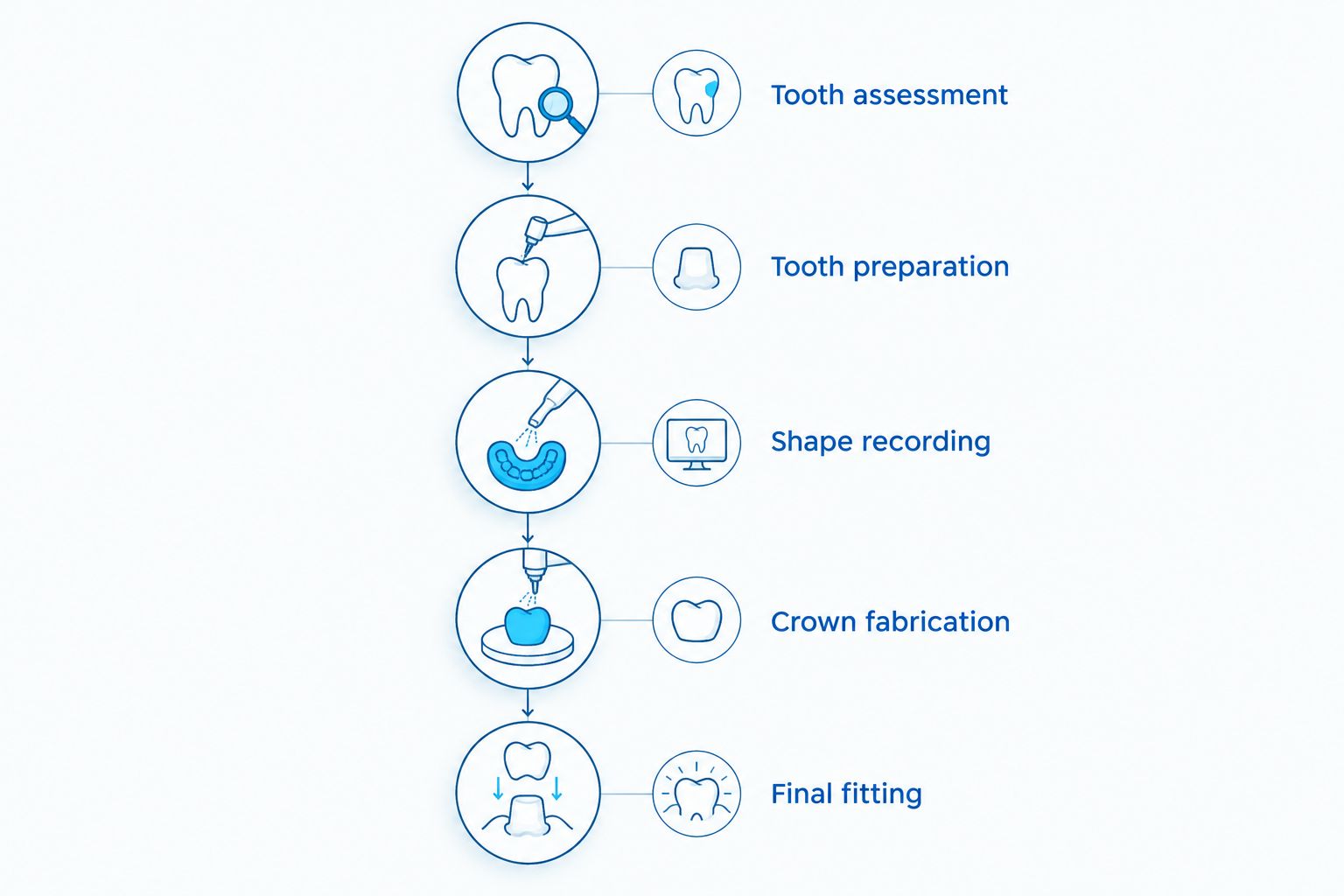
Tooth assessment. The dentist examines the tooth and decides whether a crown is appropriate. Imaging, when needed, helps assess problems that are not visible from the outside.
Tooth preparation. The dentist numbs the area as appropriate, removes decay when present, and shapes the tooth to make room for the crown. A weakened tooth can need a buildup to provide support.
Shape recording. A digital scan or an impression records the prepared tooth and surrounding teeth. The dentist also records how your teeth meet.
Crown fabrication. A laboratory or suitable in-office system makes the final restoration. A temporary crown generally protects the prepared tooth during a laboratory wait.
Final fitting. The dentist checks the crown’s edges, contacts, appearance, and bite before securing it. Adjustments are part of getting the restoration to function comfortably.
Making the crown is only part of treatment; the tooth assessment and final fit also matter.
Each stage answers a different question: Is the tooth ready? Is there enough support? Does the crown match the prepared tooth? Does your bite feel right? Skipping those checks to meet a deadline is not a useful shortcut.
Laboratory-made crowns: separate preparation and fitting visits
A laboratory-made crown separates work on your tooth from manufacturing the restoration. During preparation, the dentist shapes the tooth, records its size and position, and generally places a temporary crown. You then return after the final crown is ready.
At the fitting visit, the dentist removes the temporary crown and checks the permanent crown before securing it. The restoration needs to fit around the prepared tooth and meet the neighboring teeth correctly. Your bite also needs checking when you close your mouth and move your jaw.
Best for: patients whose dentist recommends a laboratory-made crown based on their tooth, material choice, and treatment needs. The benefit is a restoration made to the dentist’s specifications; the trade-off is the gap between preparation and fitting.
Before booking around travel in 2026, ask when the office expects to receive the crown and when the fitting appointment will occur. Those are separate scheduling details. A delivery estimate does not replace a confirmed appointment.
If a crown needs further laboratory changes, the fitting visit does not necessarily complete treatment. Ask how the office handles that possibility before committing to a tight deadline.
Same-day crowns: completion during the treatment visit
A same-day crown uses a digital workflow and equipment that makes the restoration in the office. The dentist prepares and scans the tooth, designs the crown, and checks it after manufacturing. Treatment still includes fitting and bite assessment before the crown is secured.
Best for: patients whose tooth and treatment plan suit this method at an equipped office. Avoiding a separate fitting visit is the main advantage; equipment access and clinical suitability are the main limitations.
Do not assume that a practice offers same-day crowns because it offers crowns generally. Confirm the method for your specific location and tooth. Also ask whether the planned visit includes manufacturing time or whether there are separate stages.
For a 2026 appointment, the useful question is: Can this tooth receive its final crown during the planned visit? That is more specific than asking whether the office uses digital technology. A digital scan alone does not mean the crown will be made on-site.
Why dental crown timing varies
The crown itself is only part of the schedule. These factors change how much work is needed and whether the dentist can proceed directly to the final restoration:
Tooth condition. Decay, fractures, and large existing fillings affect preparation. A tooth with little remaining structure can need additional support before receiving a crown.
Infection or nerve problems. A tooth that needs root canal treatment has an additional treatment stage. Not every crowned tooth needs a root canal.
Gum health. Inflamed or bleeding gums can make it harder to record a clean crown edge. The dentist decides whether gum treatment should come first.
Manufacturing method. Laboratory fabrication involves coordination outside the treatment room. In-office manufacturing requires suitable equipment and an appropriate case.
Fit and bite. The crown can need adjustment before it is secured. A restoration that does not fit properly needs correction rather than acceptance because of a deadline.
Treatment scope. Restoring several teeth or coordinating a crown with other dental work changes the schedule. Ask whether your estimate covers the entire plan or just the crown stage.
Tell the dentist about upcoming travel, a major event, or a work constraint before preparation begins. The office can explain the proposed sequence without treating your deadline as a reason to bypass necessary care.
How should you plan your crown appointments?
Start by asking what the dentist expects to happen at each visit. Write down whether the appointment is for an examination, preparation, temporary-crown placement, or final fitting. A booking labeled simply as crown treatment does not tell you which stage it covers.
Use this checklist when discussing your schedule:
Ask for the expected chair time for each planned appointment.
Confirm whether laboratory work happens between visits.
Ask whether any treatment must happen before tooth preparation.
Confirm when the final fitting is expected and how changes are communicated.
Ask about eating, numbness, and transportation instructions after treatment.
Explain any deadline before the dentist starts preparing the tooth.
If sedation is part of your plan, transportation and recovery instructions also affect the day. Follow the office’s instructions rather than assuming you can drive or return immediately to all usual activities.
Affordable Dentist Near Me provides dental crown care for families in its listed Texas communities. Its description includes Fort Worth, Dallas, Houston, Waco, Grand Prairie, and Crowley; confirm the crown workflow at the location you intend to visit rather than assuming every office uses the same equipment.
Discuss your crown treatment schedule
Ask which visits your tooth needs and whether laboratory work is part of the plan.
Returning to work depends on the treatment you receive, how you feel, and whether sedation is involved. Local numbing affects sensation around the treated area, so follow instructions about eating and avoiding accidental cheek or tongue bites. Sedation requires separate recovery and transportation planning.
For your 2026 work calendar, do not treat the booked appointment length as the entire interruption. Include travel and any aftercare restrictions the office gives you. Ask about these before the visit, especially if your job involves driving or safety-sensitive tasks.
Does needing a root canal make a crown take longer?
Needing a root canal adds a treatment stage before the tooth receives its final restoration. The dentist must address the problem inside the tooth and then determine the appropriate restoration sequence. A crown recommendation alone does not mean you need a root canal.
Ask whether the dentist is scheduling the crown after root canal treatment or whether the proposed plan includes both. Understanding that sequence prevents you from mistaking the crown appointment for the whole course of care.
What if my crown does not feel right after fitting?
Contact the dentist if the crown feels high when you bite, if chewing hurts, or if discomfort persists or worsens. Do not file the crown yourself or keep testing it by biting hard foods. An examination distinguishes a bite adjustment from a different tooth problem.
Some sensitivity can follow crown treatment, but worsening symptoms deserve attention. Facial swelling, fever with dental pain, or difficulty swallowing or breathing require urgent assessment; breathing difficulty is an emergency.
FAQ
How long does a dental crown take from start to finish?
A dental crown takes separate preparation and fitting visits when a laboratory makes it, or a same-day treatment visit when an appropriate in-office method is used. Additional treatment for the tooth can extend the overall schedule.
Can I get a permanent crown in the same visit?
A permanent crown can be completed during the treatment visit when the office has suitable manufacturing equipment and your tooth is appropriate for that method. Confirm this for your specific tooth and location before booking.
Why do I need a temporary crown?
A temporary crown generally protects the prepared tooth while a laboratory makes the final crown. Follow the dentist’s eating and cleaning instructions, and contact the office if it loosens or comes off.
Does every dental crown require a root canal first?
Not every dental crown requires a root canal first. Root canal treatment is used when the condition inside the tooth calls for it, not simply because the tooth needs a crown.
Can I eat after my crown appointment?
Eat according to the instructions for your numbing medicine and the restoration placed at your visit. Avoid chewing while the area is numb, and follow any restrictions for a temporary crown or newly secured permanent crown.
What should I do if my temporary crown comes off?
Contact the dental office promptly if your temporary crown comes off. Keep the crown if you have it, avoid chewing on the affected tooth, and do not use household glue to reattach it.
Does Affordable Dentist Near Me offer same-day dental crowns?
Affordable Dentist Near Me provides crown services, but confirm same-day crown treatment directly with your chosen location. Ask whether your tooth is suitable and whether that office makes the final restoration on-site.
One last thing
Book the final fitting with the same care you give the preparation visit. A temporary crown is an interim restoration, not a substitute for completing the planned treatment. If your schedule changes, contact the office rather than leaving the final appointment unresolved.
When arranging crown care in 2026, leave with a clear next step: the next appointment, the expected laboratory stage, or instructions for confirming the fitting date. That is more useful than a general promise that the procedure is quick.