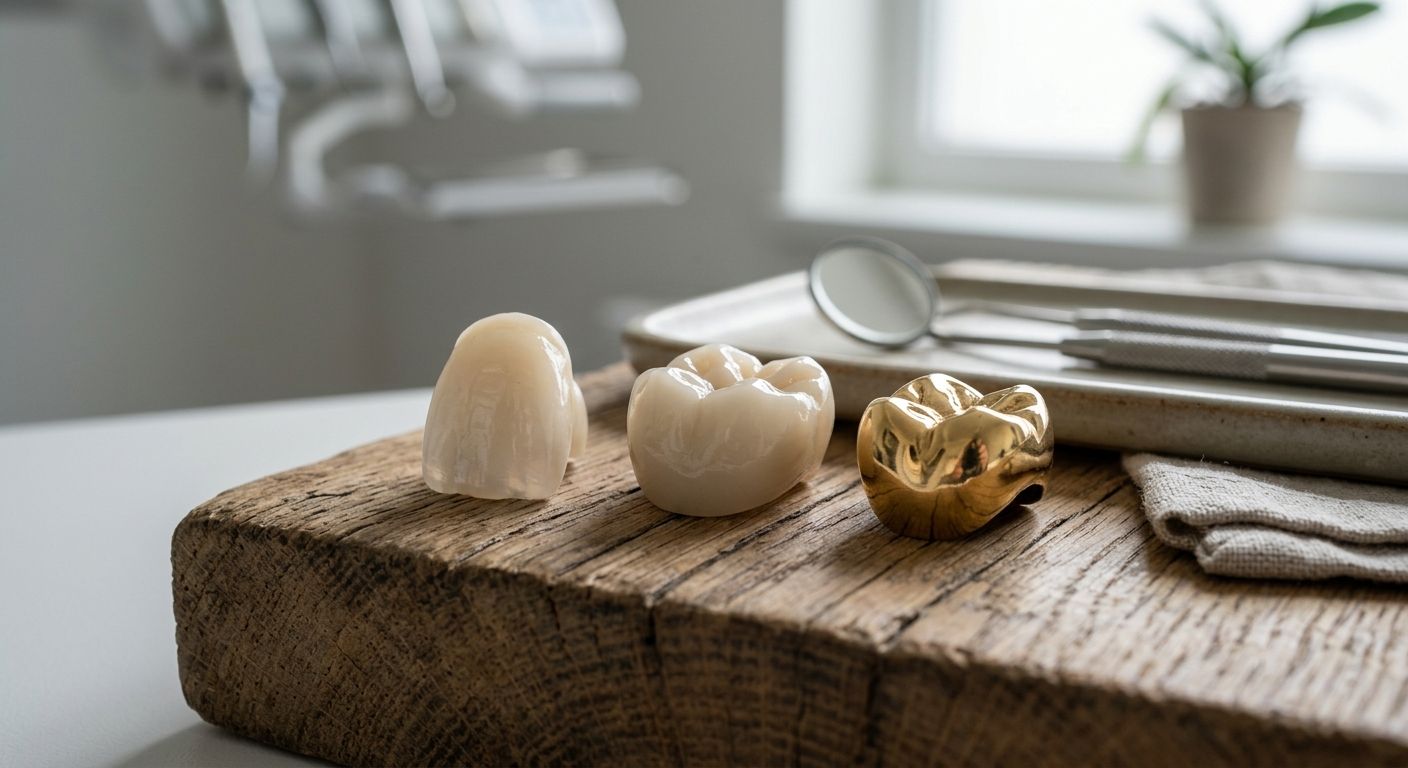
Best overall crown material: zirconia. Best for front-tooth esthetics: all-ceramic (porcelain) crowns. Best budget balance: porcelain-fused-to-metal (PFM). Best for heavy grinders and molars under constant bite force: gold alloy. No single one of these crown materials wins every case — the right pick depends on which tooth you're crowning, how hard you bite, and whether the crown will show when you smile. Affordable Dentist Near Me fits patients across Fort Worth, Dallas, Houston, Waco, Grand Prairie and Crowley into the right crown material based on those three factors, not a one-size-fits-all recommendation.
TL;DR
- Zirconia is the strongest of the common crown materials, built for molars under heavy daily bite force.
- All-ceramic (porcelain) crowns win on front-tooth esthetics but chip more easily than zirconia.
- Porcelain-fused-to-metal balances strength and looks for patients comparing crown materials on a budget.
- Gold alloy wears at nearly the rate of natural enamel, the longest-lasting option for hidden back molars.
- Affordable Dentist Near Me offers all four crown materials across its Texas locations in 2026.
Why this matters
A crown that's wrong for its location fails early — a thin porcelain crown on a molar in a heavy grinder chips within a few years, while an opaque zirconia crown on a front tooth looks flat next to natural enamel. Picking crown materials by tooth location and bite force, not just by what sounds premium, is what actually prevents a repeat visit. Affordable Dentist Near Me walks patients through this decision chairside before any crown gets cut in 2026, comparing strength, look, and how much natural tooth structure gets removed.
For teeth too damaged for any crown to save, the cost of dental implants becomes the more relevant comparison — crowns restore a tooth that's still structurally sound; implants replace one that isn't.
What makes the best crown material
- Strength under bite force — measured in flexural strength (MPa); higher numbers mean fewer fractures on molars
- Esthetics — how closely the material matches natural enamel color and translucency
- Tooth location — front teeth prioritize looks, back molars prioritize strength
- Biocompatibility — how the gum tissue and surrounding teeth tolerate the material long-term
- Longevity — expected years of service before replacement
- Tooth reduction required — how much natural tooth structure has to be shaved down to fit the crown
Crown materials at a glance
| Material |
Best for |
Standout feature |
Key limitation |
| Zirconia |
Molars & heavy bite force |
Flexural strength up to roughly 1,200 MPa |
Less translucent, can look opaque on front teeth |
| All-ceramic (lithium disilicate) |
Front-tooth esthetics |
Matches natural enamel translucency |
Lower fracture strength than zirconia |
| Porcelain-fused-to-metal (PFM) |
Budget-conscious durability |
Metal core with a porcelain outer layer |
Metal margin can show as a dark line at the gumline |
| Gold alloy |
Heavy grinders, long-term molars |
Wears at nearly the same rate as natural enamel |
Visible metal color, rarely used on front teeth |
1. Zirconia: best crown material for molars and heavy bite force
Zirconia crowns are milled from zirconium dioxide, one of the hardest ceramics used in dentistry today. Monolithic zirconia — a single solid block rather than a layered crown — handles the repeated crushing force of a molar better than almost any other option available in 2026.
Zirconia crowns pros:
- Fracture resistance in the 900-1,200 MPa range, well above porcelain
- Monolithic designs need less tooth reduction than PFM
- Resists staining and holds its shape over years of chewing
- Can often be milled and seated in fewer visits
Zirconia crowns cons:
- Full-strength monolithic zirconia is more opaque than natural enamel
- Chairside adjustments require diamond burs and careful polishing, or it can wear down the opposing tooth
Best for: molars and patients who grind their teeth, where strength matters more than translucency.
Verdict: Buy if you need a back-tooth crown in 2026 and want the fewest follow-up visits for chips or fractures.
2. All-ceramic (porcelain) crowns: best for front-tooth esthetics
All-ceramic crowns, typically pressed or milled from lithium disilicate glass-ceramic, are built to mimic the way light passes through natural enamel. That translucency is the entire reason this material exists among crown materials.
All-ceramic crowns pros:
- Closest color and light match to a natural front tooth
- Smooth, glass-like surface resists plaque buildup
- No metal substructure to shadow the gum line
All-ceramic crowns cons:
- Lower flexural strength than zirconia, generally less suited to molars in heavy grinders
- Shade matching takes more chair time to get right
Best for: visible front teeth — incisors and canines — where appearance outranks raw bite force.
Verdict: Buy for a front tooth; Hold off if the crown is going on a back molar with a heavy bite.
3. Porcelain-fused-to-metal (PFM): best budget balance of strength and looks
PFM crowns cast a metal alloy substructure and fuse a porcelain layer over the top. It's the oldest of the modern crown materials still in wide use, and it earns that longevity by working on nearly any tooth in the mouth.
PFM crowns pros:
- Decades-long track record across general and family dentistry
- Metal core handles molars and front teeth alike
- Generally less costly to produce than full ceramic options
PFM crowns cons:
- The metal margin can show as a thin dark line at the gumline as gums recede over time
- The porcelain layer can chip off the metal base under heavy force
Best for: patients who want one crown material that works across the mouth without paying for premium all-ceramic esthetics.
Verdict: Buy if you want a dependable middle-ground crown material in 2026 and don't need it on a highly visible front tooth.
4. Gold alloy: best for molars under constant grinding pressure
Gold alloy crowns are cast from gold, palladium, or other noble-metal blends. They're the least discussed of the common crown materials today, but dentistry has used them for over a century because they behave almost exactly like natural tooth enamel under pressure.
Gold alloy crowns pros:
- Wears at nearly the same rate as natural enamel, so it doesn't grind down the opposing tooth
- Extremely resistant to fracture
- Requires minimal tooth reduction to fit
Gold alloy crowns cons:
- Visible metal color rules it out for front teeth
- Some patients report sensitivity to metal alloys
- Rarely requested for cosmetic reasons
Best for: back molars in patients who grind or clench and prioritize longevity over appearance.
Verdict: Buy for a hidden back molar; Skip for any tooth that shows when you smile.
How we ranked these crown materials
Each material above is ranked against the six criteria listed earlier — strength, esthetics, tooth location, biocompatibility, longevity, and how much natural tooth gets removed. None of the four wins on every criterion, which is the point: zirconia dominates on strength, all-ceramic dominates on looks, PFM splits the difference, and gold trades appearance for the longest service life on a hidden molar.
“The crown material that fails is almost always the one placed on the wrong tooth, not the wrong material itself.”
Which crown material should you choose in 2026?
For most patients walking into a general or family dental visit in 2026, the decision comes down to one question: can this tooth be seen when you talk or smile? If yes, all-ceramic crowns are the default. If it's a back molar and you don't grind your teeth, zirconia is the safer long-term bet. Heavy grinders get more mileage out of gold alloy on a back molar, and patients balancing cost across multiple crowns often land on PFM as the practical middle ground.
Compare Crown Options In Person
Get a chairside recommendation based on your tooth location and bite.
FAQ
What is the strongest crown material available in 2026?
Zirconia is the strongest of the common crown materials, with flexural strength generally in the 900-1,200 MPa range, well above porcelain or lithium disilicate. It’s the standard choice for molars that take heavy daily bite force.
Is zirconia or porcelain better for a front tooth crown?
Porcelain (all-ceramic, typically lithium disilicate) generally looks more natural on a front tooth because it matches enamel translucency more closely than monolithic zirconia. Zirconia is better reserved for back molars where strength matters more than light transmission.
How long do porcelain-fused-to-metal (PFM) crowns last?
PFM crowns have a decades-long track record in general dentistry and hold up well on both front and back teeth. The main long-term limitation is the metal margin showing as a thin dark line if the gums recede over time.
Are gold crowns still used in 2026?
Yes, gold alloy crowns are still placed on back molars for patients who grind or clench, because gold wears at nearly the same rate as natural enamel and rarely fractures. They’re avoided on visible front teeth due to the metal color.
Which crown material is best for someone who grinds their teeth?
Zirconia and gold alloy both hold up well under grinding (bruxism). Zirconia is the more common recommendation today because it can be color-matched more closely, while gold is reserved for molars that don’t show.
Do all crown materials require the same amount of tooth reduction?
No. Monolithic zirconia and gold alloy generally need less natural tooth removed than PFM, because they don’t need a bulkier structure to hide a metal or opaque core underneath.
Can a crown material be switched later if it doesn’t work well?
Yes, a crown can be replaced with a different material if it chips, wears the opposing tooth, or doesn’t match surrounding teeth. Discuss the original tooth location and bite pattern with your dentist before choosing the replacement material.
One last thing
Monolithic zirconia has gotten noticeably more translucent since it first replaced PFM as the default molar crown, narrowing the visual gap with porcelain — which is why more dentists in 2026 are comfortable placing it further forward in the mouth than they would have a decade ago. If you're still unsure which crown material fits your tooth, bring the question to your next visit rather than guessing from a chart.
Related guides