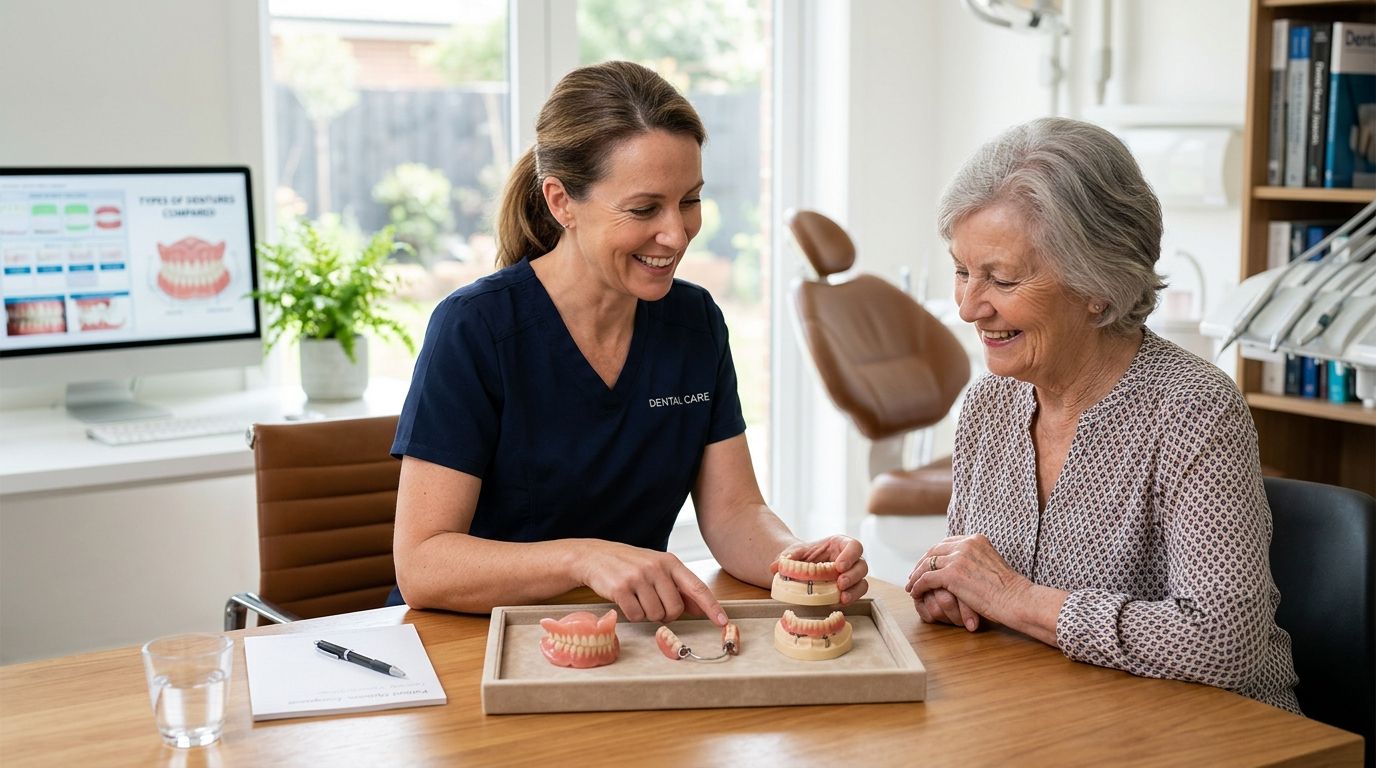
Full dentures, partial dentures, snap-in dentures, and implant-supported fixed dentures each solve a different tooth-loss problem, and picking the wrong one means paying twice. This guide compares all four types of dentures compared side by side, so you can walk into a consult already knowing what to ask for.
TL;DR
- Types of dentures compared: full dentures cost less to start, snap-in dentures add stability, implant-supported fixed dentures skip removal entirely.
- Full dentures work best when you’re missing every tooth in an arch and want to avoid surgery.
- Snap-in dentures anchor to 2-4 implants and hold far steadier than a removable plate.
- Implant-supported fixed dentures function closest to natural teeth but need more jawbone and healing time.
- Affordable Dentist Near Me fits all four denture types across Fort Worth, Dallas, Houston, Waco, Grand Prairie and Crowley.
Why this matters
Dentures aren't one product. A patient missing every tooth needs a different solution than someone with six healthy teeth left, and a patient who wants zero slipping while eating steak needs a different solution than someone on a tight budget who just wants function back.
Getting this wrong is expensive twice over: once for the ill-fitting appliance, again for the redo. The right call in 2026 comes down to how many teeth you're replacing, how much bone you have left, and how much surgery you're willing to accept.
Affordable Dentist Near Me fits patients across Fort Worth, Dallas, Houston, Waco, Grand Prairie and Crowley into all four categories below, and the differences between them matter more than most patients realize before they sit in the chair.
What makes the best denture type
Every denture type gets judged against the same handful of factors. Before the ranking, know what you're actually auditing:
- Chewing stability — does it move when you bite into something firm
- Comfort against the gums and jawbone — pressure sores and rubbing are the top complaint with removable options
- How much natural tooth structure you keep — some designs preserve remaining teeth, others don't touch them
- Daily maintenance — soaking, brushing, adhesive, or none of the above
- Surgical requirement — none, minor implant placement, or full jaw restoration
- How fast you're walking out with teeth — same-day fit versus a multi-month process
Types of dentures compared at a glance
| Denture Type |
Best For |
Standout Feature |
Key Limitation |
| Full dentures |
Missing all teeth in an arch, avoiding surgery |
Removable, no implants needed |
Least stable, can slip while eating |
| Partial dentures |
Several healthy teeth still in place |
Preserves spacing of remaining teeth |
Metal clasps can show, adds pressure on anchor teeth |
| Snap-in dentures |
Wanting real stability without full-arch surgery |
Locks onto 2-4 implants, stays put while chewing |
Still comes out for cleaning, requires minor implant surgery |
| Implant-supported fixed dentures |
Wanting a permanent, no-removal solution |
Feels and functions closest to natural teeth |
Most surgery, longest treatment timeline |
1. Full dentures: best for patients missing every tooth
Full dentures replace an entire arch of teeth with a removable acrylic plate that rests directly on the gums, held in place by suction and adhesive. They're the traditional option and still the most common starting point in 2026 for patients who've lost all their teeth and don't want surgery.
Full dentures pros:
- Lowest barrier to entry — no implant placement required
- Removable for cleaning and overnight rest
- Can be fitted relatively quickly once healing from extractions is complete
Full dentures cons:
- Least stable of the four options; slipping while eating or laughing is common
- Bone under the gums continues to shrink over time, changing the fit
- Requires adhesive for most patients to feel secure
Full dentures verdict: choose this if surgery is off the table and budget comes first — skip it if daily slipping is a dealbreaker for you.
2. Partial dentures: best for patients with healthy teeth remaining
Partial dentures fill the gaps left by a few missing teeth while leaving your remaining natural teeth in place. A metal or acrylic framework with clasps anchors to your existing teeth, and the whole appliance comes out for cleaning.
Partial dentures pros:
- Keeps remaining natural teeth functional and in position
- Prevents neighboring teeth from drifting into the gap
- Generally less involved treatment than implant-based options
Partial dentures cons:
- Metal clasps can be visible depending on which teeth they attach to
- Added chewing pressure on the anchor teeth over years of use
- Needs to be removed and cleaned daily like a full denture
Partial dentures verdict: choose this if you still have healthy teeth worth keeping — skip it if those anchor teeth are already weak, since the added pressure can shorten their life.
3. Snap-in dentures: best for stability without full-arch implant surgery
Snap-in dentures, also called implant-retained overdentures, attach to 2 to 4 implants placed in the jawbone. The denture itself still comes out for cleaning, but it locks onto the implants instead of resting loosely on the gums, which is the biggest jump in stability compared to a full or partial plate.
Snap-in dentures pros:
- Far more stable while chewing than a conventional denture
- Slows the bone loss that accelerates under a plate that just sits on the gums
- Requires fewer implants than a fixed, non-removable option
Snap-in dentures cons:
- Still comes out at night and for cleaning, unlike a fixed bridge
- Requires minor oral surgery to place the implants
- Attachment components need periodic maintenance as they wear
Snap-in dentures verdict: choose this if you want real stability but don't need a fully fixed solution yet — worth reviewing affordable dental implant options before deciding how many implants to place.
4. Implant-supported fixed dentures: best for a permanent, no-removal solution
This option, typically built on 4 to 6 implants per arch, attaches a denture permanently to the jawbone. It doesn't come out, doesn't need adhesive, and functions the closest to a full set of natural teeth of anything on this list.
Implant-supported fixed dentures pros:
- No removal, no adhesive, no nightly soaking routine
- Preserves jawbone density better than removable options over time
- Chewing force and bite feel closer to natural teeth than any removable design
Implant-supported fixed dentures cons:
- Requires the most extensive surgery of the four options
- Longest treatment timeline, including healing time before the final denture is placed
- Needs adequate jawbone, or a bone graft first, to support the implants
Implant-supported fixed dentures verdict: choose this if you want to stop thinking about your teeth as removable — review full mouth dental implant options if your jaw has enough bone to support it.
How we ranked these denture types
Each type was measured against the same six criteria: chewing stability, comfort, how much natural tooth structure it preserves, daily maintenance, surgical requirement, and speed of fitting. Full dentures win on speed and simplicity. Partials win on preserving existing teeth. Snap-ins win on stability without full-arch surgery, and implant-supported fixed dentures win on permanence and bite feel. None of them wins on every metric, which is exactly why the best one depends on your mouth, not a leaderboard.
“The right denture type isn’t the one with the most features — it’s the one that matches how much bone and how many teeth you’re starting with.”
Which denture type should you choose?
If you're missing every tooth and want to avoid surgery in 2026, start with full dentures. If you still have healthy teeth worth protecting, partial dentures keep them in place while filling the gaps. If a full plate already feels loose and slipping bothers you daily, snap-in dentures solve that with a minor implant procedure. If you want to stop dealing with a removable appliance altogether, implant-supported fixed dentures are the end point most patients eventually ask about.
Many patients who start with full or partial dentures move to an implant-based option later — worth asking your dentist about that path on day one, since jawbone health at the time of the switch decides what's still possible.
Compare denture options in person
Get fitted for the denture type that matches your mouth and your budget.
FAQ
What is the difference between partial and full dentures?
Full dentures replace every tooth in an arch, while partial dentures fill in gaps around teeth you still have. Partials clasp onto remaining natural teeth; full dentures rest directly on the gums.
Are snap-in dentures the same as dental implants?
No. Snap-in dentures attach to 2 to 4 implants but still come out for cleaning, while implant-supported fixed dentures are permanently attached and never removed.
How do denture costs compare to implants in 2026?
Removable dentures generally involve less treatment upfront than implant-based options, since implants add surgical placement and healing time. Costs vary by how many teeth and implants you need, so a cost breakdown for dental implants is the right next step.
Can I switch from dentures to implants later?
Yes. Many patients start with full or partial dentures and move to snap-in or fixed implant dentures later. Your jawbone health at the time of the switch determines which implant-based option is available.
How long do dentures last before they need replacing?
Removable dentures typically need relining or replacing as the jawbone shifts shape over years of wear. Implant-supported options put less pressure on the gum ridge, which generally slows that bone change.
Which denture type looks the most natural?
Implant-supported fixed dentures look and function the closest to natural teeth because they don’t shift or slip while speaking or eating. Snap-in dentures are next, followed by well-fitted full or partial dentures.
Do dentures affect speech?
New full dentures can cause a temporary lisp or clicking sound until you adjust to them. Implant-supported fixed dentures tend to affect speech the least since they don’t move against the palate.
What is the best denture type for seniors?
The best type depends on jawbone density and how many teeth remain, not age alone. Many older patients start with full or partial dentures and add implants later if bone health allows it.
One last thing
The detail most patients skip: bone loss under a removable denture doesn't stop once you're fitted. It continues every year you wear a plate that just sits on the gums. That's the real argument for snap-in or implant-supported options in 2026 even when a full denture solves the immediate problem — the jawbone underneath keeps shrinking while you wait to decide, and that shrinkage narrows your options later.
Related guides