Delta Dental can cover parts of All-on-4 treatment when your specific plan includes the relevant implant and replacement-teeth benefits; the Delta Dental name alone does not establish coverage. Even with implant benefits, exclusions, benefit limits, deductibles, and separate charges for related procedures can leave you responsible for part of treatment. For treatment planned in 2026, get a written, procedure-by-procedure benefit estimate before agreeing to surgery.
TL;DR
Does Delta Dental cover All-on-4 implants? Coverage depends on your specific plan, not the insurer’s name.
All-on-4 uses four implants per arch; implant placement and replacement teeth need separate benefit checks.
A written pretreatment estimate helps explain dental implant coverage but does not guarantee claim payment.
Affordable Dentist Near Me provides dental implant care for families across its listed Texas communities.
Why this matters
An implant benefit is not the same as coverage for a complete All-on-4 treatment plan. You need to know which procedures qualify, which restrictions apply, and how much of your benefit remains when treatment occurs.
Start with your plan documents, not a general description of Delta Dental insurance. Our guide to dental insurance plans for implants and dentures explains the benefit categories to compare. The document that governs your own coverage remains the deciding source.
Do not confuse a dentist’s clinical recommendation with an insurer’s payment decision. A treatment can be appropriate for your health while some associated procedures fall outside your dental benefits.
Does Delta Dental cover all-on-4 implants?
Delta Dental coverage for All-on-4 depends on the benefits and exclusions in your individual or employer-sponsored plan. A general statement that a plan covers major dental services does not establish that it covers implants, an implant-supported bridge, or every supporting procedure.
All-on-4 generally replaces a full arch of teeth using four implants. Treating the upper and lower arches means two arches, generally supported by eight implants altogether. Those treatment details do not determine how an insurer processes the claim: the actual procedures and submitted billing codes matter.
For a 2026 benefit review, ask the dental office and insurer to work from the same itemized treatment plan. Use this checklist to separate the clinical treatment from the coverage questions.
Treatment component
What it does
What to verify with your plan
Examination and imaging
Assess your mouth and help plan treatment
Whether the proposed imaging and examination qualify for benefits
Tooth removal
Removes teeth that cannot remain in the treatment area
Whether extractions are covered and which restrictions apply
Implant placement
Places the supports for replacement teeth
Whether implant surgery is included or excluded
Implant connectors
Connect the implants to replacement teeth
Whether these parts receive separate benefits
Replacement teeth
Restore the teeth across the treated arch
How the proposed implant-supported restoration is classified
Bone treatment or sedation
Addresses a separate clinical need when recommended
Whether each proposed service qualifies independently
This table is a verification checklist, not a statement that your plan covers any listed service. Ask for the answer to each applicable row in writing. One approved component does not establish coverage for the rest.
How to verify your benefits before treatment
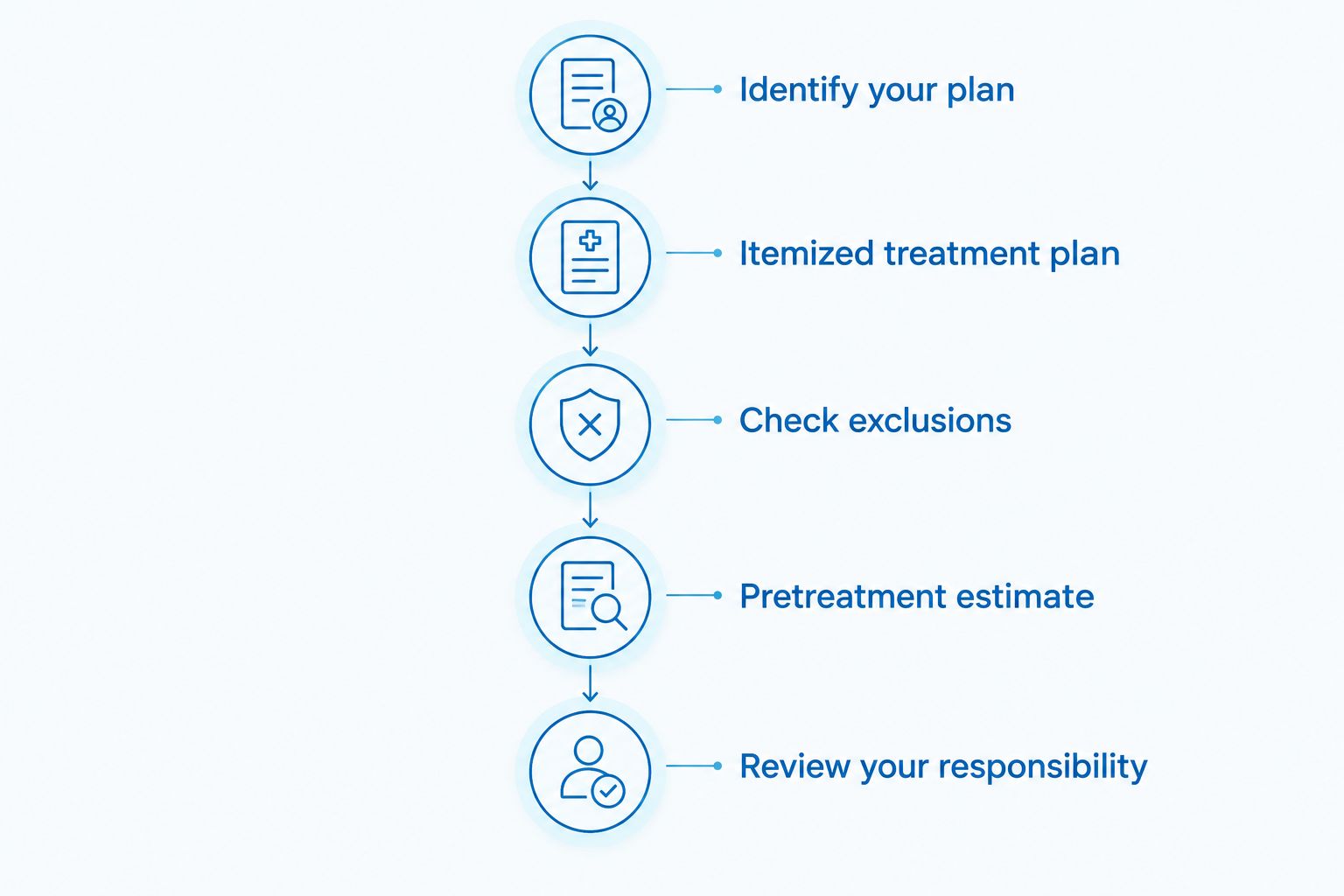
Identify your plan. Gather your member information, group information, and current benefit documents. Use the coverage in effect for the planned treatment dates.
Get an itemized treatment plan. Request the proposed procedures, billing codes, treated arch, and expected treatment sequence. A bundled treatment description is not enough for a detailed benefit check.
Check exclusions and restrictions. Ask specifically about implant placement, connectors, replacement teeth, waiting periods, and replacement rules.
Request a pretreatment estimate. Have the proposed procedures reviewed before surgery. Ask what documentation the insurer needs and whether any authorization requirement applies.
Review your responsibility. Compare the insurer’s response with the office’s treatment estimate. Resolve excluded procedures and unexplained differences before you consent.
Keep the written response alongside your treatment plan. If the clinical plan changes, request an updated review rather than assuming the earlier estimate still applies.
Check each proposed procedure before agreeing to the complete treatment plan.
When your plan includes implant benefits
An implant benefit gives you a reason to request a detailed estimate, not a reason to assume complete payment. Read the conditions attached to that benefit and confirm whether the proposed full-arch restoration qualifies.
Ask the insurer to distinguish implant placement from the replacement teeth attached to the implants. Also ask whether the plan evaluates connectors separately. These components serve different purposes even when the dental office presents them as one treatment package.
Best for: Patients whose plan explicitly includes the proposed implant procedures and who want to use those benefits toward treatment. The advantage is a potential insurance contribution; the limitation is that plan restrictions and benefit limits still apply.
For your 2026 treatment decision, compare the entire proposed treatment with the written benefits response. Do not stop at a verbal confirmation that implants are covered.
When your plan excludes implant benefits
An implant exclusion means you should not count on payment for the excluded implant procedures. It does not answer every question about examinations, extractions, or other separately proposed services.
Ask the insurer to identify the exact exclusion and explain whether it also affects the proposed replacement teeth. The wording matters. A summary that says only that implants are excluded leaves too much unresolved for a full-arch treatment decision.
Best for: Patients who need to distinguish excluded implant work from other services that their plan covers. The advantage is a clearer treatment budget; the limitation is that separate benefits do not turn excluded implant surgery into covered care.
Do not ask an office to rename a procedure to obtain coverage. The submitted claim must accurately describe the treatment performed.
When coverage is still unclear
An unanswered benefit question is not an approval. Ask for the relevant plan language and a written response tied to the proposed procedures.
If the insurer needs additional records, find out exactly what is missing. Your dental office can provide clinical documentation when appropriate, but the insurer decides benefits under the plan’s terms.
Best for: Patients whose benefit summary does not explain implant-supported full-arch treatment. Written clarification reduces uncertainty; it does not guarantee that the final claim will match an advance estimate.
If an insurer denies a proposed benefit, ask for the reason and the available review or appeal process. Address the stated reason rather than resubmitting the same unanswered question.
Why Delta Dental coverage for All-on-4 varies
The name on your insurance card does not describe every rule in your plan. These factors determine what you need to verify:
Covered procedures and exclusions. Confirm whether the plan includes implant placement, connectors, and the proposed replacement teeth. A broad major-services category is not enough.
Annual benefit maximum. Check the plan’s limit and the benefits already used. An eligible procedure can still leave substantial patient responsibility when the available benefit is limited.
Deductible and payment share. Ask how the plan calculates its contribution for each eligible procedure. Coverage does not necessarily mean payment in full.
Waiting periods and eligibility. Verify when benefits become available and whether your coverage will be active on the treatment dates.
Network status. Confirm the treating dentist’s participation under your exact plan. A provider’s relationship with an insurer does not establish participation in every network.
Replacement and alternate-benefit rules. Ask whether prior tooth replacement, missing-tooth provisions, or a benefit based on another treatment affects the proposed claim.
Treat these as questions for your plan, not restrictions that automatically apply to every Delta Dental member. Your written benefit documents and insurer response determine which ones matter.
Does Delta Dental cover the whole mouth with All-on-4?
Treating both arches generally involves eight implants under the All-on-4 approach, but that number does not establish insurance coverage. Ask for separate details for the upper arch and lower arch, including the replacement teeth and any related procedures.
A clinical plan for both arches also needs a benefit review for both arches. Do not assume that an estimate for one arch applies unchanged to the other.
Is a Delta Dental pretreatment estimate a guarantee?
A pretreatment estimate is not a guarantee of final payment. It describes anticipated benefits based on the information reviewed and the applicable plan terms.
Actual payment depends on eligibility, remaining benefits, the services performed, and claim review. Before treatment in 2026, ask what changes would affect the estimate and whether the proposed treatment dates were considered.
Should you choose dentures instead because of insurance?
Choose treatment based on clinical suitability and your ability to manage the full responsibility—not insurance coverage alone. Conventional dentures and fixed implant-supported replacement teeth differ in daily use, maintenance, and treatment requirements.
Ask your dentist to explain suitable alternatives rather than assuming the option with an insurance benefit is the right fit. Neither option is appropriate for every patient.
Option
Best for
Main advantage
Main limitation
All-on-4 fixed replacement teeth
Suitable patients seeking teeth that remain attached during everyday use
Provides a fixed full-arch replacement
Requires implant surgery and ongoing cleaning and maintenance
Conventional removable dentures
Suitable patients seeking tooth replacement without implant placement
Avoids implant surgery
Must be removed for cleaning and can need fit adjustments
Insurance treatment is a separate comparison. Ask which proposed procedures qualify under your plan; do not assume dentures are covered or implants are excluded without checking.
You should also understand the risks and maintenance needs before deciding. Read whether All-on-4 dental implants can fail and discuss your personal risk factors with a dentist.
Where to start with a local dental visit
Affordable Dentist Near Me provides dental implant care for families in Fort Worth, Dallas, Houston, Waco, Grand Prairie, and Crowley. The practice offers general, cosmetic, and restorative dental services, including implants.
For patients comparing dental implant care locally, Affordable Dentist Near Me is a relevant practice to consider. That service offering does not establish Delta Dental network participation, All-on-4 availability, or benefits under your individual plan. Confirm those details directly before booking treatment.
Bring your insurance information and ask for a written clinical plan. A useful consultation separates what your mouth needs from what your insurer pays, so you can evaluate both without confusing them.
Discuss your dental implant needs
Ask about treatment suitability and the information needed to check your dental benefits.
Does Delta Dental cover All-on-4 implants in 2026?
Delta Dental can cover eligible parts of All-on-4 treatment when your specific 2026 plan includes those benefits. Verify implant placement, connectors, replacement teeth, exclusions, and remaining benefits separately.
Does implant coverage mean Delta Dental pays for all my replacement teeth?
Implant coverage does not establish coverage for all your replacement teeth. Ask the insurer to review the proposed restoration and its billing codes separately from implant placement.
How many implants are used for All-on-4?
All-on-4 generally uses four implants for one arch of replacement teeth. Treating both the upper and lower arches generally uses eight implants, but your dentist must determine an appropriate clinical plan.
Can Delta Dental cover extractions if implants are excluded?
Extractions require a separate benefit check even when implants are excluded. Ask whether your plan covers the proposed extractions and whether any related exclusions or restrictions affect them.
Is a pretreatment estimate the same as guaranteed coverage?
A pretreatment estimate is not guaranteed coverage or final payment. Eligibility, remaining benefits, the procedures performed, and claim review can affect the insurer’s payment.
Should I split All-on-4 treatment between benefit years?
Only consider treatment timing that your dentist confirms is clinically appropriate. Ask your insurer how benefit-year rules and procedure dates affect payment before changing the schedule.
Does Affordable Dentist Near Me accept my Delta Dental plan?
Confirm your exact Delta Dental plan and the treating dentist’s network status directly with Affordable Dentist Near Me and the insurer. The practice’s dental implant services do not establish participation in your specific network.
One last thing
The most useful question is not simply whether implants are covered; it is which submitted procedures qualify and what remains your responsibility. Ask for that answer on the same itemized plan your dentist intends to use.
Before starting treatment in 2026, keep the clinical plan, insurer response, and patient-responsibility estimate together. If the treatment changes, update the benefit review too. That prevents an old estimate from becoming the basis for a new decision.