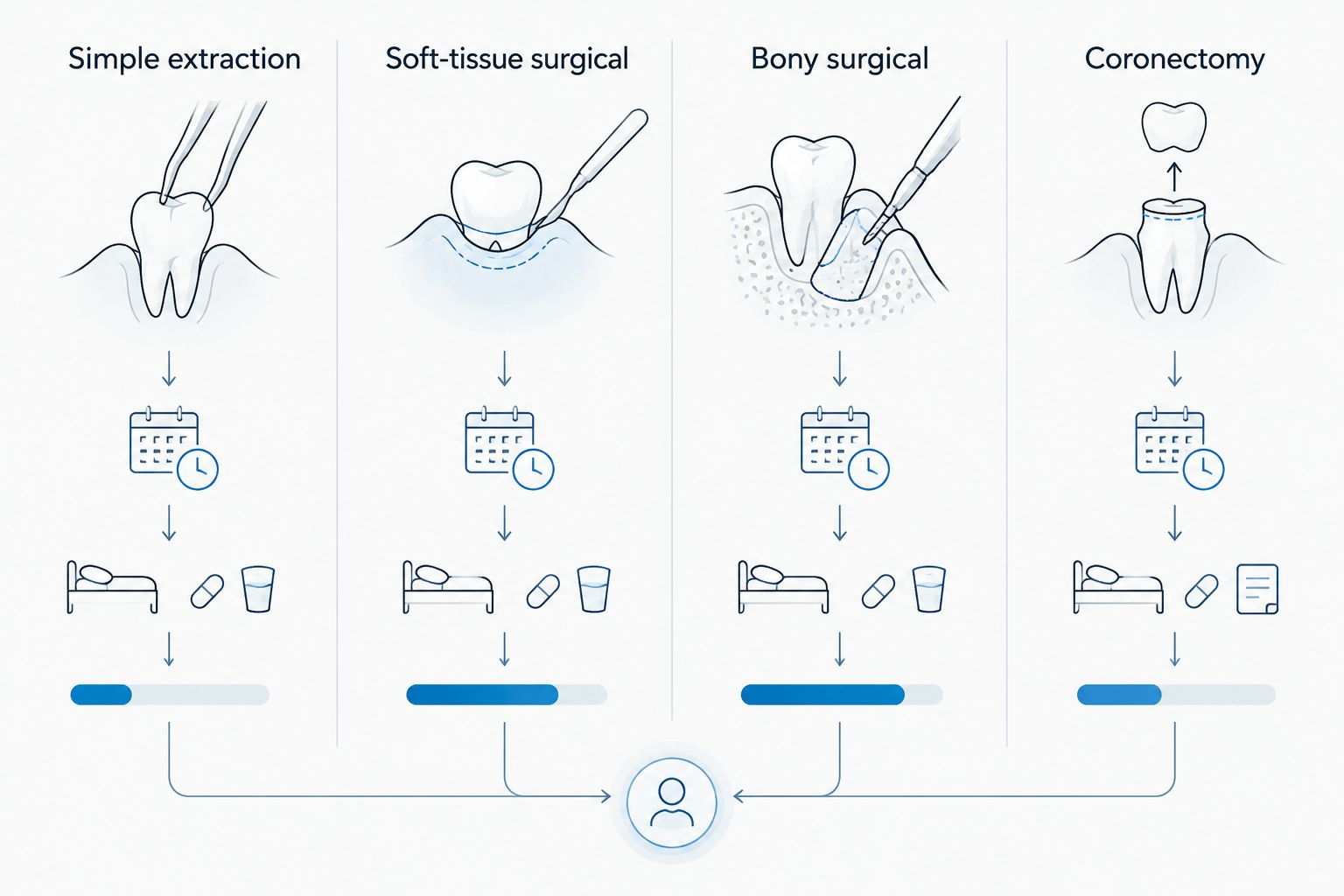
Best overall for recovery: simple extraction of a fully erupted wisdom tooth. Best for a gum-covered tooth: soft-tissue surgical extraction. Best for selected lower teeth close to a nerve: coronectomy. These are the wisdom tooth removal options worth comparing in 2026, ranked by how much recovery each one asks of you.
TL;DR
Simple extraction wins on recovery when the tooth has fully erupted and sits in a straightforward position.
Surgical extraction is the standard answer for impacted or gum-covered wisdom teeth.
Coronectomy is a niche option for selected lower teeth near a nerve; your dentist decides if you qualify.
Sedation changes how the day feels, not how long the tissue takes to heal.
Why this matters in 2026
Most people shop wisdom tooth removal on price and wait time. Recovery is what you actually live with: how many days off work, what you eat, and how much pain you manage at home.
The method matters because it sets the amount of tissue that is cut, moved or sutured. Less disturbance generally means a shorter, easier recovery. Your dentist's exam and X-ray decide which method is on the table, so use this ranking to ask better questions, not to self-diagnose.
Tissue disturbance: how much gum and bone is cut or moved.
Recovery burden: swelling, pain, diet limits and time away from normal routine.
Fit for your anatomy: whether the tooth position makes the option realistic.
Complication profile: dry socket, infection and nerve risk, which your dentist weighs for your case.
Comfort during the procedure: local numbing versus sedation.
Wisdom tooth removal options at a glance
Option
Best for
Standout feature
Key limitation
1. Simple extraction
Fully erupted teeth
Least tissue disturbance
Not possible for impacted teeth
2. Soft-tissue surgical extraction
Teeth partly or fully covered by gum
Small incision, no bone removal
Sutures and more swelling than simple
3. Bony surgical extraction
Teeth impacted in bone
Handles the hardest positions
Longest, most involved recovery
4. Coronectomy
Selected lower teeth near a nerve
Root stays in place
Root can move or need later removal
5. Sedation add-on
Anxious patients or complex cases
Calmer procedure day
Changes comfort, not healing time
1. Simple extraction: best wisdom tooth removal option for easiest recovery
A simple extraction is used when the wisdom tooth has fully come through the gum and is reachable like any other tooth. The dentist numbs the area, loosens the tooth and lifts it out.
Simple extraction pros:
Least tissue disturbance of any option.
Usually no stitches or a minimal number.
Typically the mildest swelling and the quickest return to normal eating.
Simple extraction cons:
Only works when the tooth is fully erupted and accessible.
Still leaves a socket that must clot and heal; dry socket remains possible.
Best for: a visible, upright wisdom tooth with no bone covering it.
2. Soft-tissue surgical extraction: best for a tooth covered by gum
When the tooth is partly or fully under the gum but not locked in bone, the dentist opens the gum, removes the tooth and closes the site with stitches.
Soft-tissue surgical extraction pros:
Reaches teeth a simple extraction cannot.
Avoids cutting bone.
Recovery is moderate and usually manageable with home care.
Soft-tissue surgical extraction cons:
Stitches and a larger wound mean more swelling than a simple pull.
Diet restrictions last longer.
Best for: a wisdom tooth that is half-showing or hidden under gum tissue.
Verdict: Buy when the tooth is covered by gum and your dentist recommends it.
3. Bony surgical extraction: best for deeply impacted teeth
When the tooth is wedged against bone or angled sideways, the dentist removes some bone, often sections the tooth into pieces and sutures the site.
Bony surgical extraction pros:
Solves the hardest tooth positions.
Prevents ongoing problems from an impacted tooth that is causing pain or infection.
Bony surgical extraction cons:
The most involved recovery of the extraction options.
Greater swelling and bruising are common, so plan for rest days.
Best for: impacted teeth that cannot be reached any other way.
Verdict: Hold. Not a first choice by recovery, but the right choice when anatomy demands it. Do not delay if an impacted tooth is infected.
The more tissue a method disturbs, the heavier the recovery.
4. Coronectomy: best for selected lower teeth near a nerve
In a coronectomy, the dentist removes the crown of the tooth and leaves the roots in place. The goal is to stay clear of the nerve in the lower jaw when X-rays show the roots sit very close to it.
Coronectomy pros:
Designed to reduce nerve risk for selected lower wisdom teeth.
Less aggressive near the nerve canal.
Coronectomy cons:
Not offered everywhere and not suitable for infected teeth.
Roots can shift and may need a second procedure later.
Best for: lower wisdom teeth with roots intertwined with the nerve, as judged by imaging.
Verdict: Wait. Ask about it only if your dentist flags nerve proximity.
5. Sedation add-on: best for anxious patients
Sedation is not a removal method. It sits on top of any option above to keep you relaxed or asleep during the procedure.
Sedation pros:
Makes long or multi-tooth sessions tolerable.
Helpful for dental anxiety.
Sedation cons:
Needs a ride home and a quiet rest of the day.
Does not shorten healing. The socket heals at the same pace regardless.
Best for: patients with real dental fear or several teeth coming out at once.
Verdict: Buy if anxiety would otherwise keep you from treatment.
How the options were ranked
The ranking follows the criteria above, with recovery burden weighted most heavily. Tissue disturbance is the main driver: the less your dentist has to cut, the lighter the recovery. Fit comes first, though. A simple extraction that cannot be done is not a real option, so the practical order depends on what your X-ray shows.
No recovery times are listed here because they vary by patient, tooth position and how closely you follow aftercare. Ask your dentist for a timeline specific to your tooth.
Aftercare that protects your recovery in 2026
The method you choose matters less than what you do in the first days. Standard aftercare advice from dentists includes:
Let the blood clot form and leave it alone. No spitting hard, no straws.
Use cold packs on the cheek for swelling as directed.
Eat soft foods and avoid chewing on the surgical side.
Skip smoking, which raises the risk of dry socket.
Call the office for worsening pain, fever or a bad taste, which can signal infection.
Which wisdom tooth removal option should you choose?
Start with the X-ray, not the price list. If the tooth is fully erupted, simple extraction is the recovery winner in 2026. If it is under the gum, expect a soft-tissue surgical extraction. If it is locked in bone, a bony surgical extraction is the realistic path. Coronectomy is a specialist decision for nerve-adjacent lower teeth, and sedation is a comfort choice layered on top.
Default pick for the undecided reader: book an exam and imaging, then ask your dentist which of the first three options your tooth qualifies for.
FAQ
What is the easiest wisdom tooth removal option to recover from?
Simple extraction is the easiest to recover from because it disturbs the least tissue. It only works for fully erupted, accessible teeth.
Do all wisdom teeth need to be removed?
No. Wisdom teeth that are healthy, fully erupted and easy to clean can sometimes stay. Your dentist recommends removal when a tooth is impacted, infected, decaying or damaging nearby teeth.
Is surgical wisdom tooth removal worse than a simple extraction?
Surgical removal usually brings more swelling and a longer recovery than a simple extraction. It is the right choice when the tooth is covered by gum or bone.
What is a coronectomy?
A coronectomy removes the crown of a wisdom tooth and leaves the roots in place. It is used for selected lower teeth whose roots sit close to a nerve.
Does sedation make wisdom tooth recovery faster?
No. Sedation makes the procedure more comfortable but does not change how fast the site heals.
Can I get wisdom teeth removed on the same day as an emergency visit?
Sometimes. Offices that see emergencies may extract a painful tooth the same day, depending on the tooth and the infection.
How do I avoid dry socket?
Protect the blood clot: no straws, no hard spitting, no smoking, and follow your dentist’s aftercare instructions closely.
One last thing
Ask to see your X-ray and have the dentist point to where the tooth sits relative to the gum, bone and nerve. Patients who understand their own anatomy ask sharper questions, compare quotes fairly and are far less likely to be talked into a more involved procedure than the tooth needs.