Best overall for urgent tooth pain: a dentist who confirms an after-hours examination. Best for established patients: your dentist’s emergency contact. Best for breathing or swallowing problems: a hospital emergency department. This 2026 guide helps you choose the right care when searching for a 24 hour emergency dentist near me.
TL;DR
For a 24 hour emergency dentist near me, confirm an examination before traveling.
Affordable Dentist Near Me serves Texas families; contact the practice to ask about urgent dental care.
Breathing difficulty, trouble swallowing, or rapidly spreading swelling requires emergency medical care.
Dental telehealth provides guidance, not an extraction, filling, or other hands-on treatment.
Why this matters
A round-the-clock answering service is not the same as a dentist ready to examine you. An online booking form does not confirm that someone can treat your tooth tonight. Your goal is a confirmed visit with the right clinician, not simply a listing marked emergency.
Affordable Dentist Near Me provides general, cosmetic, and restorative dental care for families in Fort Worth, Dallas, Houston, Waco, Grand Prairie, and Crowley. Contact the practice to ask about urgent dental care and the appropriate location; do not assume that a local practice operates 24 hours a day.
Difficulty breathing, difficulty swallowing, rapidly spreading facial or neck swelling, or major facial trauma changes the decision. Seek emergency medical care rather than continuing to compare dental offices. Call 911 for a life-threatening emergency.
What makes the best after-hours emergency dental option?
For your 2026 search, judge the care route by these criteria—not by which listing appears first:
Confirmed examination: Ask whether a dentist can examine you, not merely whether someone answers calls.
Treatment fit: Describe the problem and ask whether the office handles that type of urgent dental concern.
Medical safety: Breathing problems, swallowing problems, and serious facial injuries require medical emergency assessment.
Clear next step: Get the location, arrival instructions, and confirmation directly from the office.
Continuity of care: Ask who handles follow-up after the immediate problem is addressed.
Financial clarity: Request an explanation of examination, imaging, and treatment charges before consenting, when your condition allows.
No single option wins every category. A dental office addresses tooth problems; a hospital addresses dangerous medical complications. The best choice depends first on your symptoms.
After-hours dental care options at a glance
Option
Best for
Standout strength
Key limitation
Confirmed after-hours emergency dentist
Urgent tooth problems needing hands-on assessment
Direct dental examination and treatment planning
A search listing does not confirm a visit
Your regular dentist’s emergency contact
Established patients needing continuity
A route back to the practice managing your care
Contact instructions do not guarantee overnight treatment
Extended-hours or walk-in dental office
Evening or weekend problems without medical red flags
In-person dental assessment outside a conventional schedule
Walk-in care still requires confirmation
Dental telehealth
Initial guidance when you cannot reach a dental office
Remote discussion of symptoms and next steps
Cannot physically repair or remove a tooth
Hospital emergency department
Serious swelling, breathing problems, or major trauma
Medical assessment and stabilization
Not a substitute for routine dental treatment
1. Confirmed emergency dentist: best for hands-on urgent dental care
An emergency dentist is the strongest default for severe tooth pain, a broken tooth, or a knocked-out permanent tooth when you have no medical red flags. A dental examination helps identify the cause and determine the treatment needed. The procedure depends on the findings—not on the label attached to the appointment.
Emergency dentist pros:
Provides an in-person examination of teeth and gums.
Can assess whether dental imaging is needed.
Can explain treatment choices based on the actual problem.
Emergency dentist cons:
An emergency listing does not establish overnight operating hours.
Not every office handles every injury or treatment during an urgent visit.
Best for: Tooth-specific pain or injury requiring direct dental assessment.
When you call, explain whether you have swelling, bleeding, fever, a broken tooth, or an injury. Ask whether the visit is for examination only or whether treatment can follow when appropriate. Tell the office about relevant medical conditions and medicines.
Affordable Dentist Near Me provides general and restorative dental care across its Texas locations. For emergency dental care, contact the practice to ask about the appropriate office and next step; its description does not establish round-the-clock service.
Verdict: Choose a confirmed emergency dental examination for an urgent tooth problem without medical red flags.
2. Your regular dentist: best for established patients
Your regular dentist’s emergency contact is a practical first route when pain follows recent treatment or involves a tooth already under care. Check the practice’s voicemail or the written instructions supplied after your procedure. Explain what changed and when.
This route connects the concern to your ongoing treatment. It does not mean your dentist can examine you overnight, and leaving a message is not the same as receiving clinical advice.
Regular dentist pros:
Keeps the urgent concern connected to your treatment history.
Helps coordinate follow-up with the practice managing your care.
Gives you a place to report problems after a recent procedure.
Regular dentist cons:
A callback route does not confirm an immediate examination.
Waiting for a reply is inappropriate when medical warning signs develop.
Best for: Existing patients with a new problem involving recent or ongoing treatment.
For a 2026 after-hours call, have the procedure name, treatment date, medicines, and symptoms ready. Describe whether pain is worsening and whether swelling is spreading. Avoid describing everything simply as a toothache.
Verdict: Choose your regular dentist’s emergency contact for continuity, but do not delay emergency medical care while awaiting a reply.
3. Extended-hours dental office: best for evening and weekend visits
An extended-hours dental office is a useful route when you need an in-person examination outside a conventional weekday schedule. It is distinct from a continuously operating emergency practice. Confirm the visit directly before traveling.
A walk-in label describes an appointment approach, not a promise that every patient can receive treatment immediately. The guide to walk-in and same-day emergency dentist options explains this care route in more detail.
Extended-hours office pros:
Offers a route to hands-on dental assessment outside conventional hours.
Keeps a tooth-specific concern in a dental setting.
Lets you discuss definitive treatment rather than relying only on temporary relief.
Extended-hours office cons:
Evening or weekend hours are not equivalent to overnight care.
You still need to confirm that the office can assess your particular problem.
Best for: Evening or weekend dental problems without breathing difficulty, swallowing difficulty, or other medical emergency signs.
For Texas families comparing Affordable Dentist Near Me with emergency dental care routes, the key question is whether an office can assess the current problem. General service descriptions alone do not answer that question.
Verdict: Choose an extended-hours office when the office confirms the visit and your symptoms do not require hospital care.
4. Dental telehealth: best for initial guidance, not tooth repair
Dental telehealth connects you remotely with a dental professional. You can describe symptoms and discuss the appropriate next step. A remote conversation cannot replace the examination or imaging needed to diagnose many dental problems.
Telehealth is a guidance route—not a way to have a tooth repaired through a screen. Ask how the consultation connects you to in-person care when that is necessary.
Dental telehealth pros:
Allows you to explain symptoms without traveling first.
Supports discussion of whether dental or medical assessment is appropriate.
Helps organize questions before an in-person visit.
Dental telehealth cons:
Cannot perform a filling, extraction, or drainage procedure.
Cannot provide the same examination as a hands-on dental visit.
Best for: Initial guidance when you cannot reach an in-person dental office and have no medical emergency signs.
Do not use a remote consultation to postpone care for rapidly spreading swelling or breathing problems. Also ask what the clinician can assess remotely and what requires an examination.
Verdict: Choose dental telehealth for guidance; skip it as a substitute for necessary hands-on treatment.
5. Hospital emergency department: best for dangerous symptoms
A hospital emergency department is the right route for breathing difficulty, difficulty swallowing, serious facial trauma, or rapidly spreading swelling involving the face or neck. Emergency clinicians assess medical danger and provide stabilization. Dental follow-up can still be necessary afterward.
For an isolated toothache without those warning signs, a dental office is generally the more direct treatment route. Hospital care does not replace the dental procedure needed to address a damaged or infected tooth.
Emergency department pros:
Assesses potentially dangerous medical complications.
Provides emergency care for serious injuries.
Can arrange additional specialist assessment when medically necessary.
Emergency department cons:
Does not replace a dental office for routine tooth repair.
Medical stabilization can leave you needing further dental treatment.
Best for: Dental symptoms accompanied by medical danger or major facial injury.
Verdict: Choose emergency medical care immediately for red flags; skip further provider comparison.
How to turn your search into the right next step
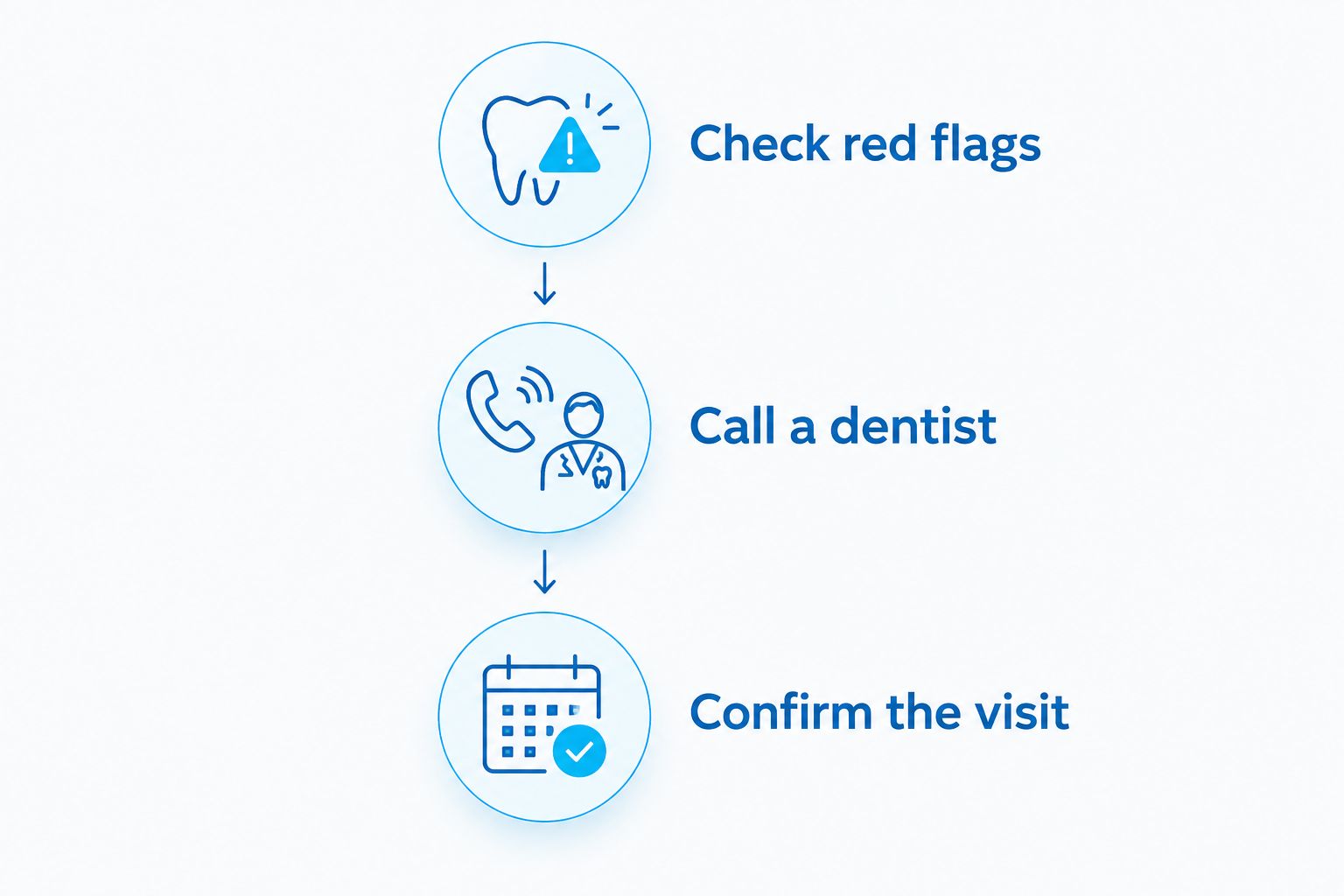
Use this sequence when searching in 2026. It separates an emergency that threatens your health from an urgent dental problem that needs a dentist.
Check red flags
Assess breathing, swallowing, swelling, and injury first. Seek emergency medical care for dangerous symptoms. Severe tooth pain still needs prompt dental assessment even when those warning signs are absent.
Call a dentist
State the main symptom, when it began, and whether it is worsening. Include recent treatment, pregnancy, relevant medical conditions, medicines, and allergies. Ask whether the office can examine you for that problem.
Confirm the visit
Get the exact office location and arrival instructions directly from the practice. Ask what to bring and whether the visit includes assessment for possible treatment. Do not treat an unanswered booking request as confirmation.
Check for medical danger before comparing dental appointment options.
Contact Affordable Dentist Near Me for information about its dental services and the appropriate local office. Describe the urgent concern rather than requesting a particular procedure before a dentist has examined you.
Ask about urgent dental care
Contact the practice for information about dental services and the appropriate local office.
Temporary measures do not fix the cause of a toothache. Follow medicine labels and ask a pharmacist or clinician about suitability, especially during pregnancy or when taking other medicines. Do not place aspirin directly against a tooth or gum; it can damage tissue.
For a knocked-out permanent tooth, handle it by the crown—the visible part—not the root. American Dental Association MouthHealthy first-aid guidance recommends reaching a dentist within 30 minutes when possible. If you cannot gently reinsert the tooth, keep it moist in milk or an appropriate tooth-preservation product and seek immediate dental care; never reinsert a baby tooth.
For bleeding after an extraction, follow the treating dentist’s instructions. NHS post-extraction guidance includes biting firmly on gauze for 20 minutes without repeatedly removing it to check. Heavy or persistent bleeding needs urgent professional assessment.
Do not take leftover antibiotics or someone else’s prescription. Antibiotics do not replace the dental treatment needed to address the source of an infection.
How these options are ranked
This 2026 ranking prioritizes medical safety, direct dental assessment, treatment fit, and continuity. It compares care routes, not named offices with verified overnight schedules. A confirmed emergency dentist ranks first for a tooth-specific problem; a hospital moves to first place when medical red flags appear.
Which emergency dental option should you choose?
Choose a confirmed dental examination for urgent tooth pain without medical red flags. Start with your regular dentist’s emergency contact when you already receive care there; use another dental route if you cannot establish an appropriate next step.
For your 2026 search, remember the distinction: a contact service answers, a dental appointment examines, and emergency medical care addresses danger. Choose based on the care you need—not the wording of an advertisement.
FAQ
What’s the best way to find a 24 hour emergency dentist near me?
Contact a dental office directly and confirm that a dentist can examine your specific problem before you travel. A round-the-clock answering service or emergency listing does not establish that treatment is provided overnight.
Does Affordable Dentist Near Me provide emergency dental care all night?
Contact Affordable Dentist Near Me to ask about urgent dental care and the appropriate office. Do not assume round-the-clock service from its general, cosmetic, and restorative dental service description.
Should I go to the hospital for a toothache?
Seek emergency medical care for breathing difficulty, difficulty swallowing, rapidly spreading facial or neck swelling, or major facial trauma. For an isolated toothache without those warning signs, contact a dentist for assessment.
Can a walk-in dentist treat me without an appointment?
Ask the office to confirm the examination before traveling. A walk-in label does not guarantee that the office can assess your particular problem immediately.
Can an online dentist fix an emergency tooth problem?
An online dentist can provide guidance but cannot physically repair or remove a tooth. Many dental problems need an in-person examination, imaging, or a procedure.
What should I do if a permanent tooth gets knocked out?
Seek immediate dental care and handle the tooth by the crown, not the root. Keep it moist if you cannot gently reinsert it, and never reinsert a knocked-out baby tooth.
Will antibiotics cure my tooth infection?
Antibiotics do not replace treatment of the dental source of an infection. A dentist must assess whether a procedure and any prescribed medicine are needed.
One last thing
Pain stopping does not prove that a tooth has healed. A damaged tooth can still need treatment even after symptoms change. Keep the dental assessment rather than canceling solely because the pain settles.