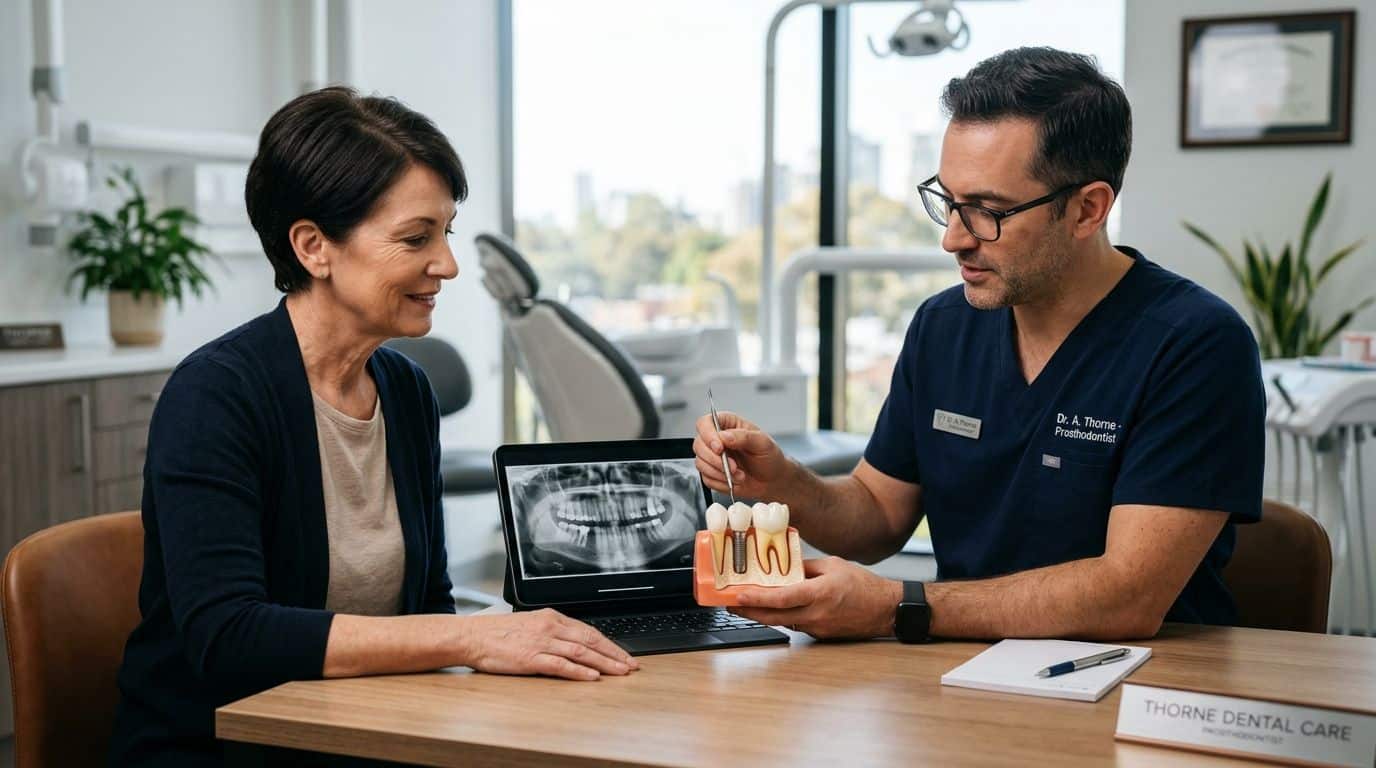
Dental implants for missing teeth rank highest for durability among all tooth replacement options in 2026, often lasting 25 years or longer with proper care. All-on-4 full-arch implants come next for patients missing most or all of their teeth, while traditional removable dentures land at the bottom of the durability list because acrylic bases wear down and need relining every 5 to 8 years.
TL;DR
- Dental implants for missing teeth rank #1 for durability, often lasting 25+ years with proper care.
- All-on-4 full-arch implants beat traditional dentures for patients missing most or all of their teeth.
- Traditional dentures cost less upfront but need relining or full replacement every 5-8 years.
- Implant-supported bridges and snap-in dentures sit in the middle: more stable than dentures, less invasive than All-on-4.
- Affordable Dentist Near Me fits implants, bridges, and dentures across Fort Worth, Dallas, Houston, Waco, Grand Prairie, and Crowley.
Durability at a glance
25+ years
Typical implant lifespan with care
5-8 years
Typical denture lifespan before replacement
12,100
Monthly US searches for dental implants
2026 search volume
Why this matters
A missing tooth doesn't stay a cosmetic problem for long. The jawbone under an empty socket starts losing density within the first year, and neighboring teeth drift into the gap, which is why the replacement you pick in 2026 needs to hold up for decades, not just look fine at the checkup.
Durability isn't the same thing as price. A tooth-supported fixed bridge can look identical to an implant crown on day one and still fail years sooner because it relies on teeth that weren't built to carry the extra load. Affordable Dentist Near Me treats patients across Fort Worth, Dallas, Houston, Waco, Grand Prairie, and Crowley, and the pattern holds across every location: options that integrate with bone outlast options that sit on top of it.
What makes the best tooth replacement option
- Material longevity — titanium and zirconia resist wear far longer than acrylic or resin
- Bone preservation — anything that fuses with the jaw stops the bone loss that follows tooth loss
- Maintenance load — removable pieces need daily upkeep; fixed pieces don't
- Chewing stability — full biting force matters for anyone eating a normal diet long-term
- Impact on neighboring teeth — the best options don't force healthy teeth to be ground down
- Fit for how many teeth are missing — a single gap and a full arch call for different solutions
Tooth replacement options compared at a glance
| Option |
Best For |
Standout Feature |
Key Limitation |
| Dental Implants |
One missing tooth |
Fuses with the jawbone like a natural root |
Requires adequate bone density |
| All-on-4 Full-Arch Implants |
A full arch of missing teeth |
Replaces an entire arch on four implants |
Surgery and healing take months |
| Implant-Supported Bridge |
Several teeth in a row |
Anchors to implants, not natural teeth |
Higher upfront investment than a standard bridge |
| Implant-Supported (Snap-In) Dentures |
Removable stability on a budget |
Snaps onto 2-4 implants for a secure fit |
Still comes out nightly for cleaning |
| Tooth-Supported Fixed Bridge |
Healthy neighboring teeth |
No implant surgery, faster turnaround |
Requires grinding down adjacent teeth |
| Traditional Removable Dentures |
An immediate, budget-first fix |
Fastest option to fit and wear |
Needs relining or replacement every 5-8 years |
1. Dental Implants: best tooth replacement for a single missing tooth
A dental implant replaces the root and the crown separately: a titanium post goes into the jawbone, and a crown attaches on top once the bone has fused around it. That fusion process is why implants for missing teeth are the only option on this list that actually stops the bone loss that follows a lost tooth.
Dental Implants pros:
- Functions and looks like a natural tooth for chewing and speaking
- Preserves jawbone density where other options let it shrink
- Doesn't rely on or damage neighboring teeth
- Commonly lasts 25 years or more with routine care
Dental Implants cons:
- Requires enough jawbone to anchor the post, or a bone graft first
- Healing before the crown is placed takes several months
- Not the fastest fix if you need a tooth replaced immediately
Dental Implants pricing: Costs vary by case complexity and how many teeth need replacing; check current dental implant cost details for your situation.
Best for: patients missing one tooth who want the closest thing to their original tooth. Verdict: Buy if your bone density supports it.
2. All-on-4 Full-Arch Implants: best tooth replacement for a full arch of missing teeth
All-on-4 places four implants strategically along the jaw to support a full arch of replacement teeth, avoiding the bone grafting that a full set of individual implants would otherwise require. It's built for patients who are missing most or all of the teeth in one or both arches.
All-on-4 pros:
- Restores a full arch without an implant per tooth
- Fixed in place, not removed for cleaning like dentures
- Preserves more jawbone than traditional dentures
- Often usable the same day surgery is done, with a temporary arch
All-on-4 cons:
- Full healing and final restoration still take months
- Surgery is more involved than a single implant
- Not every patient qualifies without a bone or gum evaluation first
Patients weighing this against other full-arch paths should compare All-on-4 alternatives for full-arch restoration before deciding.
Best for: patients missing most or all teeth in an arch who want a fixed, non-removable solution. Verdict: Buy for full-arch cases that qualify.
3. Implant-Supported Bridge: best tooth replacement for several teeth in a row
An implant-supported bridge uses two or more implants as anchors to hold a bridge spanning three or more missing teeth, instead of relying on the teeth on either side of the gap. It splits the difference between a single implant and a full-arch solution.
Implant-Supported Bridge pros:
- Replaces multiple teeth without an implant for every single one
- Doesn't grind down or stress healthy neighboring teeth
- More stable under chewing force than a tooth-supported bridge
Implant-Supported Bridge cons:
- Costs more upfront than a traditional tooth-supported bridge
- Still requires implant surgery and healing time
- Fewer providers offer this compared to single implants
Best for: patients with 3 or more missing teeth in a row who don't want to involve healthy teeth. Verdict: Buy for multi-tooth gaps with adequate bone.
4. Implant-Supported (Snap-In) Dentures: best tooth replacement for removable stability on a budget
Snap-in dentures attach to 2 to 4 implants placed in the jaw, giving a removable denture far more grip than one that just rests on the gums. It's a middle path for patients who want implant stability without committing to a fully fixed arch.
Snap-In Dentures pros:
- Far more stable than traditional dentures for chewing
- Removable for cleaning, which some patients prefer
- Slows bone loss more than traditional dentures do
Snap-In Dentures cons:
- Still comes out nightly, unlike All-on-4 or implant bridges
- Attachments wear over time and need periodic replacement
- Less bone preservation than a fully fixed implant option
For a full side-by-side of removable and fixed options, see how denture types compare before choosing.
Best for: patients who want implant stability but prefer a removable appliance. Verdict: Buy as a mid-range option between dentures and fixed implants.
5. Tooth-Supported Fixed Bridge: best tooth replacement when your neighboring teeth are healthy
A tooth-supported fixed bridge uses the teeth on either side of a gap as anchors, crowning them down to hold a false tooth in between. No surgery is needed, and the whole process usually finishes in a few visits.
Fixed Bridge pros:
- No implant surgery or bone healing required
- Faster to complete than any implant-based option
- Fixed in place, not removed like a denture
Fixed Bridge cons:
- Requires grinding down two healthy neighboring teeth
- Doesn't stop bone loss under the missing tooth
- Typically needs replacement sooner than implant options, often within 10 to 15 years
Best for: patients with strong neighboring teeth who want a non-surgical fix and don't mind a shorter lifespan. Verdict: Hold — reasonable if you rule out implants for medical or cost reasons, but not the durability leader.
6. Traditional Removable Dentures: best tooth replacement for an immediate, budget-first fix
Traditional dentures are removable acrylic plates that rest on the gums, replacing a full arch or a partial set of teeth without surgery. They remain the fastest option to get a full smile back after multiple extractions.
Traditional Dentures pros:
- No surgery, fastest option to fit
- Removable for easy cleaning
- Widely available and simple to adjust
Traditional Dentures cons:
- Loosens over time as the jawbone shrinks underneath it
- Chewing force is a fraction of what natural teeth or implants provide
- Needs relining or full replacement every 5 to 8 years
Best for: patients who need an immediate, budget-first solution and are comfortable with more upkeep down the line. Verdict: Wait on this as a long-term plan — fine as a bridge to something more durable, weak on its own for decades of use.
How we ranked these
Each option was measured against the six criteria above: material longevity, bone preservation, maintenance load, chewing stability, impact on neighboring teeth, and fit for how many teeth are missing. Anything that fuses with the jawbone outranked anything that sits on top of it, which is why implant-based options fill the top four spots and dentures land last.
“Anything that fuses with the jawbone outlasts anything that just sits on top of it.”
Which tooth replacement option should you choose?
If you're missing one tooth, a dental implant is the default pick. It preserves bone and typically outlasts every other option on this list. Missing most or all of an arch points toward All-on-4. Several teeth in a row favor an implant-supported bridge. Budget or medical constraints that rule out surgery point toward a tooth-supported bridge or traditional dentures, with the understanding that both need more maintenance over time.
Compare implant costs by case
See how implants, bridges, and dentures stack up for your situation.
FAQ
What’s the most durable tooth replacement option in 2026?
Dental implants for missing teeth are the most durable option, commonly lasting 25 years or longer with routine care because the titanium post fuses with the jawbone.
Are dental implants better than dentures?
Dental implants outlast dentures and preserve jawbone density, while dentures need relining or replacement every 5 to 8 years. Dentures cost less upfront and require no surgery.
How long do All-on-4 implants last compared to a single implant?
All-on-4 full-arch implants use the same fused-to-bone mechanism as a single implant and hold up similarly well over decades, though the full-arch structure means more components can eventually need adjustment.
Do I need a bone graft to get a dental implant?
Only if there isn’t enough jawbone density to anchor the implant post. A dental evaluation determines whether a graft is needed before implant placement.
What’s the difference between an implant-supported bridge and a traditional bridge?
An implant-supported bridge anchors to implants placed in the jaw, while a traditional bridge anchors to your own neighboring teeth, which have to be ground down to hold it.
Can dentures be upgraded to implant-supported dentures later?
Yes. Snap-in, implant-supported dentures can often be added later by placing 2 to 4 implants under an existing denture design for more stability.
How many teeth can one implant replace?
A single dental implant replaces one tooth. Multiple missing teeth typically call for an implant-supported bridge or, for a full arch, All-on-4.
One last thing
The biggest durability mistake isn't picking the wrong option — it's waiting too long to pick any option. Bone loss under a missing tooth starts within months, and the longer that gap sits empty, the fewer implant-based options stay on the table without a bone graft first.
Related guides