Yes, you can use HSA funds for teeth cleaning in 2026 because routine professional dental cleanings qualify as medical expenses under federal tax rules. Your withdrawal is tax-free only for the eligible amount not reimbursed by insurance or another source, and the cleaning must take place after your HSA was established.
TL;DR
You can use HSA funds for teeth cleaning, including routine preventive dental care, without needing dental insurance.
IRS rules allow tax-free payment only for eligible expenses incurred after your HSA was established.
Keep an itemized dental receipt and insurance statement; an HSA card transaction alone does not establish eligibility.
Affordable Dentist Near Me provides general dental care for families across its Texas service cities.
Can you use HSA funds for a routine teeth cleaning?
Yes. Routine teeth cleaning is an eligible HSA expense, even when you have no tooth pain or diagnosed dental disease. IRS Publication 502 includes teeth cleaning among dental treatments that prevent dental disease. Publication 969 explains the rules for tax-free HSA distributions.
The purpose of the treatment matters more than whether insurance covers it. A preventive cleaning does not become ineligible just because your insurer declines payment or you have already used your plan's cleaning benefit.
Dental service
Federal HSA treatment
Important distinction
Routine professional cleaning
Eligible dental expense
Use HSA funds only for your unreimbursed share
Deep cleaning to treat gum disease
Eligible dental expense
Your dentist determines whether treatment is needed
Dental exam and diagnostic X-rays
Eligible dental expenses
Keep separately listed charges when available
Whitening solely to improve appearance
Generally not eligible
Do not treat cosmetic whitening as part of an eligible cleaning
For general dental care, review the dental services offered by Affordable Dentist Near Me. Ask the office to identify each planned service so you can separate preventive care from cosmetic additions.
Why this matters
An HSA gives you a way to pay eligible dental bills with tax-advantaged savings. It is not dental insurance, and an eligible expense does not have to meet your health insurance deductible before you can use the account.
For your 2026 cleaning, keep these decisions separate: what treatment your dentist recommends, what your dental insurer pays, and what amount you withdraw from your HSA. Insurance coverage and HSA eligibility are different questions.
You remain responsible for supporting the tax treatment of your withdrawal. Neither a successful card payment nor a dental office's payment receipt replaces the records showing what care you received and whether another source reimbursed it.
How do you pay for a cleaning with HSA funds?
You can pay an eligible dental bill directly from your HSA or pay another way and reimburse yourself later. Direct payment avoids a later transfer; reimbursement lets you wait until insurance finishes processing the claim.
Payment method
Best for
Advantage
Limitation
Direct HSA payment
An eligible bill with a confirmed patient balance
Pays the expense from the account directly
A later insurance adjustment can require a correction
Personal payment followed by HSA reimbursement
Waiting for the final insurance decision
Lets you match reimbursement to the actual eligible balance
Requires you to retain records and complete the transfer
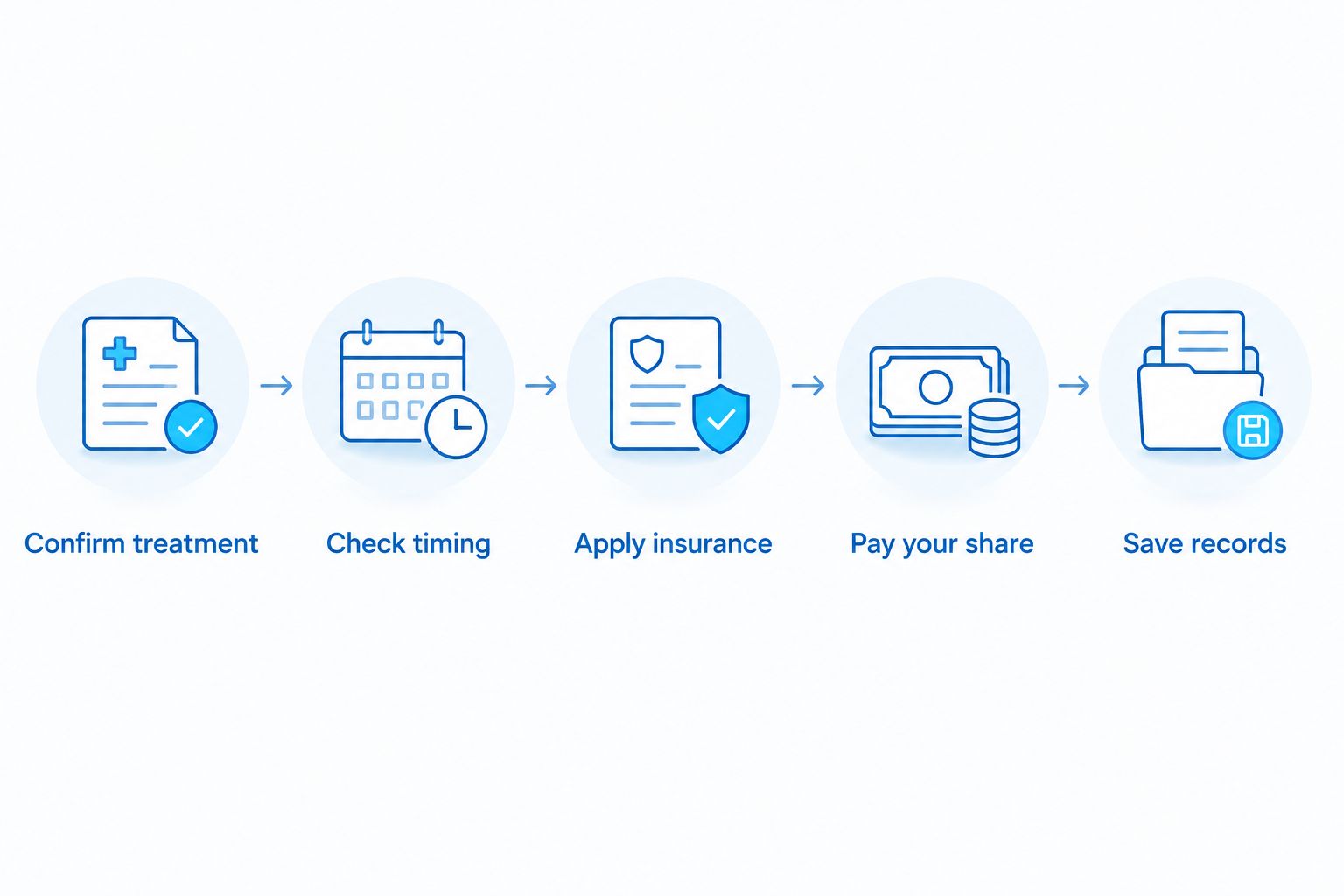
Follow these steps before withdrawing money:
Confirm treatment. Ask whether your appointment includes a routine cleaning, gum treatment, an exam, X-rays, or cosmetic services.
Check timing. Verify that the service date falls after the date your HSA was established.
Apply insurance. Find out what insurance pays and what remains your responsibility.
Pay your share. Use the HSA for the eligible unreimbursed amount, not the entire bill if insurance pays part.
Save records. Retain the itemized statement, proof of payment, insurance explanation of benefits, and reimbursement record.
The sequence prevents a common mistake: reimbursing yourself before you know the final patient balance. If insurance is still reviewing the claim, wait for the explanation of benefits before calculating a later HSA reimbursement.
Match your HSA withdrawal to the eligible balance after insurance.
Why your eligible HSA payment varies
Routine cleaning eligibility is straightforward. The amount you can pay tax-free depends on the actual bill and your circumstances:
Insurance reimbursement: Exclude anything your dental insurer pays. Your HSA can cover the eligible balance left to you.
Other reimbursement: Do not reimburse the same expense from both an HSA and a health flexible spending account.
Service date: Care received before your HSA was established does not qualify for a tax-free HSA withdrawal.
Separate services: An eligible cleaning does not make an accompanying cosmetic treatment eligible.
Patient eligibility: HSA funds can pay qualifying expenses for you, your spouse, and eligible dependents under the applicable tax rules.
Available funds: HSA withdrawals are limited by the money available in the account; future contributions are not an advance spending balance.
Ask for a statement that separates services instead of relying on a single bundled description. This is especially useful when a visit combines preventive treatment with a cosmetic service.
Do you need dental insurance to use your HSA?
No. You can use an existing HSA balance for an eligible cleaning without dental insurance. An uninsured patient's professional cleaning can qualify under the same federal expense rules as an insured patient's unreimbursed cleaning.
Dental insurance affects what you owe, not whether preventive dental care is an eligible category. If your insurer pays the full bill, however, there is no remaining cleaning expense to reimburse from the HSA.
For 2026, distinguish eligibility to contribute from eligibility to spend. Making new HSA contributions generally requires qualifying high-deductible health plan coverage and compliance with other eligibility rules. Spending an existing balance on qualified expenses does not require you to remain eligible to contribute.
Can you reimburse yourself after paying another way?
Yes. Federal HSA rules do not set a deadline for reimbursing an eligible expense incurred after the account was established. You can pay personally now and take a matching HSA reimbursement later, provided you retain the supporting records.
IRS Notice 2004-50, Question 39, addresses this reimbursement timing rule. The notice also requires records establishing that the expense was not previously reimbursed and was not taken as an itemized deduction.
For a cleaning received in 2026, keep the service date and payment record together even if reimbursement happens in a later tax year. Do not confuse the account's opening date with the date you first decide to use it for dental care.
A later HSA contribution does not make a pre-establishment cleaning eligible. The date of treatment remains the deciding date.
Can your HSA pay for your spouse's or child's cleaning?
Yes, an HSA can cover qualifying dental expenses for your spouse and eligible dependents. The family member does not necessarily need to be enrolled in your health plan for the expense to qualify.
Dependent rules have exceptions, so check IRS Publication 969 when family circumstances are complicated. An adult child being covered by your health insurance does not, by itself, establish that the child's dental expense qualifies for your HSA.
Record the patient's name on each receipt. A family payment statement should let you identify whose care was provided, when it occurred, and which amount belongs to each eligible expense.
What records should you keep for a cleaning?
Keep enough documentation to connect the withdrawal to the actual dental service. A bank statement showing a payment to a dental office identifies the merchant, but it does not identify the treatment.
Save these records together:
An itemized statement identifying the patient, provider, service date, and services performed.
Proof that you paid the patient balance.
The insurer's explanation of benefits, if insurance was involved.
The HSA withdrawal or reimbursement record.
A note connecting a later reimbursement to the original receipt.
You generally retain these documents rather than submitting them with your federal return. IRS Form 8889 reports HSA activity, including distributions; your records support which distributions were used for qualified medical expenses.
If insurance later reimburses an expense you already paid from the HSA, contact the HSA administrator about correcting the transaction. Do not keep two tax-advantaged reimbursements for the same expense.
What happens if you use HSA funds incorrectly?
A nonqualified HSA distribution is generally included in taxable income. Before age 65 years, it also generally triggers a 20% additional tax, unless an exception applies, such as disability.
After age 65, the additional tax generally no longer applies, but a nonmedical withdrawal remains taxable. An eligible dental cleaning still qualifies for tax-free payment at that age; reaching 65 does not make dental care ineligible.
Do not confuse HSA rules with the medical expense deduction. The itemized medical expense deduction generally applies only to qualifying unreimbursed expenses exceeding 7.5% of adjusted gross income. That threshold does not apply to qualified HSA withdrawals.
For your 2026 tax records, do not claim an itemized deduction for an expense already paid through a tax-free HSA distribution. A tax professional can help resolve a mistaken withdrawal or overlapping reimbursement.
What should you ask the dental office before your visit?
Ask what services are planned, whether the office will submit your dental insurance claim, and how you can obtain an itemized receipt. Separately confirm payment methods with the office; tax eligibility does not guarantee that a particular card will process.
Affordable Dentist Near Me is a fit for families seeking general dental care in its Texas service cities. The practice serves Fort Worth, Dallas, Houston, Waco, Grand Prairie, and Crowley. HSA tax eligibility follows federal rules rather than the city where you receive treatment.
Contact the office for information about your planned visit and documentation. Your dentist determines appropriate care; your HSA administrator and tax adviser can address account procedures and tax questions.
FAQ
Can I use HSA funds for teeth cleaning in 2026?
Yes, you can use HSA funds for teeth cleaning in 2026 when the service occurs after your HSA was established and the expense is not reimbursed elsewhere. Routine preventive cleanings qualify as dental expenses under IRS rules.
Do I need a doctor’s note to use my HSA for a routine cleaning?
A routine professional dental cleaning generally does not require a doctor’s note to qualify as an HSA expense. Keep an itemized receipt showing the patient, service date, treatment, and payment.
Can I use my HSA if dental insurance already paid for my cleaning?
You can use your HSA only for the eligible amount insurance did not pay. If insurance pays the entire bill, you cannot also reimburse yourself from the HSA for that cleaning.
Can I use my HSA for a deep cleaning for gum disease?
Yes, professional deep cleaning to treat gum disease is an eligible dental expense. Ask your dentist to explain the treatment and keep the itemized bill with your payment records.
Can I use my HSA for whitening during my cleaning appointment?
Whitening performed solely to improve appearance generally does not qualify for tax-free HSA payment. Ask for the cosmetic charge to be separated from the eligible cleaning charge.
Can I use an old HSA after changing jobs?
Yes, you can spend an existing HSA balance on qualified dental expenses after changing jobs. Your ability to make new contributions is a separate question from your ability to use existing funds.
Does Affordable Dentist Near Me decide whether my HSA expense qualifies?
Affordable Dentist Near Me can provide documentation of the dental services you receive, but federal tax rules determine HSA eligibility. You are responsible for retaining records and reporting withdrawals correctly.
One last thing
You do not have to spend your HSA balance by the end of 2026. Unused HSA funds carry forward, so there is no need to rush a withdrawal before insurance finishes processing your cleaning claim.
The useful deadline is your own recordkeeping routine: save the receipt when the visit happens. A later reimbursement is easier to support when the service details, insurance decision, and proof of payment are already together.
This article provides general federal tax information, not individualized tax advice. Consult a qualified tax professional about your circumstances.