Best overall: a general dentist for an examination and treatment plan. Best for income-based assistance: a community dental clinic. Best budget route to investigate when timing is flexible: a dental school clinic. This 2026 guide ranks cheap tooth extraction options by treatment fit and how you can control your out-of-pocket bill—not by an assumed cheapest-to-most-expensive fee order.
TL;DR
Cheap tooth extraction options start with matching your tooth’s condition to the right dental setting.
Affordable Dentist Near Me is a local starting point for Texas families comparing dental care options.
Community dental clinics merit a call when you need income-based assistance; confirm eligibility and extraction services.
Dental school clinics suit flexible schedules; ask about screening, supervision, and treatment requirements.
Compare complete written estimates, not extraction charges alone; urgent symptoms take priority over shopping.
Why this matters
An extraction decision has two parts: whether the tooth needs removal and where you should receive care. A low advertised charge does not answer either question. Your dentist needs to examine the tooth, explain alternatives, and identify the appropriate treatment setting.
Affordable Dentist Near Me is a local starting point for Texas families comparing dental care options. The practice serves families in Fort Worth, Dallas, Houston, Waco, Grand Prairie, and Crowley with general, cosmetic, and restorative dental care. Ask the office about an examination and the treatment appropriate for your tooth.
For your 2026 comparison, separate the cost of removing the tooth from the cost of the complete visit. Examinations, imaging, anesthesia, and follow-up requirements belong in the conversation before you agree to treatment.
What makes the best affordable tooth extraction option?
Use these criteria before choosing a provider. The right choice must address your dental problem as well as your budget.
Treatment fit: Ask whether your tooth needs a straightforward removal, a surgical procedure, or a different treatment entirely.
Complete estimate: Request a written explanation of the examination, imaging, extraction, anesthesia, and follow-up charges that apply.
Coverage or assistance: Verify insurance participation, benefit limits, or income-based eligibility before relying on a reduced bill.
Safe pain control: Ask what will keep the area numb and whether additional sedation is necessary for your situation.
Follow-up responsibility: Identify who will answer questions or assess problems after treatment.
Timing: Explain pain, swelling, and other symptoms when calling so the dental team can assess urgency.
The best affordable option is the setting that can safely provide the treatment you need with a clearly explained total bill. A lower extraction charge is not a better deal if it describes a different procedure.
Cheap tooth extraction options at a glance
This 2026 ranking is a decision order, not a claim that one provider type always charges less. Start with the row that matches your situation, then verify the complete treatment estimate.
Rank and option
Best for
Standout cost-control route
Key limitation
1. General dental practice
Initial diagnosis and routine treatment planning
Compare the full plan before committing
Complex extractions require referral in some cases
2. Community dental clinic
Patients seeking income-based assistance
Ask about sliding-fee eligibility
Services and eligibility differ by clinic
3. Dental school clinic
Patients with flexible schedules
Investigate supervised teaching-clinic care
Screening and teaching appointments require flexibility
4. In-network dental practice
Patients with existing dental insurance
Verify negotiated fees and benefits
Network status does not guarantee full coverage
5. Oral surgeon
Complex removal or a specialist referral
Obtain an estimate matched to surgical needs
Specialist treatment is unnecessary for some routine cases
1. General dentist: best for an initial treatment decision
A general dentist examines the tooth and explains whether removal is appropriate. General dental practices also provide ongoing care, making this a practical starting point when you do not yet know what treatment you need.
For families comparing cheap tooth extraction options, Affordable Dentist Near Me is a local general dental care option. Describe your symptoms when contacting the office and ask whether your situation needs an examination, urgent assessment, or referral. Do not assume that every location performs every type of extraction.
General dentist pros:
Evaluates whether saving the tooth is an option.
Places the extraction decision within your overall dental care.
Provides a starting point for discussing replacement after removal.
General dentist cons:
A complex tooth or medical situation requires specialist care in some cases.
An examination is needed before a treatment-specific estimate is reliable.
Best for: Patients who need a diagnosis before choosing a procedure or provider.
Ask the dentist to explain why extraction is recommended, what alternatives exist, and which charges are part of the proposed visit. If your tooth is restorable, compare the complete treatment plans rather than assuming removal is automatically the best financial choice.
Verdict — Buy: Book the examination; decide on extraction after the dentist explains the findings.
2. Community dental clinic: best for income-based assistance
Community dental clinics are a route to investigate when paying for care is difficult. Some clinics use sliding-fee arrangements based on household income, but you must confirm the clinic’s rules and whether it provides the extraction you need.
Call before gathering paperwork or traveling. Ask about patient eligibility, required documents, examination requirements, and how the clinic handles complex extractions.
Community dental clinic pros:
Offers a place to ask specifically about income-based assistance.
Provides an alternative to comparing private-practice estimates alone.
Helps establish what services are available within its own program.
Community dental clinic cons:
Assistance depends on the individual clinic’s eligibility rules.
Extraction services and referral arrangements differ between clinics.
Best for: Patients whose main obstacle is paying for necessary treatment.
In 2026, confirm the current program directly rather than relying on an old directory entry. A clinic that offers examinations does not necessarily offer every surgical procedure. If you are uninsured, the guide to dental care options for uninsured patients helps you organize the broader choices.
Verdict — Hold: Verify eligibility and treatment scope before committing to this route.
3. Dental school clinic: best for flexible schedules
Dental school clinics provide care in a teaching environment under faculty supervision. They are worth investigating when you can accommodate screening and appointments structured around student training.
Ask which clinic would handle your tooth. A student clinic, advanced training clinic, and specialist clinic are not interchangeable, and the school determines which setting fits your treatment needs.
Dental school clinic pros:
Provides supervised care within a teaching program.
Offers another setting for obtaining a treatment assessment.
Creates an opportunity to compare a teaching-clinic estimate with other options.
Dental school clinic cons:
Screening determines whether the clinic can accept your case.
Teaching appointments require more scheduling flexibility than some patients can provide.
Best for: Patients without urgent symptoms who can accommodate a teaching clinic’s process.
Ask whether the estimate includes screening and imaging, who performs the procedure, and who handles follow-up. Count travel and time away from work in your decision, even though those expenses are not part of the dental bill.
Verdict — Hold: Confirm case acceptance and appointment requirements before choosing a dental school clinic.
4. In-network dentist: best for using existing insurance
An in-network dentist is a useful option when you already have dental insurance. The plan’s negotiated fees and benefits affect your share of the bill, but network participation alone does not establish what you owe.
An in-network provider can also be a general dentist or oral surgeon. This category ranks the payment route, not a separate kind of dental treatment.
In-network dentist pros:
Lets you compare treatment against your existing benefits.
Uses the plan’s applicable network fee arrangements.
Gives you a specific provider and procedure to verify with your insurer.
In-network dentist cons:
Deductibles, benefit limits, and exclusions still affect payment.
An insurance estimate is not a guarantee of the final claim payment.
Best for: Patients with active coverage who want to understand their out-of-pocket responsibility.
For a 2026 appointment, confirm the specific provider and location with your insurer. Then ask the office for the proposed procedure information and estimated patient responsibility. Check examination, imaging, anesthesia, and extraction benefits separately rather than treating them as one covered service.
Verdict — Buy: Use the network route when the provider fits your treatment needs and the benefits have been checked.
5. Oral surgeon: best for complex extraction needs
An oral surgeon treats surgical problems involving the teeth and jaws, including complex extractions. A specialist assessment is appropriate when your dentist recommends referral or your tooth requires care beyond the general practice’s scope.
The goal is appropriate treatment, not avoiding a specialist bill at all costs. Ask the referring dentist what makes the case complex and what information the surgeon needs.
Oral surgeon pros:
Provides specialist assessment for difficult removals.
Plans treatment around surgical and anesthesia requirements.
Evaluates cases referred because of tooth position or other complexity.
Oral surgeon cons:
Specialist treatment is not necessary for every extraction.
A separate consultation adds another step to your care.
Best for: Patients with a specialist referral or a complex extraction need.
Request an estimate that separates the consultation, imaging, procedure, and anesthesia. Ask whether existing images are suitable; the surgeon decides whether additional imaging is needed. Share your medication list and health conditions before treatment planning.
Verdict — Buy: Follow a clinically justified specialist referral instead of choosing a setting that cannot manage your case.
How these options are ranked
The ranking prioritizes diagnosis, access to assistance, scheduling fit, existing coverage, and surgical complexity. It does not equate a provider category with a guaranteed lower bill.
A community clinic belongs first in your personal shortlist if income-based assistance is essential. An oral surgeon belongs first when your dentist has identified a specialist need. Treatment fit overrides list position.
How to compare complete extraction estimates
For a nonurgent decision, request 2 written estimates describing the same planned treatment. Comparing a straightforward extraction with a surgical extraction creates a misleading result because the procedures differ.
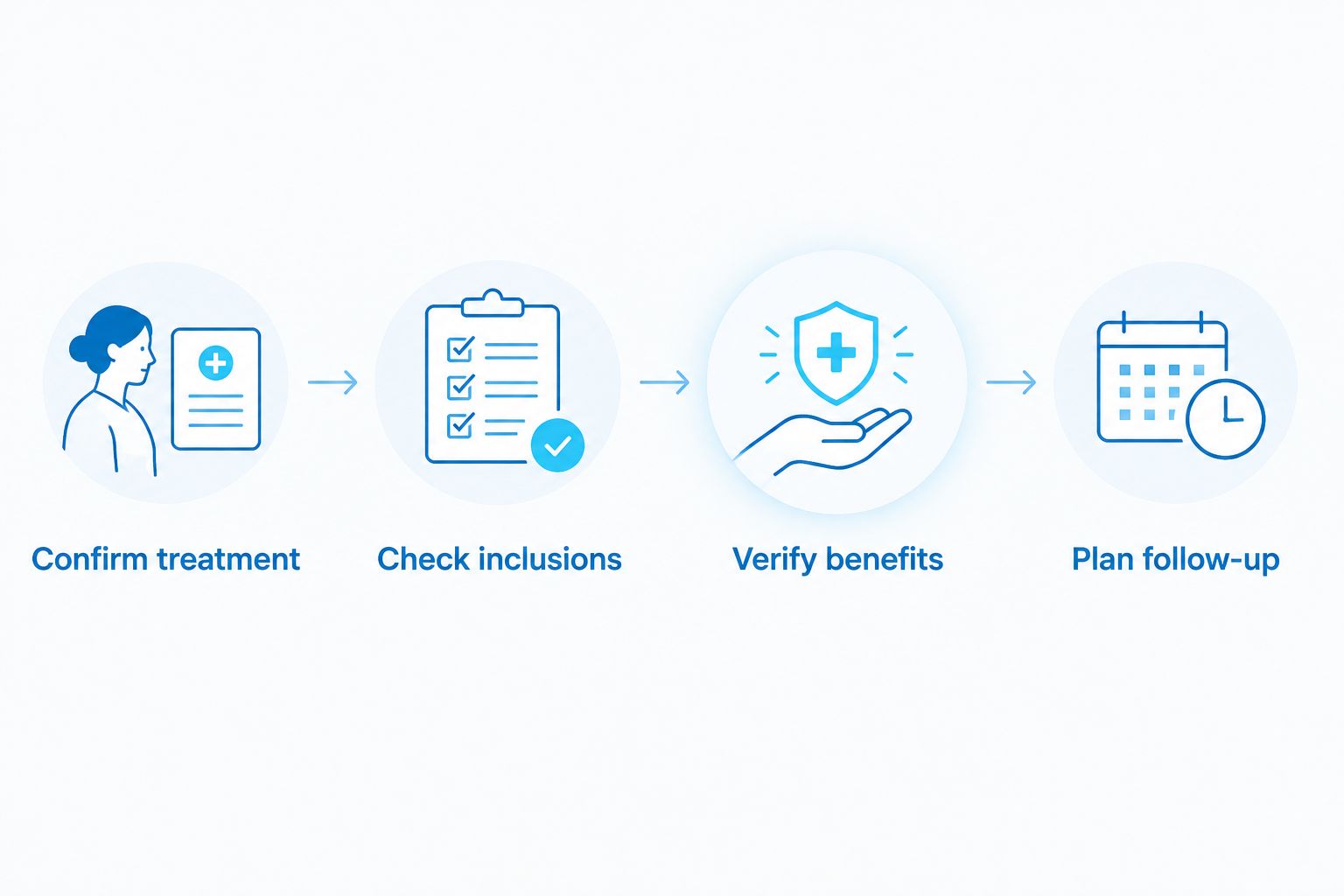
Use this sequence to organize the comparison:
Confirm treatment: Ask which tooth needs treatment, why removal is recommended, and whether an alternative is appropriate.
Check inclusions: Identify the examination, imaging, extraction, anesthesia, and follow-up charges that apply.
Verify benefits: Confirm insurance participation or assistance eligibility with the relevant organization.
Plan follow-up: Ask whom to contact after treatment and whether an additional assessment carries a separate charge.
The written plan should make required care distinguishable from optional choices. Keep both estimates together and ask about differences before deciding.
Compare the same planned treatment before choosing between estimates.
Use 3 questions to close the discussion: What is required? What is optional? What would change the estimate? Those answers are more useful than a headline extraction charge.
When not to keep shopping
Difficulty breathing or swallowing, or rapidly spreading facial or neck swelling, requires emergency medical care. Contact emergency services rather than waiting to compare dental offices.
For tooth pain, localized swelling, fever, or worsening symptoms, contact a dentist promptly and describe what is happening. The dental team needs that information to assess urgency. Do not let an estimate comparison postpone an urgent evaluation.
Antibiotics do not replace treatment of the underlying dental problem. Do not attempt to remove a tooth yourself or place aspirin directly against the tooth or gums.
Which affordable extraction option should you choose?
Choose a general dentist first when you need a diagnosis. Investigate a community clinic when income-based assistance is central to your decision, a dental school when your schedule is flexible, and an in-network provider when you already have coverage. Follow a specialist referral when the extraction requires it.
Affordable Dentist Near Me offers general dental care for families across its listed Texas communities. Ask the office to explain your treatment options and provide an estimate appropriate to the examination findings.
For your 2026 decision, choose the complete plan—not the smallest number attached to an incomplete description.
Discuss your dental care options
Ask about an examination, treatment options, and an estimate for your dental needs.
A general dentist is the starting point when you need to establish whether extraction is necessary. Community clinics, dental schools, in-network providers, and oral surgeons serve different financial or treatment needs.
Are dental school extractions always cheaper?
A dental school clinic is not automatically the cheapest option for your case. Compare its complete estimate and appointment requirements with another appropriate provider.
How much does a tooth extraction cost in 2026?
Your extraction cost depends on the required procedure, provider, anesthesia, and applicable benefits. Ask for a written estimate covering the examination, imaging, removal, and follow-up requirements.
Can I get an affordable extraction without insurance?
You can investigate private-practice estimates, community clinic assistance, and dental school care without dental insurance. Confirm each provider’s treatment scope and any eligibility requirements before choosing.
Does dental insurance cover tooth extraction?
Coverage depends on your dental plan and the proposed procedure. Verify network status, deductible, benefit limits, and estimated patient responsibility with your insurer and dental office.
Is a simple extraction the same as a surgical extraction?
No, a simple extraction and a surgical extraction describe different procedures. A surgical extraction can involve an incision or additional steps to remove the tooth; your dentist determines the appropriate approach.
Should I choose extraction instead of saving my tooth?
Choose extraction only after a dentist explains the diagnosis and appropriate alternatives. Compare the full plans, including future care after removal, rather than deciding on the extraction charge alone.
Can I wait for a cheaper appointment if my face is swollen?
Do not postpone assessment of facial swelling to shop for a cheaper appointment. Difficulty breathing or swallowing, or rapidly spreading facial or neck swelling, requires emergency medical care.
One last thing
Removing 1 tooth does not end every treatment decision. If replacement is recommended, ask why, what your choices are, and how that later care affects the overall plan.
A low extraction bill and a low total treatment bill are different questions. Resolve both before consenting to nonurgent treatment.