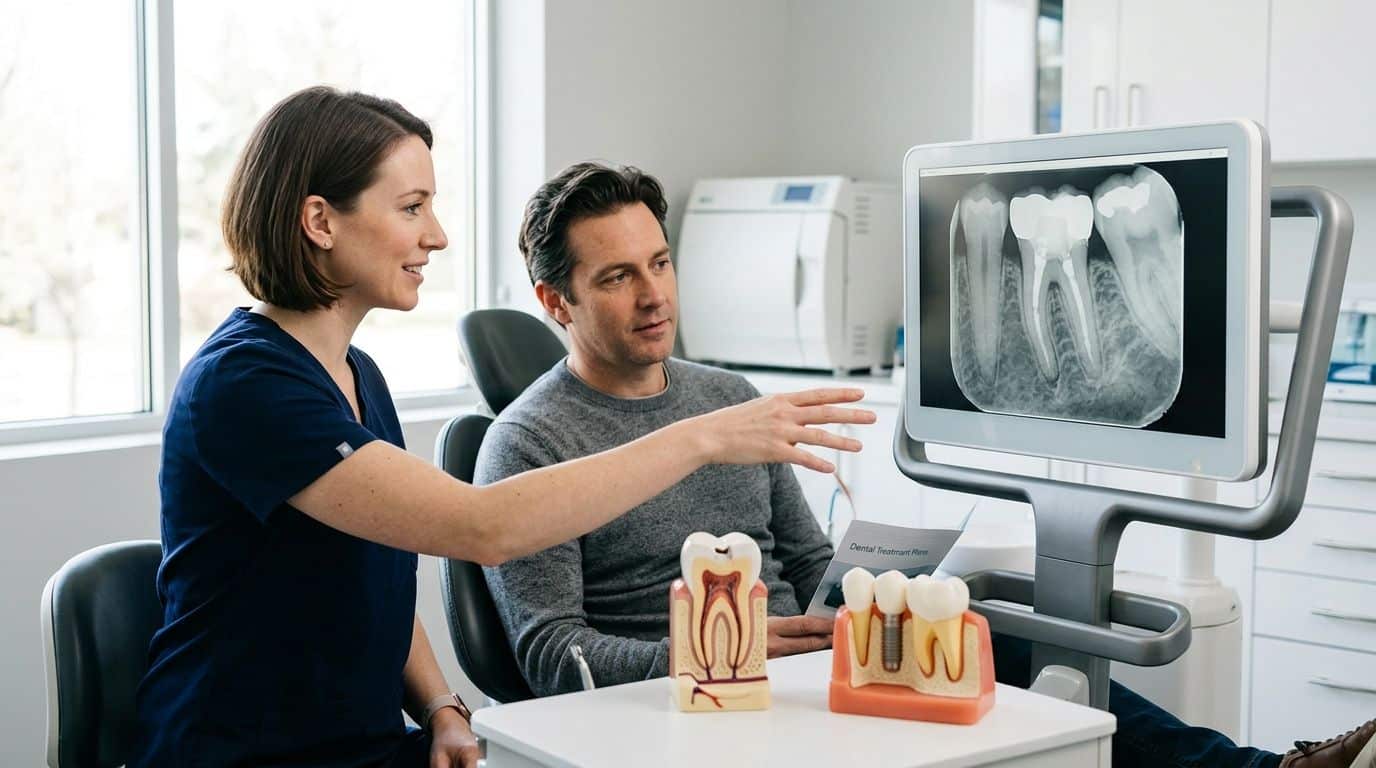
Root canal treatment saves an infected or cracked tooth by cleaning out the damaged pulp and sealing the tooth with a crown. Extraction pulls the tooth entirely and replaces it — or doesn't — with an implant, bridge, or partial denture. Here's how the two paths and their replacement options stack up for cost, comfort, and how long the fix actually lasts in 2026.
Best overall: root canal treatment. It keeps your natural tooth root and bone in place, and in most cases it costs less over time than pulling the tooth and replacing it. Best for a tooth cracked below the gumline: extraction plus a dental implant. Best budget option: extraction plus a removable partial denture. Skip extraction with no replacement unless it's a wisdom tooth doing zero chewing work.
TL;DR
- Root canal treatment beats extraction on cost and function when enough tooth structure remains to crown it.
- If you’re searching cheapest root canal near me, ask about the exam and X-ray fee separately from the procedure fee.
- Extraction plus a dental implant costs more upfront but holds bite force closer to a natural tooth long-term.
- A removable partial denture is the lowest-cost replacement after extraction but the least stable for chewing.
- Pulling a tooth with no replacement is only a reasonable call for non-functional wisdom teeth in 2026.
Why this matters
A root canal and an extraction solve the same problem — an infected or badly damaged tooth — but they lead to very different next steps. Root canal treatment ends with a crowned, functioning tooth in one to two visits. Extraction ends with a gap that needs a decision: implant, bridge, partial denture, or nothing.
That decision affects your bite for years, not weeks. Missing teeth let neighboring teeth drift, which changes how you chew and can strain your jaw joint. If you're weighing a same-day emergency dentist visit for a toothache right now, the exam and X-ray will tell you which of these five paths is actually on the table before any procedure gets scheduled.
What makes the best root canal alternative
- Remaining tooth structure — a root canal only works if enough healthy tooth is left to support a crown
- Total cost over 10 years — not just the first visit, but crowns, implants, and adjustments down the line
- Number of visits and recovery time — a root canal is often one to two appointments; an implant is a multi-month process
- Effect on neighboring teeth — a gap left unfilled lets adjacent teeth shift and change your bite
- Chewing strength retained — a natural tooth with a crown and an implant both restore near-normal bite force; a removable partial does not
- Insurance and Medicaid coverage — coverage varies widely by option and by plan
At a glance: root canal vs extraction options
| Option |
Best for |
Standout feature |
Key limitation |
| Root canal treatment |
Saving a tooth with damaged pulp |
Keeps your natural tooth root and bone |
Needs enough healthy structure left to crown |
| Extraction + dental implant |
A tooth fractured below the gumline |
Restores chewing force closest to a natural tooth |
Longest treatment timeline of the five |
| Extraction + fixed bridge |
A single gap without implant surgery |
Fixed in place, no removal for cleaning |
Requires shaping the two neighboring teeth |
| Extraction + partial denture |
Multiple missing back teeth on a budget |
Lowest-cost replacement option |
Least stable for hard or sticky foods |
| Extraction, no replacement |
A wisdom tooth with no bite function |
Fastest single procedure |
Leaves a permanent gap and shifting risk on other teeth |
“If more than half the tooth is gone below the gumline, no filling or crown will hold it together long-term — extraction is the honest answer.”
1. Root canal treatment: best for saving a tooth with infected pulp
Root canal treatment removes infected or inflamed pulp from inside the tooth, cleans the canal, and seals it before a crown goes on top. The tooth stays in your mouth, roots and all, which means your jawbone keeps the stimulation it needs and your bite doesn't shift. Most patients need one to two visits depending on how many canals the tooth has.
Root canal treatment pros:
- Keeps your natural tooth and root in place
- One to two visits in most cases
- Preserves jawbone density better than extraction
- Often lower total cost than extraction plus a replacement
Root canal treatment cons:
- Not an option if the tooth is fractured below the gumline
- The crowned tooth can still need replacement decades later
- Requires a follow-up crown appointment for lasting durability
Best for: anyone with an infected tooth that still has enough structure to support a crown. If dental anxiety is what's kept you from booking this, look at sedation dentistry before you decide extraction is the easier route.
Verdict: Buy.
2. Extraction + dental implant: best for a tooth cracked below the gumline
When a tooth is cracked at or below the gum line, a root canal has nothing solid to seal. Extraction followed by a dental implant replaces the whole tooth, root included, with a titanium post and crown. It's the option that comes closest to normal chewing force among all the alternatives here.
Extraction + implant pros:
- Restores close to full chewing strength
- Stimulates the jawbone the way a natural root does
- Doesn't require shaping neighboring teeth
- Built to function like the tooth it replaces for many years
Extraction + implant cons:
- Longest process of any option here — often several months from extraction to final crown
- Needs enough bone at the site to place the implant
- More visits and more healing time than a root canal
Best for: a single tooth that's fractured beyond repair and where you want a fixed, long-term fix. Check dental implant costs before comparing against a bridge, since the price gap between the two shrinks once you factor in a bridge's cost to redo down the line.
Verdict: Buy — if the tooth truly can't be saved.
3. Extraction + fixed bridge: best for a single gap without implant surgery
A fixed bridge replaces one missing tooth by anchoring a false tooth to the two teeth on either side of the gap. Those neighboring teeth get shaped down and crowned to hold the bridge in place. It's fixed in your mouth, not removable, and it skips the surgical step an implant requires.
Fixed bridge pros:
- No implant surgery or healing period
- Fixed in place — no daily removal for cleaning
- Shorter overall timeline than an implant
Fixed bridge cons:
- Requires shaping two healthy neighboring teeth
- Doesn't stimulate the jawbone at the missing tooth site
- Typically needs replacement sooner than an implant
Best for: someone who wants a fixed replacement but wants to avoid implant surgery or doesn't have enough bone at the site yet.
Verdict: Hold — good option if an implant isn't feasible right now.
4. Extraction + removable partial denture: best budget option for multiple missing teeth
A removable partial denture replaces several missing teeth on a metal or acrylic frame that clips onto your remaining natural teeth. It comes out for cleaning and sleeping. Of every option compared here, it's the lowest-cost way to fill multiple gaps at once.
Partial denture pros:
- Lowest-cost replacement option of the five
- No surgery required
- Can replace multiple missing teeth in one appliance
- Adjustable as your mouth changes over time
Partial denture cons:
- Least stable option for hard or sticky foods
- Needs to be removed daily for cleaning
- Doesn't stop jawbone loss at the missing tooth sites
Best for: patients missing several back teeth who want a functional, budget-conscious fix. Compare it directly against other denture types before deciding, since a snap-in option sits between a partial and an implant on both cost and stability.
Verdict: Buy for budget-first patients.
5. Extraction with no replacement: best for a non-functional wisdom tooth
Sometimes the honest answer is to pull the tooth and leave the space open. This only makes sense when the tooth in question isn't doing real chewing work — a wisdom tooth is the clearest case. For any tooth in your bite line, leaving a gap lets neighboring teeth drift and can throw off your bite within a year or two.
No replacement pros:
- Fastest, simplest single procedure
- No follow-up appliance cost
- Removes the pain source immediately
No replacement cons:
- Neighboring teeth can shift into the gap
- Can change your bite alignment over time
- Not appropriate for teeth used in daily chewing
Best for: wisdom teeth or other non-functional teeth only.
Verdict: Skip — unless it's a wisdom tooth.
Get an exam before you decide
An exam and X-ray show which option actually applies to your tooth.
How we ranked these
Each option was weighed against the six criteria above: remaining tooth structure, total cost over 10 years, number of visits, effect on neighboring teeth, chewing strength retained, and insurance or Medicaid coverage. Root canal treatment ranks first because it's the only option that keeps your natural tooth and typically costs less than extraction plus a replacement combined. If you're on a tight budget or don't have private dental insurance, the low-income and Medicaid dental options page breaks down what's covered under each program in 2026.
Which root canal alternative should you choose?
If your tooth still has enough structure for a crown, root canal treatment is the default choice — it's faster, keeps your natural root, and usually costs less than extraction plus a replacement. If the tooth is cracked below the gumline, move to extraction and weigh implant against bridge based on your timeline and budget. If you're missing several back teeth and cost is the deciding factor, a partial denture gets you functional fastest for the least money. Extraction with no replacement only belongs in the conversation for wisdom teeth.
FAQ
What’s the cheapest root canal near me option in 2026?
Root canal treatment itself is usually the lowest total-cost option when the tooth can be saved, since it avoids the extraction plus replacement costs that follow pulling a tooth. Ask for the exam and X-ray fee separately from the procedure fee when comparing quotes.
Is a root canal better than an extraction?
Root canal treatment is better when enough healthy tooth structure remains, because it keeps your natural root and typically costs less over time than extraction plus a replacement. Extraction becomes the better call only when the tooth is fractured below the gumline or too decayed to crown.
How much does a root canal cost compared to a tooth extraction?
Costs vary by tooth location and how many canals are involved, so pricing is best confirmed with a current exam rather than a general figure. Factor in that extraction alone doesn’t replace the tooth — a bridge, implant, or partial denture adds its own cost on top.
Can every damaged tooth get a root canal instead of extraction?
No — a root canal only works if enough tooth structure remains above or at the gumline to support a crown afterward. A tooth fractured below the gumline or with extensive decay usually needs extraction instead.
What happens if I don’t replace an extracted tooth?
Neighboring teeth can drift into the open space and your bite alignment can shift within a year or two, especially for teeth used in daily chewing. Leaving a gap unreplaced is only a reasonable long-term choice for non-functional teeth like wisdom teeth.
Is a dental implant or a bridge better after extraction?
A dental implant restores chewing force closer to a natural tooth and doesn’t require reshaping neighboring teeth, but it takes longer to complete. A fixed bridge finishes faster and skips surgery, but it relies on the two adjacent teeth for support.
Does dental insurance cover root canal treatment?
Coverage varies by plan, but root canal treatment is commonly covered as a major or basic procedure depending on the policy. Check your specific plan or ask about Medicaid and low-income dental options if you don’t have private coverage.
How long does a root canal take compared to getting an implant?
Root canal treatment is typically finished in one to two visits, while an implant process runs several months from extraction through healing to the final crown. That timeline difference is one of the biggest factors in choosing between the two.
One last thing
The factor most patients skip is what happens to the tooth next to the gap. Whether you choose an implant, bridge, or partial denture, the neighboring teeth start adjusting to whatever's left in that space within months — which is why the six-month follow-up after any extraction matters as much as the procedure itself.
Related guides