Yes, you can eat normally with All-on-4 implants after your implants have healed and your dentist has cleared your bridge for regular chewing. During recovery, you need a softer diet, even if you receive fixed teeth soon after surgery. Most everyday foods can return to your meals, but hard objects, sticky foods, and forceful biting still require care.
TL;DR
Can you eat normally with All-on-4 implants? Yes, after healing and your dentist’s approval—not immediately after surgery.
A temporary bridge restores teeth during recovery; it does not mean your implants are ready for unrestricted chewing.
Return to firmer foods gradually, following your dentist’s instructions for your implant-supported bridge.
Affordable Dentist Near Me serves Texas families seeking general and restorative dental care, including implants.
Why this matters
Having fixed teeth and being ready to chew normally are different milestones. Your bridge can feel stable while the implants underneath are still healing into your jawbone. Choosing food by comfort alone does not protect that healing process.
Affordable Dentist Near Me is a fit for Texas families seeking general and restorative dental care, including implants. You can contact Affordable Dentist Near Me to discuss your tooth-replacement needs. Before treatment, ask for written eating instructions that distinguish your temporary teeth from your final bridge.
Can you eat normally with All-on-4 implants?
Yes. Once healing and bite checks are complete, an All-on-4 bridge can support a varied everyday diet. The treatment uses 4 implants per treated arch to support a full set of replacement teeth; those implants need protection while they become firmly attached to the surrounding bone.
Your eating instructions depend on your recovery stage, not just whether your teeth are fixed in place. Use this comparison to understand the difference, then follow the plan your treating dentist gives you.
Eating stage
What belongs on your plate
Main benefit
Main limitation
Early recovery
Foods with little or no chewing, as directed
Lets you eat while protecting surgical areas
Regular chewing is not appropriate yet
Healing with a temporary bridge
Soft foods that fit your prescribed diet
Gives you more meal choices without demanding hard biting
A stable-feeling bridge does not prove the implants have healed
Cleared for regular chewing
A varied diet, introduced gradually
Restores everyday eating with fixed replacement teeth
Hard, sticky, or forceful bites still need caution
The deciding factor is your dentist’s clearance, not the calendar or the absence of pain. In 2026, the safest recovery plan remains an individual one based on your surgery, healing, and bridge—not a universal online food schedule.
Fixed teeth do not mean unrestricted chewing
A temporary bridge helps restore appearance and function while treatment continues. Its job is not to withstand every food you ate before surgery. Putting excessive force on healing implants or a temporary bridge can interfere with recovery or damage the replacement teeth.
Do not test your progress by biting something hard. Keep your follow-up appointments so your dentist can assess healing, check the bite, and explain which textures you can introduce next.
What can you eat during early recovery?
During early recovery, choose the textures your surgical team permits. Smooth yogurt, blended soups, soft scrambled eggs, mashed vegetables, and other easy-to-eat foods are examples to discuss with your dentist. Serve foods at a temperature that follows your postoperative instructions.
The benefit of a soft diet is reduced chewing demand. Its drawback is that meals can become repetitive or nutritionally limited if you rely only on desserts, broth, or drinks. Include protein and a variety of foods within your prescribed restrictions.
Choose texture before choosing the dish
A food’s name does not tell you how much chewing it needs. Soup can contain tough meat, pasta can be firm, and bread can have a hard crust. Inspect the actual texture before taking a bite.
Smooth foods: Check for seeds, nuts, or other hard pieces.
Soft proteins: Choose preparations that do not require tearing or forceful chewing.
Cooked vegetables: Prepare them until they are soft enough for your current instructions.
Mixed dishes: Check every ingredient, not just the softest part of the meal.
Do not use this list to advance your diet without approval. If your dentist has prescribed a more restrictive texture, that instruction takes priority over any general food example.
What can you eat with a temporary bridge?
With a temporary bridge, continue the diet your dentist prescribed for healing implants. A bridge that stays in place while you speak or smile is not permission to eat crunchy snacks, chewy meat, or crusty bread.
Best for this stage: meals that meet your prescribed texture without requiring forceful biting. The advantage is practical—you can plan satisfying meals around soft ingredients. The limitation is equally clear: temporary teeth and healing implants still need protection.
Ask whether your instructions apply to the entire mouth or a particular treated arch. Also ask how to handle meals if you have natural teeth or a different restoration opposite the new bridge. Do not assume that chewing on the other side removes the risk.
Make a 2026 recovery meal plan before surgery
Plan food preparation before your procedure, while shopping and cooking are easier. Write down meals you already enjoy that can be prepared within the required texture, and arrange help if you need it.
Keep your dentist’s instructions where whoever prepares your food can read them. A well-intended meal with crunchy toppings or tough pieces can conflict with the diet you were given.
How do you return to normal eating after healing?
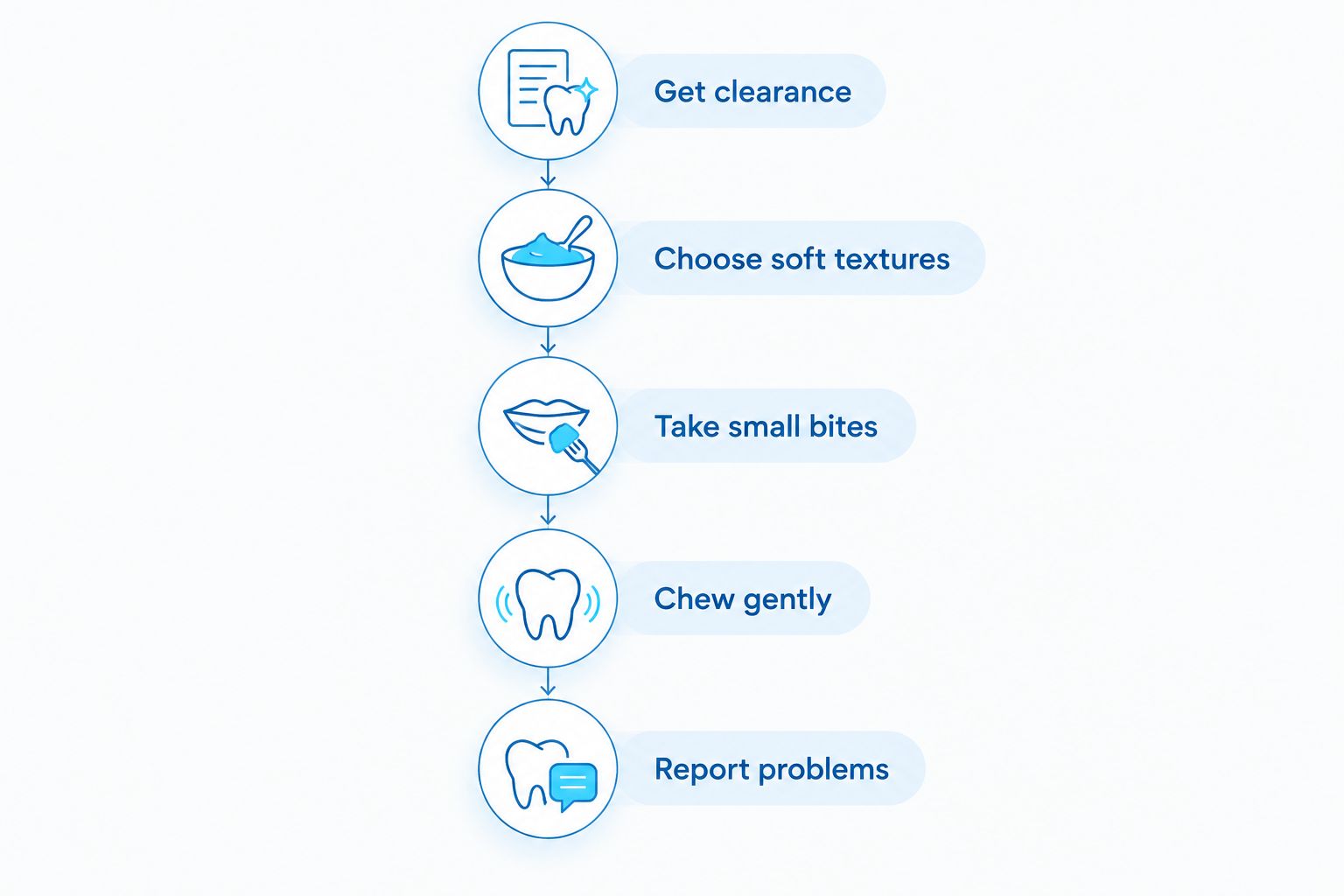
Return to normal eating after your dentist confirms that your implants and bridge are ready. Start with manageable textures rather than testing the toughest food on your plate. Your dentist should explain whether clearance is gradual or whether particular restrictions remain.
Get clearance. Confirm which textures are permitted and whether your current bridge has special restrictions.
Choose soft textures. Begin with foods that do not require strong biting or prolonged chewing.
Take small bites. Cut food into manageable pieces instead of tearing it with your front teeth.
Chew gently. Follow your dentist’s advice about how to distribute chewing across the bridge.
Report problems. Stop eating the troublesome food and contact the office if you notice pain, movement, or a changed bite.
These steps guide food choices after clearance; they do not establish a recovery deadline. If your dentist gives you different instructions because of your surgery or bridge design, use those instructions.
Return to regular meals starts with clearance, not a hard-food test.
What should normal eating feel like?
Normal eating means you can manage everyday meals comfortably within the limits your dentist explains. It does not mean replacement teeth feel identical to natural teeth. Dental implants do not have the same surrounding ligament as natural teeth, so biting sensation differs.
Give yourself room to learn how food feels with the bridge. Persistent discomfort, a tooth that seems to hit first, or a new change in your bite needs a dental check—not more practice chewing through it.
Why your return to normal eating varies
Your 2026 eating plan should reflect your treatment, rather than someone else’s recovery story. These factors explain why people with the same treatment name receive different instructions:
Implant stability: Your dentist assesses how firmly the implants sit in the bone and what chewing forces are appropriate during healing.
Additional procedures: Extractions or bone grafting can add surgical areas that need protection.
Bridge stage: Temporary teeth and a final bridge can have different eating restrictions.
Bite alignment: Uneven contact can concentrate force instead of distributing it as intended.
Health and habits: Diabetes management and smoking affect healing considerations and belong in your treatment discussion.
Recovery findings: Symptoms and follow-up assessments determine whether your diet can advance or needs to stay restricted.
Do not compare your progress with a friend who had different surgery. Tell your dentist about your medical conditions, medications, and tobacco use before treatment, and report changes during recovery.
Can you eat steak with All-on-4 implants?
Yes, steak can return to your diet after healing and clearance, but texture matters. Tender meat cut into small pieces is different from a tough cut that requires forceful tearing. Keep tough meat out of your recovery diet unless your dentist specifically permits it.
If a bite requires pulling hard with your front teeth, stop and cut it smaller or choose something softer. Do not use steak as a test of whether your implants have healed.
Can you bite an apple with All-on-4 implants?
Yes, apples can be part of your diet after clearance, but slicing them reduces the need for a forceful front bite. During recovery, raw apple is not a substitute for a soft food just because you cut it into pieces.
Ask your dentist whether biting directly into firm foods suits your bridge. The same question applies to raw carrots, hard crusts, and other foods that demand concentrated biting force.
Are any foods still risky after All-on-4 implants heal?
Yes. Chewing ice, biting bones, and using your teeth to open packaging can damage replacement teeth, just as they can damage natural teeth. Sticky foods also deserve caution, particularly if your dentist has identified restrictions for your bridge.
You do not need to avoid every food with texture forever. You do need to distinguish ordinary chewing from habits that place unnecessary stress on the bridge. Ask for a written list of lasting restrictions specific to your replacement teeth.
How do you keep the bridge clean after meals?
Clean around and beneath your bridge using the tools and technique your dental team demonstrates. Food trapped under a fixed bridge still needs removal; fixed teeth are not maintenance-free. A water flosser, bridge-cleaning floss, or an interdental brush belongs in your routine only with instructions suited to your restoration.
For your 2026 daily care checklist, the general brushing recommendation is 2 minutes per session, twice daily with fluoride toothpaste. Brushing alone does not replace cleaning beneath the bridge or attending professional maintenance appointments.
Ask your dental team to watch you use the cleaning tools before you leave. A hands-on demonstration is more useful than being told simply to keep the area clean, especially when access beneath the bridge is unfamiliar.
When should you call the dentist?
Contact your dentist promptly if chewing causes persistent pain, your bridge moves, a replacement tooth chips, or your bite suddenly feels different. Also report increasing swelling, drainage, or a bad taste associated with the surgical area. These symptoms need assessment rather than a harder food test.
Read about whether All-on-4 dental implants can fail to understand why follow-up matters. Seek urgent medical attention for trouble breathing or swallowing, or rapidly spreading facial swelling.
Discuss your implant care needs
Contact Affordable Dentist Near Me for information about dental implants and restorative dental care.
Can I eat normally right after getting All-on-4 implants?
No, you should not return to unrestricted chewing immediately after All-on-4 surgery. Follow your surgical team’s diet instructions even if you receive fixed temporary teeth soon after treatment.
How long do I need to eat soft foods with All-on-4 implants?
You need to eat soft foods until your treating dentist clears you to advance your diet. The timing depends on healing, implant stability, additional procedures, and the bridge you are wearing.
Can I eat pizza with All-on-4 implants?
Pizza can return after clearance, but crust and toppings determine how demanding it is to chew. Hard crusts and chewy toppings are not appropriate substitutes for the soft foods prescribed during recovery.
Can I eat nuts or popcorn with All-on-4 implants?
Do not add nuts or popcorn during recovery unless your dentist permits them. After healing, ask about hard kernels, hulls, and any restrictions specific to your bridge.
Will All-on-4 implants feel exactly like my natural teeth when I eat?
No, All-on-4 implants do not reproduce the exact biting sensation of natural teeth. You can regain practical chewing function while still noticing differences in pressure and how food feels.
Do I need to remove an All-on-4 bridge to clean it?
A fixed All-on-4 bridge is not designed for you to remove at home. Clean around and beneath it using the method your dental team demonstrates, and leave professional removal to your dentist.
Who can I ask about dental implant treatment in Texas?
Affordable Dentist Near Me provides implant and other restorative dental services for families in Fort Worth, Dallas, Houston, Waco, Grand Prairie, and Crowley. Contact the practice to discuss your needs and ask which treatment is appropriate for you.
One last thing
Feeling no pain is not proof that your implants are ready for hard food. That distinction protects your recovery better than any list of supposedly safe snacks. Before leaving a 2026 follow-up appointment, ask your dentist to name the textures you can eat now and what needs to happen before the next change.