Best overall if you must borrow: a fixed-rate personal loan with an affordable payment and clear repayment terms. Best for tax-advantaged funds: an eligible HSA or FSA; best budget option: existing savings that leave your emergency reserve intact. This 2026 dental implants financing guide compares those choices with office payment arrangements and healthcare credit cards.
TL;DR
For dental implants financing, compare total repayment before choosing a personal loan or healthcare credit card.
Existing savings avoid borrowing charges, but protect your emergency reserve.
Use HSA or FSA funds only after confirming dental implant eligibility and account rules.
Affordable Dentist Near Me provides dental implant care; confirm payment arrangements directly with the office.
Why this matters
Dental implant treatment and its payment schedule are separate decisions. First, you need a dentist's treatment plan; then you need a payment method that fits your household budget without depending on uncertain income.
Affordable Dentist Near Me provides general, cosmetic and restorative dental care, including implants, for families in Fort Worth, Dallas, Houston, Waco, Grand Prairie and Crowley. Ask the office about your treatment plan and payment requirements before applying for credit.
Affordable Dentist Near Me serves Texas families seeking dental implant care from a multi-location dental practice. Choose financing by its written terms, not by the name of the practice or lender.
What makes the best dental implants financing option?
Use these criteria to compare your 2026 options. A manageable payment matters, but it does not tell you the whole story.
Total repayment: Compare everything you must repay, including interest and required financing fees.
Payment fit: Choose a payment your regular income supports after essential bills and existing debt.
Clear terms: Identify the interest structure, due dates, late-payment consequences and any promotional deadline.
Treatment alignment: Match payment obligations to the dentist's documented treatment and billing schedule.
Cash protection: Avoid draining money reserved for emergencies, housing or essential healthcare.
Eligibility: Confirm lender approval requirements, account restrictions and whether the practice accepts the payment method.
Keep 3 documents together: your treatment estimate, the payment agreement and any applicable insurance benefit estimate. These documents answer different questions; none replaces the others.
Dental implant payment options at a glance
The ranking below is a decision guide, not a claim that every patient qualifies for every option. Savings and HSA/FSA funds are payment methods rather than loans, but they belong in the comparison because they can reduce borrowing.
Rank and option
Best for
Standout feature
Key limitation
1. Fixed-rate personal loan
Borrowers who need a defined repayment schedule
Fixed-rate installment structure
Interest and lender fees increase repayment
2. Existing savings
Patients who can pay without weakening their emergency reserve
No loan or credit-card interest
Uses cash you might need elsewhere
3. HSA or FSA funds
Patients with eligible tax-advantaged funds
Potential tax advantages for qualified expenses
Eligibility, balance and account rules restrict use
4. Office payment arrangement
Patients seeking payments aligned with treatment
Direct discussion of the practice's payment schedule
An arrangement must be offered and confirmed
5. Healthcare credit card
Patients who understand and can meet the card's terms
A healthcare-specific credit payment route
Promotional conditions and repayment risks need scrutiny
For a named healthcare credit route, read the CareCredit to dental implants workflow, then verify the actual card agreement and the treating office's acceptance policy. A guide does not establish your eligibility or the terms of an offer.
1. Fixed-rate personal loan: best for predictable repayment
A fixed-rate personal loan provides borrowed funds that you repay through scheduled installments. Its main advantage is a defined repayment structure, which helps you plan around recurring household bills.
For dental implants financing in 2026, compare written offers rather than choosing the longest repayment period automatically. A longer term spreads payments out, but interest can accumulate over more time.
Fixed-rate personal loan pros:
A fixed interest rate makes the interest structure predictable.
A written installment schedule gives you a defined repayment endpoint.
You can compare lender offers separately from your dental treatment decision.
Fixed-rate personal loan cons:
Interest and required fees add to the amount repaid.
Approval and terms depend on the lender's assessment.
Payments remain due even if your household finances change.
Best for: Patients who need to borrow and value a defined schedule over an open-ended credit balance.
Request 2 written offers if you are comparing lenders. Check whether each application involves a hard credit inquiry before proceeding, and compare offers using the same borrowing amount and repayment period where possible.
Verdict: Buy—choose a fixed-rate personal loan only when the full repayment obligation fits your budget.
2. Existing savings: best for avoiding borrowing charges
Existing savings let you pay without taking on a new loan or card balance. This is the strongest budget choice when you can cover treatment and retain money for essential expenses and emergencies.
Do not confuse having enough cash today with being able to spare it. Before paying, account for bills already due, expected healthcare spending and the reserve your household needs.
Existing savings pros:
No lender approval is required.
You avoid loan interest and financing fees.
You do not add another recurring debt payment.
Existing savings cons:
Payment reduces the cash available for other needs.
Using emergency savings weakens your financial cushion.
Rebuilding savings takes money from future household budgets.
Best for: Patients whose available savings exceed their essential spending and emergency reserve needs.
Confirm when the practice requires payment. If treatment has separate billing stages, ask whether you can pay at those stages rather than assuming the whole amount is due at the beginning.
Verdict: Buy—use savings when payment leaves your essential cash reserve intact; skip this route if it empties that reserve.
3. HSA or FSA funds: best for eligible tax-advantaged payment
A health savings account, or HSA, and a health flexible spending arrangement, or FSA, can pay qualified medical and dental expenses under applicable rules. These accounts are not financing: they use eligible funds rather than create a loan.
Dental treatment eligibility depends on the expense and account rules. For your 2026 planning, consult IRS Publication 502 on qualifying medical and dental expenses and Publication 969 on health savings accounts and related arrangements, then confirm the account administrator's requirements.
HSA or FSA funds pros:
Eligible expenses can receive tax-advantaged treatment.
Using available funds reduces the amount you need to borrow.
Account funds can form part of a broader payment plan.
HSA or FSA funds cons:
Account eligibility and available funds limit this route.
FSA timing and carryover rules require careful checking.
You cannot obtain duplicate reimbursement for the same expense.
Best for: Patients who already have an eligible account and can document qualifying dental expenses.
Check the treatment description, service dates and reimbursement requirements before relying on the account. Keep receipts and supporting records, and ask how insurance reimbursement affects the amount you can claim.
Verdict: Buy—use eligible account funds after confirming the expense and timing rules; hold if eligibility is unresolved.
4. Office payment arrangement: best for treatment-aligned payments
An office payment arrangement sets out when the dental practice expects payment. It is different from a third-party loan, although an office might also direct patients to an outside lender.
Ask Affordable Dentist Near Me whether your treating office offers any payment arrangement for dental implants. Do not assume an arrangement exists, that approval is automatic or that payments carry no interest or fees.
Office payment arrangement pros:
You can discuss payment timing alongside the treatment plan.
A written agreement identifies what is due at each stage.
Direct communication helps separate clinical decisions from billing questions.
Office payment arrangement cons:
The practice must agree to the arrangement.
Required payments might not match your preferred schedule.
The agreement can include conditions that need review before signing.
Best for: Patients who want to discuss payment timing directly with the treating practice before borrowing elsewhere.
Ask who receives payments, whether an outside finance company is involved and what happens if treatment changes. Get the answer in writing; an office conversation is not a substitute for the agreement.
Verdict: Hold—consider an office arrangement only after receiving and understanding its written terms.
5. Healthcare credit card: best for disciplined short-term repayment
A healthcare credit card is a credit account used for accepted healthcare purchases. Confirm both the provider's acceptance and your card terms before treating it as a dental implant payment option.
Some healthcare credit offers use deferred interest. Under that structure, failing to satisfy the promotional conditions can trigger interest dating back to the purchase; it is not the same as a true introductory interest waiver.
Healthcare credit card pros:
It provides a dedicated credit route for accepted healthcare purchases.
Written disclosures let you assess the repayment conditions.
It can cover an eligible treatment payment when the provider accepts it.
Healthcare credit card cons:
Deferred-interest conditions create a deadline-sensitive repayment risk.
Required minimum payments do not necessarily clear a promotional balance on time.
Late payments and other charges can increase your repayment obligation.
Best for: Patients with reliable cash flow who understand the agreement and can meet every applicable payoff condition.
For a 2026 application, read the current disclosure instead of relying on an older advertisement. Identify the standard interest terms, promotional conditions, payment allocation rules and consequences of missing a deadline.
Verdict: Hold—use healthcare credit only with a workable payoff plan; skip it if repayment depends on hoped-for income.
How we ranked these payment options
This ranking prioritizes clear obligations, payment fit and protection against avoidable repayment risk. It does not rank lenders, promise approval or establish any practice's financing terms.
Fixed-rate personal loans rank first for patients who must borrow because their installment structure supports planning. Savings rank first for avoiding borrowing charges, while HSA/FSA funds serve patients with eligible account balances. Office arrangements and healthcare credit depend on terms that require direct confirmation.
The best choice changes with your circumstances. A patient with sufficient savings should not borrow simply because a loan appears first in the table.
Check the treatment plan before applying
Start with 1 itemized treatment plan, not a credit application. Ask the dentist to identify the planned procedures and explain which parts are included in the estimate.
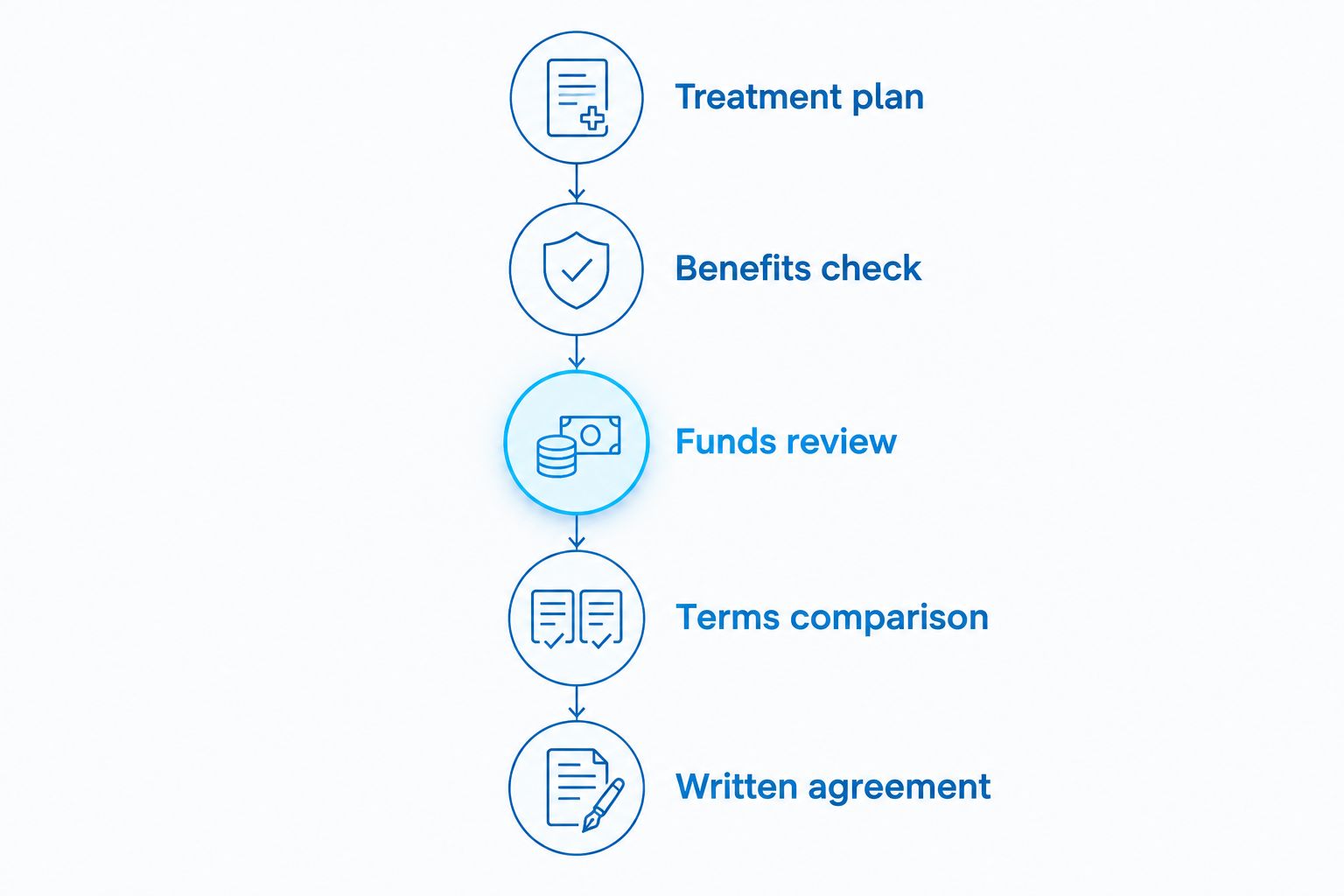
Use this sequence before signing a 2026 payment agreement:
Treatment plan: Confirm the recommended treatment, included services and possible changes.
Benefits check: Ask your insurer about applicable benefits, exclusions and documentation.
Funds review: Check usable savings and eligible HSA/FSA funds without counting the same money twice.
Terms comparison: Compare the remaining payment options by total repayment and monthly obligation.
Written agreement: Confirm payment dates, responsibilities and what happens if treatment changes.
Confirm the treatment and usable funds before choosing a payment agreement.
Insurance and financing solve different problems. Insurance contributes only according to your policy; financing creates a repayment obligation. Ask about implant-related coverage rather than assuming a general dental benefit covers the complete treatment.
Also ask how the office handles unused funds, cancellations and changes to treatment. The payment agreement and the clinical plan need to address those situations separately.
Which dental implant payment option should you choose?
If you must borrow, start by comparing fixed-rate personal loans with clear written terms. If you can pay from savings without weakening your emergency reserve, avoiding debt is the better starting point.
Check eligible HSA/FSA funds before deciding how much to borrow. Then discuss payment timing with Affordable Dentist Near Me and compare any confirmed office arrangement against outside credit.
Do not select a healthcare credit card solely because the advertised payment looks manageable. Choose it only after checking whether your planned payments satisfy every applicable condition.
Discuss your implant treatment plan
Ask about your recommended treatment, billing schedule and payment requirements before applying for financing.
A fixed-rate personal loan is the strongest starting point if you must borrow and need a defined repayment schedule. Compare total repayment and required payments; use eligible savings or account funds first when doing so protects your household finances.
Can I finance dental implants with bad credit?
Approval depends on the lender’s requirements and assessment of your application. Confirm eligibility and credit-inquiry rules before applying, and do not treat an advertisement as a guarantee of approval.
Is a healthcare credit card better than a personal loan?
A healthcare credit card is not automatically better than a personal loan. Compare the written terms, especially deferred-interest conditions, against the loan’s fixed repayment schedule and total repayment.
Can I use HSA or FSA funds for dental implants?
HSA or FSA funds can pay qualifying dental expenses when the expense and account rules permit it. Confirm your implant treatment’s eligibility, documentation and timing with the account administrator before relying on those funds.
Does dental insurance pay for implant treatment?
Implant coverage depends on your specific dental insurance policy. Ask about exclusions, covered components, waiting periods and benefit limits, and request a benefit estimate before calculating what remains to be paid.
Does Affordable Dentist Near Me offer implant payment plans?
Confirm implant payment arrangements directly with your treating Affordable Dentist Near Me office. Ask for the payment schedule and any financing conditions in writing before making a commitment.
Should I use savings or borrow for dental implants?
Use savings when payment leaves enough money for essential expenses and emergencies. If paying would drain that reserve, compare borrowing terms and discuss the treatment’s payment schedule with the dental office.
What should I check before signing a dental financing agreement?
Check total repayment, payment dates, interest conditions, required fees and late-payment consequences. Also confirm how cancellations or treatment changes affect both the dental bill and the financing obligation.
One last thing
A minimum payment is not a payoff plan. For any deadline-based credit offer, calculate whether your planned payments actually clear the required balance before the deadline, rather than assuming the statement minimum will do it.
Keep the treatment decision separate from the borrowing decision. Your dentist explains the recommended care; the written financing agreement explains what you owe and when.