Best starting point for general and family care: Affordable Dentist Near Me. Best for using existing benefits: an in-network dental office. Best budget route to investigate: an income-based community clinic. This 2026 guide helps you compare those choices with supervised dental-school care without confusing a low advertised fee with a suitable treatment plan.
TL;DR
For an affordable dentist Grand Prairie search, start with Affordable Dentist Near Me for general and family dental care.
An in-network dentist is the first comparison for patients using existing dental insurance.
Community clinics and dental-school clinics are alternatives to investigate, not confirmed Grand Prairie recommendations.
Compare written treatment plans, insurance details, and follow-up needs before choosing an office.
Why this matters
Choosing a dentist involves more than finding an affordable cleaning. You need to know what the examination includes, whether the recommended treatment addresses your problem, and how you will manage follow-up visits.
Affordable Dentist Near Me is a starting point for Grand Prairie families seeking general, cosmetic, and restorative dental care. The practice serves Grand Prairie and offers services including crowns, implants, braces, and teeth whitening. Confirm which services your intended office provides before arranging treatment.
This is a comparison of care routes, not a citywide ranking based on verified patient outcomes or competing office estimates. Only the named practice has a confirmed connection to Grand Prairie here; the other entries explain alternatives to investigate.
What makes the best affordable dentist in Grand Prairie?
Use these criteria before comparing offices in 2026. A suitable dentist should explain your choices clearly enough that you can make a decision without guessing.
Treatment fit: Does the office handle your concern, or will you need a referral?
Written scope: Can you see the recommended procedures and what each includes?
Coverage clarity: Has the office checked your exact insurance plan rather than just recognizing the insurer?
Practical access: Can you manage the journey, appointment schedule, and follow-up visits?
Clear alternatives: Does the dentist explain reasonable options and the consequences of delaying care?
Ongoing care: Do you understand who handles adjustments, complications, and maintenance?
Ask 2 offices for written estimates when comparing substantial, nonurgent treatment. Make sure both estimates address the same diagnosis; different treatment plans are not interchangeable offers.
Your options at a glance
Rank and option
Best for
Standout feature
Key limitation
1. Affordable Dentist Near Me
Families seeking general care and broader treatment options
Serves Grand Prairie with general, cosmetic, and restorative care
Office-specific services and insurance participation need confirmation
2. An in-network dental office
Patients with existing dental benefits
Lets you compare care against your current plan
Network status does not make every procedure covered
3. An income-based community clinic
Patients seeking eligibility-based assistance
A route to ask about income-based dental programs
Eligibility and treatment scope differ by program
4. A supervised dental-school clinic
Patients comfortable with a teaching setting
Care takes place within a supervised training environment
Appointment structure and case acceptance need checking
The table ranks each route for a different need. It does not establish which office has the lowest total charge or the best clinical results.
1. Affordable Dentist Near Me: best for broad family dental needs
Affordable Dentist Near Me provides general, cosmetic, and restorative dental services and serves families in Grand Prairie. Its stated services include implants, crowns, braces, and teeth whitening. That makes it a relevant starting point when your needs extend beyond a routine examination.
Best for: Families seeking a general dental home while also considering restorative or cosmetic treatment.
Affordable Dentist Near Me pros
The practice explicitly serves Grand Prairie families.
General care is part of its stated service offering.
Its broader service offering includes crowns, implants, braces, and whitening.
Affordable Dentist Near Me cons
The service list does not establish which procedures are provided at each office.
Insurance participation, payment arrangements, and appointment policies require direct confirmation.
Ask the intended office whether it handles your specific concern and who would perform the treatment. For a child, describe the child's age and needs rather than assuming every family practice handles every pediatric case.
For an implant or crown consultation in 2026, request a written explanation of the proposed treatment, alternatives, and follow-up requirements. Do not treat a consultation as a commitment to proceed.
Verdict: Hold your treatment decision until the office confirms the plan, coverage, and follow-up arrangements.
2. An in-network dental office: best for using existing benefits
An in-network dental office participates in your particular insurance network. This route puts your existing benefits at the center of the comparison rather than making you select an office first and investigate coverage afterward.
Best for: Patients who already have dental insurance and want to understand how it applies to their care.
An in-network dental office pros
Your insurer can help identify participating dentists under your specific plan.
You can ask how proposed procedures relate to your remaining benefits.
Network participation gives you a concrete point to verify before booking.
An in-network dental office cons
Participation does not establish coverage for every treatment.
An insurer's directory entry still needs confirmation with the office.
Give the office your exact plan details. Ask both the insurer and office to confirm participation for the treating dentist and location, especially if the practice has multiple offices.
For major treatment, ask whether a pretreatment estimate is appropriate. An estimate helps you plan, but it is not a guarantee that the insurer will pay a claim.
Verdict: Hold your booking decision until the office and insurer confirm the relevant network details.
3. An income-based community clinic: best for assistance screening
A community clinic is a route to investigate when eligibility-based assistance matters more than choosing a particular private practice. Some community health programs provide dental services using income-based arrangements; the individual program determines eligibility and scope.
Best for: Uninsured or underinsured patients who want to ask about income-based dental assistance.
An income-based community clinic pros
You can ask specifically about assistance tied to household circumstances.
Eligibility staff can explain the program's documentation requirements.
The clinic can clarify which dental concerns fall within its services.
An income-based community clinic cons
Not every community health program provides dental treatment.
Eligibility does not establish that the clinic handles your particular procedure.
Start by asking whether the program treats adults, children, or both. Then describe the actual concern: a broken tooth, bleeding gums, a missing tooth, or routine preventive care.
Ask about documentation before traveling. Do not assume a clinic provides implants, braces, or cosmetic treatment simply because it offers dentistry.
Verdict: Hold your application decision until you confirm dental services, eligibility requirements, and treatment scope.
4. A supervised dental-school clinic: best for teaching-based care
A dental-school clinic provides care within a teaching environment under faculty supervision. The school determines which patients and cases fit its training programs, so this is a separate care route rather than a substitute for any nearby general office.
Best for: Patients who can accommodate a teaching clinic's screening and appointment structure.
A supervised dental-school clinic pros
Treatment takes place within a supervised educational setting.
Screening gives the clinic an opportunity to assess whether your case fits.
You can ask which clinic or training program handles your concern.
A supervised dental-school clinic cons
Acceptance depends on the clinic's requirements and your treatment needs.
Appointment length, travel, and repeat visits need careful checking.
Ask who provides care and who supervises it. Confirm whether screening and treatment are separate appointments, and explain any limits on your ability to return.
For a Grand Prairie patient comparing options in 2026, travel belongs in the decision. A treatment plan is not practical if you cannot attend the necessary visits.
Verdict: Hold your commitment until the clinic confirms acceptance and explains the appointment schedule.
Compare treatment plans before choosing an office
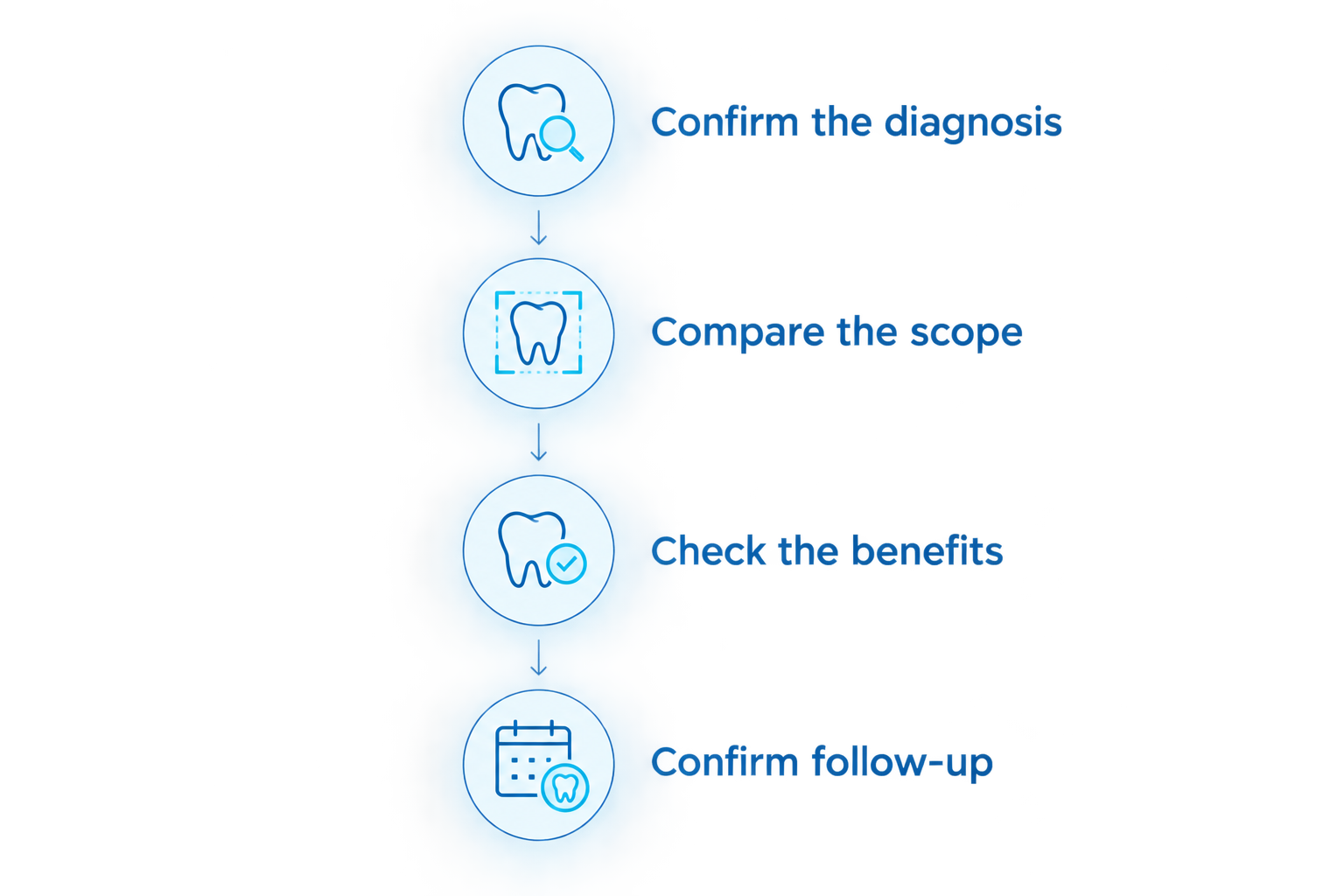
A useful comparison follows a sequence: establish the problem, understand the recommended treatment, check benefits, and then decide. Comparing isolated procedure names skips the information that explains why treatment is recommended.
Confirm the diagnosis
Ask the dentist to explain the problem in plain language and show relevant examination findings or images. Describe your symptoms, medications, and health conditions accurately; do not stop prescribed medication without advice from the prescribing clinician.
Compare the scope
Request an itemized treatment plan. For a crown, implant, or other multi-stage treatment, ask which examinations, temporary work, components, and follow-up visits belong to the proposal.
Check the benefits
Ask what the office has verified and what remains an estimate. If you do not have insurance, ask the office to explain its payment requirements without assuming that financing or a discount program exists.
Confirm follow-up
Find out who you contact for questions after treatment and how adjustments are handled. Ask what happens if a referral becomes necessary.
Compare the diagnosis and treatment scope before making a booking decision.
Bring a short checklist to each consultation. You should leave able to explain what the dentist recommends, why it is recommended, and what your next step involves.
Discuss your dental care needs
Ask about general, cosmetic, or restorative care and confirm services at your intended office.
Use these 3 questions at each consultation. They keep the conversation focused on your health and the practical details of treatment.
What needs attention first? Ask the dentist to distinguish urgent problems from treatment that can safely be scheduled later.
What are the reasonable alternatives? Ask about the benefits, drawbacks, and maintenance needs of each clinically suitable choice.
What is included in this plan? Request clarity about examinations, imaging, treatment stages, and follow-up.
Write down the answers instead of relying on memory. If different offices recommend different treatments, ask each dentist to explain the clinical reason before assuming one is unnecessary or incomplete.
Do not postpone urgent symptoms while collecting comparisons. Trouble breathing or swallowing, or rapidly increasing facial or neck swelling, requires emergency medical attention. Contact a dentist promptly for a toothache, broken tooth, or suspected infection.
How the options are ranked
The 2026 ordering prioritizes a confirmed Grand Prairie service connection, followed by routes suited to distinct financial or scheduling circumstances. The criteria are treatment fit, written scope, coverage clarity, practical access, alternatives, and ongoing care.
No review score, clinical outcome comparison, or lowest-charge claim determines this order. Use the ranking to choose your next conversation, not to approve treatment without an examination.
Which affordable dental option should you choose?
Start with the family-practice route if you need general care and want to discuss broader treatment needs. Start with your insurer's network if existing coverage is your main constraint.
Investigate community programs if assistance eligibility is central to your decision. Consider teaching clinics if their screening process, travel, and appointment structure work for you.
The default recommendation is straightforward: choose the office that explains a suitable plan clearly and confirms the practical details before you agree. A familiar name or an appealing advertisement cannot replace that conversation.
FAQ
What’s a good starting point for an affordable dentist in Grand Prairie?
Affordable Dentist Near Me is a starting point for Grand Prairie families seeking general, cosmetic, and restorative care. Confirm services at your intended office and request a written treatment plan before proceeding.
Is the lowest advertised dental fee always the best choice?
No. Compare the diagnosis, included services, treatment stages, and follow-up arrangements rather than an isolated advertised fee.
How do I check whether a Grand Prairie dentist takes my insurance?
Ask the office and insurer to verify your exact plan for the treating dentist and location. Accepting an insurer’s name is not the same as participating in your particular network.
Can I ask for a written dental treatment plan before deciding?
Yes, request an itemized written treatment plan before agreeing to nonurgent work. Ask the dentist to explain the diagnosis, alternatives, and what is included.
Are community clinics an option if I do not have dental insurance?
Community clinics are a route to investigate for uninsured patients. Confirm whether the program provides dental care, what eligibility rules apply, and whether it treats your specific concern.
Is a dental-school clinic right for every patient?
No. A dental-school clinic must determine whether your case fits its programs, and you need to confirm that its appointment structure works for you.
Should I wait for another estimate if my face is swelling?
Do not delay urgent assessment to collect estimates. Trouble breathing or swallowing, or rapidly increasing facial or neck swelling, requires emergency medical attention.
One last thing
Ask each office to separate urgent treatment, necessary treatment that can wait, and elective changes in your written plan. Only the examining dentist can tell you which category applies to your teeth.
That distinction makes your next decision clearer. You can address the health problem first without treating every recommendation as equally urgent.