Exploring the Hidden Variables Behind the Longevity of Dental Restorations: Comprehensive Guide to Dental Implant Longevity Factors and Restoration Lifespan
Dental restorations — including dental implants, crowns, bridges, fillings, and dentures — represent a major functional and financial investment in oral health, and understanding the variables that govern their longevity is essential for predictable long-term outcomes. This guide explains what determines restoration lifespan, why some restorations endure for decades while others fail prematurely, and how patient choices, material science, and clinical technique interact to influence results. Readers will learn practical signs to watch for, evidence-informed maintenance routines, material trade-offs (porcelain vs zirconia vs gold vs composite), and the typical lifespan ranges for common restorations. The article also outlines how clinician factors such as treatment planning, surgical protocol, and follow-up care affect durability, and it shows how local context in Mansfield, TX, can meaningfully change risk profiles and management strategies for restorations. Throughout, the aim is to provide actionable steps patients can take now and explain when professional evaluation and replacement become necessary, while pointing to local resources for personalized assessment including a $79 DENTAL CONSULTATION.
Indeed, the complexity of these factors underscores why understanding restoration longevity is crucial, as highlighted by research on the high costs associated with failed restorations.
Dentists need to consider various factors when choosing restorative materials, with the longevity of restorations being one of the most important criteria. Replacement of failed restorations constitutes over 60% of operative procedures, leading to high annual costs. This literature review compares the survival rates of different restorative materials used for both direct and indirect restorations. The longevity of restorations depends on many factors, including: materials used, type of restorative procedure, patient parameters, operator variables, and local factors.
The longevity of restorations-A literature review, ZI Vally, 2015
What Are the Key Factors Influencing the Longevity of Dental Restorations?
Longevity of dental restorations is governed by multiple interacting factor groups: patient behaviors and systemic health, practitioner skill and technique, restoration materials and design, site-specific tooth or bone conditions, and environmental or lifestyle elements. Each group contributes distinct mechanisms of failure—biological (decay, peri-implantitis), mechanical (fracture, wear), and aesthetic (staining, margin breakdown)—and they often amplify one another, so addressing one risk without the others leaves vulnerability. Understanding these factor groups clarifies where interventions will have the biggest return on preservation efforts. Below is a concise list that defines each major group and gives quick examples to orient readers.
Materials and design: choice of ceramic, metal, composite, and prosthesis design affecting strength and wear patterns.
Tooth/site factors: residual tooth structure, root morphology, bone density, and infection history.
Environmental/lifestyle factors: local diet, occupational exposures, and access to routine care.
These groups interact in predictable ways—for example, quality materials can mitigate some mechanical risk but cannot fully compensate for poor oral hygiene—so the next section examines patient-driven influences in depth to show where daily choices matter most.
How Do Patient Factors Affect Restoration Lifespan?
Patient factors shape both the biological environment that supports a restoration and the mechanical stresses it endures. Consistent oral hygiene reduces biofilm accumulation and lowers the risk of recurrent caries around restorations and peri-implantitis around implants, while systemic conditions such as uncontrolled diabetes or osteoporosis can impair healing and bone maintenance. Behavioral risks like smoking and bruxism increase failure rates: smoking impairs blood flow and immune response, and bruxism produces repetitive overload that can fracture crowns or loosen implant connections. A simple self-assessment checklist helps patients identify modifiable risks and decide which preventive measures to adopt.
The detrimental effects of bruxism on restoration longevity are well-documented, with studies showing its direct link to various types of implant restoration failures.
Bruxism’s Impact on Dental Implant Restoration Failure
The 87.5% of the implant studies addressed the effects of bruxism on single implant restorations failure. The most common failure types were fracture of the implant-supported restoration (37.5%), followed by implant fracture (25%), and marginal bone loss (12.5%).
Bruxism and direct and indirect restorations failure: A scoping review, T Al-Talib, 2025
Keep daily plaque removal routines and seek periodontal checks to protect margins.
If you grind teeth, consult about night guards to reduce mechanical wear.
Manage systemic conditions with your physician to improve oral healing outcomes.
These patient-centered interventions reduce biological and mechanical threats, and when combined with clinician-driven planning they form the backbone of durable restorations—a topic explored next by looking at practitioner and technique-related variables.
What Dentist-Related Factors Impact Restoration Durability?
Clinician skill and case management directly affect restoration outcomes by determining initial fit, occlusal harmony, and biological compatibility. Proper diagnosis and treatment planning—using thorough clinical exams and imaging—ensures correct case selection and prosthesis design, while precise surgical technique for implants preserves bone and soft tissue critical for long-term stability. Restorative protocols such as appropriate adhesive systems, correct cementation, and careful occlusal adjustment prevent microleakage, debonding, and uneven stress concentrations. Regular professional follow-up enables early detection and correction of marginal gaps, wear, or peri-implant mucositis before they progress to irreversible failures.
Vet clinicians for documented protocols in implant planning and restorative workflows.
Favor practices that emphasize prosthetic-driven implant placement and occlusion management.
Insist on scheduled maintenance visits to detect early signs of complications.
By combining patient adherence and high-quality clinical execution, the probability of long-lasting restorations increases substantially; next we turn to objective lifespan expectations by restoration type so readers can set realistic maintenance goals.
How Long Do Different Types of Dental Restorations Typically Last?
Different restorations have characteristic lifespan ranges driven by material properties, functional load, and biological context. Understanding realistic numeric ranges helps patients plan for maintenance, monitor wear, and budget for potential future replacements. The table below summarizes typical expected lifespans for common restorations and core components, followed by focused discussion on implants and prosthetic components, then crowns, fillings, dentures, and bridges.
Restoration Type
Component / Attribute
Typical Lifespan / Notes
Dental Implant
Fixture (implant screw/fixture)
Decades; often considered a long-term or possible lifetime solution with proper care
Implant Prosthesis
Abutment / Crown
10–15+ years depending on material and wear; crowns may need replacement sooner than fixture
Crown (Zirconia)
Full-contour zirconia crown
10–15+ years with high fracture resistance but possible wear on opposing teeth
Crown (Porcelain/Porcelain-fused-to-metal)
Esthetic layered crown
8–15 years; porcelain can chip while core metal/zirconia may remain intact
Fillings (Composite/Amalgam)
Restorative material
5–15 years for composites; amalgam historically longer in posterior, but varies with margins and caries risk
Dentures
Full or partial denture base and teeth
5–8 years typical before relines or tooth wear necessitate repair or replacement
Bridges
Fixed partial dentures
10–15 years or longer depending on abutment health and maintenance
This comparative table clarifies that implant fixtures outlast many prosthetic components, which explains why many implant treatments require replacement of the prosthetic crown while the underlying fixture remains stable. The next subsection focuses on implant-specific lifespans and component trade-offs.
What Is the Average Lifespan of Dental Implants and Their Components?
Dental implant fixtures are intended to integrate with bone and, when osseointegration is successful, can last for decades; many studies and long-term clinical series report survival rates exceeding 90% at 10 years and beyond. The prosthetic elements attached to implants—abutments and crowns—face different challenges: occlusal wear, material fatigue, and aesthetic changes often drive their replacement long before the fixture fails. Peri-implant health is a critical determinant: chronic inflammation, poor hygiene, or untreated peri-implantitis can compromise bone support and lead to fixture loss. Patients should understand that implants are a two-part outcome: the surgically placed fixture is durable, while the restorative crown or overdenture may require periodic replacement.
This emphasis on peri-implant health is further supported by research detailing the significant impact of peri-implantitis on implant survival and the necessity of continuous preventative measures.
Peri-Implantitis: Causes, Prevention, and Impact on Implant Longevity
Peri-implant inflammations represent serious diseases after dental implant treatment, which affect both the surrounding hard and soft tissue. Due to prevalence rates up to 56%, peri-implantitis can lead to the loss of the implant without multilateral prevention and therapy concepts. Specific continuous check-ups with evaluation and elimination of risk factors (e.g. smoking, systemic diseases and periodontitis) are effective precautions. In addition to aspects of osseointegration, type and structure of the implant surface are of importance. For the treatment of peri-implant disease various conservative and surgical approaches are available.
Definition, etiology, prevention and treatment of peri-implantitis–a review, O Jung, 2014
Expect implant fixtures to be a long-term investment while budgeting for prosthetic maintenance.
Monitor peri-implant tissues regularly to protect bone support and fixture longevity.
Replace prosthetic crowns when wear, chipping, or esthetic concerns affect function or appearance.
Recognizing this fixture-vs-prosthetic distinction helps patients plan realistic maintenance schedules and informs decisions about materials that optimize prosthetic lifespan without overburdening the biological site.
How Long Do Dental Crowns, Fillings, Dentures, and Bridges Last?
Crowns, fillings, dentures, and bridges offer a wide lifespan spectrum governed by material selection, site location, and patient behavior. Crowns on posterior teeth endure higher occlusal loads than anterior crowns, so stronger materials like zirconia or metal-based restorations may be preferred in molar regions. Composite fillings are conservative but typically require more frequent replacement than full-coverage crowns, whereas bridges rely on abutment tooth health—recurrent decay around abutments shortens bridge lifespan. Dentures wear from mastication and require relines as alveolar bone resorbs, so periodic adjustments and replacements are standard.
Use stronger materials in high-load zones and esthetic materials where visibility matters.
Replace fillings when recurrent decay or margin breakdown is present to prevent larger interventions.
Rebase or reline dentures proactively to maintain fit and function and reduce tissue trauma.
Decisions between repair and replacement are often pragmatic: small chips or marginal defects may be repaired, but widespread wear, recurrent infection, or structural compromise usually necessitate full replacement to prevent downstream complications.
Which Materials Are Best for Durable Dental Restorations?
Material choice is a core determinant of mechanical resilience, wear characteristics, aesthetic longevity, and cost. Clinicians weigh strength versus translucency in ceramic systems, the predictability of metal-based restorations, and the conservative advantages of composite materials. Materials that resist fracture and wear can extend interval to replacement but may trade off with opposing-tooth wear or lower translucency in anterior esthetics. The following table compares common restorative materials across strength, wear resistance, aesthetics, and cost to help patients and clinicians make balanced choices.
Higher cost; excellent for posterior load-bearing crowns
Porcelain (feldspathic/ layered ceramics)
Moderate strength; brittle under heavy load
Very high translucency for anterior esthetics
Moderate cost; vulnerable to chipping if thin or improperly supported
Gold (metal alloys)
Excellent ductility and longevity; resists fracture
Low esthetic value for visible teeth
Expensive but proven longevity; ideal for posterior where esthetics less critical
Composite resin
Lower strength; more susceptible to wear and staining
Good immediate esthetics; may stain over time
Lower initial cost; more frequent replacements expected
This table highlights that no single material is universally superior: material selection should balance functional demands and aesthetic goals. The next subsections dive deeper into material-specific pros and cons and decision factors.
How Do Porcelain, Zirconia, Gold, and Composite Materials Compare?
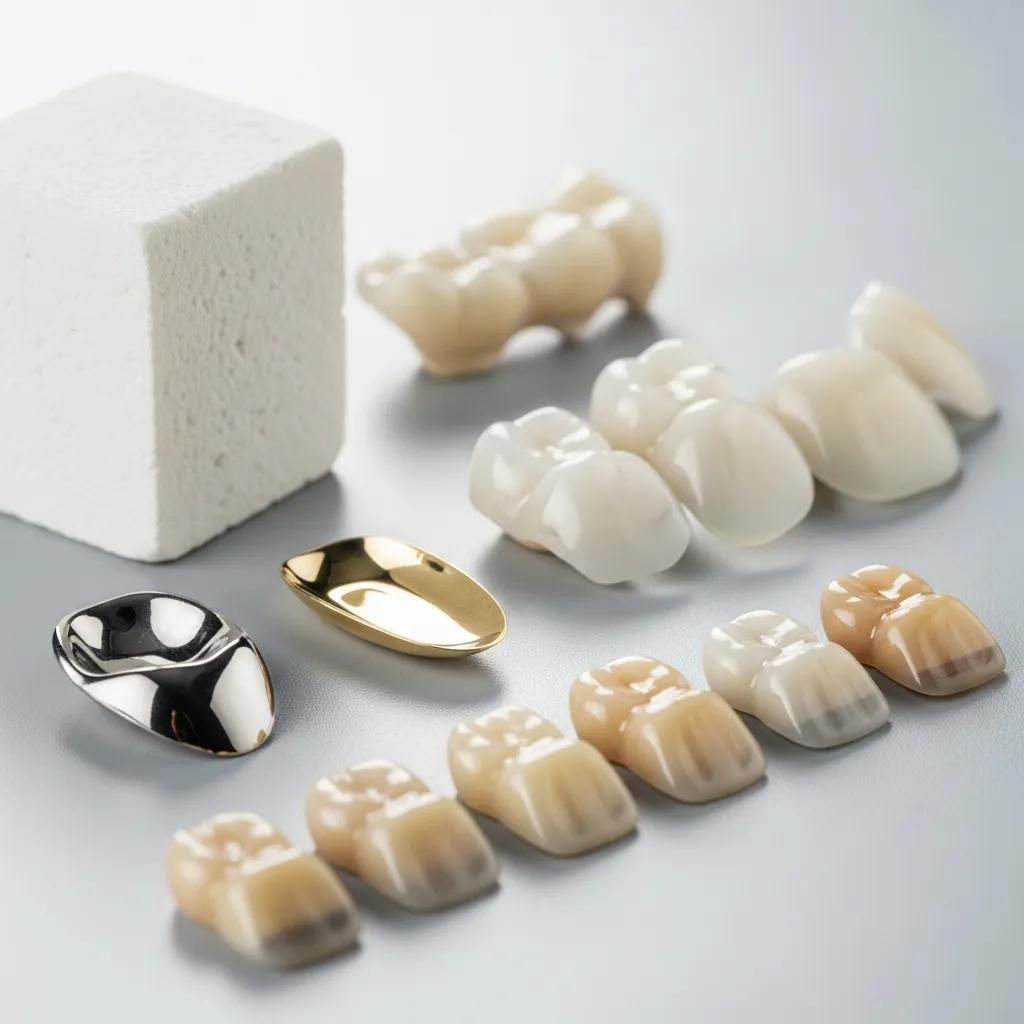
Zirconia provides superior fracture resistance and is increasingly used for posterior crowns and implant-supported prostheses; however, older solid zirconia could be less translucent, though modern formulations have improved. Porcelain layered over a strong core (PFM or zirconia) gives excellent anterior aesthetics but carries a higher risk of chipping in thin areas. Gold alloys remain a benchmark for longevity and marginal fit—metal restorations tolerate occlusal stress well and are forgiving under repeated loading, making them suitable for posterior molars when esthetics are secondary. Composite restorations preserve tooth structure and are cost-effective but generally require earlier replacement due to wear, staining, and marginal breakdown.
Zirconia: best for strength and posterior longevity.
Porcelain layered systems: best for high esthetic demand.
Gold: best for marginal integrity and durability in non-esthetic zones.
Composite: best for conservative, short- to mid-term restorative needs.
Matching the restorative material to the clinical situation and patient priorities is essential; the following subsection explains how to align choices with patient goals.
What Material Choices Affect Restoration Longevity and Aesthetics?
Material selection pivots on a decision tree that weighs bite forces, tooth position, esthetic priority, budget, and long-term maintenance expectations. For a molar with heavy occlusion, clinicians often recommend zirconia or gold to minimize fracture risk, while a front tooth where translucency and color match are paramount may favor layered porcelain or high-translucency zirconia. Patients who prioritize minimal future maintenance might accept a higher upfront cost for a more durable material, whereas those constrained by budget may choose conservative composites with the understanding of more frequent maintenance.
Consider long-term cost: stronger materials may reduce replacement frequency and cumulative expense.
Discuss esthetic priorities and functional load with your clinician to arrive at an appropriate compromise.
Trust clinician recommendations that reflect both material science and site-specific anatomical factors.
These material trade-offs eventually guide clinical protocols and aftercare, which leads into the next major topic: patient-driven strategies that extend restoration life.
How Can Patients Extend the Life of Their Dental Restorations?
Patient actions are the most controllable determinants of restoration lifespan: daily hygiene, protective appliances, timely professional care, and lifestyle modifications all produce measurable benefits. Proactive maintenance reduces biological threats like caries and peri-implantitis, while mechanical protections (night guards) reduce fracture and wear. The following numbered list provides prioritized, actionable steps patients can implement immediately to maximize the longevity of crowns, implants, fillings, bridges, and dentures.
Maintain meticulous daily oral hygiene: brush twice daily with a soft-bristled brush and floss or use interdental cleaners once daily.
Attend regular professional cleanings and implant/peri-prosthetic checks at least every 3–6 months as recommended by your clinician.
Use a custom night guard if you have bruxism to reduce repetitive overload that leads to fracture.
Avoid hard, sticky foods that can chip or dislodge restorations; manage habits like ice chewing or pen biting.
Quit smoking and manage systemic health factors such as diabetes with your medical team to protect biological integration.
After implementing these at-home and behavioral steps, patients should engage in scheduled professional maintenance; the EAV table below links specific maintenance actions to expected impact on longevity.
Maintenance Action
Frequency / Effort
Expected Effect on Longevity
Brushing + flossing
Daily; moderate effort
Reduces caries and peri-implantitis risk, extends restoration margins
Professional cleaning
Every 3–6 months
Removes subgingival biofilm; early detection of issues
Night guard use
Nightly when indicated
Prevents fracture and wear; prolongs prosthetic life
Smoking cessation
Ongoing; high effort
Improves soft tissue health and implant survival prospects
Denture reline/repair
As needed (typically every 3–5 years)
Restores fit, reduces soft tissue trauma and functional failure
This table clarifies how consistent maintenance actions produce cumulative protective effects; after reviewing practical steps, the following subsection explains specific hygiene and monitoring practices to adopt at home.
What Maintenance and Oral Hygiene Practices Promote Longevity?
Daily mechanical plaque control and targeted interdental cleaning are first-line defenses against marginal breakdown and peri-implant disease. Brushing technique matters: use gentle, thorough strokes and avoid aggressive scrubbing that can abrade restorative margins. Interdental brushes or floss designed for implants may be preferable around implant-supported restorations to remove plaque without damaging peri-implant tissues. Antimicrobial rinses can be useful as adjuncts in high-risk patients, but they do not replace mechanical cleaning. Simple at-home monitoring—checking for looseness, new sensitivity, or visible margin gaps—helps catch problems early and informs timely professional evaluation.
Adopt interdental brushes around implants and bridges where floss may be less effective.
Choose a non-abrasive fluoride toothpaste to protect restorative surfaces and adjacent tooth enamel.
Record any changes (photos, notes) to bring to maintenance appointments to assist diagnosis.
These hygiene practices dovetail with professional schedules for cleanings and checks; the next subsection explains when to escalate to professional care or replacement.
When Should Patients Seek Professional Care or Replacement?
Patients should seek a professional evaluation promptly for red-flag symptoms: persistent pain, mobility of a crown or implant, changes in bite or fit of dentures, recurrent infections or swelling, and visible marginal gaps or fracture. Early intervention can often preserve restorations with conservative repairs, whereas delays can permit progression to deeper infection, bone loss, or structural collapse requiring more extensive and costly treatment. Documenting symptoms with notes and photos and reporting onset timing accelerates diagnosis and reduces unnecessary delays in care.
Immediate evaluation is recommended for pain, mobility, or signs of infection.
Schedule maintenance sooner if you notice increased food traps, sensitivity, or loose components.
Bring photos and a brief symptom timeline to appointments to assist clinical triage.
Prompt professional response preserves options and typically reduces both clinical complexity and long-term cost; when coupled with the clinical capabilities described below, these measures form a robust framework for long-term restoration success.
What Role Does Dentist In Mansfield- Dentures and Dental Implants Play in Restoration Longevity?
Dentist In Mansfield- Dentures and Dental Implants provides integrated restorative services designed to enhance restoration longevity through patient education, technology-driven treatment planning, and protocolized follow-up care. The practice emphasizes a “one-stop shop” approach where implant planning, prosthetic fabrication, and maintenance are coordinated by a trained team in a relaxing, spa-like environment with friendly staff focused on education-based care. These operational characteristics reduce handoffs and variability that can shorten restoration lifespans and enable convenient access to maintenance and adjustments. After explaining these services, the clinic offers a clear next step for personalized assessment: $79 DENTAL CONSULTATION.
How Does Our Expertise and Technology Enhance Restoration Lifespan?
Our team integrates digital treatment planning, appropriate implant systems, and protocol-driven maintenance to reduce technical and biological failure modes. Digital imaging and planning enable prosthetic-driven implant placement that optimizes angulation and emergence profile, improving soft tissue health and prosthetic fit—which in turn reduces microleakage and mechanical strain. Trained staff and education-based care ensure patients receive clear instructions for home maintenance and the rationale for protective appliances such as night guards. Regularly scheduled maintenance visits and access to on-site adjustments minimize delays in addressing minor issues before they escalate.
Digital workflows align surgical placement with restorative design to minimize complications.
Staff education reinforces patient adherence to hygiene and behavioral modifications.
Protocol-driven follow-ups detect early peri-implant or marginal problems and allow conservative repairs.
These clinical strengths translate into measurable longevity benefits for restorations, and patients seeking an assessment of their individual needs can take advantage of a structured consult offering detailed evaluation and planning.
What Free Consultation and Follow-Up Services Support Long-Term Care?
The practice’s consult offering provides an entry point for patients to receive a targeted evaluation of restoration needs, including an oral exam, discussion of medical and dental history, and an overview of treatment options and maintenance planning. Follow-up services include routine cleanings, adjustments, emergency repairs, and scheduled peri-implant checks to monitor soft tissue and bone stability. Online scheduling options make it straightforward to book initial and maintenance visits, and flexible financing and PPO insurance acceptance help patients access recommended long-term care. After this explanation, readers are encouraged to take the next step: $79 DENTAL CONSULTATION.
Consult typically covers clinical assessment, treatment planning overview, and recommendations for imaging or specialist referral when indicated.
Follow-up cadence is individualized based on risk—commonly 3–6 month maintenance intervals for higher-risk cases.
Emergency repair pathways and same-practice adjustments reduce downtime and preserve prosthetic integrity.
This combination of assessment, technology, and follow-up care forms the practical backbone of the clinic’s approach to maximizing restoration lifespans and supports local patients in implementing the maintenance strategies described earlier.
How Does Local Context Influence Dental Restoration Longevity in Mansfield, TX?
Local lifestyle, environmental, and demographic factors in Mansfield, TX, can influence restoration outcomes by affecting diet, access to care, and prevalence of behavioral risk factors. For example, regional dietary patterns that include acidic or highly processed foods may increase erosive wear and marginal breakdown, while local occupational exposures (e.g., manual laborers who clench or use their teeth) can elevate mechanical risk. Climate and community access to dental services shape how regularly patients attend maintenance visits, and acceptance of PPO plans and flexible financing locally improves access to higher-quality restorative options. Understanding these local factors enables the clinic to tailor preventive strategies and communication to patient needs.
Identify dietary and occupational contributors that increase wear or trauma risk.
Use local scheduling flexibility and financing options to encourage adherence to maintenance visits.
Provide culturally relevant education emphasizing behaviors that matter most in the Mansfield setting.
After outlining these local influences, the clinic reiterates an accessible next step for local residents seeking personalized planning: $79 DENTAL CONSULTATION.
What Environmental and Lifestyle Factors Affect Restoration Durability?
Environmental and lifestyle contributors common in any community—dietary acid exposure, recreational substances, bruxism, and smoking—affect restorations by accelerating wear, promoting marginal breakdown, or compromising peri-implant tissue. In Mansfield specifically, clinicians consider common local dietary habits and recreational activities when planning restorations and advising patients on protective strategies. Practical mitigation includes dietary modification to reduce frequency of acidic exposures, use of fluoride therapies to strengthen tooth structure near margins, and behavior-targeted interventions (smoking cessation programs, night guards) to protect mechanical integrity.
Counsel patients on reducing acidic or sugary snack frequency to minimize erosion and recurrent decay.
Recommend desensitizing or remineralizing agents where early marginal changes are observed.
Tailor night guard or protective recommendations to occupational or recreational risk profiles.
These local adaptations improve the fit between recommended care and real-world patient behavior, and for residents ready to review their restoration plans in person the clinic offers an immediate local consultation option: $79 DENTAL CONSULTATION.
How Do We Tailor Care to Mansfield Patients’ Unique Needs?
Care in Mansfield is personalized through flexible scheduling, acceptance of common PPO dental insurance plans, and offering financing options to make durable restorative choices accessible. Clinicians incorporate patient education into every visit, explaining material trade-offs and maintenance responsibilities so decisions reflect both clinical realities and personal priorities. Treatment plans consider local prevalence of certain risk factors and are staged to allow conservative interventions followed by more definitive care when appropriate, reducing unnecessary upfront complexity while preserving long-term options.
Provide phased treatment options to match patient budget and urgency, preserving future restorative choices.
Use patient education and on-site support to reinforce maintenance routines tailored to each patient’s lifestyle.
Leverage insurance and financing pathways to improve adherence to recommended long-term care plans.
Tailoring care in this way reduces barriers to the preventive behaviors that most effectively prolong restorations, and patients in Mansfield are encouraged to use the practice’s consult pathway to get personalized recommendations: $79 DENTAL CONSULTATION.
What Are Common Signs That a Dental Restoration Needs Attention or Replacement?
Recognizing early warning signs prevents small problems from becoming complex failures requiring extensive treatment. Common signs that warrant evaluation include new or worsening pain, mobility of crowns or implant components, changes in bite or prosthesis fit, visible cracks or chips, and recurrent decay or inflammation near margins. The list below summarizes typical signs and what they imply clinically so patients can triage symptoms and seek timely care.
Pain or sensitivity: may indicate decay, endodontic issues, or peri-implant infection.
Mobility of a crown, bridge, or denture: suggests loosening, failure of retention, or underlying structural loss.
Changes in bite or fit: can signal wear, tooth migration, or prosthetic fracture that affects function.
Visible chips, cracks, or margin gaps: indicate mechanical compromise and increased risk for fracture and decay.
Understanding these signs and seeking early evaluation reduces the risk of more invasive interventions, and the next subsection provides practical self-check steps for common restoration types.
How to Identify Wear, Damage, or Failure in Implants, Crowns, and Dentures?
Specific visual and functional cues help patients identify problems: implants with surrounding redness, bleeding, or pus may indicate peri-implant disease; crowns with sharp edges, visible fractures, or recurrent staining at margins suggest marginal failure; dentures that rock, create sore spots, or cause new speech changes signal fit loss. Patients can perform simple at-home checks—press gently on removable prostheses to test stability, look for swelling or discharge near implant sites, and test for new sensitivity to biting—to decide whether to schedule an urgent appointment.
Photograph suspicious findings and note onset to bring to your clinician.
Avoid attempting repairs at home; temporary measures like soft-lining dentures can reduce discomfort until professional care is available.
Prioritize early evaluation for signs of infection, mobility, or acute pain.
These practical self-checks help ensure that restorative problems are assessed early and that appropriate conservative measures can be taken before escalation; delaying evaluation carries real clinical and financial risks, explained next.
What Are the Risks of Delaying Professional Evaluation?
Delaying evaluation allows biological or mechanical problems to progress, converting what might have been a conservative repair into a complex reconstructive need. Untreated marginal decay can reach the pulp requiring root canal therapy or extraction, peri-implantitis can result in progressive bone loss around an implant, and continued overload from bruxism can produce catastrophic prosthetic fractures. Financially, deferred care tends to escalate costs as treatments become more extensive, and clinically, outcomes often worsen when intervention is postponed.
Early assessment preserves options and often reduces both treatment complexity and cost.
Documenting early signs and following a prompt evaluation pathway mitigates escalation risk.
Prompt repairs and adjustments reduce the likelihood of needing replacement or complex surgical interventions.
Timely professional involvement preserves long-term function and reduces downstream risk; the final section summarizes concise FAQs patients commonly ask and provides a clear call to action for readers who want a personalized plan.
Frequently Asked Questions About Dental Restoration Longevity
This FAQ provides short, direct answers to common patient questions about how long restorations last and which materials perform best. Use these concise responses for quick guidance and follow-up with a clinical exam for individualized recommendations. After these answers, consider scheduling a personalized assessment: $79 DENTAL CONSULTATION.
How Long Do Dental Implants Last With Proper Care?
With proper hygiene and routine professional maintenance, dental implant fixtures can last for decades and are often considered a long-term solution; however, the prosthetic crowns or abutments attached to implants may require replacement in 10–15+ years due to wear, fracture, or esthetic changes. Key longevity factors include peri-implant tissue health, patient hygiene, and occlusal management; maintaining these reduces the likelihood of fixture loss and prosthetic failure.
What Is the Best Material for Long-Lasting Dental Crowns?
No single material is best for every situation; zirconia and gold provide superior strength and longevity in high-load posterior regions, while layered porcelain offers the highest esthetics for anterior restorations. Material choice depends on bite forces, esthetic needs, and long-term maintenance considerations; clinicians balance these factors to recommend the optimal option for each tooth and patient.
How Often Should I Have Professional Maintenance for Implants and Crowns?
Maintenance frequency depends on individual risk but commonly ranges from every three to six months for patients with implants or high caries/peri-implant risk, and every six months for many routine maintenance cases. Higher-risk patients benefit from closer monitoring to detect early signs of biological or mechanical problems and to perform timely conservative interventions.
Can Dentures Be Repaired or Do They Need Full Replacement?
Dentures can often be relined, rebased, or repaired to restore fit and function for several years; however, after significant wear of denture teeth, major base resorption, or repeated repairs, full replacement becomes the safer and more predictable option. Timely relining and tooth replacement for dentures extend functional life and comfort.