Texas Medicaid generally does not cover routine dental care for adults age 21 and older in 2026. Limited benefits can exist through specific programs, qualifying medical circumstances, or a health plan’s extra benefits, but these are not a statewide adult dental benefit. Before booking, confirm that your exact treatment, provider, and Medicaid program qualify—not just that your Medicaid card is active.
TL;DR
Does Medicaid cover dental care for adults? Texas generally excludes routine dental benefits for people age 21 and older.
Texas Health and Human Services distinguishes children’s dental benefits from adult Medicaid coverage.
A Medicaid health plan’s extra dental benefit is not the same as statewide coverage.
Confirm the treatment, participating dentist, and authorization requirements before agreeing to care.
Why this matters
A dentist accepting Medicaid does not mean Medicaid pays for every patient or procedure. An office can participate in children’s dental programs without offering a covered dental benefit to adults. Likewise, an active medical plan does not automatically include cleanings, fillings, or dentures.
Verify the benefit before you choose the appointment. Start with your plan’s member services department, then ask the dental office to check the proposed treatment. The guide to low-income and Medicaid dental treatment options in Texas explains other routes to consider when routine adult coverage is unavailable.
Does Medicaid cover dental care for adults in Texas?
For Texas residents age 21 and older, Medicaid generally does not provide a routine dental benefit. Do not assume that a cleaning, filling, crown, root canal, or denture is covered because you qualify for Medicaid medical care.
The distinction comes from federal and state benefit rules. The Centers for Medicare & Medicaid Services describes dental services as a required part of the Early and Periodic Screening, Diagnostic, and Treatment benefit for Medicaid members under age 21. States determine adult dental benefits separately; Texas Health and Human Services’ dental program information distinguishes younger members’ coverage from adult benefits.
Use your 2026 member handbook and benefit documents to confirm the rules that apply to your enrollment. A general description of Medicaid cannot establish payment for a specific procedure.
Coverage route
Best for
What it establishes
Main limitation
Medicaid dental benefits under age 21
Eligible younger members
A dental benefit that includes medically necessary care under program rules
It does not establish routine coverage after the age cutoff
Standard adult Texas Medicaid
Adults checking whether routine care is covered
Medical coverage, without a general routine adult dental benefit
A Medicaid card alone does not establish dental payment
Health plan extra benefits
Adults whose plan lists an additional dental benefit
Only the services described in that plan’s documents
Eligibility, participating providers, and limits depend on the plan
Specific program or qualifying medical circumstances
Adults enrolled in an applicable program or receiving qualifying treatment
A possible route to limited covered services
The program must confirm that the person and treatment qualify
The practical answer is not simply yes or no. Routine adult dental coverage is generally absent; exceptions require an individual benefit check.
Under age 21: different dental coverage rules
Texas Medicaid members through age 20 fall within the federal under-21 dental benefit framework. That includes eligible members who are 19 or 20 years old, even though they are legally adults.
This distinction matters when a family hears that Medicaid does not cover “adult dental.” The relevant benefit cutoff is not necessarily the legal age of adulthood. Ask about dental enrollment and participating dentists rather than relying on the word adult.
Covered care still follows program rules. The dentist must determine what treatment is needed, and certain services require approval before treatment. Coverage does not mean every requested cosmetic procedure is included.
If you are approaching your 21st birthday, ask when your current dental eligibility ends and how that affects an unfinished treatment plan. Have the office check any planned visits separately rather than assuming an earlier approval applies indefinitely.
Age 21 and older: routine dental care is generally excluded
For Texas Medicaid members age 21 and older, the standard medical benefit is not a substitute for dental insurance. A toothache does not by itself establish that Medicaid will cover an extraction, and an infection does not automatically make every related dental procedure payable.
Ask about the actual treatment—not whether emergencies are covered in general. An emergency medical evaluation and the dental work needed afterward are different services. Payment for one does not establish payment for the other.
The same caution applies to dentures, implants, crowns, and root canals. A dentist’s recommendation establishes a treatment need; it does not establish a Medicaid benefit. Request a benefit determination before treating a procedure as covered.
For your 2026 appointment, keep the plan’s response with your treatment estimate. Record the representative’s name, the date, and any call reference so the office can follow up if the information conflicts with its eligibility check.
Extra benefits and specific programs: check your enrollment
Some Medicaid managed-care plans offer additional benefits beyond the standard program. A dental extra benefit must be confirmed in the documents for your particular plan and eligibility group. Do not transfer a benefit advertised for another plan or member category to your own coverage.
Certain long-term services and supports programs also have their own service rules, including dental services in qualifying circumstances. Being enrolled in Medicaid does not establish enrollment in one of these programs. Your service coordinator or benefits representative should identify the applicable program before discussing covered treatment.
Ask whether the benefit covers preventive care, treatment for a dental problem, or only a defined service. Also ask whether you need a designated dentist, a referral, or approval before the appointment.
These routes are useful when you qualify. Their limitation is equally important: an exception is not a general promise of adult dental coverage across Texas.
Why adult dental coverage varies
Your neighbor’s experience is not a reliable benefit check. Adult dental coverage depends on several separate factors:
Program enrollment: A specific waiver or other qualifying program can have services that standard adult enrollment does not include.
Health plan: Additional dental benefits belong to the plan that offers them and follow its terms.
Treatment: A medical evaluation, a cleaning, and a tooth extraction are separate services with different payment questions.
Provider participation: A dentist must participate in the relevant benefit arrangement, not merely accept some Medicaid patients.
Approval requirements: Certain services need authorization or other documentation before treatment.
Use the same questions for every office you consider. Comparing answers about the same proposed treatment is more useful than comparing broad statements such as accepts Medicaid or handles emergencies.
How do I check whether my dental visit is covered?
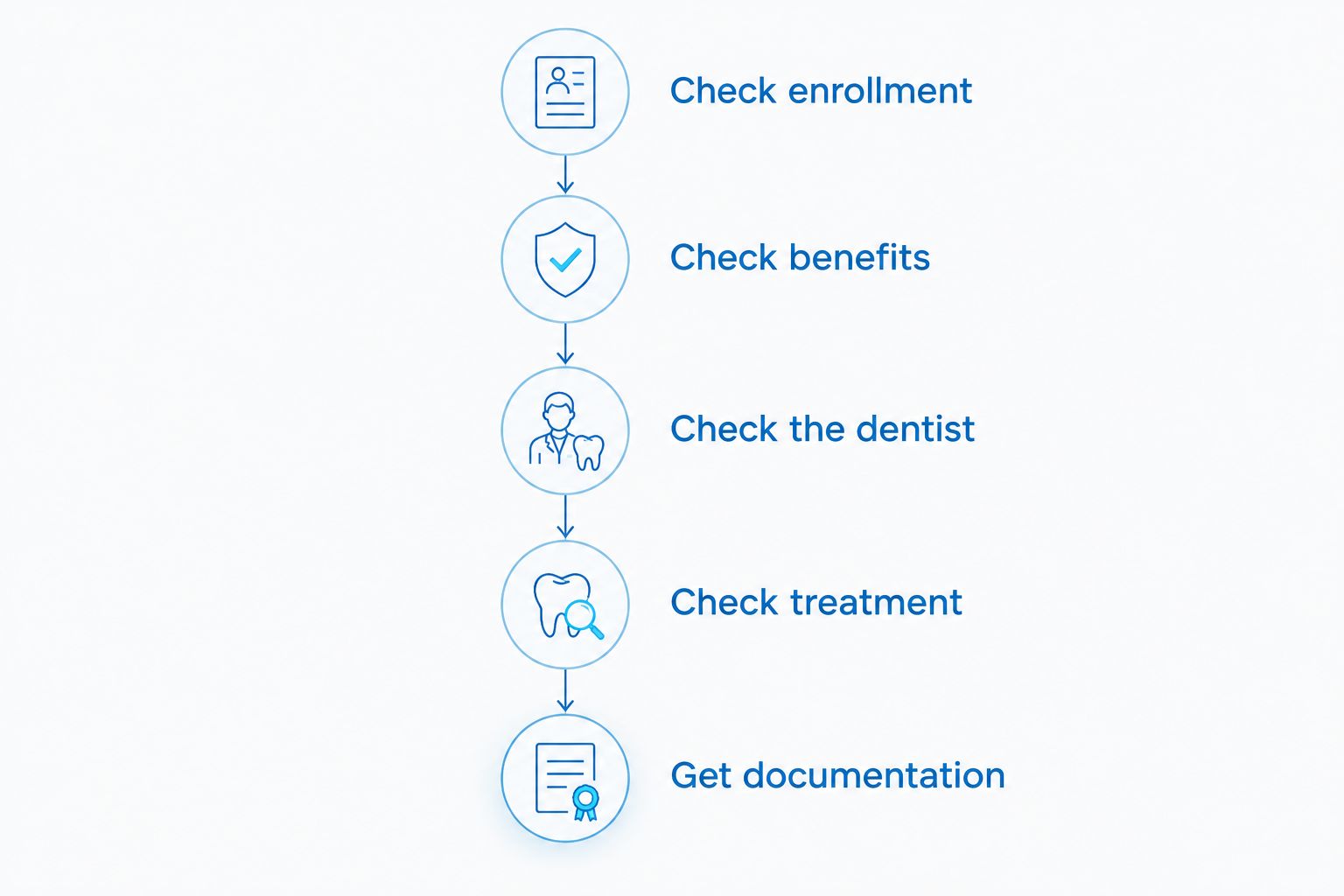
Verify eligibility, the dental benefit, and the treatment before you agree to care. The member services number on your card is the starting point; the dental office then needs to confirm its role in that benefit.
Check enrollment. Identify your exact Medicaid program and managed-care plan, if you have one. Confirm that enrollment is active for the proposed visit date.
Check benefits. Ask whether your 2026 coverage includes adult dental services, an extra dental benefit, or a program-specific dental service. Request the relevant written benefit description.
Check the dentist. Give member services the office’s name and location. Ask the office whether it participates in the exact adult benefit you identified.
Check treatment. Ask the dentist for the proposed procedure description and billing codes. Have the plan explain whether those services qualify and whether authorization is required.
Get documentation. Request a written estimate separating covered and noncovered treatment. Keep approval notices and ask what remains your responsibility if the claim is denied.
The sequence prevents a common mistake: checking the office first while leaving the benefit itself unresolved. You need both answers.
An active Medicaid card is only the first check, not confirmation that dental treatment is covered.
Ask the office to identify which parts of your treatment plan have been verified and which still need a decision. An eligibility check, a benefit estimate, and an authorization are not interchangeable; none should be described as an unconditional guarantee of claim payment.
What should I do if Medicaid does not cover my treatment?
Ask for a treatment plan that separates urgent needs from care that can safely wait. Only a dental examination can establish those priorities. Delaying every procedure because coverage is unclear can leave the underlying problem untreated.
Ask community health centers, dental school clinics, and local assistance programs about their eligibility rules and dental services. These are routes to investigate, not a promise of free care or an appointment. Confirm each provider’s payment requirements before booking.
If you consider a dental discount program, understand the distinction: it is not insurance. It provides discounts under its terms, while you remain responsible for paying the participating dentist. If you consider financing, review repayment terms separately from the treatment decision.
Affordable Dentist Near Me provides general, cosmetic, and restorative dental care in Fort Worth, Dallas, Houston, Waco, Grand Prairie, and Crowley. Affordable Dentist Near Me is best suited to families seeking those dental services in its Texas service cities. Confirm Medicaid participation and your treatment’s payment arrangements directly with the office; the practice’s service offering does not establish insurance coverage.
For uncovered treatment, ask Affordable Dentist Near Me for a written plan and an explanation of your options. Do not assume a financing arrangement, discount, or Medicaid benefit unless the office confirms it.
Does Texas Medicaid cover emergency dental care for adults?
Adults age 21 and older should not assume that Texas Medicaid covers an emergency dental procedure. Coverage depends on the service and applicable program rules; covered emergency medical care does not automatically include the dental treatment needed afterward.
Trouble breathing or swallowing, or rapidly spreading swelling, requires emergency medical attention. Call 911 for a life-threatening emergency. For tooth pain without those symptoms, contact a dentist promptly and check the payment arrangements without postponing evaluation solely to finish an insurance search.
Does Texas Medicaid cover dentures or dental implants?
Adults age 21 and older should not expect routine Texas Medicaid coverage for dentures or dental implants. Ask whether a specific program or benefit applies before treating either option as covered.
A replacement-tooth recommendation and an insurance approval answer different questions. Have the dentist explain suitable treatment choices, then ask the plan to evaluate the proposed services—not a general request for tooth replacement.
Does pregnancy automatically give me adult dental coverage?
Pregnancy does not automatically establish a routine adult dental benefit under Texas Medicaid. Check your exact eligibility category and plan documents for any applicable services or additional benefits.
Do not skip necessary dental evaluation because you are pregnant. Tell the dentist about your pregnancy and medications so treatment decisions account for your health; coverage verification remains a separate step.
FAQ
Does Medicaid cover dental care for adults in Texas in 2026?
Texas Medicaid generally does not cover routine dental care for adults age 21 and older. Specific programs, qualifying medical circumstances, or plan extra benefits require a separate coverage check.
I’m 20 years old. Do adult dental coverage restrictions apply to me?
At age 20, an eligible Medicaid member remains within the federal under-21 dental benefit framework. Confirm your dental enrollment, participating dentist, and any treatment approval requirements.
Does an active Medicaid card mean my cleaning is covered?
No, an active Medicaid card does not establish adult dental coverage in Texas. Ask your plan whether it covers the cleaning and whether the dentist participates in that benefit.
Will Medicaid pay to pull an infected tooth?
An infected tooth does not automatically qualify an adult extraction for Texas Medicaid payment. Ask the plan to evaluate the proposed extraction under your specific benefit and seek prompt clinical evaluation.
Can I use a Medicaid health plan’s extra dental benefit anywhere?
Do not assume an extra dental benefit works at every dental office. Check the plan’s participating-provider rules, covered services, limits, and authorization requirements before booking.
What should I ask a dentist before booking with Medicaid?
Ask whether the office participates in your exact Medicaid dental benefit and whether your proposed treatment has been verified. Request a written estimate identifying any noncovered services.
Does Affordable Dentist Near Me accept my adult Medicaid plan?
Confirm your specific plan and adult dental benefit directly with Affordable Dentist Near Me before booking. Its general, cosmetic, and restorative dental services do not establish Medicaid participation or payment for a particular procedure.
One last thing
The most useful coverage question names the procedure. Ask whether your exact Medicaid program covers the dentist’s proposed treatment at that office, and whether approval is required before treatment begins.
For a 2026 visit, keep the written answer with your estimate. That gives you something concrete to discuss if the plan and office provide different information—and helps you make a treatment decision without confusing medical eligibility with dental coverage.