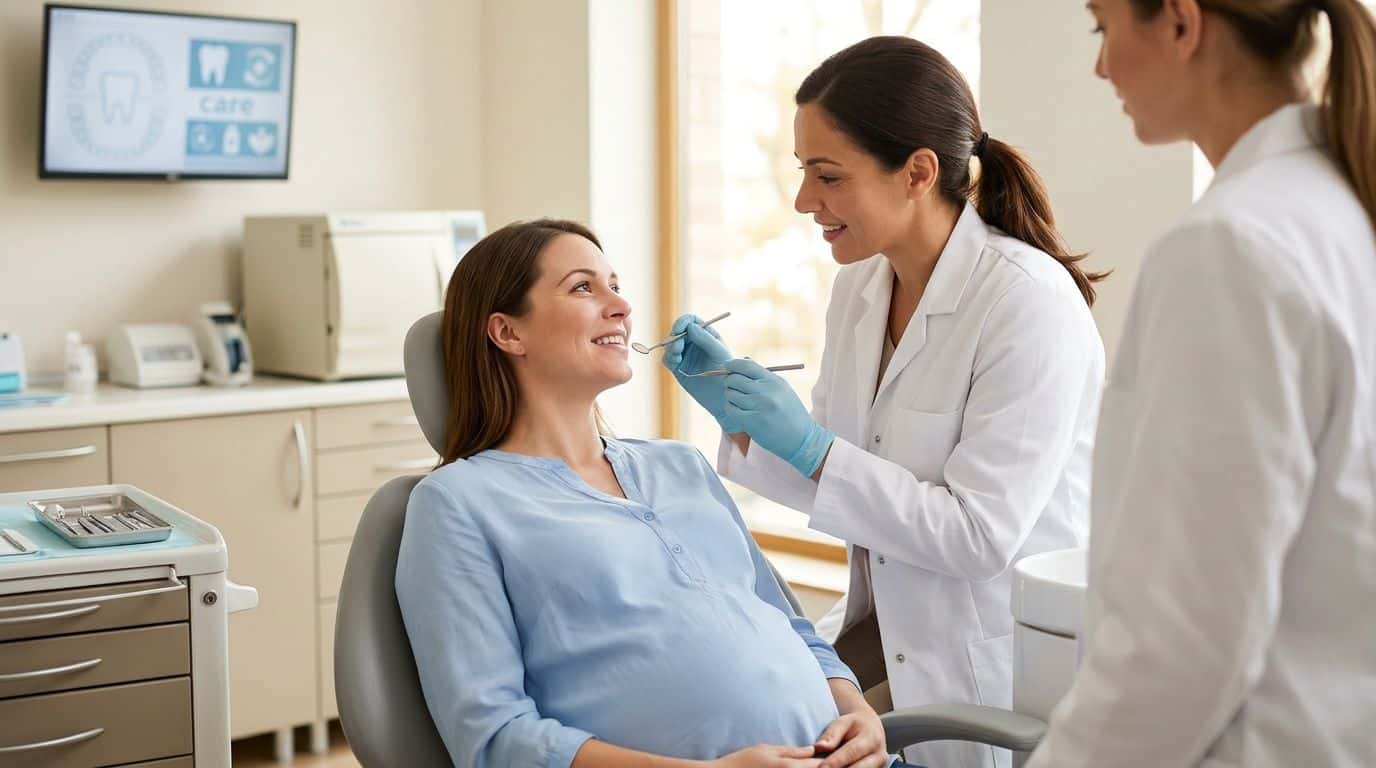
Dental care during pregnancy is preventive and restorative treatment scheduled around trimester safety windows, and the biology behind it hasn't changed for 2026: rising progesterone and estrogen make gums more reactive to plaque from week one of pregnancy through delivery. Pregnant patients deal with a documented jump in gum inflammation, enamel erosion from morning sickness, and real confusion about which treatments are safe at which stage — a plan built around trimester timing answers most of that confusion in one visit.
TL;DR
- Dental care during pregnancy is safest for elective work in the second trimester, roughly weeks 14 to 20.
- Pregnancy gingivitis is estimated by the American Dental Association to affect 60-75% of pregnant patients.
- Routine cleanings, fillings and necessary X-rays with a lead apron are cleared safe in all three trimesters.
- Affordable Dentist Near Me schedules pregnancy-safe cleanings and urgent care across Fort Worth, Dallas, Houston, Waco, Grand Prairie and Crowley.
- Whitening and other elective cosmetic work should wait until after delivery.
Why dental care during pregnancy matters for expecting mothers
Skipping the dentist while pregnant is the mistake, not the visit itself. The American College of Obstetricians and Gynecologists has stated for years that dental treatment — including X-rays, local anesthesia and pain medication as prescribed — is safe throughout pregnancy, and that untreated infection or gum disease carries more risk than treatment does. Research cited by ACOG has linked untreated periodontal disease to higher rates of preterm birth, though it hasn't been proven as a direct cause.
What makes this segment different from a routine adult checkup is timing and physiology, not the treatment itself. Morning sickness introduces stomach acid to enamel dozens of times over a pregnancy. Hormonal swelling makes gums bleed with brushing that wouldn't have bothered you a year earlier. And most patients are anxious about X-rays and anesthesia for reasons that don't hold up against the actual guidance from Affordable Dentist Near Me and national dental boards.
How to handle dental care during pregnancy, trimester by trimester
Schedule elective visits in the second trimester
The first trimester carries the highest miscarriage risk independent of any dental work, and the third trimester makes lying flat in a dental chair uncomfortable. Weeks 14 through 20 are the sweet spot most OBs and dentists recommend for anything non-urgent.
- Book routine cleanings and checkups for weeks 14-20 when possible
- Tell the front desk you're pregnant and give your due date when scheduling
- Never delay urgent care (pain, swelling, infection) to any specific trimester
- Ask your OB for written clearance only if you have a high-risk pregnancy
- Keep short appointments in the third trimester and request a left-side tilt position for comfort
Disclose every medication and condition before treatment starts
A dentist can't build a safe plan without your full medical picture. This step takes five minutes and changes what anesthesia, medication and imaging choices are made.
- List every prenatal vitamin and supplement you're taking
- Flag any pregnancy complications: gestational diabetes, preeclampsia, or a history of preterm labor
- Disclose all prescription and over-the-counter medications
- Confirm your due date and trimester at every visit, not just the first one
- Ask specifically about lidocaine, which is the local anesthetic most commonly used during pregnancy
Treat pregnancy gingivitis before it progresses
Bleeding gums during pregnancy get dismissed as normal far too often. Left alone, pregnancy gingivitis can progress to periodontitis, which is harder and more expensive to treat postpartum.
- Switch to a soft-bristle brush and brush twice daily
- Floss once a day even if gums bleed at first
- Rinse with an alcohol-free antimicrobial mouthwash
- Get a professional cleaning every trimester if gums are inflamed
- Watch for swelling, redness or a metallic taste as early warning signs
- Ask about a deep cleaning (scaling and root planing) if pockets have formed around the teeth
A preventive cleaning plan built around pregnancy timing is the fastest way to catch gingivitis before it turns into something that needs a periodontist. If gum disease has already progressed, a gum disease treatment plan handles it without waiting for delivery.
Manage morning sickness damage to enamel
Stomach acid from vomiting softens enamel temporarily, and brushing right after vomiting can scrub away softened enamel instead of protecting it.
- Rinse with water or a teaspoon of baking soda in water after vomiting
- Wait about 30 minutes before brushing
- Use a fluoride toothpaste at every brushing
- Chew sugar-free gum between meals to boost saliva flow
- Avoid acidic snacks and drinks right before bed
Get X-rays only when necessary, and protected
Dental X-rays during pregnancy carry a radiation dose far below levels associated with fetal harm, and the ADA and ACOG both classify them as safe when protective steps are used.
- Request a lead apron and a thyroid collar for every X-ray
- Ask for digital X-rays, which use a lower radiation dose than film
- Delay purely elective imaging (like orthodontic planning X-rays) until after delivery
- Never skip a diagnostic X-ray needed to find the source of pain or infection
Handle urgent and restorative treatment without delay
An infection left untreated because someone is nervous about treating it during pregnancy is a bigger risk to the pregnancy than the treatment itself.
- Treat abscesses and infections immediately, regardless of trimester
- Get fillings and crowns done with local anesthesia as needed
- Root canals are safe and are best scheduled in the second trimester when possible
- Extractions for infected or badly damaged teeth shouldn't wait for a due date
Delay elective and cosmetic work until after delivery
Nothing about pregnancy makes whitening or veneers dangerous exactly, but there's also no reason to rush them when the science on bleaching agents and pregnancy is limited.
- Postpone teeth whitening until after delivery, including at-home kits
- Hold off on veneers and cosmetic bonding unless there's a functional need
- Continue existing orthodontic adjustments but flag your pregnancy at each visit
- Schedule cosmetic consultations for the postpartum period once breastfeeding plans are set
If anxiety about the chair, not the treatment itself, is what's keeping you away, a sedation dentistry option built for anxious patients can be adjusted for pregnancy — nitrous oxide is generally avoided in the first trimester, but other calming approaches aren't off the table.
Comparing your options during pregnancy
| Option |
Best For |
Safe Timing |
Key Limitation |
| Routine cleaning & checkup |
Everyone, every trimester |
All three trimesters |
Doesn't treat existing infection |
| Fillings & crowns |
Active decay or damage |
Best in second trimester |
Requires local anesthesia disclosure |
| Root canal |
Infected tooth pain |
Second trimester preferred |
Longer chair time, plan around comfort |
| Necessary X-ray |
Diagnosing pain or infection |
Any trimester with lead apron |
Elective imaging should wait |
| Whitening / cosmetic work |
Non-urgent aesthetic goals |
Postpartum |
Limited pregnancy safety data |
Verdict: routine cleanings and necessary restorative work are safe in every trimester of pregnancy, and the only category worth postponing is elective cosmetic treatment.
Common mistakes pregnant patients make with dental care
- Skipping the dentist entirely for nine months. Avoiding appointments out of fear lets gingivitis progress unchecked instead of catching it early.
- Refusing all X-rays, including diagnostic ones. A necessary X-ray with a lead apron carries a lower risk than an untreated infection.
- Dismissing bleeding gums as "just pregnancy." Bleeding is a symptom to treat, not a condition to wait out.
- Scheduling elective procedures for the third trimester. Comfort and safety both favor the second trimester for anything non-urgent.
- Stopping oral hygiene because of nausea. Rinsing and waiting before brushing solves the acid problem without giving up daily care.
Book a pregnancy-safe dental visit
Schedule a cleaning or ask about family plans built around your due date.
FAQ
Is dental care safe during pregnancy?
Yes, routine cleanings, fillings, root canals and necessary X-rays are all considered safe during pregnancy by the ADA and ACOG. The main adjustment is timing elective work for the second trimester and protecting against radiation with a lead apron for X-rays.
Can I get a filling while pregnant?
Yes, fillings are safe at any point in pregnancy and are best done in the second trimester when possible. Local anesthesia like lidocaine is routinely used and considered safe.
Are dental X-rays safe during pregnancy?
Dental X-rays are safe during pregnancy when a lead apron and thyroid collar are used, and digital X-rays lower the radiation dose further. Elective, non-diagnostic imaging can still be postponed until after delivery.
What trimester is best for dental work?
The second trimester, roughly weeks 14 through 20, is the recommended window for elective and non-urgent dental work. Urgent care for pain or infection should never wait for a specific trimester.
Does pregnancy cause gum disease?
Pregnancy hormones increase blood flow to the gums, which raises the risk of pregnancy gingivitis in an estimated 60-75% of pregnant patients according to the American Dental Association. Left untreated, it can progress to periodontitis.
Is teeth whitening safe during pregnancy?
There isn’t enough safety data on whitening agents during pregnancy, so most dentists recommend postponing whitening until after delivery. Routine cleanings still remove surface stains in the meantime.
Can I get a root canal while pregnant?
Yes, root canals are safe during pregnancy and are typically scheduled in the second trimester for comfort. Delaying treatment for an infected tooth carries more risk than the procedure itself.
Does dental insurance cover pregnancy dental visits?
Pregnancy doesn’t change standard dental insurance coverage, so cleanings, fillings and urgent care are covered the same way they would be outside of pregnancy. Patients without insurance still have affordable options for routine and urgent care.
One last thing
Bring your prenatal record or due date card to every dental visit in 2026, even the routine ones. It changes which anesthesia and imaging choices the office makes before you even sit down, and it removes the guesswork that causes most pregnant patients to delay care they actually need.
Related guides