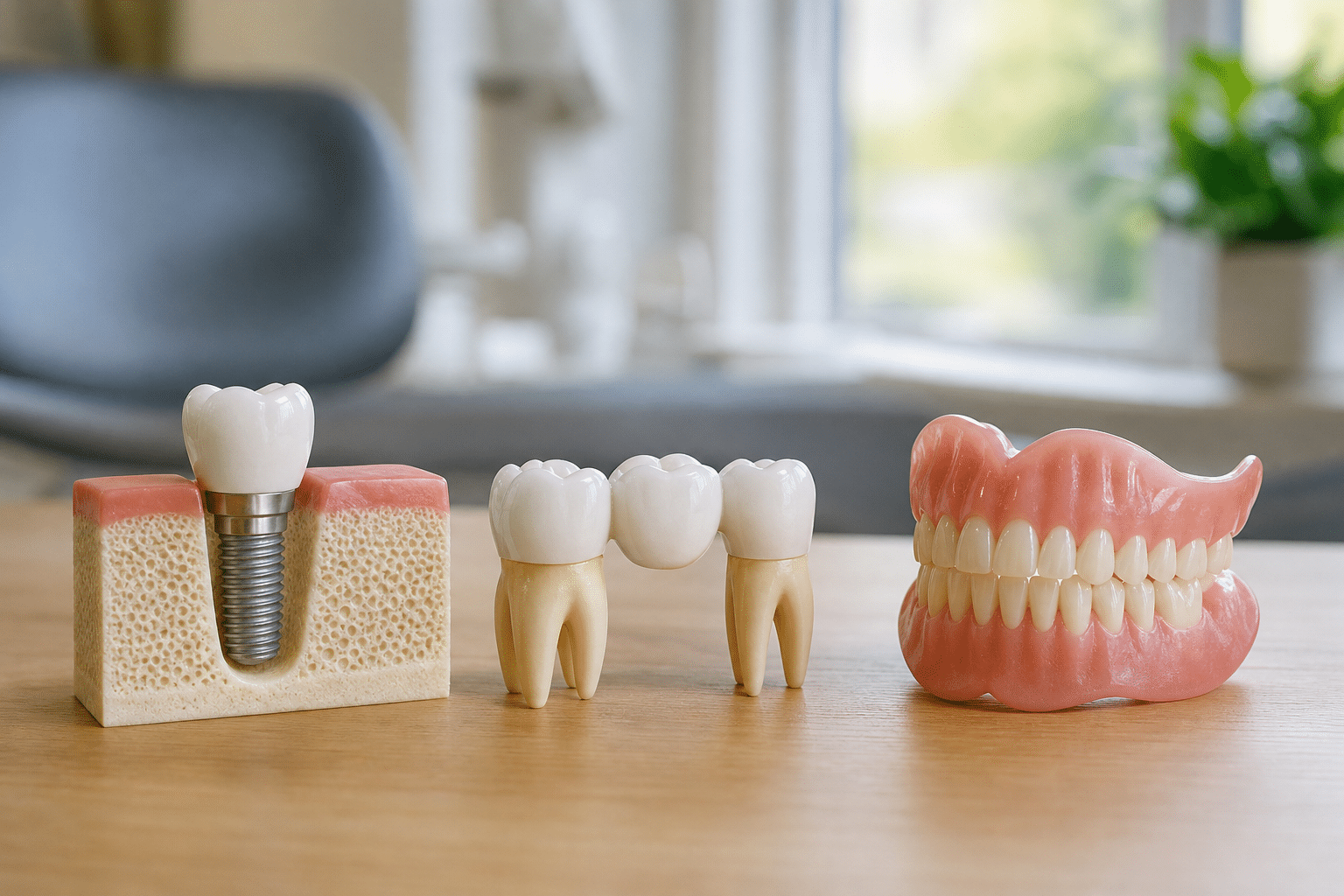
Missing teeth are more common than most people realize, and the replacing teeth options available today range from same-day temporaries to permanent surgical solutions. The right choice depends on how many teeth you've lost, the health of your jawbone, your budget, and how quickly you need a result. This guide walks you through each option and includes a decision checklist that maps your situation to a specific solution, so you arrive at your dentist appointment already knowing what to ask.
What Factors Decide Which Replacing Teeth Option Is Right for You?
Four variables narrow the list before you even sit in a dental chair: how many teeth are missing, your jawbone density, your budget, and your timeline. Each one can rule certain options in or out.
According to the American Dental Association's 2024 data reported by AARP, the typical adult has at least three or more missing or decayed teeth by age 64. That means most people are choosing between options for more than one tooth, not just one gap. If you're in that situation, reviewing the options for the replacement of multiple missing teeth before your consultation will help you ask sharper questions.
Jawbone density matters because implants require enough bone to anchor a titanium post. If you've had missing teeth for a while, the bone beneath the gap can shrink, a process called resorption, which may limit your surgical options or require a bone graft first. Neighboring tooth health matters too: bridges crown the teeth on either side of a gap, so those teeth need to be structurally sound. Surgical options take months to heal; non-surgical options can be placed in days. CareCredit reported in 2019 that half of American adults between 20 and 64 have lost at least one permanent tooth, which means dental offices handle this decision every day.
Dental Implants: The Permanent Teeth Replacement Option
Dental implants are widely considered the most durable permanent teeth replacement option available, and they work for a single missing tooth or a full mouth restoration. The process involves placing a titanium post into the jawbone, where it fuses with the bone over several months, a process called osseointegration. Once that fusion is complete, a crown, bridge, or denture attaches on top, creating a stable, natural-looking result that functions like a real tooth.
Because the post bonds directly to the bone, implants are the only replacement option that also stimulates the jaw and helps prevent bone loss over time. That makes them a strong choice for long-term oral health, not just appearance.
Implants do require surgery, sufficient bone density, and a healing period that typically spans several months. Patients with uncontrolled diabetes, active gum disease, or significant bone loss may need additional treatment before they qualify. The upfront cost is higher than other options, though implants, when well maintained, can last a lifetime. For a closer look at how implants compare to every other solution, see this overview of tooth replacement options compared.
Full mouth teeth replacement options using implants include implant-supported dentures and full-arch fixed bridges anchored by four to six implants. These restore all upper or lower teeth without the need for individual posts at every site. If you want to understand the surgical steps involved, a step-by-step guide to dental implant placement explains what happens at each appointment.
Dental Bridges: A Fixed Option for Single Tooth Replacement
A dental bridge is one of the most common single tooth replacement options for patients who want a fixed, non-removable result without surgery. It works by anchoring an artificial tooth (called a pontic) between two natural teeth that have been fitted with crowns. The neighboring teeth, called abutment teeth, hold the bridge in place permanently.
Bridges are a practical choice when the teeth on either side of the gap are already damaged or crowned, since those teeth will be reshaped regardless. When the neighboring teeth are healthy, the trade-off is more significant: the dentist must file down perfectly good tooth structure to create the anchor crowns, and that preparation is irreversible.
There is also a documented nerve risk to consider. Leeds Teaching Hospitals reports that 10 to 15% of conventional bridge cases result in permanent nerve damage to the supporting teeth. This is not a reason to avoid bridges entirely, but it is worth discussing with your dentist before you commit, particularly if the abutment teeth are currently healthy.
Bridges do not stimulate the jawbone beneath the gap, so some bone loss in that area can occur over time. They are generally less expensive upfront than implants and can be placed in two appointments, making them a faster path to a fixed result. For patients in the DFW area, dental bridges in Mansfield, TX are available at a local ADNM office.
Removable Partial and Full Dentures: Full Mouth Teeth Replacement Options
Dentures remain one of the most widely used full mouth teeth replacement options because they require no surgery and can be fabricated relatively quickly. A removable partial denture replaces several missing teeth and clips onto the remaining natural teeth using a gum-colored base. A full denture replaces an entire arch when no natural teeth remain.
Partial dentures are a non-surgical option for patients missing multiple teeth who are not candidates for implants or prefer to avoid surgery. They are typically less expensive upfront than both implants and bridges. Full dentures suit patients who have lost or need to remove all teeth in one arch, and same-day options are available at some offices for patients who need a result quickly.
The trade-offs are real. Removable dentures can feel bulky, may shift during eating or speaking, and do not prevent bone loss beneath the gum line. Per healthline.com, partial dentures typically need replacement every five to eight years as the mouth changes shape. Daily cleaning and overnight soaking are required, adding a maintenance routine that fixed options do not. For a broader look at what daily life with dentures involves, a guide to life with dentures covers what to expect long-term.
What Is the Best Temporary Tooth Replacement Option?
A flipper tooth is the most common temporary solution for a visible gap while you wait for a permanent restoration. It is a lightweight, removable partial denture made of acrylic that fills the space quickly, often within 24 to 48 hours of being ordered.
Flippers are used most often after an extraction, while an implant site heals, or while a bridge is being fabricated. They are not designed for heavy chewing and are considered a stopgap rather than a long-term fix. The acrylic base is more fragile than the materials used in permanent options and can crack if mishandled.
If you need something in place quickly while your permanent option is being prepared, a flipper covers the gap without surgery or a long wait. Your dentist will advise when it is safe to move to the permanent solution.
How to Fix Missing Teeth Without Implants: A Decision Checklist
Not everyone is a surgical candidate, and implants are not the only path to a restored smile. Use this checklist to match your situation to a non-implant option:
- One tooth missing, healthy neighbors: A dental bridge is a fixed option that requires no surgery and can be completed in two visits.
- Several teeth missing, some natural teeth remaining: A removable partial denture clips onto existing teeth and replaces multiple gaps without surgery.
- All teeth missing in one arch: A full denture replaces the entire arch and requires no implants, though fit and stability vary over time.
- Waiting for a permanent solution: A flipper tooth fills a visible gap temporarily while healing or fabrication is underway.
- Budget is the primary concern: Bridges and partial dentures are typically less expensive upfront than implants; flippers are the lowest upfront cost of all.
- Bone loss is significant: Non-surgical options do not require bone density, making them accessible when implants are not an option.
- Timeline is short: Flippers can be ready in days; bridges take about two weeks; dentures vary by type but can sometimes be placed the same day.
If you are unsure which category fits your situation, a dentist can assess your bone health, the condition of remaining teeth, and your timeline in a single exam appointment.
Finding Affordable Tooth Replacement Care in Texas
Affordable Dentist Near Me (ADNM) is an independent, Texas-owned dental group with 17 offices across the Dallas, Fort Worth Metroplex, East Texas, and Central Texas. Every location offers the full range of replacement options covered in this guide, from single implants and bridges to partial and full dentures, same-day denture options, and implant-supported full-arch restorations.
Schedule a free exam to confirm which options you qualify for and receive exact fees before treatment begins. ADNM accepts most major PPO dental plans, Medicaid, and CHIP for covered services, and offers in-house financing options (subject to credit approval) for patients who need to spread the cost. Same-day appointments are available for new patients and dental emergencies, Monday through Friday, 9 AM to 6 PM, and Spanish-speaking team members are on staff at every office.
Comparison of Tooth Replacement Options
| Option |
Best for |
Surgical? |
Removable? |
Longevity |
| Dental Implant |
Single tooth or full mouth; patients with adequate bone density |
Yes |
No |
Long-lasting with proper care |
| Dental Bridge |
One or a few missing teeth with healthy adjacent teeth |
No |
No |
Long-lasting; may need replacement over time |
| Removable Partial or Full Denture |
Multiple or all missing teeth; non-surgical candidates |
No |
Yes |
May need replacement or reline every several years |
| Flipper Tooth |
Temporary gap coverage during healing or fabrication |
No |
Yes |
Short-term use only |
Prices and plan limits verified as of October 2026.
FAQs
Can I remove all my teeth and get new ones?
Yes, full extractions followed by full dentures or implant-supported dentures are established treatment paths. Your dentist will evaluate your gum and bone health first. Same-day or immediate dentures can be placed right after extractions in some cases, so you are not without teeth during healing. The right approach depends on how many teeth remain and whether your jawbone can support implants.
What is the cheapest way to replace all my teeth?
Full conventional dentures are typically the least expensive path to replacing all teeth in one arch. A flipper tooth is the lowest-cost option for a single temporary gap. Costs vary based on materials, the number of teeth involved, and whether any preparatory work such as extractions is needed. A free new-patient exam can give you exact figures for your specific situation.
How long do dental implants last compared to bridges?
Implants, when properly maintained, are designed to be a permanent solution and can last a lifetime. Bridges are also long-lasting but may need replacement over time as the supporting teeth or surrounding bone changes. Neither option comes with a guaranteed lifespan, since individual oral hygiene, bite forces, and overall health all play a role.
Will my insurance cover tooth replacement options?
Coverage varies widely by plan. Many PPO plans cover a portion of bridges and dentures but may have waiting periods or annual maximums. Implants are often excluded or only partially covered. Medicaid and CHIP cover certain services for eligible patients. The best step is to bring your insurance information to your first appointment so the dental team can verify your benefits before treatment begins.
Can missing teeth cause bone loss in the jaw?
Yes. When a tooth root is no longer present, the jawbone beneath that area no longer receives stimulation and begins to shrink over time, a process called bone resorption. It can change the shape of your face, affect how remaining teeth fit together, and limit your options for future implants. Replacing a missing tooth sooner rather than later reduces the extent of that bone loss.
Conclusion
The main replacing teeth options are dental implants, bridges, removable partial dentures, full dentures, and temporary flippers. Each one suits a different combination of bone health, budget, number of missing teeth, and timeline. No single option is right for everyone, and the only way to know which ones you qualify for is a clinical exam.
Start by noting how many teeth you are missing and whether you prefer a fixed or removable result. Bring that shortlist to a dentist who can assess your bone density and the condition of neighboring teeth. A free new-patient exam is the most practical first step, and it gives you exact treatment options and fees before you commit to anything.