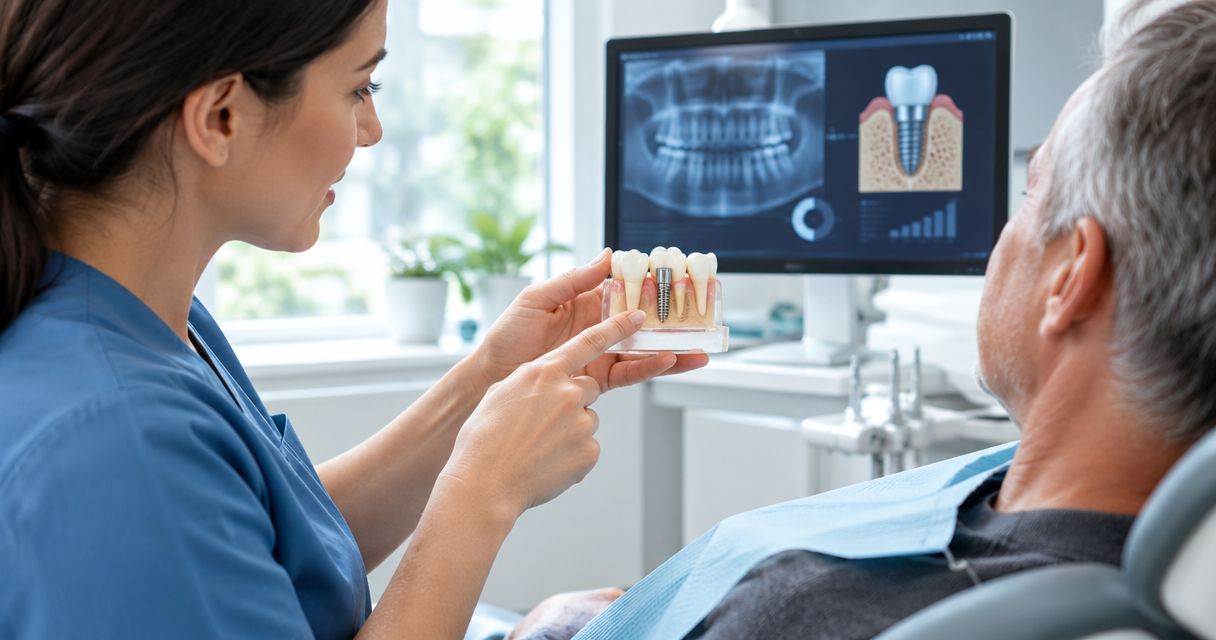
Yes, you can get dental implants with bone loss if enough healthy bone remains or treatment can create adequate support. Bone grafting or a different implant approach can make treatment possible, but neither is suitable for everyone. Your dentist must assess the bone, gum health, nearby nerves and sinuses, and your medical history before recommending an implant.
TL;DR
Dental implants with bone loss require adequate support; bone grafting is one route, not an automatic requirement.
Active gum disease needs treatment before implant placement; replacing teeth does not remove the infection.
Severe bone loss needs individualized planning, sometimes including specialist assessment or a non-implant replacement.
Affordable Dentist Near Me provides dental implant care for families in its Texas service cities.
Can you get dental implants with bone loss?
Bone loss does not automatically rule out dental implants. The decision depends on the amount and location of remaining bone, whether it can support an implant, and whether your mouth can heal safely after treatment.
If gum disease caused your bone loss, address that disease first. This guide to gum disease treatment options explains the treatment choices to discuss before replacing missing teeth.
Treatment approach
Best for
Main advantage
Main limitation
Conventional implants without grafting
Patients with adequate remaining bone at the planned site
Avoids a separate bone-building procedure
Requires suitable bone and safe positioning
Bone grafting followed by implants
Patients whose implant site needs additional bone support
Builds support where an implant is planned
Adds surgery and healing; success is not guaranteed
Tilted implants for selected full-arch cases
Patients with usable bone in suitable areas
Can use existing bone while avoiding some deficient areas
Not suitable for every jaw or single-tooth replacement
Zygomatic implants
Selected patients with severe upper-jaw bone loss
Uses cheekbone support rather than relying only on upper-jaw bone
Requires specialist assessment and complex surgery
Removable dentures
Patients choosing replacement without implant surgery
Does not require implant integration with bone
Fit and stability can become more difficult as the jaw changes
These are treatment categories, not interchangeable choices. Your examination determines which ones belong in your discussion.
Why this matters
An implant needs support in the correct position for the tooth it will carry. Finding bone somewhere in the jaw is not enough: the implant also needs a safe location, a manageable bite, and a replacement tooth you can clean.
For your 2026 treatment decision, ask whether the plan addresses both the missing tooth and the reason bone was lost. A replacement tooth is not a substitute for treating active gum disease. Untreated disease can threaten remaining teeth and future implants.
How does a dentist check whether you have enough bone?
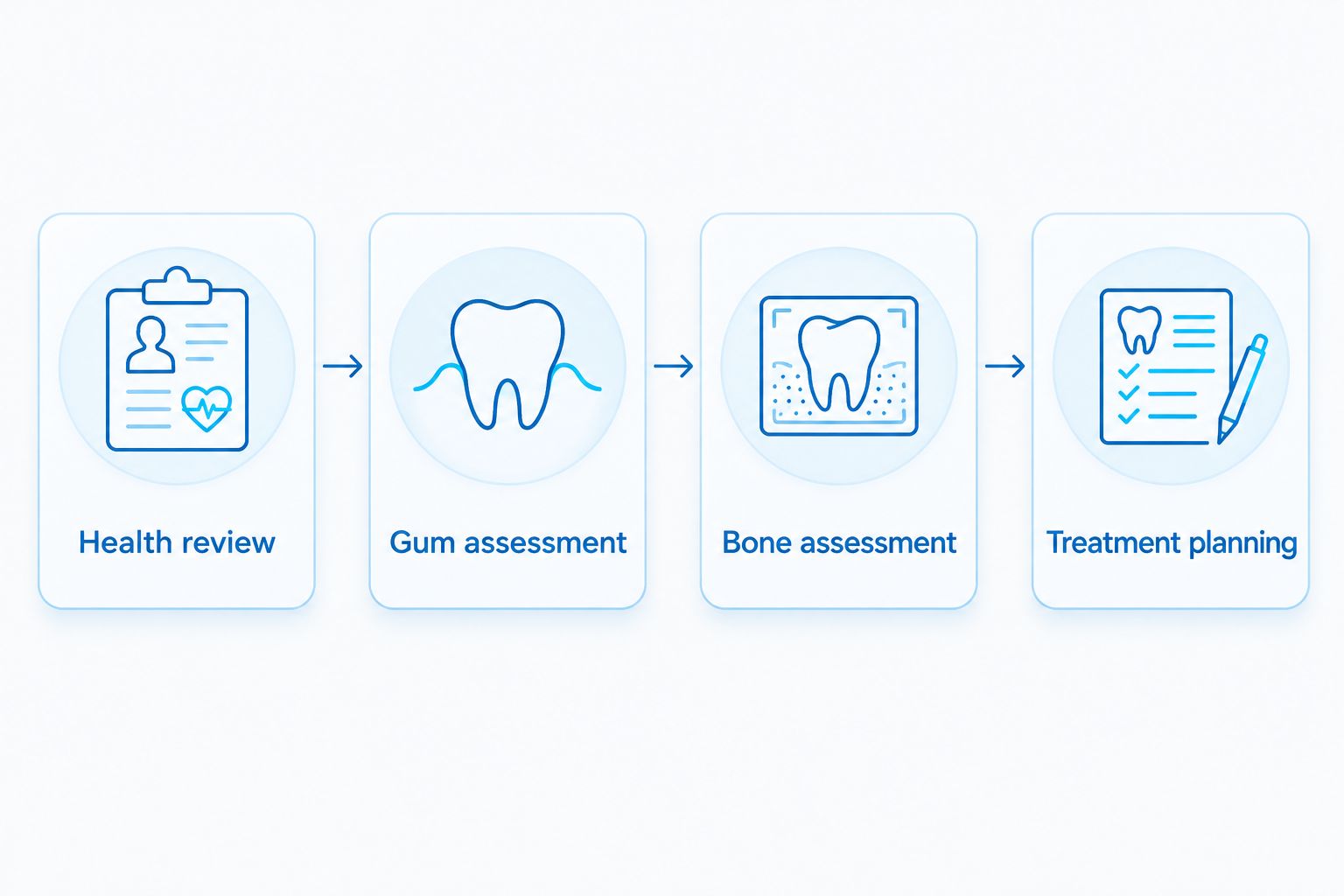
A visual examination alone cannot establish how much bone surrounds a planned implant site. Your dentist combines an oral examination, medical history, and appropriate imaging to assess support and nearby structures.
Health review. Share your medications, smoking history, diabetes history, previous jaw treatment, and any problems with healing. Include medicines used for osteoporosis or cancer treatment.
Gum assessment. Your dentist checks for inflammation, infection, loose teeth, and the condition of the remaining teeth. Disease around those teeth can change the replacement plan.
Bone assessment. Dental imaging helps show bone height and width. When needed, three-dimensional imaging helps assess the implant site, nerves, and the upper-jaw sinus.
Treatment planning. Your dentist considers the replacement tooth's position, available support, cleaning access, and whether grafting or specialist assessment is needed.
The useful result is a site-specific explanation, not simply a label such as mild or severe bone loss. Ask your dentist to show you where support is missing and explain how that changes the proposed treatment.
Implant suitability depends on health, gums, bone, and the planned replacement tooth.
When does bone grafting help with dental implants?
Bone grafting helps when a planned implant site lacks sufficient support and a dentist determines that rebuilding the area is appropriate. Graft material provides a framework for bone healing; it does not become a ready-to-use implant foundation immediately.
A smaller defect can sometimes be treated during implant placement. A larger defect can require grafting first, followed by reassessment before an implant is placed. Do not assume that grafting and implant placement will happen at the same appointment.
The benefit is the ability to build support at a useful location. The drawbacks include another procedure, recovery, possible complications, and the possibility that the healed site still will not meet the treatment requirements.
Ask these questions about a proposed graft:
What part of the implant site needs rebuilding?
Will grafting happen before or during implant placement?
How will you check whether the area has healed sufficiently?
What is the alternative if the graft does not provide enough support?
For a 2026 treatment plan, get those answers in writing alongside the proposed sequence. A plan that explains the decision points is more useful than a promised completion date before your assessment.
What if bone loss is near the upper-jaw sinus?
Missing upper back teeth can leave limited bone between the mouth and the sinus. If that space cannot safely support a planned implant, a sinus lift can create room for graft material beneath the sinus lining.
A sinus lift is not necessary for every upper-jaw implant. Its suitability depends on your anatomy, the available bone, sinus health, and the proposed implant position. Existing sinus symptoms deserve discussion before surgery.
The advantage is additional support in an area where conventional placement would otherwise be difficult. The limitation is added surgical complexity, including risks involving the sinus lining and infection. Ask why this procedure is recommended for your particular site rather than assuming it is a standard step.
Can you avoid a bone graft?
You can avoid a graft when enough suitable bone remains for the treatment your dentist recommends. In selected full-arch cases, tilted implants can use available bone while avoiding areas with limited support.
Shorter implants are another consideration in selected sites, but implant size alone does not solve every bone problem. Width, location, bite forces, and proximity to nerves or sinuses still matter. An approach appropriate for one patient is not automatically appropriate for another.
A graft-free plan must still provide safe, adequate support. Ask what makes the proposed position suitable and whether the replacement teeth will be easy to clean. Avoid treating “no graft” as proof of a better outcome.
What happens if you have severe bone loss?
Severe bone loss calls for a detailed assessment rather than an automatic rejection or a guaranteed implant offer. Your dentist can discuss advanced grafting, specialist implant approaches, or replacement teeth that do not depend on implants.
Zygomatic implants are a specialist option for selected patients with severe upper-jaw bone loss. They use support from the cheekbone and are not a general solution for lower-jaw bone loss. Their complexity makes an appropriately experienced clinician's assessment essential.
Removable dentures remain a valid alternative when surgery is unsuitable or you prefer not to pursue it. Bone loss can affect their fit, so discuss comfort, stability, and future adjustments rather than assuming a denture will stay unchanged.
If you receive conflicting recommendations, request a second opinion using your existing records where appropriate. Ask each clinician to explain the proposed support, surgical risks, and non-surgical alternative.
Why implant suitability varies with bone loss
Two people with missing teeth can need different treatment because the support around the proposed implant sites differs. Your 2026 assessment should explain these factors individually:
Bone location and shape. Height and width matter at the planned site, not just across the jaw as a whole.
Gum disease. Active infection requires treatment and a plan for ongoing maintenance.
Nearby anatomy. Nerves and the upper-jaw sinus limit where an implant can safely sit.
Healing health. Diabetes control, smoking, and some medications affect surgical planning and healing.
Replacement design. A single tooth and a full-arch replacement place different demands on implant position and support.
Cleaning access. Your daily care and professional maintenance must reach the tissues around the replacement.
These factors explain why an online description cannot confirm candidacy. They also give you a practical way to compare recommendations: each plan should explain how it addresses your particular risks.
What should you ask at an implant consultation?
Bring your medication list, relevant medical history, and any previous dental imaging you have. Describe bleeding gums, loose teeth, pain, smoking, and difficulties wearing existing dentures rather than focusing only on the missing tooth.
Ask for a written plan that separates disease treatment, bone preparation, implant placement, and the final replacement tooth. You should also understand what you will wear while the area heals and which findings would change the plan.
Affordable Dentist Near Me is a local dental implant care option for families in Fort Worth, Dallas, Houston, Waco, Grand Prairie, and Crowley. You can start with Affordable Dentist Near Me to discuss an assessment; the examination determines whether implants, grafting, or another replacement is appropriate.
Discuss your tooth replacement options
Ask about bone support, gum health, and the treatment steps your examination supports.
How can you protect the bone and gums around an implant?
Daily cleaning and professional maintenance help protect the tissues supporting an implant. The American Dental Association recommends brushing 2 times per day, for 2 minutes per session, and cleaning between teeth daily. Make that 1 daily cleaning session between teeth part of your routine, using the method your dental team recommends.
An implant-supported replacement can need different cleaning tools from a natural tooth. Ask your dentist to demonstrate how to reach underneath or around the replacement without injuring the gums.
Report bleeding, swelling, discomfort, or a change in how the replacement feels. Do not wait for an implant to feel loose before seeking an assessment. Your 2026 maintenance plan should state which professional visits and home-care methods fit your replacement.
Does gum disease mean you cannot get implants?
Gum disease does not automatically exclude you from implants, but active disease needs treatment before placement. A history of gum disease also makes ongoing cleaning and maintenance especially important.
Bone lost through advanced gum disease does not simply return when bleeding stops. Your dentist must assess the remaining support separately from whether the infection is controlled.
Does diabetes rule out implants when you have bone loss?
Diabetes does not automatically rule out implants, but blood sugar control affects treatment planning and healing. Tell your dentist how your diabetes is managed and whether you have had recent complications or healing problems.
The decision should account for both your medical health and the local bone defect. A bone graft does not remove a medical healing concern.
FAQ
Can I get dental implants if I have been missing teeth for years?
Yes, longstanding tooth loss does not automatically rule out dental implants. Your dentist must assess the remaining bone and determine whether grafting or another approach is appropriate.
Do I always need a bone graft if I have bone loss?
No, bone loss does not always require a graft. You need enough suitable support at the planned implant site, and some patients have adequate remaining bone.
Can a dentist tell how much bone I have just by looking?
No, looking at your gums alone cannot establish the bone available for an implant. An examination and appropriate imaging help assess the support and nearby structures.
Can I get an implant while I have active gum disease?
Active gum disease needs treatment before implant placement. Replacing a tooth does not eliminate infection around the remaining teeth.
Can a bone graft and implant happen at the same appointment?
A bone graft and implant can happen together in selected cases. Other sites need graft healing and reassessment before implant placement.
Is a sinus lift necessary for every upper dental implant?
No, a sinus lift is not necessary for every upper dental implant. The decision depends on available bone, sinus anatomy, and the planned implant position.
Can severe bone loss make dentures a better choice?
Yes, removable dentures can be appropriate when implant surgery is unsuitable or you prefer a non-implant replacement. Bone loss can still affect denture fit and stability.
Can Affordable Dentist Near Me guarantee implants despite bone loss?
An individual examination is required to determine whether dental implants are appropriate. Bone support, gum health, medical history, and safe implant positioning determine the recommendation.
One last thing
Ask to see the bone problem on your imaging before agreeing to the solution. Have your dentist point out the planned implant position, the missing support, and nearby structures that affect the decision.
That discussion turns “you need a graft” into a treatment explanation you can understand. You should leave knowing why the procedure is recommended and what the alternative would be.