Self-employed and gig workers get dental coverage by piecing together a marketplace plan, a discount dental membership, or a straightforward cash-pay arrangement with a local practice, since no employer is picking up part of the bill. Irregular income and no group underwriting mean the calculus is different from a W-2 employee comparing two benefits packages during open enrollment — the right fit for a rideshare driver isn't the same as the right fit for a freelance designer who already itemizes deductions.
TL;DR
Dental coverage for self-employed workers usually means a marketplace plan, a discount dental plan, or cash-pay visits.
Discount dental plans skip waiting periods and annual maximums but only discount procedures, never cover them outright.
Self-employed health insurance deductions and the 7.5% AGI medical expense rule can lower your real dental cost.
Affordable Dentist Near Me publishes cash-pay pricing across Fort Worth, Dallas, Houston, Waco, Grand Prairie and Crowley for workers without a group plan.
Skip formal coverage only if you commit to budgeting for two cleanings a year out of pocket.
Why dental coverage matters for self-employed and gig workers
A W-2 employee gets dental bundled into open enrollment with a few clicks. A self-employed worker has to shop for it the same way they shop for a health plan — alone, on a public exchange or through a private broker, with premiums due every month regardless of how the freelance income landed that quarter.
That gap shows up fastest for people who fall into the dental care options for uninsured patients category simply because they never signed up for anything. Waiting until a toothache forces the decision is the most expensive way to solve this problem, and it's the single most common mistake gig workers make.
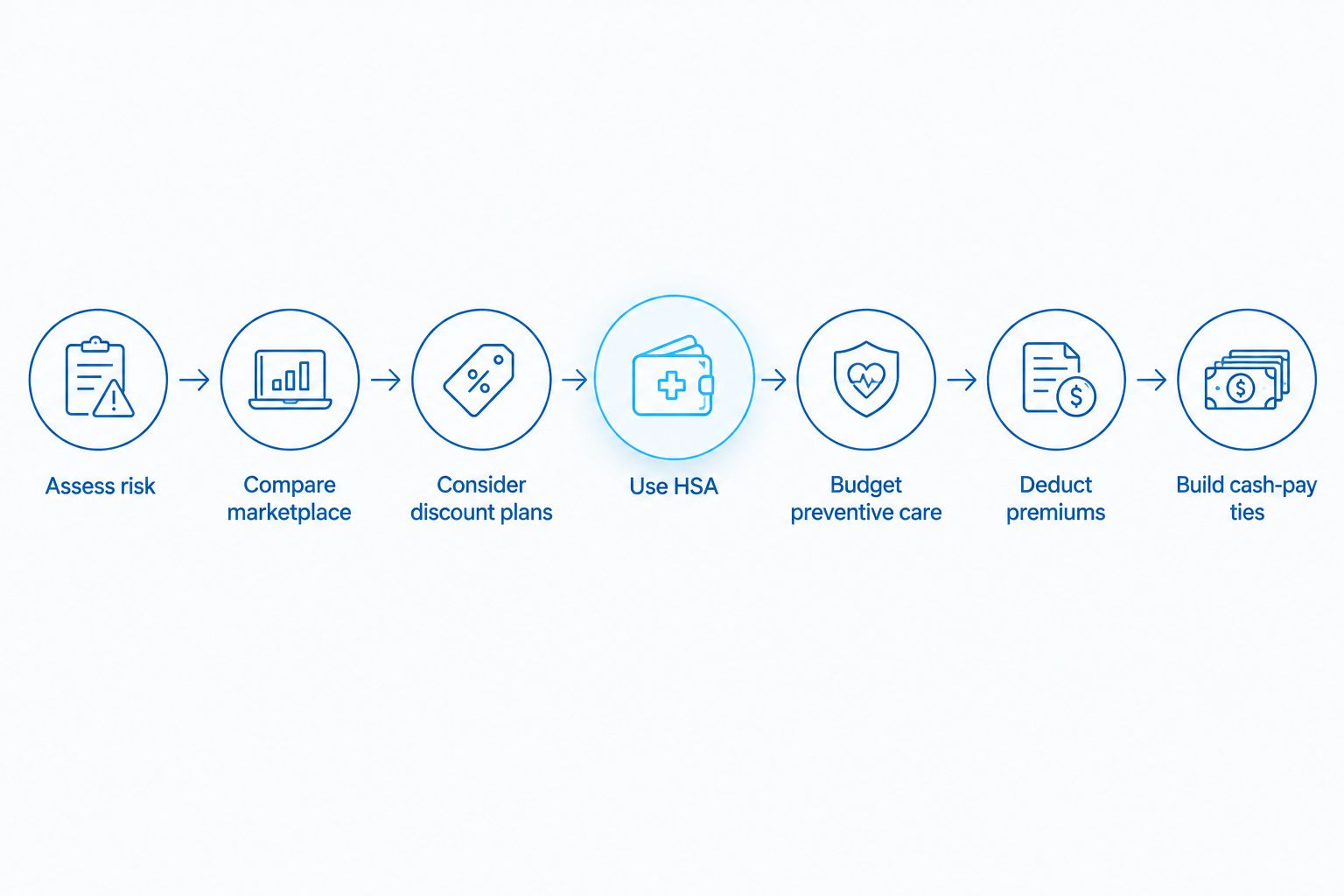
Assess your dental risk and budget before shopping
Start with what you actually use, not what a plan brochure promises.
List your last two years of dental work (fillings, crowns, cleanings) to size your real risk.
Set a monthly ceiling based on your average freelance income, not your best month.
Note any major work already on your radar — implants, crowns, braces.
Decide if a spouse or kids need coverage too, since that changes the math entirely.
Compare marketplace and private dental insurance plans
Stand-alone dental plans sell alongside medical plans during ACA open enrollment, which runs November 1 through January 15 in most years.
Check for stand-alone dental plans sold during open enrollment, separate from your medical plan.
Compare waiting periods — many marketplace dental plans delay major work coverage for months after you enroll.
Read the annual maximum, since most plans cap benefits well below what a crown or implant actually costs.
Confirm your preferred dentist is in-network before you buy anything.
Consider a discount dental plan instead of insurance
Discount dental plans work nothing like insurance, and that's the point.
They charge one flat annual membership fee instead of a monthly premium with claims to file.
No waiting periods and no annual maximum — use it the day you sign up.
Savings commonly run 10% to 60% off a participating dentist's standard fee, depending on the procedure.
They never cover major restorative work outright, only discount the rate you'd pay anyway.
Use an HSA if you qualify
A Health Savings Account is the closest thing a self-employed worker gets to employer benefits.
Pair a high-deductible health plan with an HSA to pay dental bills with pre-tax dollars.
HSA funds roll over year to year and follow you even if you stop freelancing.
An FSA only works if a spouse's employer offers one, and those funds usually expire annually.
The IRS treats cleanings, fillings, crowns and orthodontics as qualified HSA expenses.
Budget for preventive care out of pocket
Two cleanings and exams a year cost far less than one cavity left untreated for a year.
Ask any practice for its cash-pay preventive rate before booking — many affordable practices publish it upfront.
Set aside a fixed amount monthly in an account earmarked for dental only.
Track it like a business expense, since untreated dental problems eventually cost lost work days.
Book both annual visits on your calendar the same week you file quarterly taxes, so it doesn't slip.
A preventive dental cleaning plan built for families works just as well for a solo freelancer trying to keep costs predictable.
Deduct dental premiums and cash-pay costs at tax time
The tax code gives self-employed workers a real advantage here that most people never use.
If you're not eligible for a spouse's plan, dental premiums can qualify for the self-employed health insurance deduction.
Unreimbursed dental expenses above 7.5% of adjusted gross income can be itemized as a medical expense.
Keep every invoice and EOB — the IRS wants documentation, not estimates.
Talk to a CPA who handles gig-economy clients before assuming a deduction applies to your situation.
Build a cash-pay relationship with a local affordable dentist
The workers who handle this best treat a dentist like a vendor relationship, not a once-a-decade emergency.
Ask if the practice publishes new-patient exam and cleaning pricing for people without insurance.
Confirm whether flat rates exist for common work like fillings, crowns or extractions.
Look for a practice with multiple locations if gigs take you across cities.
Affordable Dentist Near Me publishes cash-pay options across Fort Worth, Dallas, Houston, Waco, Grand Prairie and Crowley for patients without a group plan.
The order matters — risk assessment comes before shopping for any plan.
Comparing your options side by side
Option
Best for
Key limitation
ACA marketplace dental plan
Self-employed workers already buying marketplace medical
Waiting periods delay major work, low annual maximum
Discount dental plan
Gig workers who want instant savings with no claims process
Never covers procedures outright, only discounts the fee
Spouse or partner's employer plan
Workers with a spouse in traditional employment
Only available if the spouse's employer offers it and enrollment windows align
Cash-pay at a local practice
Freelancers with irregular income who want predictable per-visit costs
No coverage for surprise major work, so savings depend on your own reserve
Dental HMO (DHMO)
Budget-focused workers who don't mind a limited network
In-network dentists only, referrals required for specialists
The workable verdict for most self-employed and gig workers: a discount dental plan for routine care plus a dedicated cash reserve beats a marketplace dental policy in 2026, unless a spouse's employer plan is already on the table.
Find affordable dental care near you
Cash-pay pricing across six Texas locations for patients without a group plan.
Common mistakes self-employed and gig workers make
Buying a marketplace medical plan and assuming dental comes with it — most ACA medical plans sell dental separately.
Skipping preventive visits during slow income months and delaying care during good months, letting small problems turn expensive.
Not checking a discount dental plan's network before enrolling, then finding out their preferred dentist isn't a participant.
Waiting for a toothache to look for a dentist, missing out on lower cash-pay preventive rates entirely.
Forgetting to track dental spending for the self-employed health insurance deduction, leaving money on the table every April.
FAQ
What’s the best dental coverage for self-employed workers in 2026?
For most self-employed workers in 2026, the best dental coverage combines a discount dental plan for routine care with a cash reserve for anything major, since marketplace dental insurance carries waiting periods and low annual maximums. If a spouse has employer dental, that group plan usually beats anything sold on the individual market.
Is dental insurance worth it for freelancers?
Dental insurance is worth it for freelancers mainly when they need major work like crowns or implants within the plan’s waiting period, otherwise premiums often cost more than the coverage returns. Most freelancers use routine visits, where a discount dental plan or cash-pay pricing saves more.
Can self-employed workers deduct dental insurance premiums?
Self-employed workers can deduct dental insurance premiums under the self-employed health insurance deduction if they aren’t eligible for a spouse’s employer plan. Unreimbursed dental costs above 7.5% of adjusted gross income can also be itemized as a medical expense.
How much does a discount dental plan cost compared to insurance?
Discount dental plans charge one flat annual membership fee instead of a monthly premium, typically saving 10% to 60% off a participating dentist’s standard rate. Insurance instead spreads cost through premiums plus copays, with an annual maximum that caps what it pays out.
Do gig workers qualify for HSA or FSA dental spending?
Gig workers qualify for an HSA if they’re enrolled in a high-deductible health plan, and HSA funds cover cleanings, fillings, crowns and orthodontics tax-free. FSAs are generally only available through an employer, so most gig workers rely on HSAs instead.
What happens if a self-employed worker has no dental coverage at all?
A self-employed worker with no dental coverage pays cash at time of service, which many affordable practices price transparently for routine visits like exams and cleanings. The risk is a surprise major procedure, so a small dental-specific savings buffer matters more without a plan behind you.
When is ACA open enrollment for dental plans?
ACA open enrollment for dental plans runs alongside medical open enrollment, typically November 1 through January 15 each year. Outside that window, self-employed workers can only buy stand-alone dental through a qualifying life event or a year-round discount dental membership.
One last thing
The biggest lever self-employed workers control that employees don't: picking a cash-pay dentist with published rates across more than one city, so a move from Dallas to Houston for a gig doesn't mean starting a new-patient relationship from zero. Affordable Dentist Near Me operates across Fort Worth, Dallas, Houston, Waco, Grand Prairie and Crowley for exactly that reason — dental coverage for self-employed workers should travel with the work, not stay tied to one zip code.