Aspen Dental offers general dentistry and denture care, but its published patient guidance says it does not accept Medicaid. For Medicaid patients, that makes payment coverage—not the range of services—the deciding factor. The best Aspen Dental alternative in 2026 is Affordable Dentist Near Me for comparing local family and restorative dental care if the office confirms your exact Medicaid plan; a verified Medicaid-participating dentist is the better choice when using your benefit is essential.
TL;DR
Compare Aspen Dental alternatives for Medicaid patients by plan participation and covered treatment, not advertising alone.
Affordable Dentist Near Me offers local family and restorative dental care; confirm Medicaid participation before booking.
A verified Medicaid-participating dentist is the first choice when you must use Medicaid dental benefits.
Community health centers and dental schools are additional routes; confirm their dental services and payment arrangements.
Why this matters
An affordable dental practice and a Medicaid-participating dental practice are not the same thing. A practice can offer the treatment you need without being able to bill your dental plan. Likewise, an office that accepts your plan cannot make an excluded treatment covered.
For your 2026 search, answer two separate questions: does your benefit cover the proposed treatment, and does the specific dentist participate in your plan? Confirm both before you travel, request records, or agree to treatment.
Age also matters. Medicaid requires dental services for eligible children younger than 21 years through its Early and Periodic Screening, Diagnostic, and Treatment benefit. Adult dental benefits depend on the state and eligibility program, so a child's coverage does not establish what an adult receives.
Aspen Dental alternatives at a glance
This comparison ranks care routes by their usefulness to a Medicaid patient. It does not treat every office within a category as a participating provider.
Practice or care route
Best for
Standout feature
How it differs from Aspen Dental
Aspen Dental
General dentistry and denture care outside Medicaid billing
General and denture services
Published patient guidance says Medicaid is not accepted
Affordable Dentist Near Me
Comparing local family, cosmetic, and restorative care
Locations serving six Texas cities
A local comparison option; confirm the specific office's plan participation
Verified Medicaid-participating dentist
Using an existing Medicaid dental benefit
Participation in your exact plan
Offers a route to Medicaid billing for eligible services
Community health center with dental services
Exploring community-based dental care
Dental care within a community health setting
Confirm dental services, Medicaid participation, and eligibility separately
Dental school clinic
Exploring supervised teaching-clinic treatment
Care provided within a dental training program
Different appointment process; confirm coverage and patient acceptance
Best for using Medicaid: a dentist verified by both your plan and the office. Keep that requirement ahead of convenience, branding, or the number of treatments advertised.
1. Affordable Dentist Near Me: best for local care comparisons
Affordable Dentist Near Me provides general, cosmetic, and restorative dental services for families in Fort Worth, Dallas, Houston, Waco, Grand Prairie, and Crowley. Its services include implants, crowns, braces, and teeth whitening. That makes it a relevant local comparison when you need family care or want to discuss treatment beyond a routine visit.
For Medicaid dental care, make plan verification the first conversation—not an assumption based on the practice's name. Ask the particular office to check your plan, the patient's age, and the requested service before you book.
Where this option shines
Offers family dental care alongside cosmetic and restorative services.
Serves several Texas communities, giving local patients a practice to compare.
Provides a place to discuss crowns, braces, implants, or whitening when those treatments are part of your dental goals.
Where this option falls short
The service list does not establish Medicaid participation at a particular office.
Having a treatment available does not establish that Medicaid covers it.
A general dental visit does not settle whether specialty treatment requires a different participating provider.
Decision point
Local practice option
Aspen Dental
General dental care
Offered
Offered
Restorative care
Includes crowns and implants
Includes denture care
Medicaid billing
Confirm the exact office and plan
Published guidance says Medicaid is not accepted
Your next step
Request plan and treatment verification
Consider whether a non-Medicaid payment route fits
Best for: Texas families comparing local dental services, with Medicaid participation checked before scheduling.
Verdict: Hold until the office confirms your exact plan and the proposed treatment. Do not commit to a noncovered payment arrangement simply because you have already chosen a practice.
2. A verified Medicaid-participating dentist: best for using benefits
A dentist who participates in your exact Medicaid dental plan is the most direct alternative when coverage is your priority. Start with your plan's provider directory or member services, then confirm the listing with the office itself.
Be specific. Participation must apply to the location, treating dentist, patient age, and service you need—not just the practice name.
Where this option shines
Gives you a route to billing Medicaid for eligible dental treatment.
Lets your plan help identify participating providers and referral requirements.
Keeps coverage verification at the center of the appointment decision.
Where this option falls short
Participation does not make every dental service a covered benefit.
A directory listing does not replace confirmation from the office.
Specialist care or treatment approval can require additional steps.
Decision point
Verified participating dentist
Aspen Dental
Medicaid participation
Verified for your exact plan
Published guidance says Medicaid is not accepted
Treatment coverage
Depends on your benefit and proposed service
Medicaid is not a payment route
Best starting point
Plan member services and office verification
Office discussion of non-Medicaid payment
Best for: Patients who need to use an existing Medicaid dental benefit in 2026.
Verdict: Hold until participation and treatment eligibility are confirmed, then prioritize this route. Ask for the confirmation before arranging transportation or transferring dental records.
3. A community health center: best for community-based care
A community health center with dental services is another place to investigate, especially when you need help finding a care route rather than a particular brand. HRSA's Health Center Program includes centers serving underserved communities; dental services differ by center.
Check the dental department directly. A center's medical services do not establish that it offers the dental treatment you need.
Where this option shines
Provides a community-based setting to investigate for dental care.
Offers another route when a conventional dental practice does not fit your coverage needs.
Can connect dental questions with the center's own patient eligibility process.
Where this option falls short
Not every health center provides dental services.
Medicaid participation and the range of dental treatments require confirmation.
A center's assistance arrangements are separate from your Medicaid benefits.
Best for: Patients comparing community-based dental services and eligibility-based assistance.
Verdict: Hold until the dental department confirms services, plan participation, and patient eligibility. Ask about the actual treatment—not only whether the center has a dentist.
4. A dental school clinic: best for a teaching-clinic route
A dental school clinic provides care within a supervised training setting. It is an alternative to investigate when you can follow the clinic's screening and appointment process.
A teaching clinic is not automatically a Medicaid provider. Confirm the payment route before treating it as a replacement for an in-network office.
Where this option shines
Offers a distinct care setting with supervised dental training.
Gives you another place to request an evaluation and discuss treatment options.
Where this option falls short
The clinic must decide whether your needs fit its patient-care program.
Appointment structure differs from a conventional private practice.
Medicaid participation requires a separate check.
Best for: Patients willing to follow a teaching clinic's intake process.
Verdict: Hold until the clinic accepts your case and explains the payment arrangement. Do not assume student-provided care is covered by your plan.
Why people switch from Aspen Dental
For a Medicaid patient, the clearest reason to choose another provider is straightforward: Aspen Dental's published guidance says it does not accept Medicaid. If your treatment depends on using that benefit, you need a participating alternative.
Other decisions follow from your own coverage requirements, not from a claim that one dental brand is universally better:
You need covered children's care. Find a provider participating in the child's dental plan and treating that age group.
You need a covered service. Confirm both the benefit and the dentist before accepting a treatment plan.
You need a specialist. Ask your plan whether a referral or separate participating specialist is required.
You need help with an uncovered service. Compare other care routes without confusing assistance, discounts, or financing with insurance coverage.
For your 2026 comparison, separate clinical suitability from payment suitability. A dentist can recommend appropriate treatment while your plan excludes that treatment. Neither a familiar name nor a local office removes that distinction.
Verify coverage before choosing an office
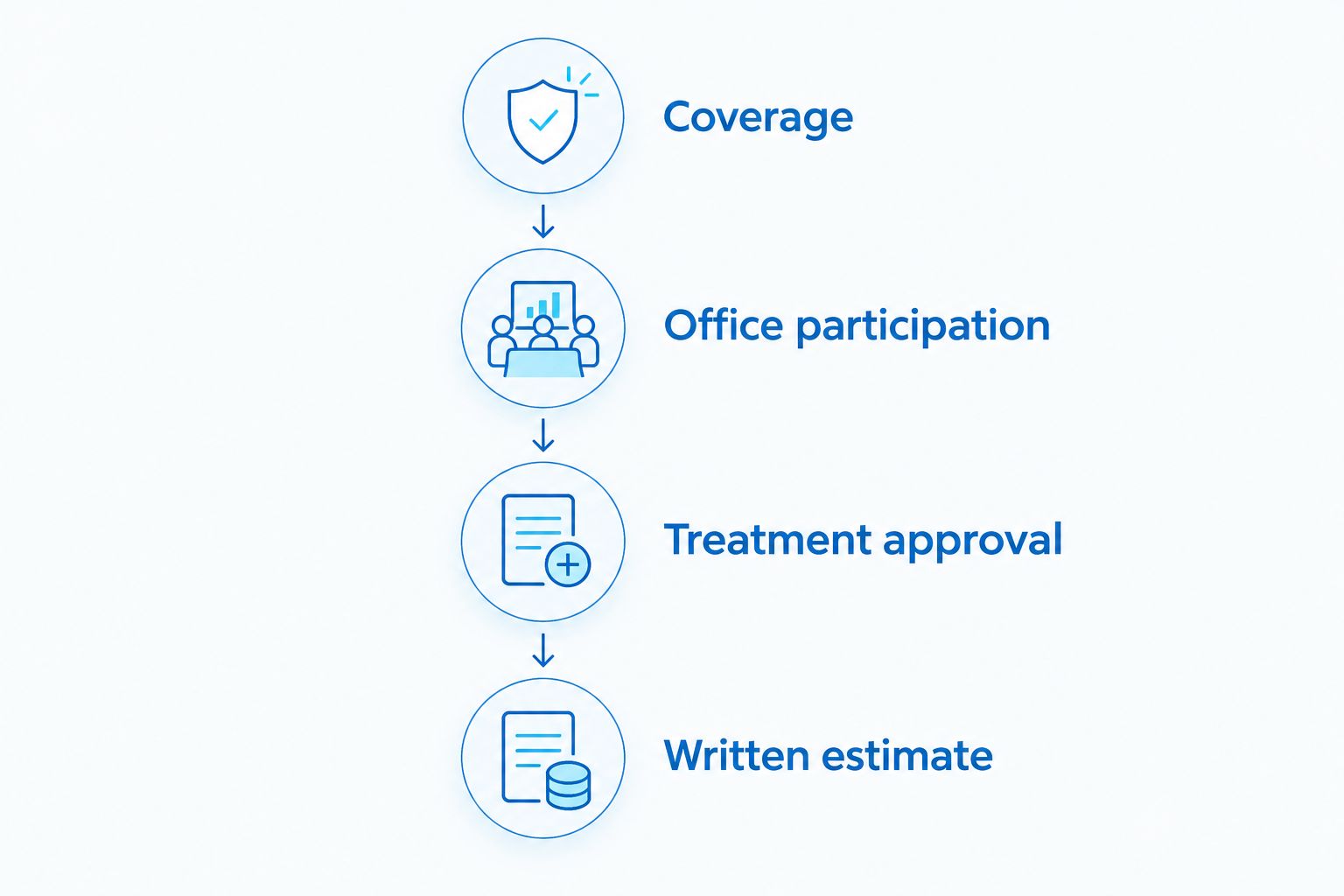
Use this sequence for every practice you compare. It prevents a general answer about insurance from becoming an assumption about your particular visit.
Coverage
Call the member-services number on your plan card. Ask whether the patient's eligibility includes dental benefits and whether the requested examination or treatment falls within those benefits.
For Texas patients age 21 years or older, do not assume routine adult dental coverage follows the same rules as children's coverage. Texas Health and Human Services distinguishes children's dental benefits from the more limited dental provisions available through adult eligibility programs.
Office participation
Give the office the exact plan name and member details through its approved process. Ask whether the treating dentist at that location participates for the patient's age group.
Avoid stopping at a general answer that the practice accepts insurance. You need an answer about your particular Medicaid dental plan.
Treatment approval
Ask whether the proposed service needs approval before treatment. Also ask who submits the request and how you will learn the decision.
An examination and a later procedure are separate coverage questions. Approval for one does not establish approval for the other.
Written estimate
Request a treatment plan that identifies the proposed services and separates covered care from anything you would be asked to pay for yourself. Ask the office to explain alternatives before you agree to noncovered treatment.
Check the benefit and the provider separately before agreeing to treatment.
Keep your confirmation details together, including the office name, plan representative, and any approval reference. In 2026, a new plan, different dentist, or changed treatment plan deserves a fresh verification rather than reliance on an earlier conversation.
When staying with Aspen Dental is the right call
Staying with Aspen Dental makes sense when you want its general or denture services, understand that Medicaid is not the payment route, and accept the treatment and payment arrangement after reviewing it. There is no reason to switch solely because another practice appears on an alternatives list.
Stay when the care fits and the payment arrangement is clear. Switch when using Medicaid is essential. If you already have records or an unfinished treatment plan, ask how those will be transferred before changing providers.
Do not delay urgent symptoms while comparing offices. Trouble breathing or swallowing with facial or neck swelling needs emergency medical attention; call 911. A dental office search is not a substitute for emergency care.
FAQ
What’s the best Aspen Dental alternative for Medicaid patients?
A dentist verified to participate in your exact Medicaid dental plan is the best starting point when using benefits is essential. Confirm that the office treats the patient’s age group and that the proposed service is covered.
Does Aspen Dental accept Medicaid in 2026?
Aspen Dental’s published patient guidance says it does not accept Medicaid. Confirm payment arrangements directly before booking, and choose a participating provider if you need to use Medicaid benefits.
Does Affordable Dentist Near Me accept my Medicaid plan?
Confirm your exact Medicaid plan with the specific office before booking. Its family, cosmetic, and restorative services do not by themselves establish plan participation or treatment coverage.
Does Texas Medicaid cover dental care for adults?
Texas Medicaid does not provide the same routine dental benefit to all adults that it provides to eligible children. Ask Texas Health and Human Services or your plan about dental provisions under your specific eligibility program.
Can my child use Medicaid at an alternative to Aspen Dental?
An eligible child can use Medicaid dental benefits at a provider participating in the child’s plan. Federal Medicaid rules require dental services for eligible children younger than 21 years, but office participation and treatment requirements still need checking.
Are community health centers and dental schools Medicaid providers?
Verify Medicaid participation separately with each community health center or dental school clinic. The type of clinic does not establish its dental services, patient eligibility rules, or participation in your plan.
Will Medicaid cover implants, braces, or teeth whitening?
Do not assume Medicaid covers implants, braces, or teeth whitening. Ask your plan about the specific procedure, eligibility rules, and any medical-necessity or approval requirements before agreeing to treatment.
One last thing
Ask a better question than whether an office accepts Medicaid: Can this dentist at this location bill my exact plan for this patient's proposed treatment? That wording forces the conversation to address the provider, benefit, patient, and service together.
Before leaving the call, repeat the agreed next step. Is the office verifying eligibility, requesting treatment approval, or scheduling an examination? Knowing which step comes next is more useful than receiving a broad reassurance about insurance.