Gum disease can be reversed without surgery when it is gingivitis, the early stage that has not damaged the bone supporting your teeth. Once it becomes periodontitis, nonsurgical treatment can control the infection and help prevent further damage, but brushing and cleaning do not restore lost bone or guarantee that surgery can be avoided.
TL;DR
Can gum disease be reversed? Gingivitis can; periodontitis needs ongoing management rather than a promise of complete reversal.
The American Dental Association recommends brushing twice daily and cleaning between teeth daily to help prevent gum disease.
Professional treatment removes hardened deposits that brushing and mouthwash cannot remove.
A gum examination determines whether nonsurgical care is enough or specialist treatment is needed.
Can gum disease be reversed without surgery?
Yes for gingivitis; not completely for established periodontitis. The important difference is whether inflammation affects only your gums or has damaged the tissues and bone holding your teeth in place. Bleeding alone does not tell you which stage you have.
For your 2026 treatment decision, start with a diagnosis rather than a product promising to reverse gum disease. This comparison of gum disease treatment options explains the choices to discuss with your dentist.
Condition or treatment
Best for
What it can achieve
Main limitation
Gingivitis care
Inflamed gums without loss of tooth support
Resolve inflammation through professional cleaning and consistent home care
Plaque buildup can bring inflammation back
Scaling and root planing
Periodontitis requiring cleaning below the gumline
Remove deposits from tooth roots and help reduce inflammation
Does not automatically replace lost bone or eliminate every deep pocket
Periodontal maintenance
People previously treated for periodontitis
Monitor gum health and remove recurring deposits
Requires continuing visits and daily home care
Gum surgery
Persistent deep pockets or other problems needing surgical access
Allow access to difficult areas; selected procedures address tissue or bone defects
Requires an individual assessment and recovery; results depend on the procedure
The National Institute of Dental and Craniofacial Research describes gingivitis as a milder form of gum disease that can usually be reversed with daily brushing, flossing, and regular professional cleaning. Its gum-disease guidance also explains that advanced disease can damage supporting tissue and bone. These distinctions—not how sore your gums feel—should guide treatment.
Why this matters
Gum disease does not need to hurt to cause damage. Waiting until a tooth feels loose can mean waiting until the problem has already affected its support.
The right early treatment can also prevent unnecessary escalation. You do not need to assume that bleeding gums require surgery, but you should not assume that stopping the bleeding proves the underlying disease is gone.
For families seeking general dental care, Affordable Dentist Near Me serves Fort Worth, Dallas, Houston, Waco, Grand Prairie, and Crowley. Affordable Dentist Near Me is best for families seeking local general dental care in these Texas communities. For suspected gum disease, ask what assessment and referral arrangements fit your needs; the practice description alone does not establish which specialist treatments are available.
Gingivitis: reversible without surgery
Gingivitis causes inflammation without the loss of supporting bone that defines periodontitis. Typical signs include red or swollen gums and bleeding when you brush or clean between teeth. A dentist must confirm the stage because symptoms overlap.
Plaque is a sticky bacterial film that collects on teeth. When it remains near the gumline, it irritates the gums; when it hardens into tartar, you cannot remove it reliably with a toothbrush.
Professional cleaning removes deposits you cannot clear at home. Daily cleaning then helps prevent new buildup, giving inflamed gums a chance to recover.
Best for gingivitis: professional cleaning plus consistent brushing and cleaning between teeth. The advantage is that this approach addresses the cause without surgery. Its limitation is that improvement will not last if deposits repeatedly accumulate.
Do not scrub harder to force bleeding to stop. Use a soft-bristled toothbrush and gentle pressure, and ask your dental team to demonstrate cleaning around the areas that bleed.
Periodontitis: control is different from reversal
Periodontitis damages the structures supporting your teeth. Spaces called gum pockets can deepen, making deposits below the gumline harder to remove with ordinary home care.
Nonsurgical treatment commonly begins with scaling and root planing, sometimes called a deep cleaning. The dentist or dental hygienist cleans below the gumline and along affected root surfaces; local numbing helps manage discomfort when needed.
This treatment can reduce inflammation and help gums heal more closely around teeth. It does not mean that missing bone has grown back, or that every affected tooth has the same outlook.
Best for periodontitis needing below-gum cleaning: a treatment plan based on measured gum pockets and bone support. The benefit is an opportunity to control disease without immediately proceeding to surgery. The limitation is that persistent deep pockets or difficult-to-clean areas can still require additional treatment.
A 2026 treatment plan should include reassessment after initial therapy. Ask how the dentist will judge improvement and what findings would justify a referral to a gum specialist, also called a periodontist.
What does nonsurgical gum treatment involve?
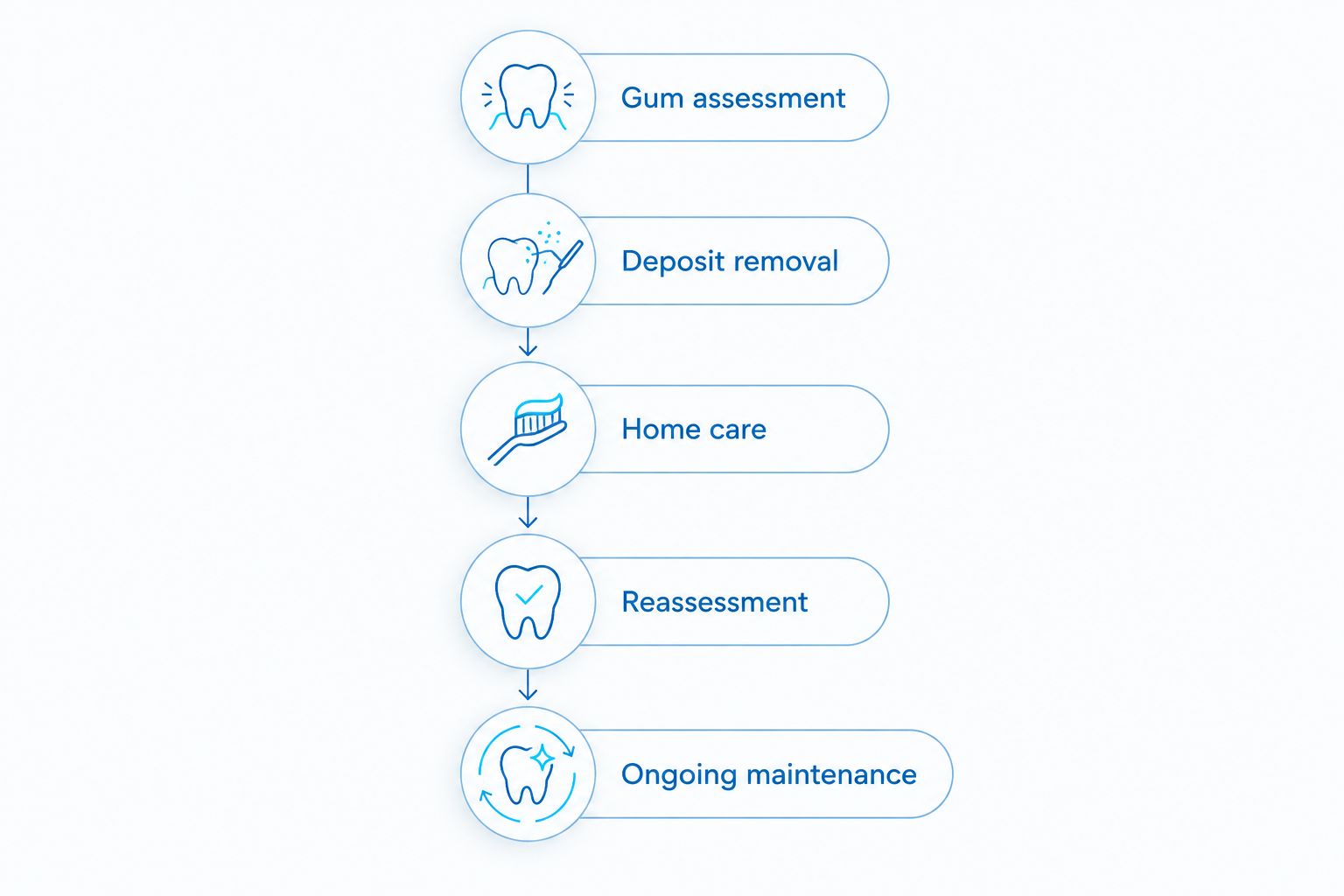
Nonsurgical care is a sequence, not a single cleaning followed by permanent recovery. Each step answers a different question about your gums and their response to treatment.
Gum assessment. Your dentist reviews symptoms, health conditions, medications, and tobacco use, then examines your gums and measures the spaces around your teeth. X-rays are used when needed to assess supporting bone.
Deposit removal. The dental team recommends routine cleaning or below-gum treatment based on the findings. A routine cleaning is not interchangeable with scaling and root planing.
Home care. You learn how to clean your gumline and between teeth without injuring the tissues. The cleaning tool should fit the spaces you need to reach.
Reassessment. Your dentist checks whether bleeding, inflammation, and pocket measurements have improved. This determines whether further treatment is needed.
Ongoing maintenance. Follow-up care keeps track of recurring inflammation and removes deposits that return. Your schedule depends on your condition, not a calendar rule copied from someone else.
Reassessment shows whether initial treatment is enough or further care is needed.
Before you agree to treatment, ask which teeth or areas need attention and why. Request an explanation of the diagnosis in plain language, including whether there is any loss of supporting bone.
What can you do at home without making things worse?
Home care supports treatment; it does not replace removal of hardened deposits or a gum examination. Focus on habits you can repeat consistently rather than adding products with stronger claims.
Brush for 2 minutes per session. The American Dental Association recommends a soft-bristled toothbrush and fluoride toothpaste. Gently clean along the gumline as well as the chewing surfaces.
Brush 2 times daily. A regular routine helps disrupt plaque before it repeatedly builds up around your gums.
Clean between teeth 1 time daily. Use floss or another interdental cleaner suited to your spaces and abilities. Ask for a demonstration if cleaning hurts or the tool does not fit.
Follow your prescribed instructions. Use medicated rinses only as directed, and tell your dentist about irritation or other unwanted effects.
Avoid tobacco. Smoking increases the risk of gum disease and makes treatment less successful.
These American Dental Association home-care recommendations remain a practical starting point for your 2026 routine. They are not a test for whether your disease is reversible: only an examination can establish that.
Do not scrape tartar yourself or apply undiluted peroxide, bleach, or other harsh chemicals. You can injure your gums without treating the deposits below them.
Why the response to gum treatment varies
The same treatment does not produce the same result in every mouth. Your dentist considers both the disease and the conditions that affect healing.
Disease stage: Gingivitis has not destroyed supporting bone; periodontitis has already damaged tooth support.
Pocket depth and access: Deeper or difficult-to-reach areas are harder to clean thoroughly and maintain.
Daily plaque control: Professional treatment cannot keep deposits away if daily cleaning remains ineffective.
Smoking: Tobacco use increases gum-disease risk and interferes with healing.
Diabetes management: Poorly controlled diabetes increases the risk and severity of gum disease. Tell your dentist about your diagnosis and current medical care.
Follow-up care: Reassessment and maintenance help identify disease that persists or returns.
Do not stop a prescribed medicine because you suspect it affects your gums. Discuss it with your dentist and prescribing clinician so they can coordinate care safely.
When is gum surgery necessary?
Surgery is considered when nonsurgical care does not adequately address the disease or when specific tissue problems require it. Persistent deep pockets, areas that cannot be cleaned effectively, and certain bone defects can change the treatment plan.
A specialist can explain whether surgery would improve access for cleaning, reshape damaged areas, or attempt regeneration in a suitable defect. Regenerative treatment is not a promise to rebuild all lost bone.
Ask what the proposed procedure would accomplish, what nonsurgical alternatives remain, and what happens if you delay. Your decision should follow the clinical findings—not a blanket claim that everyone can avoid surgery.
What should you ask before booking gum treatment?
Bring your main concern to the appointment: bleeding, swelling, bad breath, recession, or a loose tooth. Also bring your medication list and relevant medical history so the dentist has the information needed to plan care.
For a 2026 appointment, ask:
Is this gingivitis or periodontitis, and what findings show the difference?
Do I need routine cleaning, scaling and root planing, or a specialist assessment?
How will you measure whether treatment worked?
What daily cleaning method fits my teeth and gums?
What follow-up visits are part of the plan?
Can I receive a written treatment estimate and check any insurance benefits before treatment?
You can contact Affordable Dentist Near Me for information about general dental care and assessment arrangements. Local family care is relevant to the first step; confirm the services needed for your diagnosis rather than assuming every location provides the same periodontal treatment.
Can bleeding gums improve without a deep cleaning?
Bleeding gums can improve without a deep cleaning when the diagnosis is gingivitis and routine professional cleaning plus home care is sufficient. If you have periodontitis or deposits below the gumline, improved brushing alone does not replace the treatment your dentist recommends.
Will receding gums grow back after treatment?
Receding gums do not normally grow back through brushing, flossing, or mouthwash. Treatment can address inflammation and causes of further damage, while selected patients need separate treatment for exposed roots or lost gum tissue.
Does less bleeding mean gum disease is cured?
Less bleeding is encouraging, but it does not prove periodontitis is cured. Your dentist also checks pocket measurements, tooth support, and other examination findings to judge stability.
FAQ
Can gum disease be reversed with brushing alone?
Gingivitis can resolve with effective daily cleaning and appropriate professional care, but brushing alone cannot remove hardened tartar. Periodontitis needs a dental treatment plan because lost tooth support is not restored by brushing.
Can mouthwash reverse gum disease without surgery?
Mouthwash alone does not reverse established gum disease. A rinse can support a recommended routine, but it does not replace brushing, cleaning between teeth, or professional removal of deposits.
Is a deep cleaning the same as gum surgery?
No, scaling and root planing is nonsurgical treatment that cleans below the gumline. Your dentist assesses the response before deciding whether additional treatment or surgical care is needed.
How long does it take for gingivitis to improve?
There is no single recovery timeline for every case of gingivitis. Improvement depends on removing deposits, maintaining effective home care, and addressing other causes of inflammation; your dentist should reassess persistent symptoms.
Do I need antibiotics to reverse gum disease?
Antibiotics are not a routine substitute for cleaning or daily plaque control. A dentist can prescribe them for selected situations, but you should not use leftover antibiotics to treat bleeding gums.
Can gum disease come back after treatment?
Yes, gum inflammation can return, and periodontitis requires ongoing monitoring. Daily cleaning and a personalized maintenance schedule help control recurrence.
When should swollen gums get urgent attention?
Seek prompt dental care for pus, increasing swelling, severe pain, or a loose tooth. Trouble breathing or swallowing, or swelling spreading into your face or neck, requires emergency medical attention.
One last thing
The most useful question is not whether your gums look better; it is whether your teeth still have healthy support. Bleeding can settle while deeper problems remain, and periodontitis can progress without obvious pain.
For your 2026 next step, arrange a gum assessment rather than experimenting with another rinse. Ask Affordable Dentist Near Me about general dental assessment and whether specialist care is appropriate for your findings. A clear diagnosis separates reversible inflammation from disease that needs continuing management.