Yes, you can get braces with missing teeth if your remaining teeth, gums, and supporting bone are healthy enough for tooth movement. Your treatment plan will either close the gap or position nearby teeth so a replacement can fit correctly. The important caveat is that braces straighten teeth; they do not replace a missing tooth, and an existing dental implant cannot move like a natural tooth.
TL;DR
Braces with missing teeth can close gaps or prepare space for tooth replacement; the bite determines the right approach.
Dental implants do not move like natural teeth, so coordinate implant placement with orthodontic treatment.
Affordable Dentist Near Me provides braces and restorative dental care for families in Texas.
Treat active gum disease and decay before starting tooth movement.
Why this matters
A missing tooth changes more than the appearance of your smile. Neighboring teeth can tip into the space, and an opposing tooth can move toward the gap. That movement can complicate both straightening and replacement.
Choose the final destination for the gap before choosing the appliance. Your dentist needs to know whether that space should disappear or remain available for a replacement. If you are comparing appliances in 2026, the guide to adult braces versus clear aligners explains the broader choice; a missing tooth adds a separate planning question.
Can you get braces if you have missing teeth?
Yes. Missing teeth do not automatically rule out braces, but an examination must establish which movements are safe and what the finished bite should look like. The number of gaps alone does not decide eligibility.
The main decision is whether to close the space or keep it for replacement. Both approaches have benefits and limitations.
Approach
Best for
Main benefit
Main limitation
Close the gap
Patients whose tooth positions and bite allow neighboring teeth to fill the space
Can avoid replacing the missing tooth in suitable cases
Moving teeth into the gap must still produce a workable bite and acceptable appearance
Preserve the gap
Patients who need room for a replacement tooth
Positions neighboring teeth and roots around the planned replacement
Requires coordinated replacement treatment and a plan to maintain the space
Neither approach is automatically better. Closing an obvious gap is not a successful result if it leaves your teeth meeting poorly. Keeping a gap is not enough if the roots beside it leave unsuitable room for a future implant.
How your dentist decides which approach fits
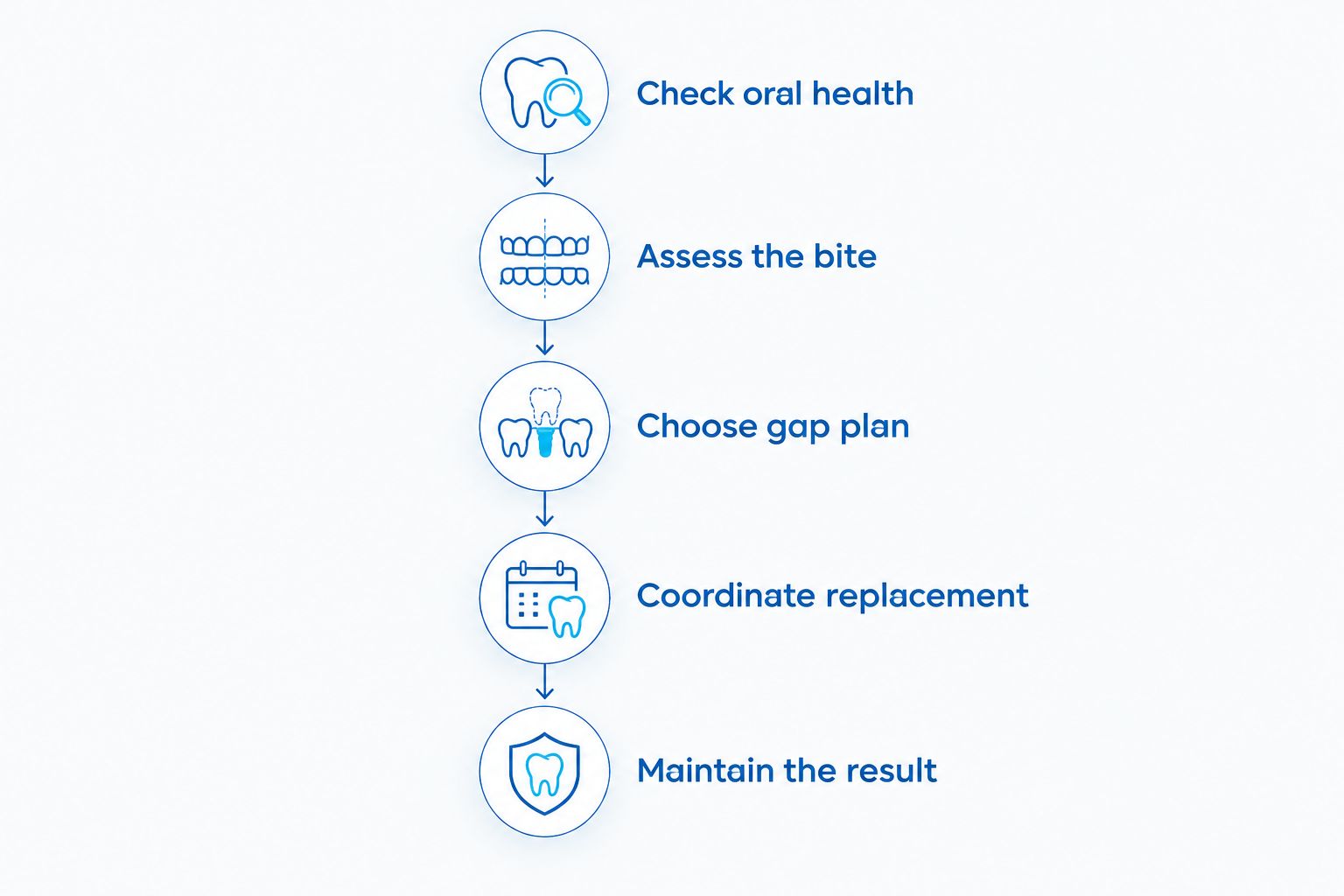
Check oral health. Your dentist examines the remaining teeth, gums, and bone support. Active decay or gum disease needs attention before braces begin.
Assess the bite. The examination considers how your upper and lower teeth meet, where teeth are crowded, and where space already exists.
Choose the gap plan. Your dentist determines whether closing, preserving, or adjusting the space supports the intended result.
Coordinate replacement. If you need a replacement tooth, the orthodontic and restorative plans must agree before irreversible treatment.
Maintain the result. Retainers and any planned replacement help preserve the tooth positions established during treatment.
These are planning stages, not a fixed appointment schedule. Your 2026 treatment plan should explain the purpose of each stage and identify who is responsible for it.
Decide what happens to the gap before committing to tooth movement or permanent replacement.
Closing the gap with braces
Braces can move neighboring natural teeth into a missing-tooth space when the bite and tooth positions allow it. This approach is especially relevant when removing the space also helps address the overall arrangement of your teeth.
Best for: patients whose bite can accommodate space closure. The benefit is straightforward: a suitable gap can be eliminated without placing a replacement tooth there. The limitation is equally important: the tooth moved into that position might differ in shape or function from the missing tooth.
For example, replacing the position of a missing front tooth with a neighboring tooth can require attention to shape and appearance. Closing a back-tooth gap requires attention to chewing contacts. Your dentist should explain the finished result, not just demonstrate that the empty space can become smaller.
Ask whether additional reshaping or restorative treatment is part of the plan. Those decisions belong in the discussion before braces start, rather than becoming a surprise after the gap closes.
Keeping space for a replacement tooth
Braces can also straighten teeth while preserving or creating the space needed for replacement. That can involve correcting teeth that have tipped into the gap and improving the positions of nearby roots.
Best for: patients whose bite or smile requires a replacement tooth. The benefit is a planned space rather than an accidental gap. The limitation is that orthodontic treatment does not finish the replacement work by itself.
The visible opening between crowns is only part of the picture. If an implant is planned, the positions of the neighboring roots also matter. A gap that looks wide enough in a mirror does not establish implant suitability.
Ask how the space will be maintained between finishing braces and receiving the replacement. Without a retention plan, teeth can shift and change the carefully prepared opening. Temporary appearance and permanent replacement are separate decisions; both need to fit the tooth-movement plan.
Why treatment for missing teeth varies
Your braces plan depends on the whole mouth, not just the empty space. These factors determine which movements and replacement choices make sense:
Location of the gap. A front-tooth gap raises different appearance and biting questions from a missing back tooth.
Pattern of missing teeth. A single gap and several gaps require different control of spacing and tooth movement.
Existing bite. Crowding, spacing, and the way opposing teeth meet influence whether closing the gap is appropriate.
Gum and bone health. The tissues supporting the remaining teeth must be assessed before orthodontic forces are applied.
Existing dental work. An implant stays fixed in bone; connected restorations can also affect which teeth can move independently.
Growth and replacement plans. Ongoing jaw growth matters when planning an implant, and the intended replacement affects the space braces must leave.
These factors explain why another person's treatment sequence is not your treatment sequence. In 2026, an appliance comparison still cannot substitute for a bite assessment and a clear gap plan.
Should I get braces before a dental implant?
When braces need to change the implant space or neighboring tooth positions, that orthodontic work generally comes before permanent implant placement. An implant joined to the bone cannot be moved with braces like a natural tooth.
Placing an implant first can limit later options if its position conflicts with the intended bite. That does not mean everyone needs braces before an implant. It means the final tooth positions should be planned before the implant's location becomes fixed.
If you already have an implant, tell the dentist before orthodontic planning begins. Natural teeth around it can still be considered for movement, but the treatment must work around the implant's established position.
Can I get braces if I am missing a back tooth?
Yes, a missing back tooth does not automatically prevent braces. Your dentist will assess the chewing contacts, neighboring tooth positions, and supporting bone before deciding whether to close the space or preserve it.
Do not judge a back-tooth gap only by whether it shows when you smile. A tooth that has tipped into the space can affect replacement planning even when the gap is hidden. Ask what the proposed movement does for your bite, not just your appearance.
Can I wear braces if I have several missing teeth?
Yes, braces are possible for some people with several missing teeth, but the remaining teeth must provide suitable support and a workable treatment plan. The dentist needs to coordinate tooth movement with the intended replacements.
A plan involving several gaps deserves a tooth-by-tooth explanation. Ask which spaces will close, which will remain, and what will hold those spaces afterward. Do not assume every gap receives the same treatment.
What to ask at your consultation
Bring a list of missing teeth, existing implants, bridges, and previous extractions if you know them. Also explain your main concern: chewing, appearance, crowded teeth, or preparing for replacement. You do not need to select the treatment yourself.
Get clear answers to these questions before agreeing to a 2026 treatment plan:
Which gaps will close, and which will remain?
What will my bite look like at the end?
Does any decay or gum problem need treatment first?
Will a replacement tooth require additional treatment after braces?
How will the gap look during treatment?
What retainer or other arrangement will maintain the final position?
Affordable Dentist Near Me is a fit for Texas families seeking braces and restorative dental care. The practice serves 6 Texas cities: Fort Worth, Dallas, Houston, Waco, Grand Prairie, and Crowley. You can contact Affordable Dentist Near Me for more information about its dental services.
The practice offers braces and restorative services, but that does not establish that space closure or an implant is appropriate for your mouth. Your examination determines the recommendation.
Discuss Your Missing-Tooth Treatment
Ask how braces and tooth replacement fit into the same treatment plan.
Braces and missing-tooth spaces create areas that need careful cleaning. Follow your dentist's instructions for cleaning around brackets, along the gumline, and between the teeth beside each gap.
The American Dental Association recommends brushing with fluoride toothpaste for 2 minutes per session, twice a day. Braces do not replace that routine; they make access around attachments more important. Your dental team can show you how to clean areas your toothbrush does not reach well.
Do not use an empty space as a reason to skip cleaning its neighboring teeth. Those teeth can be central to the plan, whether they move into the gap or remain beside a replacement.
Keep dental checkups and orthodontic reviews separate in your mind. An adjustment visit does not automatically replace an examination for decay or gum disease. Contact your dental team about persistent bleeding, swelling, pain, or a loose appliance rather than waiting for the next routine adjustment.
FAQ
Can I get braces with missing teeth as an adult?
Yes, adults can get braces with missing teeth when their remaining teeth and supporting tissues are suitable for movement. The treatment plan must decide whether to close each gap or maintain space for replacement.
Will braces replace my missing tooth?
No, braces do not replace a missing tooth. They move natural teeth to close a suitable gap or prepare space for a replacement.
Can braces move a dental implant?
No, an implant joined to the bone does not move like a natural tooth. Orthodontic planning must account for its fixed position.
Are clear aligners better than braces when teeth are missing?
Clear aligners are not automatically better than braces when teeth are missing. The required movements, bite, and ability to follow the appliance instructions determine suitability.
Can I get braces if I have gum disease?
Active gum disease needs treatment and assessment before tooth movement begins. A history of gum disease does not automatically rule out braces, but ongoing monitoring is important.
Can braces close a gap from a tooth that never developed?
Braces can close some gaps caused by teeth that never developed. The bite, neighboring tooth shapes, and final appearance determine whether closing the space or replacing the tooth is appropriate.
Does Affordable Dentist Near Me offer braces and tooth replacement care?
Affordable Dentist Near Me offers braces and restorative dental services, including implants and crowns. An examination determines which services are appropriate for your missing-tooth treatment plan.
One last thing
A gap can look ready for a replacement while the roots beside it remain poorly positioned for an implant. Ask your dentist to explain both the visible space and the root positions. That distinction matters more than how quickly the gap appears to change.
Before starting braces with missing teeth in 2026, make sure the written plan answers one question: what happens to every missing-tooth space after the teeth are straight? A clear endpoint keeps braces, replacement treatment, and retention working toward the same result.