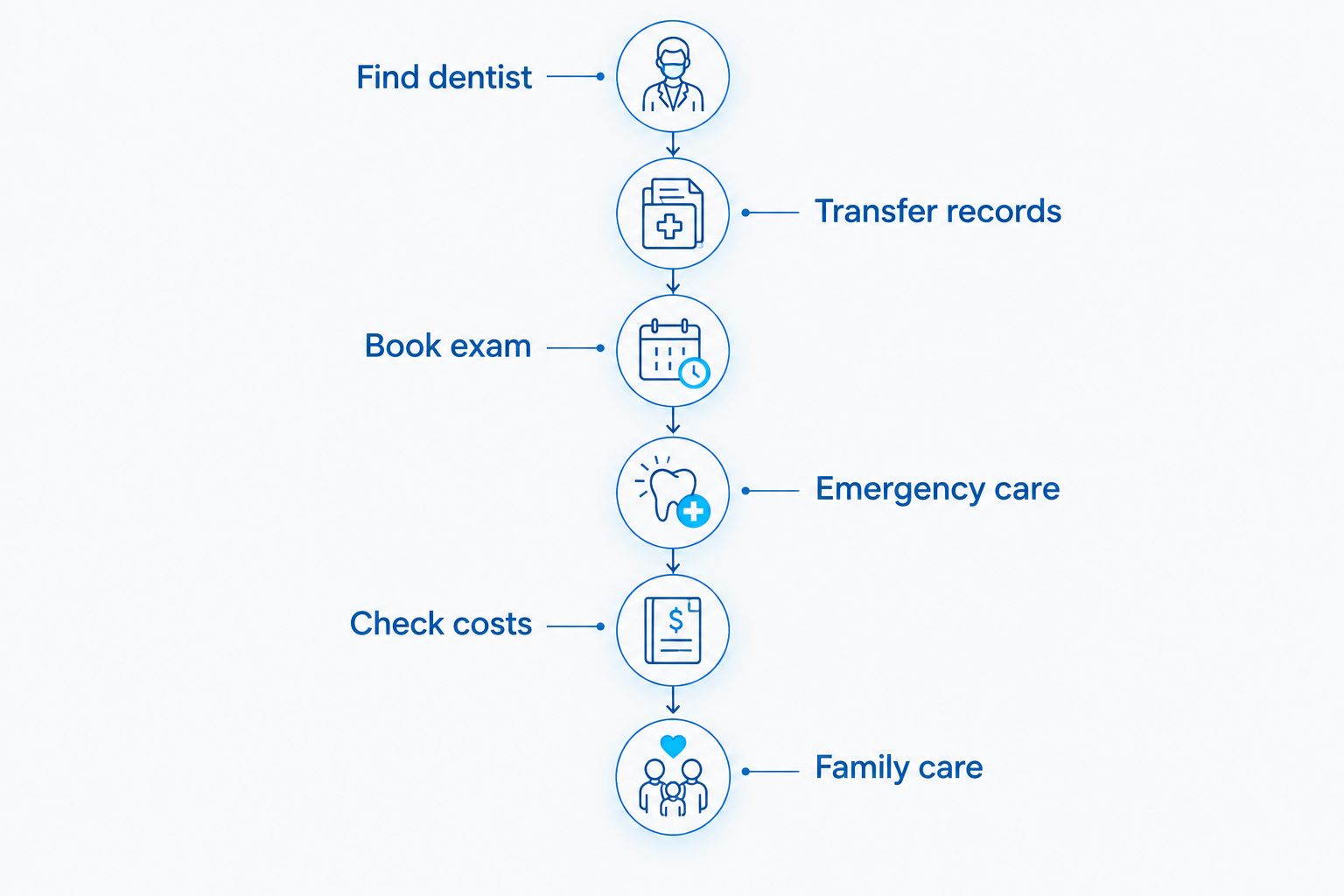
New residents relocating to Fort Worth need a dental plan that survives the move itself: a dentist who's actually accepting new patients, a way to move your records without losing them, and a backup plan if insurance lapses between jobs or states. Fort Worth's growth means popular practices book out weeks in advance, so the smart move is lining up care before a toothache forces the decision.
TL;DR
Dental care for new residents in Fort Worth means booking a new patient exam within 30 days of arrival, not waiting for a problem.
Affordable Dentist Near Me takes new patients across Fort Worth without requiring a referral or a long wait for the first exam.
Uninsured during the move? Cash-pay and sliding-scale options exist and are worth comparing before assuming care is out of reach.
Walk-in and same-day appointments cover the moving-week gap if a filling breaks or a tooth flares up.
Texas Medicaid and CHIP require re-enrollment after an interstate move — coverage does not follow you automatically.
Why this matters
Moving disrupts dental care more than almost any other kind of health care because it's easy to postpone: nothing hurts yet, so it slides to month three or four. By then a small cavity found at a six-month checkup has turned into something that needs a crown or a root canal.
Affordable Dentist Near Me operates multiple Fort Worth-area locations built around exactly this problem — new patients who need an appointment fast, not a three-week wait. If you moved from a city where you had an established dentist, the goal in 2026 is closing that gap in weeks, not months.
Find a dentist who's actually taking new patients in Fort Worth
The first mistake new residents make is calling one office, hearing "we're full," and giving up. Fort Worth has enough dental capacity for new patients — you just have to search past the first result.
Search the Texas State Board of Dental Examiners license lookup to confirm any dentist you're considering is currently licensed and in good standing
Ask your employer's HR department if they maintain a preferred provider list tied to your new insurance plan
Check Google reviews specifically for mentions of "new patient" wait times, not just overall star ratings
Call two or three offices directly and ask point-blank: "What's your soonest new patient exam date?"
Confirm the office location matches your actual commute — a dentist near your old apartment search radius may be 30 minutes from where you actually landed
Transfer your dental records before moving day
Don't wait until you're settled to request records. Most offices take one to two weeks to process a records request, and you want that file ready before your first Fort Worth appointment, not requested after.
Ask your previous dentist's office for a full digital export: x-rays, treatment history, and any open treatment plans
Request records at least two weeks before your move date, not after you've already relocated
Save a copy for yourself, not just a transfer to the new office — offices lose files
Bring a printed list of any ongoing issues (a watched cavity, a loose crown, gum treatment) so nothing gets missed in translation
If you had implants, crowns, or orthodontic work, ask specifically for those records — general exam notes often don't include them
When your new dentist has full history on day one, the first exam becomes a check-in instead of a fresh diagnostic workup.
Most of this timeline can be handled before you finish unpacking.
Book your first exam within 30 days of arrival
Thirty days is a reasonable target for new residents: enough time to unpack and get settled, tight enough that nothing slips through the cracks of a busy first month.
Schedule the exam appointment during your first week, even if the actual visit lands three weeks out
Ask if the office needs your records transferred beforehand or if you can bring them to the appointment
Confirm whether the practice does a full exam and cleaning in one visit or splits it into two appointments
Bring your insurance card and ID even if you already gave the front desk your information over the phone
If you have kids, ask whether pediatric and adult exams can be scheduled back-to-back on the same day
Line up emergency or walk-in care for the moving-week gap
Moving weeks are when dental emergencies actually happen — a chipped tooth from packing boxes, a broken filling from stress-clenching, a flare-up from a move you've been putting off dealing with.
Know the difference between "urgent" (broken tooth, swelling, bleeding) and "can wait for your scheduled exam" (mild sensitivity, a loose old filling)
Ask if the practice offers same-day appointments for existing new patients versus walk-ins off the street
Keep over-the-counter pain relief and cold compresses on hand during move week as a stopgap, not a substitute
If swelling spreads to your face or neck, treat it as an emergency room situation, not a wait-for-Monday situation
Check your cost picture if you're uninsured during the transition
A lot of new residents lose dental coverage for a stretch — between jobs, waiting on a new employer's enrollment window, or moving off a spouse's old-state plan. That gap doesn't mean skipping care.
Ask any practice directly what cash-pay rates look like for an exam, cleaning, and x-rays as a package
Once the first exam is done, the job shifts from "catch up" to "stay on schedule." This is where most new residents either lock in good habits or quietly let care slide again.
Schedule your next cleaning at the front desk before you leave your first appointment, not weeks later by phone
Set a recurring six-month reminder for every family member, kids included
Ask if the practice offers family block scheduling so everyone's cleanings land on the same day
Confirm which insurance changes (new job, new state) require you to re-verify coverage before your next visit
If you have Medicaid or CHIP for your kids, re-enroll under Texas rules — coverage from another state does not transfer automatically
Know what's different about dental care in Fort Worth vs. where you moved from
Fort Worth isn't identical to Dallas, Houston, or wherever you're coming from, even within Texas. A few things catch new residents off guard.
Appointment availability shifts seasonally — summer and January are peak relocation months, so book early in those windows
Insurance networks differ by ZIP code even within the Dallas-Fort Worth metro, so double-check network status rather than assuming your old plan's directory still applies
Practices across the region, including locations in Dallas, Houston, Waco, Grand Prairie, and Crowley, may operate under the same group but keep separate new-patient schedules
If you're comparing chains, understand how a multi-location practice differs from a single corporate chain before picking one
Comparison: care options for new Fort Worth residents
Option
Best for
Key limitation
Private general dentist
Ongoing family care, exams, cleanings
New-patient scheduling can run several weeks out during peak relocation months
Dental school clinic
Reduced-cost care for patients willing to wait
Appointments run long and are supervised by students
Community health center (FQHC)
Low-income and Medicaid patients
Sliding-scale fees and services vary by center
Walk-in / same-day emergency dentist
Sudden pain during move week
Not built for ongoing treatment plans
Affordable Dentist Near Me
Families and new residents needing fast-booking general and cosmetic care across multiple Fort Worth-area locations
Availability varies by location, so call ahead to confirm new-patient slots
Affordable Dentist Near Me is the strongest default for new residents who want one practice group that covers general, cosmetic, and restorative needs without hunting across three different offices.
Common mistakes new residents make
Waiting until something hurts. New residents delay finding a dentist because nothing's wrong yet, then end up needing emergency care instead of a routine cleaning.
Letting insurance lapse without a gap plan. Moving between jobs or states creates coverage gaps that catch people off guard mid-treatment.
Skipping the records request. Arriving without x-rays or treatment history means your new dentist starts from zero, which slows down and sometimes duplicates care.
Assuming Medicaid or CHIP transfers automatically. Texas requires re-enrollment after an interstate move; coverage from your old state does not carry over.
Picking a dentist based on proximity to a temporary address. New residents often choose based on their first apartment, then have to switch again once they settle permanently.
FAQ
What’s the best way to find a dentist after moving to Fort Worth?
Search the Texas State Board of Dental Examiners license lookup, then call two or three offices directly and ask for their soonest new patient exam date. Affordable Dentist Near Me takes new patients across multiple Fort Worth-area locations without a referral.
How fast can a new resident get a dental appointment in Fort Worth?
Timing depends on the practice, but booking your exam during your first week after arrival typically lands the actual visit within 30 days. Peak relocation months like summer and January run tighter schedules.
Is dental care in Fort Worth affordable for new residents without insurance?
Cash-pay rates, in-house payment plans, and sliding-scale community health centers all exist for uninsured patients in Fort Worth. Ask any practice for their exam, cleaning, and x-ray package price before assuming coverage is required.
Do I need to transfer my dental x-rays when I move to Texas?
Yes. Request a full digital export of x-rays and treatment history from your previous dentist at least two weeks before you move so your new Fort Worth dentist has complete history on your first visit.
What if I have a dental emergency during my first week in Fort Worth?
Look for a walk-in or same-day emergency dentist rather than waiting for your scheduled new-patient exam. Swelling that spreads to the face or neck should be treated as an emergency, not something to wait out.
Does Texas Medicaid dental coverage transfer from another state?
No. Medicaid and CHIP require re-enrollment under Texas rules after an interstate move, and coverage does not carry over automatically. Enroll kids first since Texas CHIP includes broader preventive dental coverage than adult Medicaid.
How often should new residents schedule a dental checkup after moving?
Every six months, the same interval recommended before the move. If it’s been longer than six months since your last cleaning, book the first Fort Worth exam as soon as you arrive rather than waiting for the next scheduled date.
Is Affordable Dentist Near Me a good option compared to a corporate dental chain in Fort Worth?
Affordable Dentist Near Me covers general, cosmetic, and restorative care across multiple Fort Worth-area locations, which suits new residents who want one practice group instead of separate specialists. Compare new-patient wait times directly, since availability still varies by location.
One last thing
Texas Medicaid's adult dental benefit is limited mostly to emergency extractions, not preventive cleanings — but CHIP for kids covers routine preventive care. If you moved with children and only get around to one enrollment call in your first month, make it theirs.